
Reputation recovery in Singapore after a regulatory penalty is not won on the day the notice goes up. It is won over the months that follow, by doing three things in order. Own the finding in the regulator's own words. Show the fix with named owners and dates. Then prove it held, with evidence a sceptical customer, banker or journalist can check. The penalty notice will stay searchable for years. Your job is to make sure the next page of your story is written by your actions, not by the notice alone.
This guide is for corporate affairs, public affairs, communications and regulatory leads at Singapore firms that have received, or expect, a composition, financial penalty, reprimand or similar outcome from MAS, the PDPC or the Competition and Consumer Commission of Singapore (CCCS). It covers sequence, words and proof. The legal response itself sits with your counsel and your regulator relationship. If the issue is still live and unannounced, start with Issues Management Before the Crisis Call instead.
Why a Singapore penalty is a long-tail reputation event
A penalty in Singapore rarely ends with one headline. Three features of how Singapore regulators publish make it a long-tail event, and they shape every recovery plan.
The regulator writes the first draft. MAS explains in its Enforcement Monograph that it does not publish every enforcement action. It weighs the seriousness of the misconduct, whether publication protects consumers and investors, and whether it protects the reputation of Singapore's financial markets. When it does publish, its statements on key ongoing investigations and enforcement actions appear on its Enforcement webpage. So if your case is public, a regulator has already judged that the public should know. Arguing with that judgement in public is the fastest way to lose the room.
The notice stays up. MAS's Enforcement Actions list states that entries remain on the page for five years from publication, and that prohibition orders still in force after five years stay until they stop being in force. A prospective client, a bank's onboarding team or a journalist can find your entry long after your own press statement has scrolled off your newsroom page.
Regulators publish in aggregate too. MAS issues an Enforcement Report once every 18 months. The Enforcement Report 2025/2026, published on 7 October 2026 for the period 1 January 2025 to 30 June 2026, counts S$29 million in financial penalties and compositions, 23 prohibition orders and 43 reprimands. Individual cases can resurface in that kind of round-up, in sector commentary and in industry training, months after the original notice.
The same pattern holds outside financial services. The PDPC publishes Commission's decisions and voluntary undertakings on its Enforcement Decisions page. Under section 48L of the Personal Data Protection Act, a voluntary undertaking can include taking specified action within a specified time and an undertaking to publicise the undertaking itself. CCCS can impose financial penalties of up to 10 per cent of an undertaking's Singapore turnover for each year of infringement, up to three years, and it must first be satisfied that the infringement was intentional or negligent (CCCS: Financial Penalty Framework). In every case, the regulator's wording is the reference text your stakeholders will compare you against.
That is why recovery is a narrative arc, not a statement. Spin tries to change what the notice says. An arc accepts the notice as chapter one and writes the chapters after it.
The one rule: own the finding, show the fix, prove it held
Three parts you can brief in five minutes
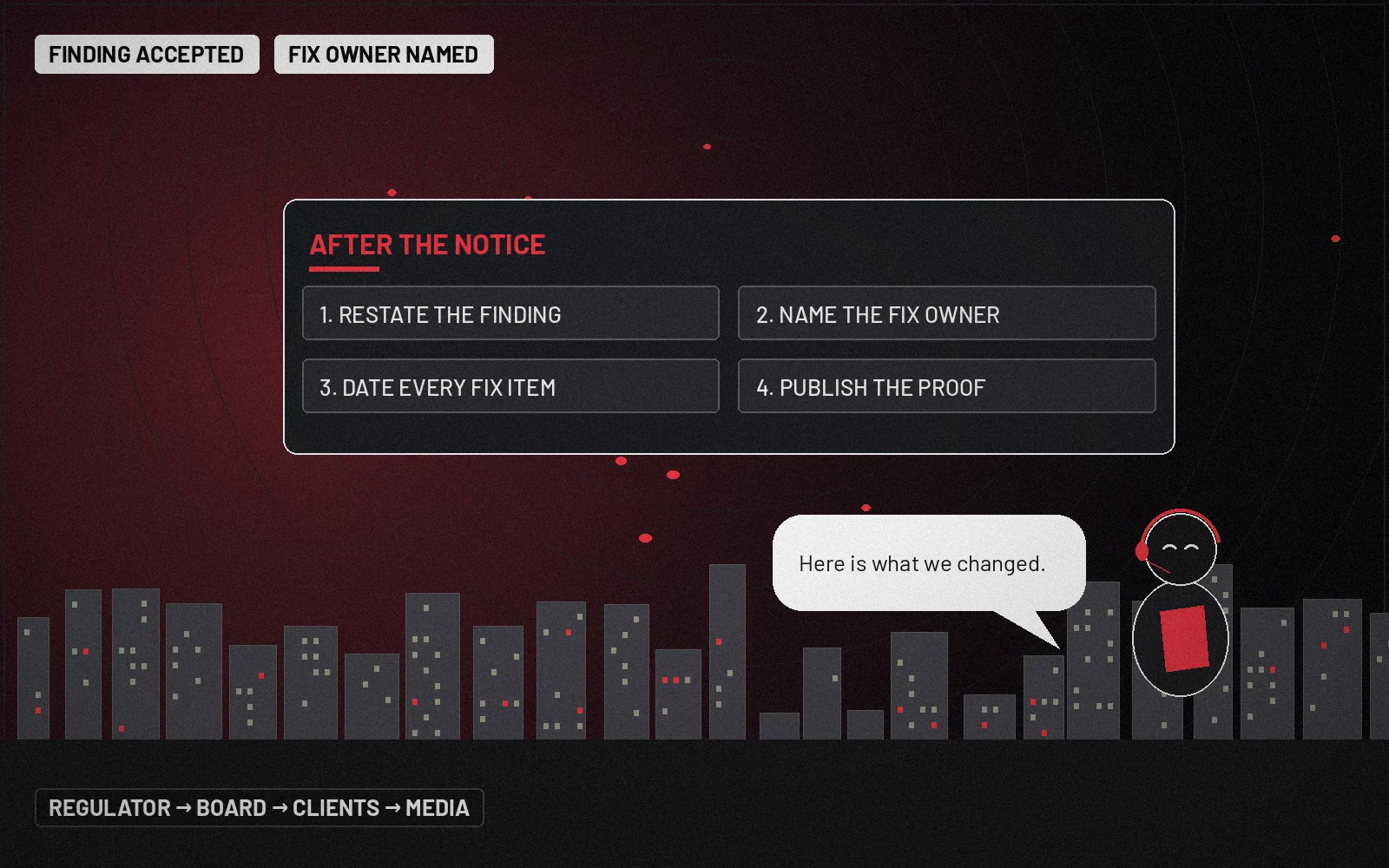
- 1. Own the finding. Restate what the regulator found, in its terms, in one or two sentences. Name the period, the control or conduct that failed, and the outcome. Do not soften "breach" into "issue", do not add "historical" unless the regulator says so, and do not cite your record elsewhere as a counterweight. If you have accepted a composition or given an undertaking, your public words must match that acceptance.
- 2. Show the fix. Say what has changed, who owns it and by when. "We have appointed a new head of compliance, reporting to the board risk committee, and replaced the transaction monitoring rules for the affected product by March" is a fix. "We have strengthened our processes" is not. For financial institutions, MAS's Guidelines on Individual Accountability and Conduct set five outcomes on senior manager accountability and conduct standards; naming the accountable senior manager in your fix follows the same logic.
- 3. Prove it held. Commit to a check that someone outside your team can see: an independent review, a completed undertaking, a follow-up confirmation from the regulator where it gives one, or a dated progress note to clients. Then publish the result when it lands, even if it is quiet news. Proof is the chapter most firms never write, and the one that does most of the recovery.
The recovery arc tracker (original framework)
Use this as a working tracker. The windows are planning targets, not rules; match them to the remediation timeline you have agreed with the regulator.
| Stage | Window | Audience first | What you publish | Proof artefact | Trap to avoid |
|---|---|---|---|---|---|
| 1. Notice day | Hour 0–24 | Regulator, board, staff, key clients | Short statement that restates the finding and names the fix owner | Board minute approving the statement | Disputing facts you have accepted |
| 2. Stabilise | Week 1–4 | Clients, counterparties, banks, partners | Direct letters or calls: what happened, what changes for them, who to call | Log of every client contacted and their questions | Silence to clients while media gets a line |
| 3. Rebuild | Month 2–6 | Clients, staff, industry bodies | Dated progress notes on each fix item | Remediation tracker with owners and completion dates | Announcing "new culture" before any fix is done |
| 4. Prove | Month 6–12 | Regulator, board, clients, media on request | Result of the independent review or completed undertaking | Review report summary, regulator acknowledgement where given | Burying the result because it is "old news" |
| 5. Hold the line | While the notice stays live | Anyone doing due diligence | A standing, factual "what we changed" page or due diligence note | One-page fact sheet kept current | Letting sales teams improvise answers |
Two points make this tracker work. First, each stage has a proof artefact, so the board can see the arc moving without relying on press coverage. Second, stage five runs as long as the notice is findable. For MAS entries, that can be five years.
Read the notice before you write a word
Most bad recovery statements fail because nobody read the regulator's text closely. Before drafting anything, the regulatory lead and the communications lead should go through the notice together and answer these questions.
- What exactly did the regulator find? Copy the operative sentence. Your statement will paraphrase it, never contradict it.
- What outcome was imposed? Composition, financial penalty, reprimand, prohibition order on an individual, direction, or voluntary undertaking. Each one reads differently to clients. A prohibition order against a former employee is a different story from a penalty on the firm.
- What period does it cover? If the conduct ended years ago, the dates say so for you. Let the dates do that work rather than adding "legacy" or "historical".
- What did the regulator say about remediation? If it notes that you cooperated or have taken steps, you can refer to that plainly. If it says nothing, do not imply it endorsed your fix.
- Who else was named? If several firms were penalised together, resist commenting on the others or framing the outcome as industry-wide.
- Is anything still open? If court proceedings or related investigations continue, your counsel sets the boundaries of what you say. The MAS Monograph notes that statements about a case can prejudice pending court proceedings.
Regulator by regulator: what changes in the arc
MAS. Financial institutions face the longest public tail because of the five-year Enforcement Actions list and the 18-month Enforcement Reports. The audiences that matter most are correspondent banks, institutional clients, fund investors and future hires, who all check the list. Your stage-five fact sheet should sit with relationship managers and onboarding teams, not just the press office. For media handling in this sector, see Media Relations in Regulated Sectors.
PDPC. Data protection decisions often name the organisation and describe the incident in detail. Customers whose data was involved are the first audience, before media. If you gave a voluntary undertaking that includes publicising it, treat that publication as stage one of the arc, not a box to tick. Our guide to PDPA breach communications covers the earlier, incident-stage messaging.
CCCS. Competition infringement decisions involve customers who may feel they overpaid and competitors who may comment. Business customers and procurement teams are the priority audience. If you received leniency for coming forward, the regulator's decision may say so; refer to it factually and let the decision speak.
Worked example (fictional)
A mid-sized Singapore payment services firm, fictional and composited from common patterns, receives a composition penalty from MAS for anti-money laundering control lapses over an 18-month period. The notice names the firm, the period and the control failures.
What the firm did wrong in the first draft: its statement opened with "We take compliance extremely seriously", called the findings "historical procedural gaps" and said the firm "has a strong track record". Its sales team told clients the penalty was "standard for the industry".
What the recovery version did instead:
- Notice day: a four-sentence statement restating MAS's finding and period, naming the new head of compliance and the board committee overseeing remediation, and giving a client contact line.
- Weeks 1–4: relationship managers called the top accounts with the same script and logged every question. The most common question, whether the firm's licence was at risk, got a factual answer cleared by counsel.
- Months 2–6: two short progress notes to clients, each listing completed fix items with dates.
- Months 6–12: an independent review confirmed the new monitoring controls were operating. The firm published a short summary and sent it to every client contacted in stage two.
- Ongoing: a one-page due diligence note, updated every quarter, answers "what changed" for bank onboarding teams.
No new headline came from the recovery. That was the point. Anyone who found the MAS entry also found a dated, checkable record of what changed after it.
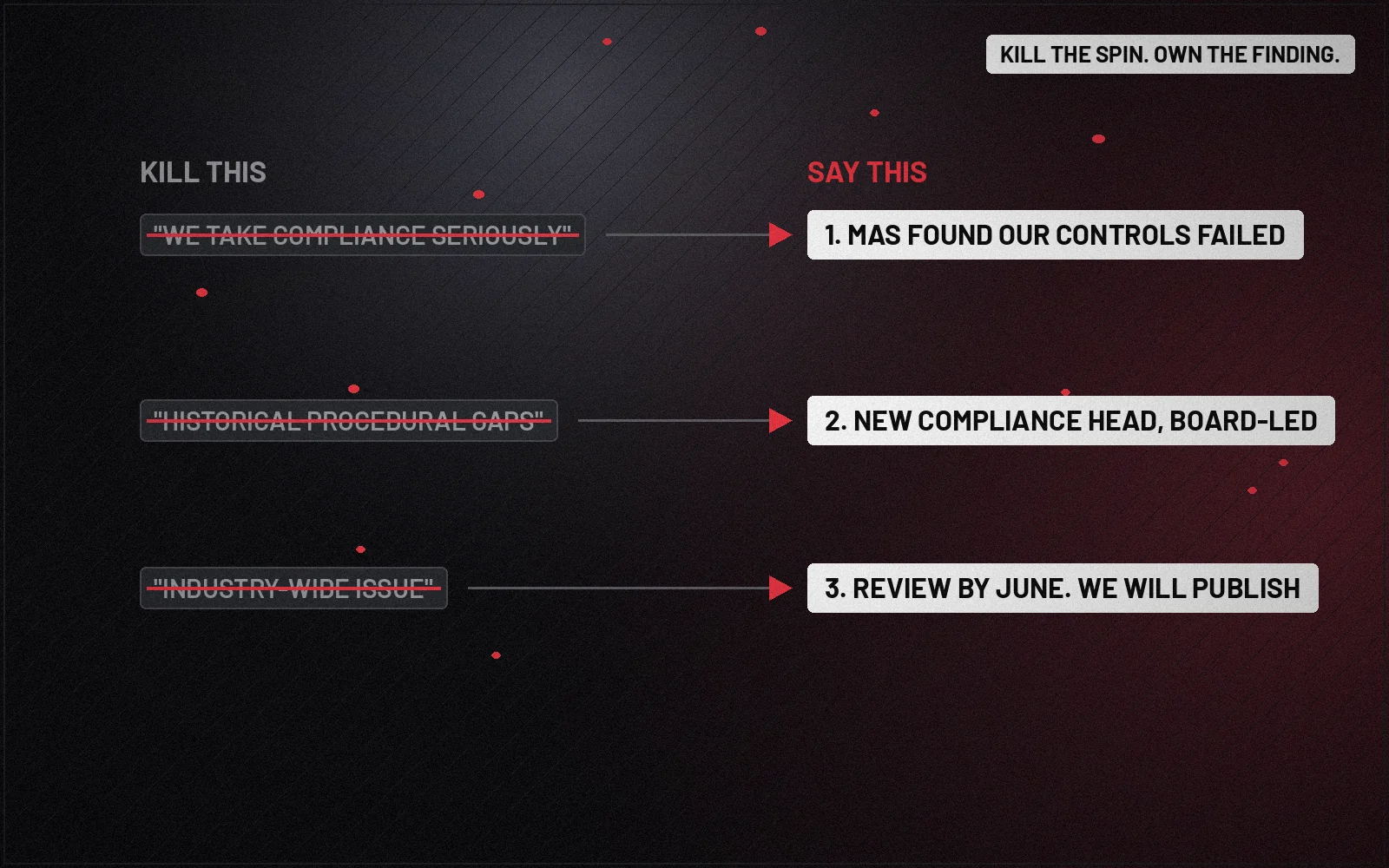
Kill this | Say this (post-penalty statements)
| Kill this | Say this |
|---|---|
| "We take compliance extremely seriously" | "MAS found that our transaction monitoring controls failed between March 2024 and August 2025." |
| "Historical procedural gaps" | "These were control failures. We accepted the composition." |
| "An industry-wide issue" | "Here is what we have changed: a new head of compliance, reporting to the board risk committee." |
| "We have a strong track record" | "An independent review will test the new controls by June. We will publish the result." |
| "No customers were harmed" (unless the regulator says so) | "If you are a client, your relationship manager has the full briefing. Call them today." |
Decision framework: how loud should the recovery be?
Match the volume of your recovery communications to how visible the notice is and who relies on you.
| Question | If yes | If no |
|---|---|---|
| Did the regulator publish a named media release, not just a list entry? | Notice-day statement on your site and to media on request; brief top clients the same day | Brief clients and partners directly; keep a media line ready |
| Do clients or counterparties run due diligence on you? | Build the stage-five fact sheet in week one and give it to every client-facing team | Keep the fact sheet internal for enquiries |
| Was an individual, not the firm, the subject of the action? | Say what controls failed to catch it and what changed; do not discuss the person beyond the notice | Treat as a firm-level recovery |
| Are related proceedings still open? | Counsel sets limits; publish only fix and proof items, not commentary on the findings | Run the full arc |
| Will the regulator confirm completion of remediation or an undertaking? | Plan stage four around that confirmation and say when you expect it | Commission an independent review as the proof point |
Desk notes: Singapore, regional and board
Singapore desk. Write for the client relationship, not the headline. Singapore's business community is close, and most of your recovery happens in meetings and onboarding calls, not in coverage. Keep every client-facing team on one script and one fact sheet, and update both at each stage of the tracker.
Regional desk. If you are a Singapore regional headquarters, other markets' regulators and partners will read the Singapore notice. Send one master fact sheet to every country lead, translated where needed, so five offices do not describe the finding five ways. Our guide to investor and stakeholder communications in Singapore covers how to keep regional messaging aligned.
Board desk. Directors need three things each quarter: the remediation tracker, the proof artefacts collected so far, and the open questions clients are still asking. Put recovery on the same page as your reputation reporting; see Corporate Reputation Management in Singapore for a scorecard boards will read.
Monday field kit: the notice read-through
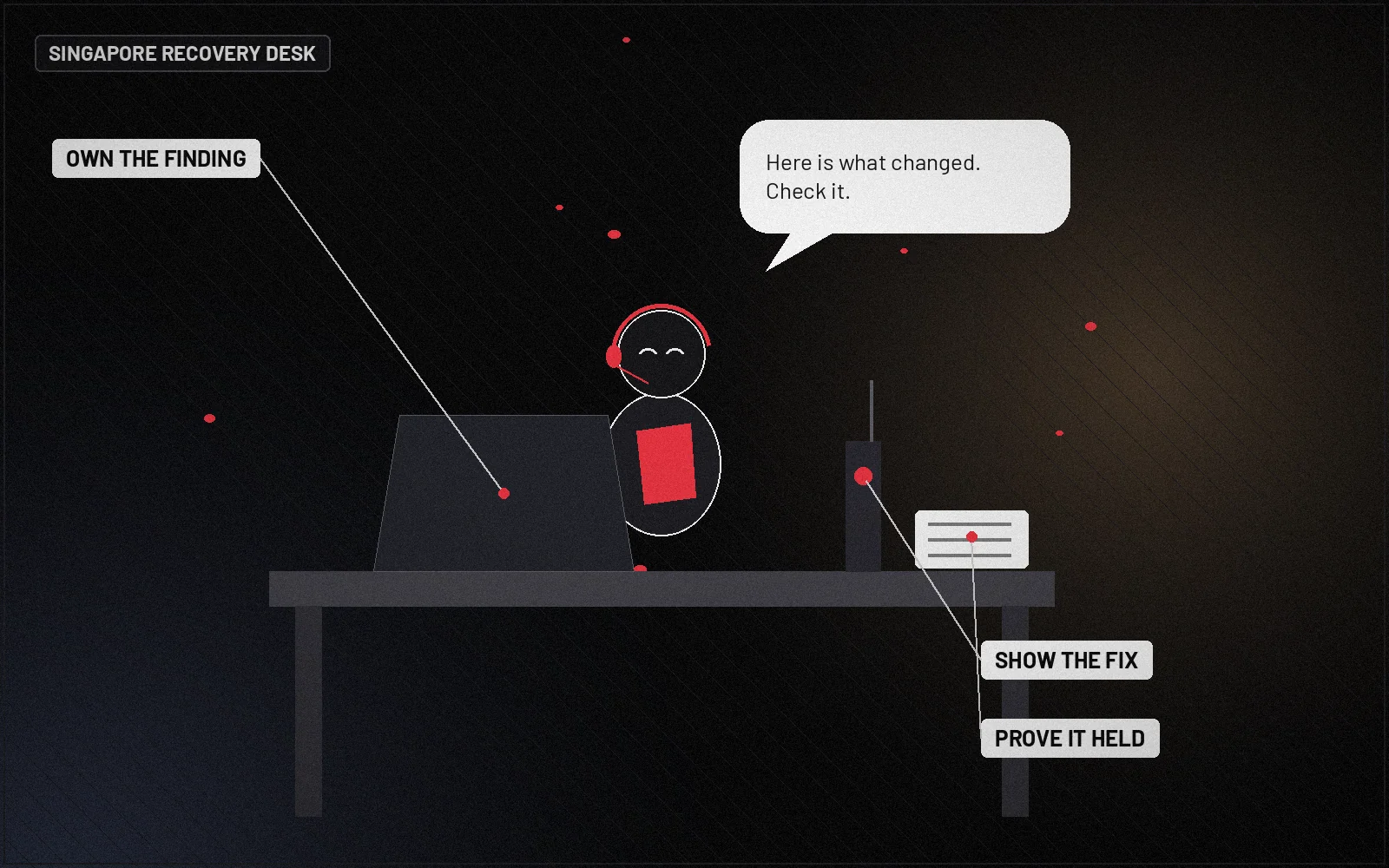
Take the regulator's notice, or if you have none, a published enforcement action from your sector on the MAS, PDPC or CCCS pages. Put your regulatory lead, communications lead and one client-facing manager in a room for an hour. Answer the six read-the-notice questions above, then draft the notice-day statement in four sentences and the first client call script in six lines. Finally, ask the client-facing manager what a long-standing client would ask first, and check that the script answers it. Most teams find their gap in the answer to that question. For 24/7 support during a live notice, see our Crisis Retainer in Singapore guide.
Who this is for / who should skip
For: corporate affairs, public affairs, communications and regulatory leads at Singapore financial institutions, data-heavy businesses and firms in competition-sensitive markets that face or expect a published regulatory outcome.
Skip if: you are still in the incident itself, where the job is containment, not recovery. Start with PDPA breach communications or cyber incident communications. If you need regulatory strategy rather than communications, see our Singapore government relations practice.
What to do next
Pull the regulator's text this week and build stage one and stage five of the tracker: the four-sentence statement and the one-page fact sheet. Then assign an owner and a date to every fix item, because proof cannot be published until the fix exists. If you want a team to run the read-through with you or carry the arc over the next twelve months, talk to our Singapore crisis and issues communications team or contact us.
FAQs
Should we issue a statement if the regulator only lists the action and issues no media release?
Yes, but keep it on your own site and in direct client communications. A short, factual statement that restates the finding and names the fix gives anyone who finds the entry something to compare it with. A media push is rarely needed if the regulator has not issued a release.
How long does reputation recovery take after a Singapore penalty?
Plan for at least twelve months for stages one to four, then keep stage five running while the notice is findable. For MAS Enforcement Actions entries, that is five years from publication, longer for prohibition orders still in force.
Can we say the penalty was a settlement and not an admission?
Only if your counsel confirms it is accurate for your outcome and the regulator's wording supports it. Even then, leading with it reads as minimising. Restate the finding, then explain the fix.
Who should be the spokesperson for the recovery?
The senior manager accountable for the fix, supported by the CEO on notice day. Clients trust the person who owns the remediation more than a communications title, and for financial institutions this mirrors MAS's emphasis on senior manager accountability.