
A crisis retainer in Singapore is only as good as the sentence in the statement of work (SOW) that defines "24/7". If that sentence doesn't say who picks up, how fast, on which days, and what they deliver in the first hour, you've bought a phone number, not a crisis team. Write 24/7 as three separate clocks (acknowledge, engage, deliver), give each clock a named person, and make sure all three finish before the earliest regulatory deadline your organisation faces.
This guide is for heads of corporate communications, general counsel, and regional HQ leaders who are signing or renewing a crisis communications retainer for a Singapore entity. It is educational process guidance, not legal advice. Regulatory deadlines below are summarised from the primary sources linked; your counsel decides which ones apply to you and who files.
Neuwark Communications runs 24/7 crisis teams and supports Singapore clients from Level 39, Marina Bay Financial Centre Tower 2, 10 Marina Boulevard, Singapore 018983, with our Manila HQ in the same UTC+8 time zone (+63 923 859 6587, hello@neuwarkcommunications.com). We still think every buyer should make every agency, us included, put the meaning of "24/7" in writing. Related service: Singapore crisis and issues communications.
The short answer
A defensible 24/7 clause in a Singapore crisis retainer does five things:
- 1. Splits the clock. Time to human acknowledgement, time to a senior counsel call, and time to a first usable draft are measured separately.
- 2. Names the calendar. "24/7" explicitly includes nights, Sundays, and Singapore gazetted public holidays, plus the Monday holidays that follow when a holiday falls on a Sunday.
- 3. Names the people. A lead and a deputy, by role and seniority, not "the team".
- 4. Nests inside regulatory clocks. Your comms outputs are timed to be ready before the shortest notification window that applies to you, such as the 1-hour MAS window or the 2-hour CSA window.
- 5. Admits your own bottleneck. The SOW records your approvers and their deputies, because no agency can publish faster than you can sign off.
Why "24/7" is the most abused phrase in crisis proposals
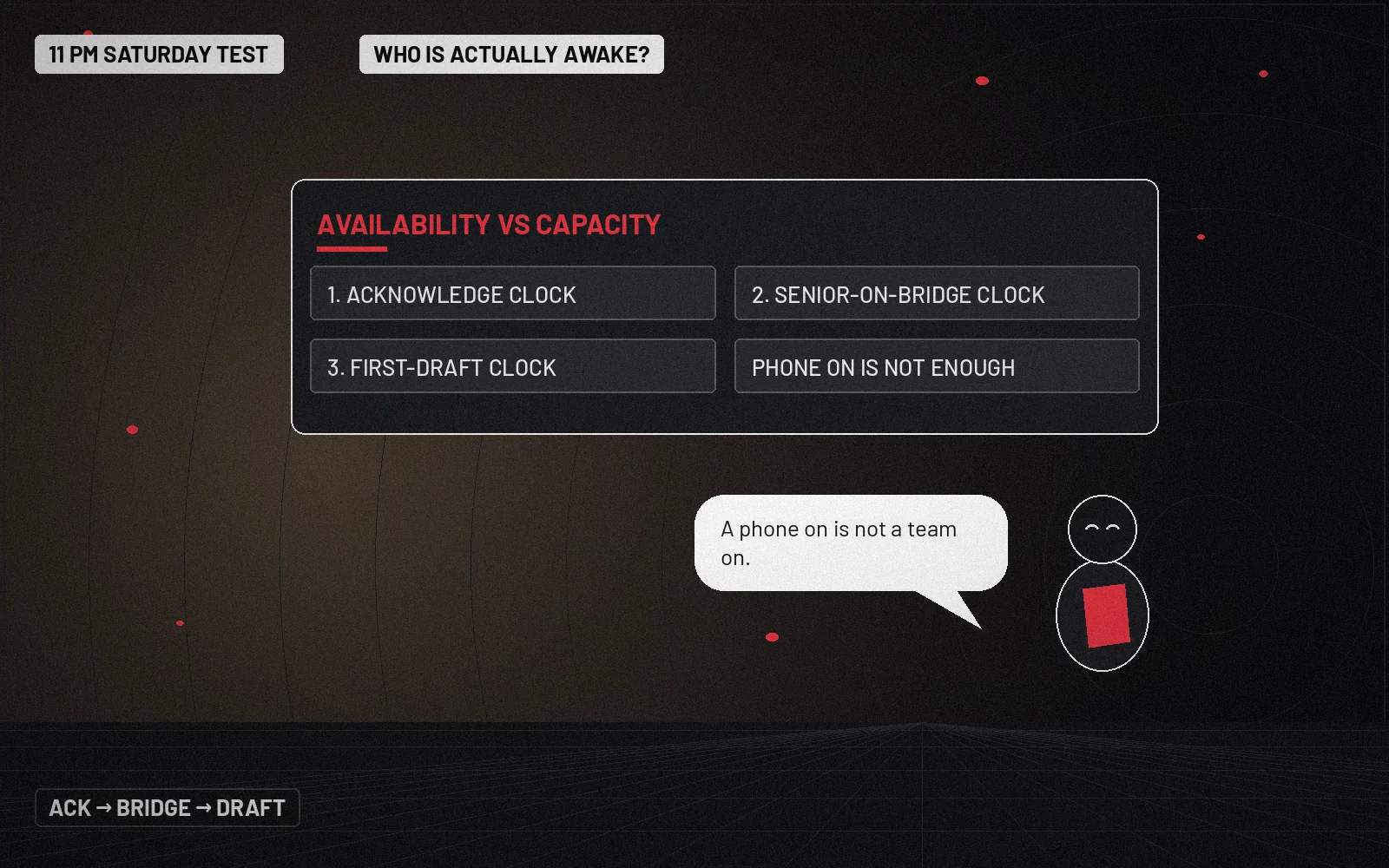
Most proposals use 24/7 to mean "someone has a phone switched on". That's availability. What you need at 11 pm on a Saturday is capacity: a person senior enough to give judgement, a writer who can turn that judgement into words, and someone watching what's being said publicly.
The gap matters more in Singapore than in many markets, because several sector regulators set notification windows measured in hours, not days, and those windows run around the clock. The table below summarises the ones crisis teams meet most often. The filing belongs to your organisation and its legal or compliance owners, not your agency. But the public statement, the customer note, and the staff message usually need to be ready at the same time, and they must not contradict what the regulator is being told.
| Clock | Who it applies to | Window (summarised) | What comms should have ready |
|---|---|---|---|
| MAS technology incident notification | Financial institutions under MAS's Notice on Technology Risk Management | Notify MAS within 1 hour of discovering a relevant incident, "regardless of when" it occurs (MAS TRM FAQ); initial incident report within 24 hours of discovery (MAS incident reporting circular) | Customer-facing service status line, staff note, media holding line |
| CSA cybersecurity incident reporting | Owners of critical information infrastructure (CII) | Notify CSA within 2 hours of becoming aware of a prescribed incident (CSA forms and reporting); reporting widened from 31 October 2025 (CSA release) | Service-disruption statement that says nothing the investigation can't support |
| PDPC data breach notification | Organisations covered by the PDPA | Assess within 30 calendar days; once assessed as notifiable, notify PDPC no later than 3 calendar days after (PDPA s26D; PDPC guide) | Affected-individual notice, FAQ, call-centre script |
| SGX continuous disclosure | SGX-listed issuers | Announce information needed to avoid a false market or likely to materially affect price (SGX Rule 703); price-moving reports to be clarified or confirmed promptly (SGX Appendix 7A) | SGXNET-first sequencing, media line that matches the filing |
| POFMA Correction Direction | Anyone issued a direction | Communicate the correction notice "by the specified time" in the direction (POFMA s11) | Placement plan for the notice, stakeholder explainer |
If your organisation sits under any of the first two rows, a retainer that promises "a call back within four hours" can't help you in the window that matters most. For the POFMA and PDPA rows, our earlier guides go deeper: POFMA directions: what to prepare the night before and PDPA breach communications as a trust narrative.
The response-time tier matrix (Neuwark's working template)
This is the matrix we use to start SOW negotiations. The targets are illustrative starting points to adjust, not an industry standard and not a regulatory requirement. Tighten them if a 1-hour or 2-hour regulatory window applies to you.
| Tier | Trigger (who declares it) | What "responded" means | Illustrative target, any day or hour | Named roles |
|---|---|---|---|---|
| 1. Watch | Client or agency flags an issue with no public trace yet | A human acknowledges and books a triage call | Acknowledge in 15 minutes; triage call within 2 hours | On-call lead |
| 2. Live issue | Public trace exists: posts, a journalist query, staff chatter | Senior counsel joins a call; holding line drafted | Senior call within 30 minutes; holding line draft within 60 minutes of that call | Senior counsel + writer |
| 3. Crisis | A regulatory clock is running, or there is material public harm | War room stood up; outputs timed to the earliest clock | Core team assembled within 60 minutes; first statement draft before the earliest regulatory deadline | Lead, deputy, writer, monitoring |
| 4. Sustained | Crisis runs past 24 hours | Shift roster, handover log, scheduled updates | Update cadence agreed at the first war-room call | Shift leads with written handover |
Two rules make the matrix work. First, the client declares the tier, and the agency can recommend an upgrade but not a downgrade. Second, each tier's clock starts when the activation message is sent, not when someone reads it.
The 24/7 SOW clause checklist
Use this before you sign. Every line should be answerable from the SOW itself, not from a sales email.
- Definition of 24/7: Says nights, Sundays, and Singapore gazetted public holidays are covered at the same response targets. The MOM public holidays page is the reference calendar.
- Time zone: All targets measured in Singapore time (SGT, UTC+8), with timestamps in the activation log.
- Activation routes: At least two channels (a phone number and a messaging channel), plus a fallback if both fail, and a list of who on your side may activate.
- Three clocks: Acknowledgement, senior engagement, and first draft each have their own target per tier.
- Named people: Lead and deputy by role and seniority, with the agency obliged to tell you in writing when either changes.
- Bench depth: At least two people who can take the senior call, so leave and illness don't break the promise.
- Your approvers: Your approval chain and deputies, including who can sign off a holding line when the CEO is on a flight.
- Regulatory clock register: Which windows apply to you (from the table above), who files, and how comms timings line up with each.
- Language scope: Whether translated statements are in scope or a surge item, if your stakeholders need Chinese, Malay, or Tamil versions.
- Monitoring: Hours, sources, and alert thresholds, and whether monitoring runs before a crisis or only after activation.
- Surge terms: How hours beyond the retainer are approved and billed, agreed in advance so nobody negotiates rates at midnight.
- Rehearsal: At least one scenario drill a year, using a real activation of the hotline.
- Data handling: How the agency stores incident materials that contain personal data, in line with your PDPA obligations.
- Post-incident review: A written review and an update of holding lines after every Tier 3 activation.
Worked example: a holiday-weekend outage (fictional)
The following scenario is invented for illustration. "Firm P" is a fictional Singapore-licensed payments company subject to MAS's Notice on Technology Risk Management.
Deepavali falls on Sunday 8 November 2026, so Monday 9 November is a public holiday (MOM). At 10:40 pm on Saturday 7 November, Firm P's engineers discover that card payments are failing for most customers. Compliance judges it a relevant incident, so the 1-hour MAS notification window runs to 11:40 pm.
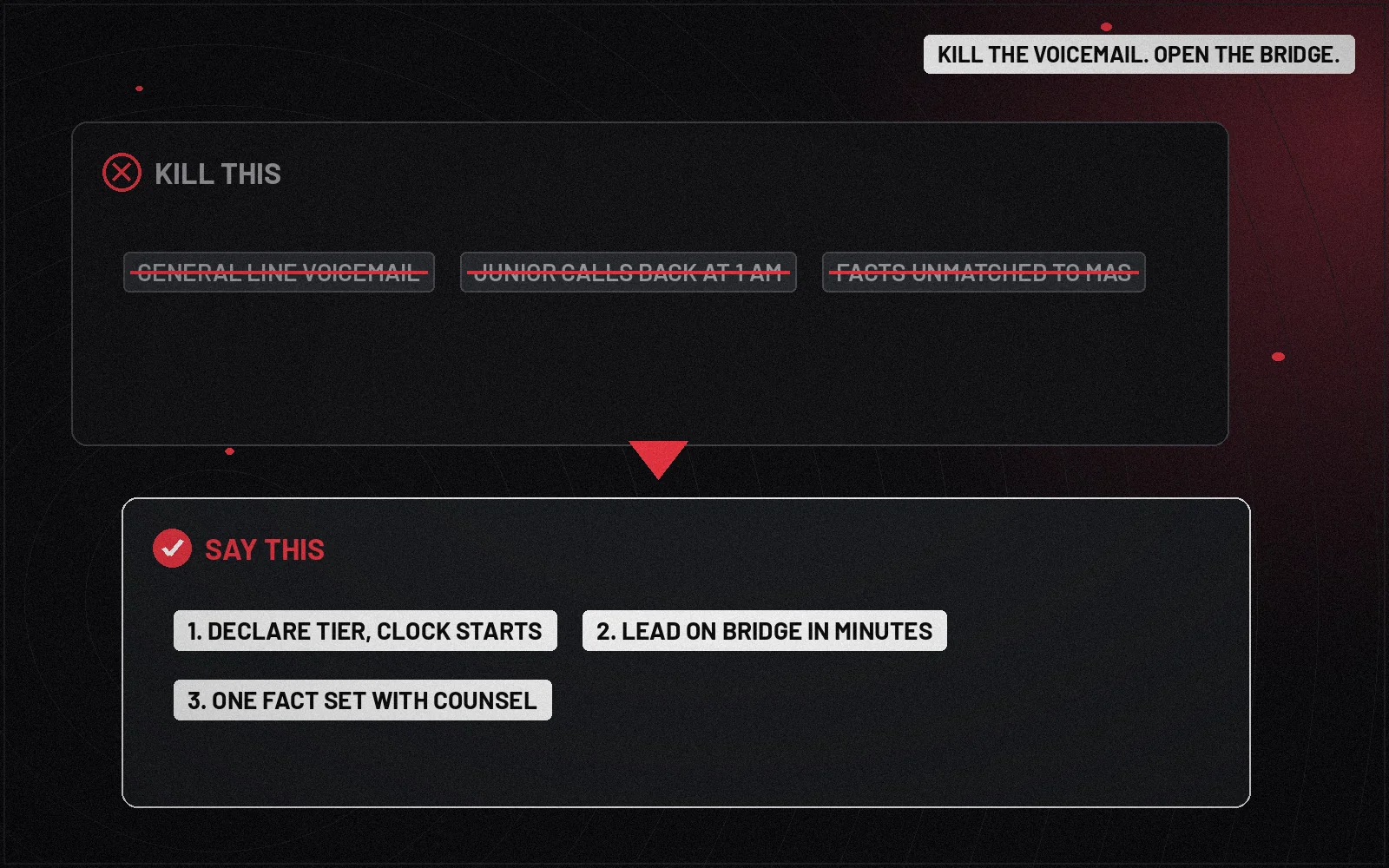
Under a vague SOW ("24/7 support, response within 4 hours"): the agency's general line goes to voicemail. A junior account executive calls back at 1:15 am, with no authority to advise on the statement. The customer status line goes out at 3 am, written by an engineer, and it says the cause is "a third-party vendor", which the root-cause work later contradicts. Monday is a holiday, so the senior counsel first sees the coverage on Tuesday.
Under a defined SOW (Tier 3, targets as in the matrix):
- 1. 10:46 pm: Firm P's comms head activates via the messaging channel and declares Tier 3. The clock starts.
- 2. 10:52 pm: the on-call lead acknowledges and opens the war-room bridge.
- 3. 11:10 pm: senior counsel is on the bridge with the comms head and compliance. They agree one fact set that matches what is going to MAS.
- 4. 11:30 pm: compliance is finalising the MAS notification, due by 11:40 pm. In parallel, the writer delivers a customer status line and a staff note that say what is known (payments failing, team working on it, next update time), and nothing about cause.
- 5. 11:45 pm: Firm P approves both. The deputy approver is used because the CEO is overseas, as the SOW anticipated.
- 6. Sunday and the Monday holiday: the shift roster covers scheduled updates, a media holding line, and preparation for questions linked to the 24-hour initial incident report.
The difference isn't heroics. It is the same people, with the decisions taken months earlier in a contract.
Who this is for, and who should skip it
| Use this if you… | Skip it, or hand it off, if you… |
|---|---|
| Run communications for a regulated Singapore entity (financial services, CII sectors, listed companies, large data holders) | Need legal advice on whether a notification duty applies, which is a question for counsel |
| Are renewing a retainer and can't say who would answer at 2 am | Want a crisis plan written from scratch first; start with issues management before the crisis call |
| Manage a regional HQ in Singapore with incidents that can start anywhere in ASEAN | Already run an in-house 24/7 newsroom with named on-call seniors and drilled approvals |
Common mistakes that make 24/7 meaningless
- One clock instead of three. "Response within an hour" lets an auto-reply count as a response.
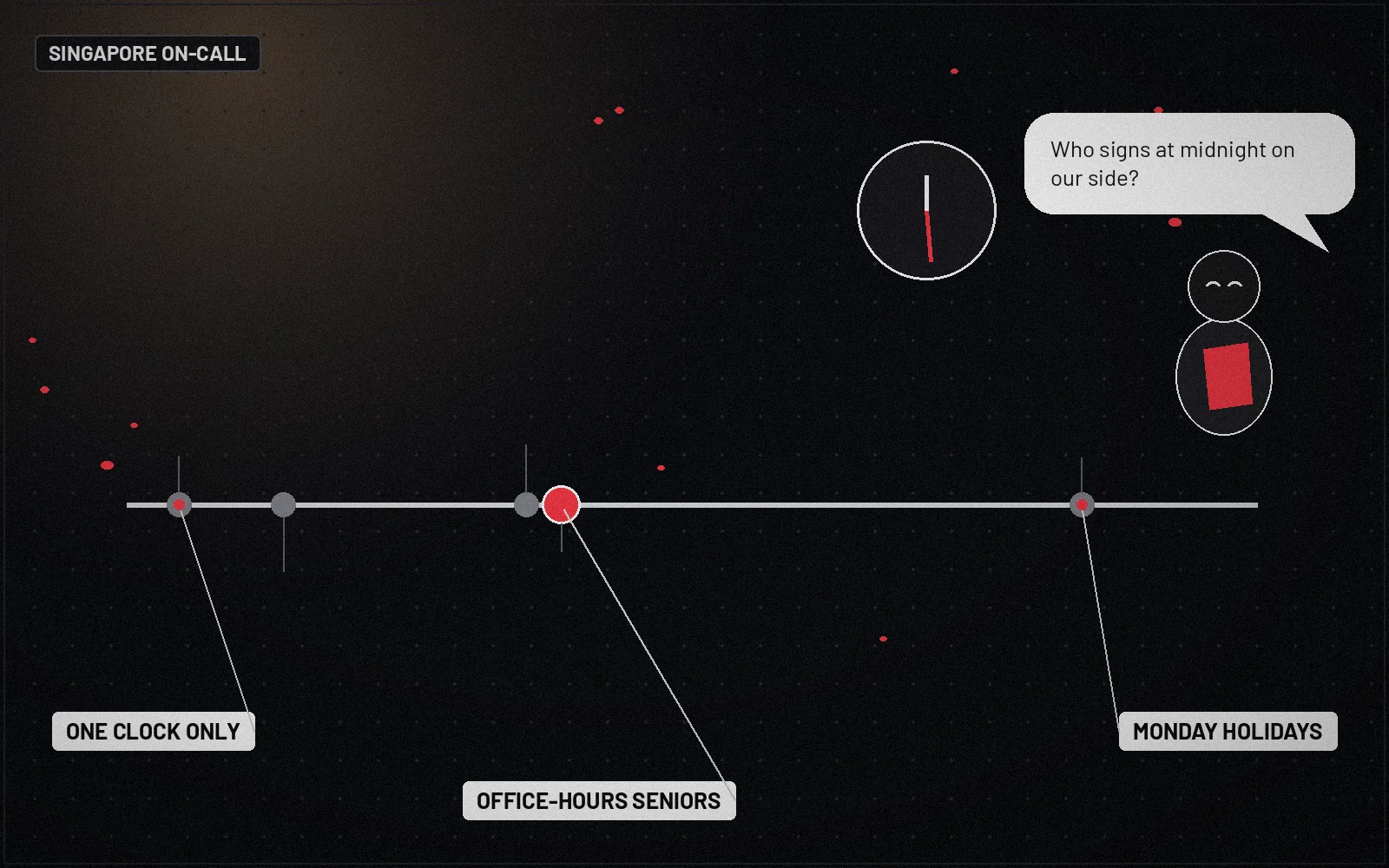
- Office-hours seniors. The senior person in the pitch isn't on the on-call roster.
- Ignoring Monday holidays. In 2026, Vesak Day, National Day, and Deepavali fall on Sundays, each followed by a Monday public holiday (MOM). Long weekends are exactly when rosters thin out.
- No client-side deputy. The fastest agency still waits for your signature.
- Cause speculation in the first statement. Early lines should state impact, action, and the next update time, and leave cause until the investigation supports it. The structure in our holding statement templates helps here.
- Drafting the dark site during the crisis. Build it in advance; see dark-site readiness.
Decision framework: retainer, surge, or in-house?
Ask four questions in order.
- 1. Does a notification window measured in hours apply to you? If yes (the MAS or CSA rows above), you need pre-agreed, named, retained capacity. A surge call-off arrangement is too slow to start.
- 2. Do you have an in-house senior who can make a call at any hour, with an approved deputy? If yes, a lighter retainer focused on writing and monitoring can be enough. If no, buy senior counsel time.
- 3. How often do issues become public? If issues surface monthly, a retainer with ongoing issues monitoring pays for itself in avoided scrambles. If they surface rarely, a smaller standby retainer with drill time can work.
- 4. Are your stakeholders regional? If a Singapore HQ fronts incidents across ASEAN, write country hand-offs into the SOW. Our APAC piece on crisis retainer scoping before midnight covers the regional scoping side; this article covers the Singapore clause.
FAQ
Is "24/7" the same as "on-call"?
No. On-call usually means someone can be reached. A useful 24/7 clause defines what that person must deliver, and how fast, at each tier. Ask for acknowledgement, senior engagement, and first-draft targets separately.
Can our crisis agency file the MAS, CSA, or PDPC notification for us?
The notification duty sits with your organisation, and your legal or compliance owners should run the filing. The agency's job is to make sure public, customer, and staff communications are ready on time and consistent with what the regulator is told.
Does a crisis retainer in Singapore need a team physically in Singapore?
Not necessarily. What matters is that the named people work in Singapore time, know Singapore's regulators and media, and can be on a call within your targets. Ask where the on-call roster sits and which time zone it works in.
How often should we test the retainer?
At least once a year through a scenario drill that uses the real activation route, plus a check whenever named people change. A drill that only uses email doesn't test the 2 am phone call.
What should a crisis retainer never promise?
Coverage outcomes, "making a story go away", or any influence over a regulator's decision. A credible retainer promises speed, judgement, and preparation, not results it can't control.
What to do next
Pull your current retainer, find the sentence that defines 24/7, and test it against the checklist above. If any line is missing, fix it at renewal, not during the incident. To pressure-test a Singapore crisis SOW or run a drill against your regulatory clocks, see Singapore crisis and issues communications, our Singapore government relations practice for regulator-facing preparation, or contact Neuwark. For the wider map of who regulates what, see the Singapore regulator map.