

Corporate reputation management in Singapore reaches the boardroom only when it fits on one page that directors can act on. Build that page around five Singapore-specific signal groups (stakeholder trust, regulator touchpoints, disclosure exposure, the policy calendar, and local media), give every metric a named owner, a data source and a threshold the board agreed in advance, and table it once a quarter next to the risk paper. Anything longer goes in an appendix nobody has to read.
This guide is for company secretaries, heads of corporate affairs, investor relations leads and general counsel who prepare board or ExCo papers for a Singapore entity, listed or not. It is process guidance, not legal advice: we link the primary rules, and your counsel decides how they apply to you.
Our APAC piece on a weekly reputation-risk scorecard covers the early-warning sheet a communications team runs across markets each week. This one covers the quarterly page a Singapore board actually opens, and the Singapore governance and regulatory signals that belong on it.
Why boards skip most reputation reports
Most reputation reports lead with share of voice and sentiment percentages, run to 20 slides, and end with "continue to monitor". A director reading one can't tell what has changed, what it means for the company's risks, or what the board is being asked to decide. The usual faults are the same three: they count activity instead of exposure, they have no agreed threshold between "fine" and "tell us now", and their metrics belong to "the communications team", which means nobody at board level. A board scorecard fixes those three things. It doesn't replace monitoring; it decides which monitoring results deserve directors' time.
Where reputation already sits in a Singapore board's duties
You don't need to invent a mandate for this page. For listed companies, the Code of Corporate Governance 2018 already gives the board the hooks, and SGX Listing Rule 710 requires issuers to describe their governance practices against the Code's principles and provisions, explaining any variation.
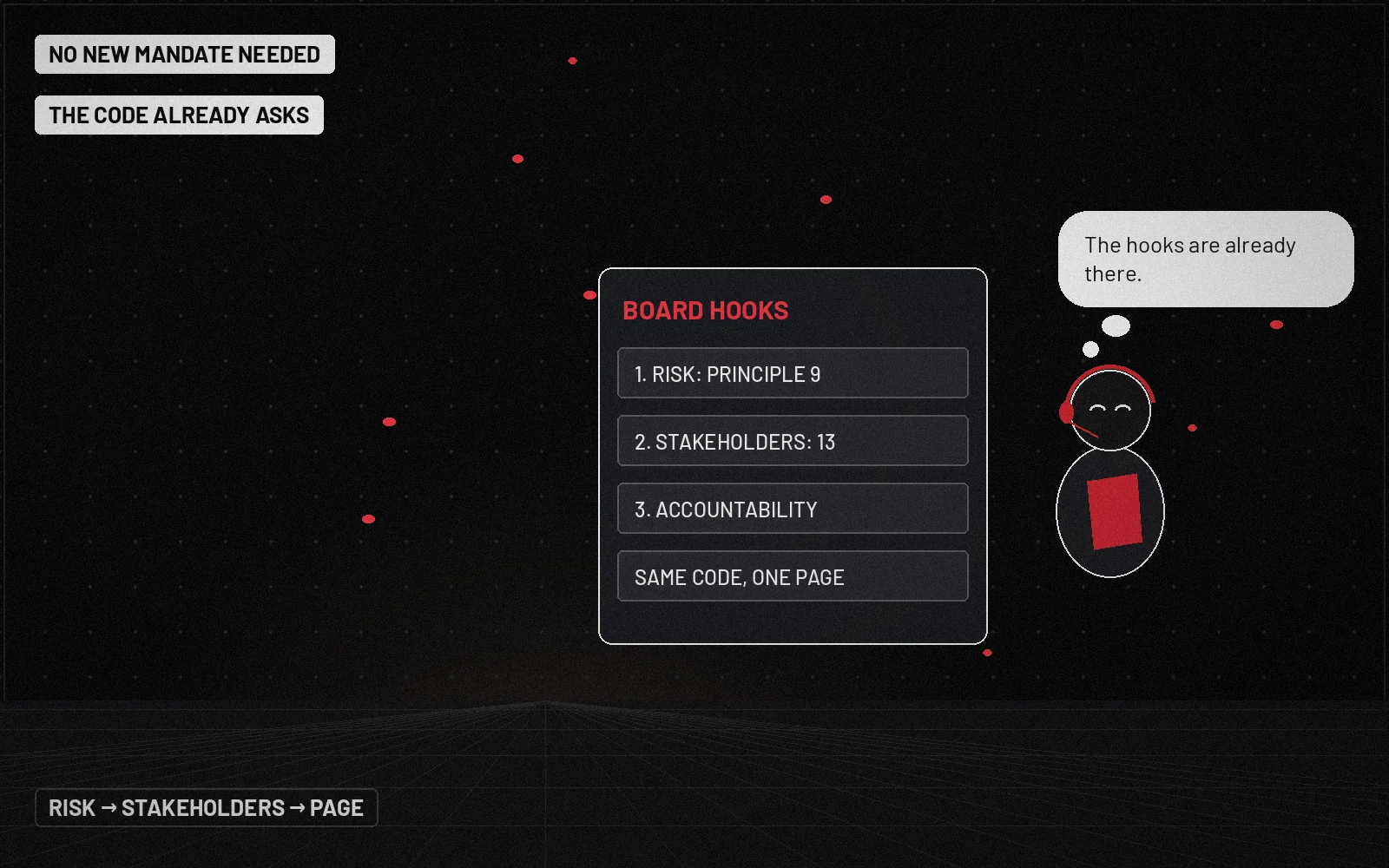
- Risk governance (Principle 9). The board "is responsible for the governance of risk", and Provision 9.1 has it determine "the nature and extent of the significant risks" the company is willing to take. The Practice Guidance asks for an explanation of how the company identifies, measures and monitors "its key and emerging risks". Reputation is rarely a standalone risk; it is how operational, compliance and conduct risks show up in public.
- Stakeholders (Principle 13). Provision 13.1 expects arrangements "to identify and engage with its material stakeholder groups", Provision 13.2 asks for disclosure of the strategy and key areas of focus in managing those relationships, and Provision 13.3 asks the company to maintain "a current corporate website". Practice Guidance 13 adds that the board "should determine the relevant stakeholders, and set policies in relation to material stakeholders identified."
- The board's role. The Code's own description of the board's role includes ensuring "transparency and accountability to key stakeholder groups".
If you are unlisted or the Singapore regional HQ of a multinational, the Code doesn't bind you the same way (it applies to listed companies on a comply-or-explain basis). Its structure is still useful, because it is the language your directors and bankers already use.
What belongs on the page: five Singapore signal groups
A Singapore scorecard earns its place by tracking things a generic global dashboard misses. We group them into five rows.
1. Stakeholder trust
Employees, customers, investors and partners: the "material stakeholder groups" of Provision 13.1. Use sources you already own, such as survey items on trust in leadership, complaint themes and shareholder questions. The Code also expects a whistle-blowing policy (Provision 10.1(f)), and the Practice Guidance asks the Audit Committee to report significant matters raised through that channel to the board. Conduct themes from that channel, reported in aggregate, are one of the earliest reputation signals a company has.
2. Regulator touchpoints
Singapore's regulators are specialised, so the scorecard should name the ones that matter to you: MAS for financial institutions, PDPC for personal data, IMDA for infocomm and media, the POFMA Office for online falsehoods, plus your sector regulator. (Our Singapore regulator map covers who does what.) The page should show open matters and their clocks, not their contents. Two clocks are worth printing on the page itself:
- Under section 26D of the PDPA, once an organisation assesses a data breach as notifiable, it must notify the PDPC "no later than 3 calendar days after the day" of that assessment.
- Under section 11 of POFMA, a Correction Direction requires the recipient to communicate a correction notice in the specified form and manner "by the specified time".
3. Disclosure exposure (listed companies)
For SGX issuers, reputation and disclosure are tied together. Listing Rule 703 requires an issuer to announce information needed to avoid a false market or likely to materially affect the price or value of its securities. SGX's Corporate Disclosure Policy (Appendix 7A) makes three points every communications team should know by heart:
- Releasing material information to the media without announcing it via SGXNET is a breach of Rule 703.
- Rumours or reports likely to affect the share price "must be clarified or confirmed promptly".
- Public relations consultants are named among the people who may be treated as insiders.
Sustainability claims belong here too. Listing Rule 711A requires a sustainability report for each financial year, issued with the annual report or, where it has been externally assured, no later than five months after the financial year end. If your scorecard tracks claims, it should track the evidence behind them; our guide to ESG communications in Singapore without greenwash covers that discipline.
4. The policy calendar
A Bill, a consultation or a parliamentary question can put your sector, and sometimes your company, on the record. The sources are public: Parliament's Order Paper and Bills Introduced pages, and the REACH public consultation listing, which in recent months has carried consultations including Singapore's Sustainability Disclosure Standards and a proposed Digital Infrastructure Bill. The scorecard row records which items touch you, whether you are responding, and by when. For how to write the response itself, see public consultation responses that read like policy.
5. Local media and online conversation
Not share of voice. The board needs to know whether Singapore coverage is accurate, whether material questions are unanswered, and whether a narrative is building in English, Chinese, Malay or Tamil-language media or online forums. One line per live issue: what is being said, whether it is accurate, and who owns the response.
The one-page scorecard template
This is the template we start from with Singapore boards. The metrics fit on one landscape A4 page. The thresholds are illustrative starting points for your board to set, not an industry standard or a regulatory requirement. Agreeing them in advance is the whole point; a threshold invented after the event is just an opinion.
| Signal group | Metric | Owner | Source of data | Green | Amber | Red |
|---|---|---|---|---|---|---|
| Stakeholder trust | Employee trust in leadership (survey item, direction vs last reading) | CHRO | Engagement or pulse survey | Flat or up | Down on two consecutive readings | Sharp fall tied to a named issue |
| Stakeholder trust | Conduct themes from the whistle-blowing channel (aggregate only) | Audit Committee chair, via internal audit | Whistle-blowing log | No significant matters | One significant matter under review | Matter involving senior management |
| Stakeholder trust | Investor and analyst questions on governance or conduct | Head of IR | IR contact log, AGM questions | Routine only | Repeated question on one theme | Question signals a shareholder campaign |
| Regulator touchpoints | Open regulator matters and their deadlines (MAS, PDPC, IMDA, sector) | General counsel | Legal and compliance register | None past internal deadline | One past internal deadline | Formal direction, notice or investigation |
| Regulator touchpoints | Data breaches under assessment or notified (PDPA s26D) | Data protection officer | Breach register | None | Assessment under way | Notifiable breach; 3-day PDPC clock running |
| Regulator touchpoints | POFMA exposure | Head of corporate affairs | POFMA Office releases, own monitoring | None | Falsehood about the company circulating | Direction received; "specified time" running |
| Disclosure exposure | Price-sensitive rumours and time to a disclosure decision | Company secretary | Rumour log, trading alerts | None, or decided same day | Decision took longer than agreed | Rumour unresolved during trading |
| Disclosure exposure | Public claims with evidence on file (sustainability, product, safety) | Head of sustainability | Claims inventory | All evidenced | Any claim without current evidence | Claim publicly challenged |
| Policy calendar | Bills, consultations and parliamentary questions touching the company | Head of government relations | Order Paper, Bills Introduced, REACH | Tracked, response on plan | Response at risk of missing deadline | Company or sector named in Parliament |
| Local media | Accuracy and open questions in Singapore coverage | Head of communications | Media log by language | Accurate; no open questions | Inaccuracy uncorrected past 48 hours | Critical narrative across several outlets |
| Local media | Corporate website currency (Provision 13.3) | Head of digital | Page review log | Key pages reviewed this quarter | Key page out of date | Website contradicts a public statement |
Three rules keep the page honest:
- 1. Every row shows direction since last quarter. An arrow is enough.
- 2. Every amber or red names the decision needed. "For noting" is not a decision.
- 3. Add a metric, remove one. A row that hasn't changed a decision in four quarters goes.
The quarterly cadence
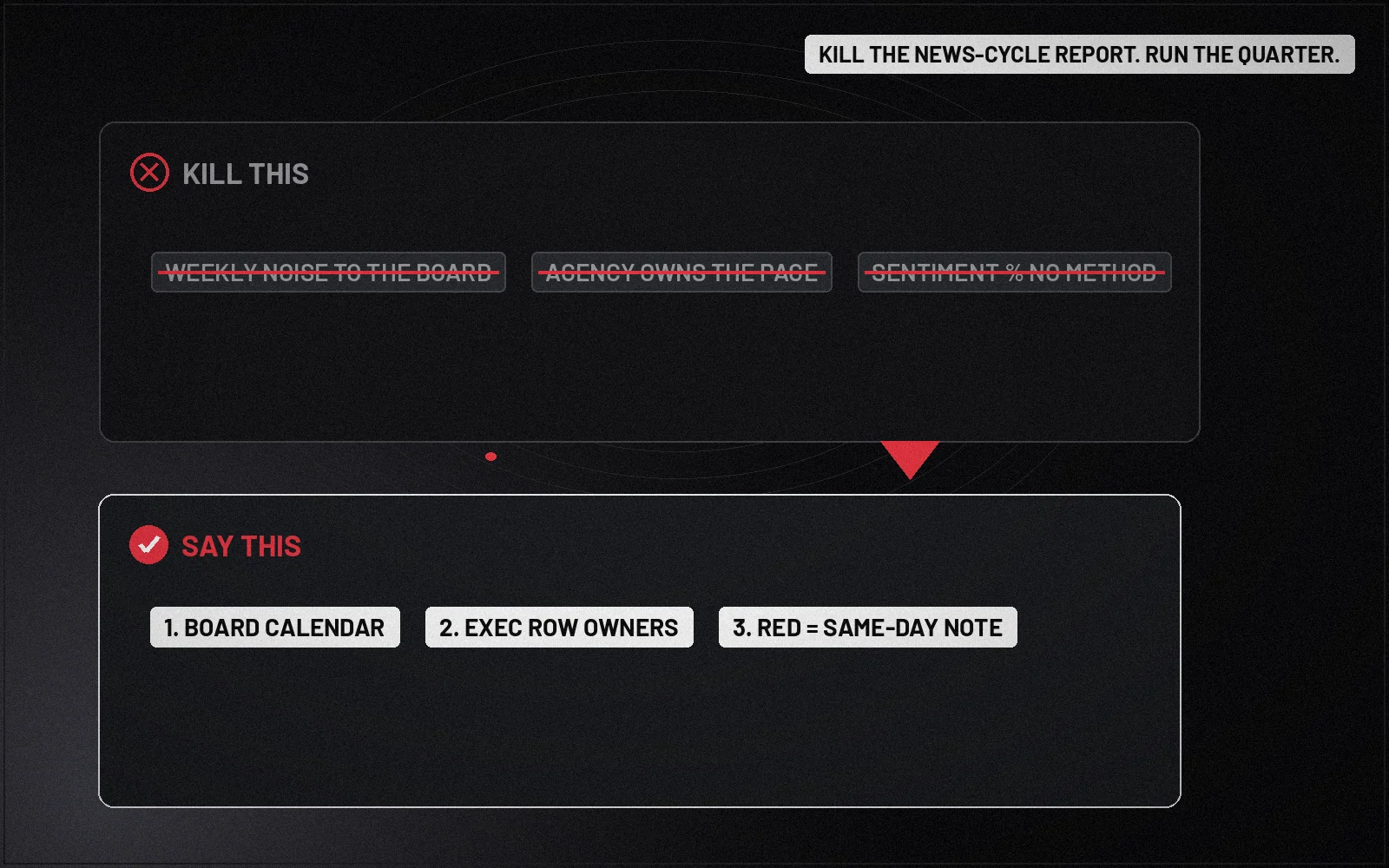
The scorecard works because it runs on the board calendar, not the news cycle. Weekly monitoring, such as the APAC weekly scorecard or the operating rhythm in issues management before the crisis call, feeds it. Here is the rhythm we use, counted back from the board meeting.
| When | What happens | Who |
|---|---|---|
| Six weeks before | Pull the data from each owner's source; confirm thresholds unchanged | Scorecard editor (corporate affairs) |
| Four weeks before | Owners confirm their rows and draft one line on any amber or red | Each row owner |
| Three weeks before | Policy calendar check for the coming quarter: Bills, consultations, sustainability report timing | Government relations, sustainability |
| Two weeks before | ExCo review; agree decisions to put to the board | CEO and ExCo |
| With board papers | One page plus no more than two pages of appendix | Company secretary |
| At the meeting | Ten minutes on the page, focused on ambers, reds and decisions | Board, led by the chair or risk committee chair |
| Within two weeks after | Record decisions, update owners, reset thresholds if the board changed them | Scorecard editor |
Between meetings, a red triggers a same-day note to the chair through the escalation route your crisis plan already sets. The scorecard is not the crisis plan; it tells the board when that plan should already be running. If yours needs work, our piece on what 24/7 should mean in a Singapore crisis retainer covers the response side.
Worked example (fictional)
"Company T" is an invented SGX Mainboard-listed logistics group. Its Q3 page shows nine greens, one amber and one red.
- Amber, regulator touchpoints. A vendor reported a data incident affecting some customer records. The assessment is under way, so the PDPA clock has not started. Decision asked: confirm customer notices and a holding line will be ready before the assessment concludes.
- Red, disclosure exposure. A forum post claimed Company T had lost its largest contract, and the shares moved that afternoon. The log shows the disclosure decision came after trading closed, missing the board's same-day threshold. Decision asked: pre-clear a form of words for "no undisclosed developments" announcements and route future rumours straight to the company secretary and IR.
The page took three minutes to read and produced two decisions and no slides. That is the test.
Who this is for, and who should skip it
| Use this if you… | Skip it, or start elsewhere, if you… |
|---|---|
| Prepare board or ExCo papers for a Singapore listed company, regional HQ or regulated entity | Need a legal view on whether a disclosure or notification duty applies; that is counsel's call |
| Already monitor media and stakeholders but can't get the board to engage | Have no monitoring yet; start with a weekly sheet and run it for a quarter first |
Mistakes that get the scorecard skipped
- Importing a global template. A group dashboard built for another market won't show PDPC clocks, SGXNET sequencing or the REACH calendar.
- Sentiment percentages with no method. If you can't explain how the number was produced in one sentence, it doesn't go on a board page.
- Letting the agency own the page. An adviser can edit it, but the row owners must be your executives.
Decision framework: build it in-house, with support, or not yet
- 1. Is there a board or risk committee that meets at least quarterly? If not, you need a management dashboard, not a board scorecard.
- 2. Do you have an owner for each of the five groups? If two or more are missing, assign owners before designing the page.
- 3. Can your team pull the data in under a week? If yes, build in-house and have an adviser challenge it yearly. If no, set up the sources first.
- 4. Are you exposed to regulator clocks or SGX disclosure? Rehearse the red rows with legal and the company secretary before the first board meeting.
FAQ
Is a reputation scorecard required under Singapore rules?
No rule requires a document with that name. For listed companies, the Code of Corporate Governance expects the board to govern risk (Principle 9) and to identify and engage material stakeholders (Principle 13), and Rule 710 requires the annual report to explain how the company applies the Code. A scorecard is one practical way to show that work.
Should unlisted companies use the SGX-related rows?
Drop the disclosure rows that don't apply, but keep the claims inventory and the stakeholder, regulator and policy rows. Private companies with banks, regulators or public-sector partners face the same trust questions without the SGXNET mechanics.
Who should own the scorecard?
One executive, usually the head of corporate affairs or the company secretary, edits it. Each row has its own owner. The board or its risk committee owns the thresholds.
What to do next
Pull every reputation line from your last board pack. If they lack the five groups, owners or thresholds, draft the one-page version before next quarter's meeting and test it on your chair. For help setting up the Singapore signals, Neuwark supports Singapore clients from our account management office at Marina Bay Financial Centre. See Singapore public affairs, Singapore government relations, crisis and issues communications for Singapore or, for regional rollouts, ASEAN market-entry communications, or contact us.