
Most Singapore corporate desks still treat “issues” as a soft label for complaints and “crisis” as whatever lands after midnight. That binary fails the first week a notifiable personal-data incident, a falsehood circulating about your product, or a cyber event forces Legal, IT, and Communications into the same room with different clocks. Issues management Singapore work is the operating rhythm that keeps early signals from becoming unplanned crisis theatre—before anyone is on a crisis bridge.
This article is for corporate communications, public affairs, and risk leads who need a weekly desk cadence, an escalation ladder, and a clear issues→crisis continuum. It is educational process hygiene—not legal advice, not an enforcement-outcome claim, and not a substitute for counsel when a statute, direction, or notification clock starts.
Educational note (YMYL): Singapore instruments such as the PDPA data-breach notification rules, POFMA directions, and cyber-incident reporting pathways change and are fact-specific. Confirm live duties with counsel and your compliance owners. Nothing here guarantees regulatory outcomes or response times.
Neuwark Communications supports Singapore crisis and issues work from our account office at Level 39, Marina Bay Financial Centre Tower 2, 10 Marina Boulevard, Singapore 018983 (contact +63 923 859 6587). Soft path: Singapore crisis & issues communications · Crisis rapid response · Singapore public affairs · Contact. Related: POFMA night-before prep · PDPA breach communications · Online Safety Act brand-admin notes · Stakeholder maps for market entry.
Direct answer: what is issues management before the crisis call?
| Layer | What it is | What “good” looks like for Comms |
|---|---|---|
| Signal | Early noise: partner rumour, employee WhatsApp, desk query, odd log spike | Logged once; owner named; no public improvisation |
| Issue | Material story risk that is not yet a full organisational crisis | Fact spine, do-not-say list, audience map, review cadence |
| Incident (ops) | Technical / data / safety event with possible regulatory clocks | Joint bridge with Legal/IT; Comms follows notification readiness, not speculation |
| Crisis | Sustained threat to operations, licence posture, people safety, or trust that needs privileged decision rights | Crisis SOW / retainer mode; single spokesperson fence; board-visible timeline |
Issues management is the weekly system that moves signals into owned issues and decides when an issue graduates to crisis. Crisis response is the exception path. If your only artefact is a holding-statement template, you are already late.
Who this is for / who should skip
| Use this rhythm | Hand off |
|---|---|
| Corp Comms / PA / risk leads who own narrative before midnight | Teams seeking legal opinions, notification filings, or “will we be fined?” answers—counsel only |
| Singapore or ASEAN-hub desks needing one issues log across markets | Anyone asking an agency to invent regulator reactions or competitor scandal narratives |
| Boards that want criteria for “call the crisis retainer” | Pure brand campaigns with no listening or escalation owners |
Why “we’ll handle it when it’s a crisis” fails in Singapore
Three structural reasons:
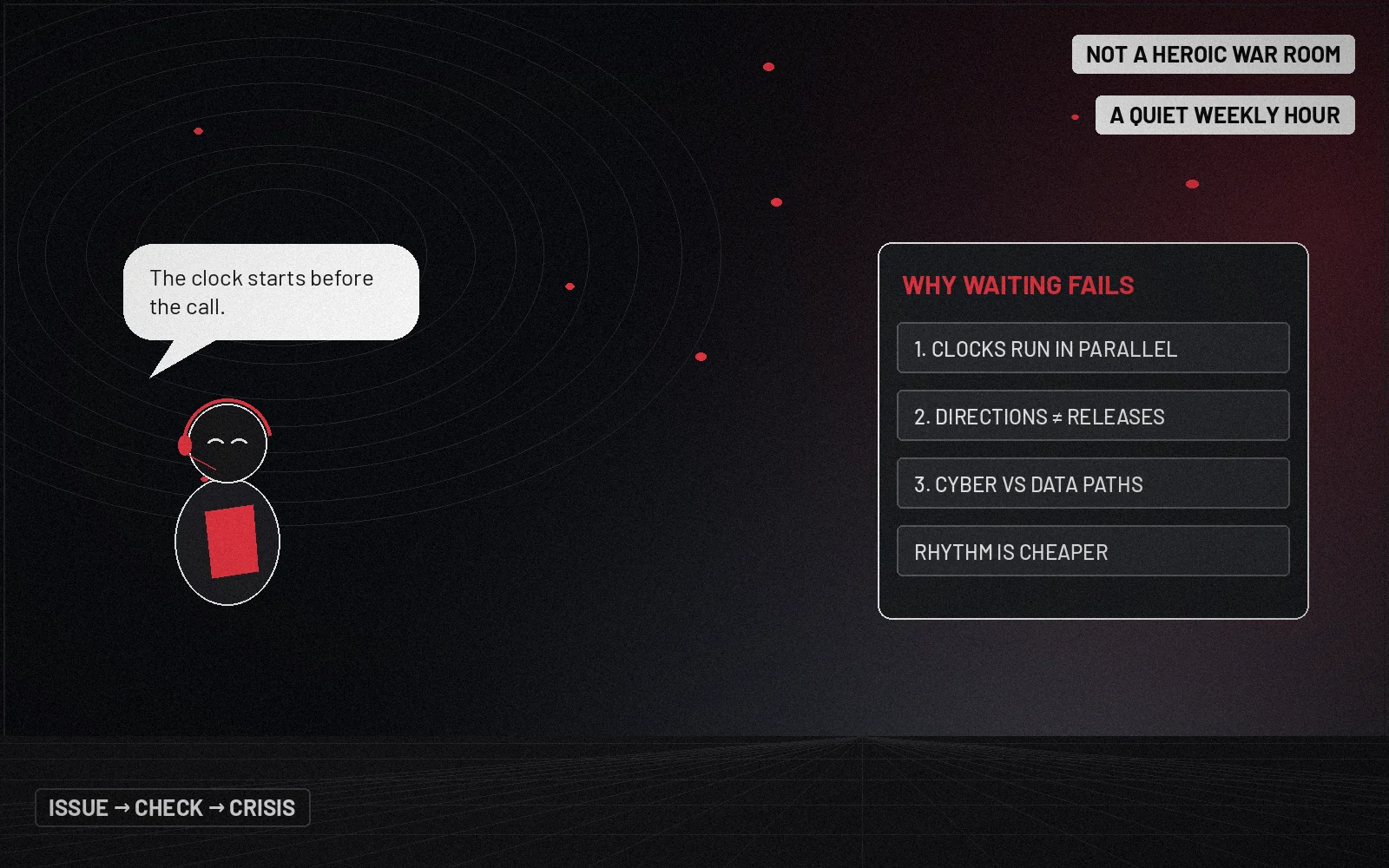
- 1. Clocks are short and parallel. Under the PDPA’s Data Breach Notification Obligation, once an organisation assesses a breach as notifiable, it must notify the Personal Data Protection Commission as soon as practicable and no later than three calendar days, and notify affected individuals as soon as practicable (at the same time or after notifying the Commission)—see the PDPC’s Guide on Managing and Notifying Data Breaches and notification timing page. Comms that only “activates” after the filing is drafted will invent vocabulary under pressure.
- 2. Directions are not press releases. The POFMA Office notes that correction directions require a notice against the original post linking to the Government’s clarification—the post is not removed by default. Prep is process (receive → draft → post), not spin. See POFMA night-before checklist.
- 3. Cyber and data pathways diverge. CSA’s Incident Response Checklist and SingCERT Cyber Aid are preparedness and reporting aids for cyber incidents; PDPC owns personal-data breach notification. An issues desk that collapses “IT ticket” and “public narrative” into one Slack thread will miss one of those lanes.
None of these facts invent a fine amount or a case outcome. They explain why a pre-crisis rhythm is cheaper than a heroic war room.
Original element 1 — The Singapore Issues→Crisis Continuum (operator table)
Score each live item 1–5 on Velocity (how fast the story can move this week) and Consequence (licence, people, money, trust if wrong). Plot into the continuum. Re-score every issues huddle—not once a quarter.
| Stage | Definition | Default Comms posture | Typical owners |
|---|---|---|---|
| Watch | Low velocity / low consequence; on a listening list | Monitor; no public line | Desk lead |
| Issue — contain | Rising interest; still containable with facts and fencing | Internal fact spine; limited stakeholder brief | Comms + functional owner |
| Issue — engage | Named audiences asking; media or association interest | Cleared FAQ; spokesperson rules; meeting notes | Comms / PA; Legal on claims |
| Incident-adjacent | Possible statutory / cyber / safety clock | Bridge with Legal/IT; prep notification and holding lines without publishing speculation | Legal A; Comms R for narrative pack |
| Crisis | Sustained organisational threat; board attention; multi-market leak risk | Crisis mode: single fence, dark-site readiness if scoped, retainer escalation | CEO / Crisis lead A; crisis desk as support |
Rule: never upgrade to “crisis” for drama. Upgrade when consequence and velocity both stay high and decision rights must leave the ordinary issues huddle.
Illustrative continuum scores (re-score for *your* sector)
| Scenario class (generic) | Velocity | Consequence | Starting stage | Narrative trap if mis-staged |
|---|---|---|---|---|
| Partner rumour, no docs | 3 | 2 | Watch → Issue-contain | Over-briefing creates the story |
| Employee post with wrong licence claim | 4 | 4 | Issue-engage | Silence while the wrong claim spreads |
| Suspected personal-data exposure | 4–5 | 5 | Incident-adjacent | Public timeline that outruns Legal assessment (PDPA breach Comms) |
| Viral false statement of fact about your product | 5 | 4–5 | Issue-engage → Crisis if directed or sustained | Treating POFMA process as “PR fight” (POFMA Office overview) |
| Ransomware / service outage | 5 | 5 | Incident-adjacent / Crisis | Customer lines that invent recovery ETAs |
| Quiet association circular questioning your sector claim | 2 | 3 | Issue-contain | Ignoring until it becomes a joint letter |
Original element 2 — Weekly Issues Desk Operating Rhythm (Singapore)
Run this as a standing 45-minute huddle (same weekday, same owner). Keep artefacts one page each.
| Cadence slot | Artefact | Done means |
|---|---|---|
| Mon — Intake | Issues log vN (signal → owner → stage → next review) | Every open item has one Accountable human |
| Tue — Fact spine | Known / Unknown / Do-not-say (one page) | Legal has stamped do-not-say for regulated claims |
| Wed — Audience fence | Who hears what this week (employees, partners, media, associations) | No channel gets a softer story than Legal would allow |
| Thu — Clock check | Any PDPA / cyber / sector / platform clock live? | If yes, counsel owns assessment; Comms owns readiness pack only |
| Fri — Continuum re-score | Velocity × consequence update; escalate or close | Written decision: stay Issue / go Incident-adjacent / call Crisis |
| Anytime — Trigger | Pre-agreed triggers (viral spike, regulator letter as category, outage, direction) | Trigger auto-opens bridge; no waiting for “next Monday” |
Issues log fields (minimum)
- 1. ID / short title (no client gossip in the filename)
- 2. Signal source (internal / partner / media / platform / other)
- 3. Stage on the continuum
- 4. Velocity / Consequence scores
- 5. Accountable owner + Comms lead
- 6. Audiences in play
- 7. Next artefact due (FAQ, holding line, employee note—not all three by default)
- 8. Clock? (none / assessing / counsel-owned)
- 9. Close criteria (what “done” looks like)
PDPC’s C.A.R.E. framing for breaches—Contain, Assess, Report, Evaluate—is a useful incident backbone once personal data is in play (see the breach management guide). Your weekly issues rhythm is what makes C.A.R.E. executable instead of improvised.
Original element 3 — Escalation decision framework (Issue vs Crisis)
Answer these five questions in order. The first “yes” that stays true after a 30-minute Legal/Comms check triggers the next stage—not a social-media mood.
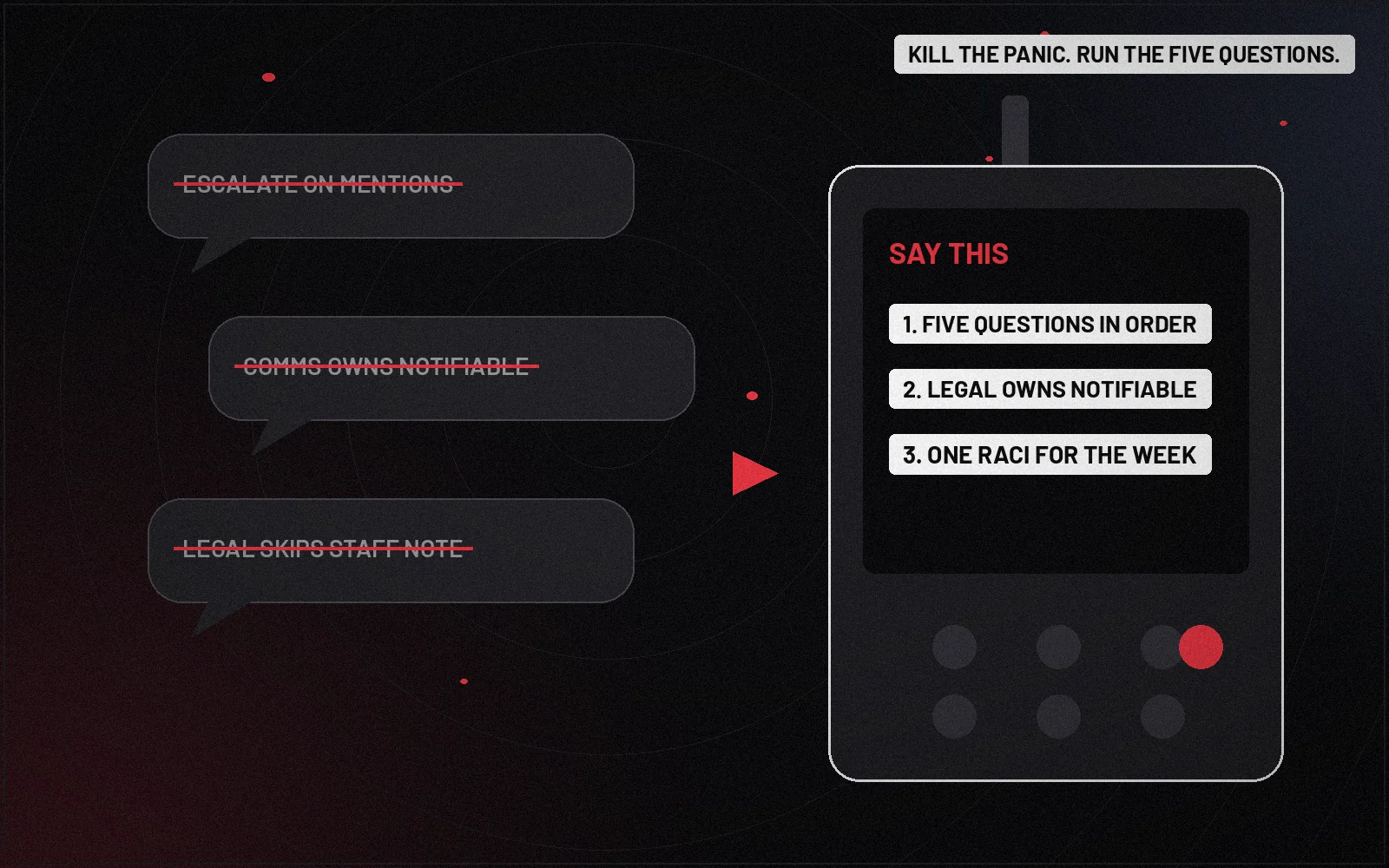
| # | Question | If yes → |
|---|---|---|
| 1 | Is there a plausible statutory or sector notification / direction path (PDPA notifiable breach, cyber reporting duty for your role, POFMA/Online Safety adjacency, licence conduct)? | Incident-adjacent bridge; counsel owns assessment |
| 2 | Are people safety, critical operations, or customer funds/access at material risk this week? | Crisis mode until cleared down |
| 3 | Is the story moving faster than your fact spine can be updated (multi-market leak, coordinated posts, major desk interest)? | Issue-engage minimum; Crisis if decision rights must centralise |
| 4 | Would a wrong public line create irreversible licence or contract harm? | Legal A on every external sentence |
| 5 | Does the board / CEO need a single timeline today (not a status email tomorrow)? | Crisis SOW / retainer; see crisis & issues hub |
RACI for the ordinary week (not the war room)
| Workstream | Corp Comms / PA | Legal / Compliance | IT / Security | Business owner | CEO / Crisis lead | External crisis desk |
|---|---|---|---|---|---|---|
| Issues log + continuum scores | A/R | C | C | C | I | C (facilitate) |
| Fact spine + do-not-say | R | A (claims) | C | C | I | C |
| Employee / partner notes | A/R | C | I | C | A (tone if sensitive) | C |
| Media fences | A/R | A (regulated) | I | I | A (who speaks) | C |
| PDPA / cyber readiness pack | R (narrative) | A | R (tech facts) | I | I | C |
| Call Crisis / retainer | C | C | C | C | A | R (rapid response) |
| After-action → issues hygiene | A/R | C | C | C | I | C |
How to read this: if Comms is Accountable for “are we notifiable?”, you have inverted risk. If Legal never sees the employee note, partners will hear a softer story than the Commission ever would—and that gap becomes the story.
Worked example: three desks, one continuum (illustrative)
Desk A — Fintech product rumour. A channel partner forwards a screenshot claiming your app “already has MAS approval language” you never cleared. Stage: Issue-contain → Issue-engage. Actions: kill the claim in partner FAQ; Legal stamps do-not-say; no media pitch. Continuum score drops when partners confirm receipt.
Desk B — Suspected mailbox exposure. IT flags anomalous access to a mailbox that may hold customer personal data. Stage: Incident-adjacent immediately. Actions: contain and assess under counsel; Comms builds readiness pack only—no public timeline until assessment exists. Use PDPC’s published guidance and self-assessment tools as organisation process aids (self-assessment overview), not as a substitute for counsel. Pair with our PDPA breach communications piece for narrative hygiene.
Desk C — Coordinated false posts about an incident that did not happen. Stage: Issue-engage; Crisis if a direction arrives or safety panic spreads. Actions: fact spine; spokesperson fence; know POFMA’s correction-notice model from the POFMA Office—do not brief that “posts will be taken down” as the default tool. Prep: POFMA night-before checklist.
Illustrative patterns only—not claims about real organisations or enforcement cases.
Mistakes Singapore issues desks still make
- 1. Calling everything a crisis so nothing gets ordinary owners.
- 2. Waiting for perfect facts before naming an Accountable human on the log.
- 3. Publishing empathy without a fact spine—then contradicting yourselves when Legal finishes assessment.
- 4. Treating POFMA / Online Safety adjacency as “content moderation PR” instead of counsel-led process (Online Safety Act notes).
- 5. Skipping employee and partner fences while drafting for media first.
- 6. No close criteria—zombie issues that never re-score.
Buyer note: issues retainer vs crisis retainer
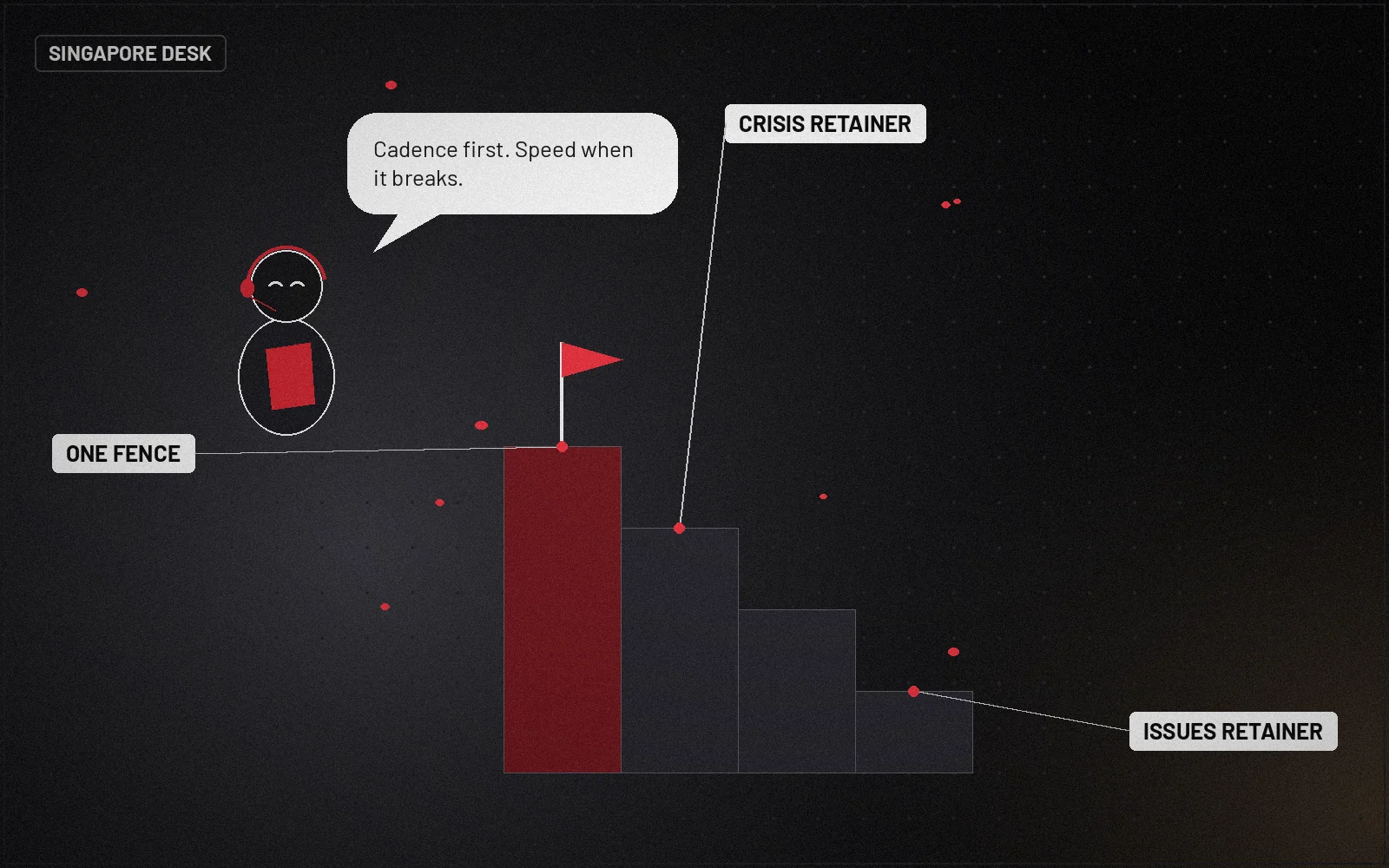
Issues management is cadence and decision rights; crisis retainers are the exception path for privileged speed and a single fence. Soft path: Singapore crisis & issues for the weekly rhythm and crisis rapid response for surge—Legal owns statutory clocks. Stakeholder clarity before any line ships: stakeholder maps.
FAQ (GEO)
What is issues management Singapore work in practice? A weekly operating rhythm that logs signals, scores velocity and consequence, assigns owners, and decides when an item graduates from issue to incident-adjacent or crisis—before midnight improvisation.
How is issues management different from crisis communications? Issues management is the standing system; crisis communications is the exception path when consequence, velocity, and decision rights require centralised control.
When should we call an external crisis desk? When the escalation framework says Crisis or readiness packs outrun in-house capacity—via /contact/, with counsel owning legal determinations.
Closing: rhythm beats the heroic call
Issues management Singapore is won on Monday’s log and Friday’s re-score—not on a holding statement invented at 1 a.m. Build the continuum, run the weekly rhythm, escalate with criteria. The crisis call should feel rare because the operating system worked.