

When a personal-data incident hits a Singapore organisation, Legal and the Data Protection Officer (DPO) correctly reach for the Data Breach Notification Obligation under the Personal Data Protection Act (PDPA). Corporate Communications often hears a thinner brief: “send the email.” That framing turns a statutory notice into a cold compliance artefact—and tells customers, employees, and partners that the clock matters more than they do.
This article is for operators who own PDPA breach communications Singapore workstreams: how to treat notification as a trust narrative without inventing legal outcomes, fines, or case studies. It offers a practical checklist, RACI, and timeline grounded in PDPC’s Guide on Managing and Notifying Data Breaches under the PDPA (revised 15 March 2021) and the Commission’s report-a-data-breach materials. Process hygiene—not legal advice.
Educational note (YMYL): This is communications education for en-SG teams. It is not legal advice, not a PDPC determination, and not a substitute for counsel or your DPO’s assessment under the PDPA, the Personal Data Protection (Notification of Data Breaches) Regulations 2021, or sector rules (e.g. MAS, MOH, CSA). Confirm live instruments before you brief leadership or publish any notice.
Neuwark Communications supports Singapore public-affairs and crisis communications from our account office at Level 39, Marina Bay Financial Centre Tower 2, 10 Marina Boulevard, Singapore 018983 (contact +63 923 859 6587). Soft path: Crisis rapid response · Singapore public affairs · Singapore government relations · Contact. Related: POFMA night-before, Online Safety Act brand admins, IMDA consultation checklist, GR vs PA buyer split.
Direct answer: what “trust narrative” means under a PDPA clock
| Audience | What they need from PDPA breach communications | What erodes trust |
|---|---|---|
| Affected individuals | Clear facts, self-protection steps, a reachable human contact—aligned with PDPC individual-notice expectations | Vague apology, missing “what you can do,” buried contacts, or tone that contradicts the PDPC filing |
| Employees | One internal line matching the external notice; who speaks; rumour kill-list | Founder posts that race Legal; Slack speculation that becomes the story |
| Partners / intermediaries | Who notifies whom, and when; contracts matching PDPA intermediary duties | Silence while a vendor’s customers already know |
| Board / leadership | Status against assessment and notification clocks; what is still unknown | Confidence theatre before assessment is documented |
PDPC’s guide organises response as C.A.R.E.—Contain, Assess, Report, Evaluate. Communications owns none of those four letters alone. It does own whether the Report step lands as accountability or as a form letter.
Who this is for / who should skip
| Use this pack | Hand off |
|---|---|
| Corporate Comms, corporate affairs, or crisis leads building an en-SG breach playbook beside Legal/DPO | Teams seeking fine amounts, “typical PDPC outcomes,” or competitor post-mortems—counsel / investigation tracks |
| Regional HQ needing one vocabulary for customers, staff, and partners | Anyone asking an agency to decide notifiability—that stays with the organisation + counsel |
| Boards that must approve holding lines before a notice goes out | Pure brand PR pitches with no DPO or Legal in the war room |
What the PDPC clocks actually say (comms-relevant excerpt)
Do not invent numbers. These clocks paraphrase PDPC’s Guide on Managing and Notifying Data Breaches and report pages. Re-check live instruments on pdpc.gov.sg and SSO before use.
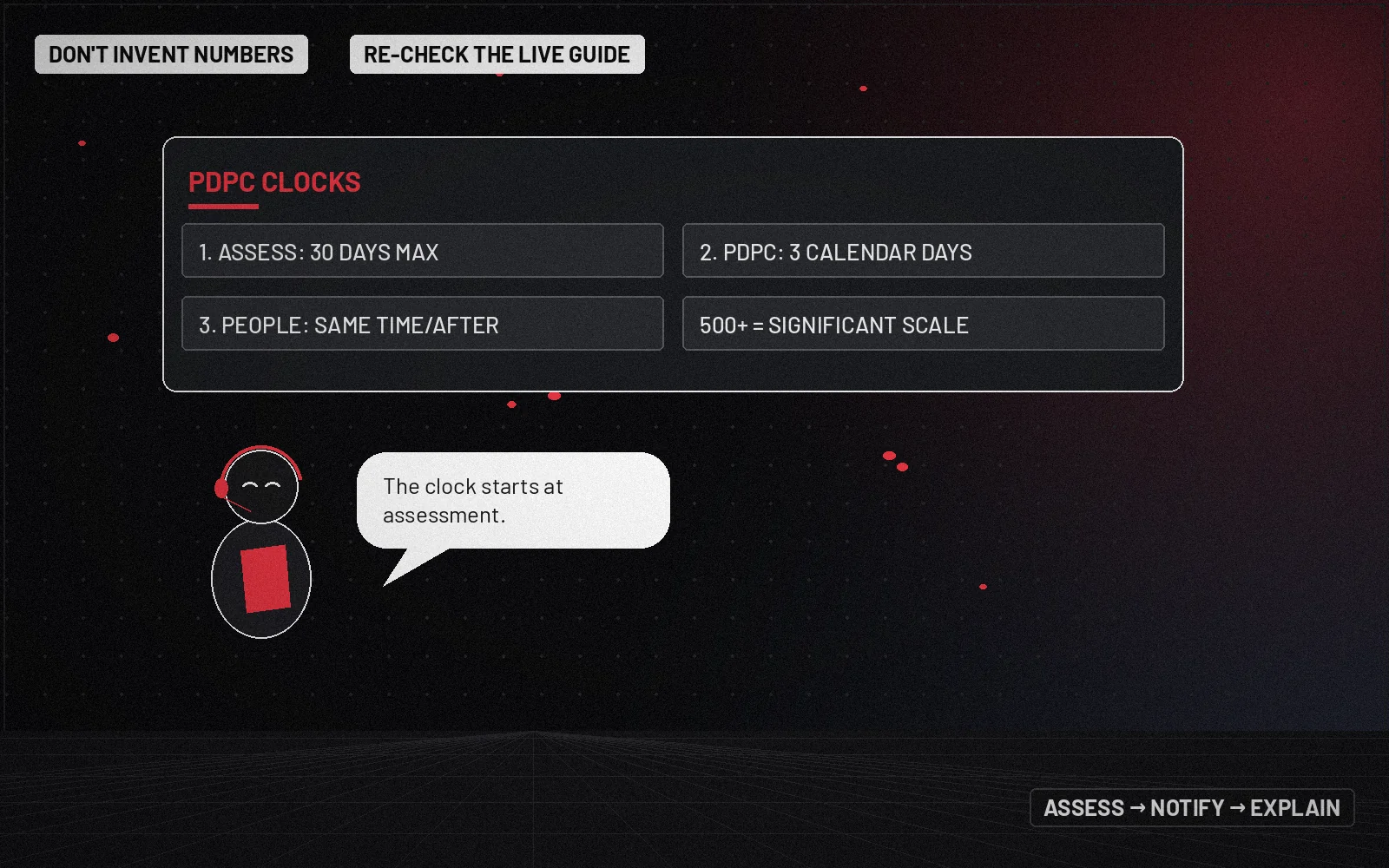
- 1. Assessment window. With credible grounds that a breach occurred, assess whether it is notifiable under the PDPA within 30 calendar days. Unreasonable delay can breach the DBN Obligation; if you overrun 30 days, be ready to explain why.
- 2. Notify the Commission. Once determined notifiable, notify the PDPC as soon as practicable, and no later than three (3) calendar days. The guide’s illustration: the first of those three days starts the day after determination (determine 1 January → notify by 4 January).
- 3. Notify affected individuals. Where required, notify them as soon as practicable, at the same time or after notifying the Commission. For incidents likely to draw wide public attention, PDPC strongly encourages seeking Commission advice before individual notification.
- 4. Significant scale. Personal data of 500 or more individuals meets the significant-scale criterion for notifying the Commission (even without prescribed “significant harm” classes)—per the guide.
- 5. Significant harm. The PDP (DBN) Regulations 2021 prescribe data classes deemed likely to cause significant harm if compromised. PDPC’s Before You Report tool lists patterns such as full name/NRIC with financial, medical, insurance, adoption, vulnerable-individual, or private-key data. Classify with the live tool and counsel—not this article.
- 6. Data intermediaries. Intermediaries must notify the organisation of a detected breach without undue delay; the organisation still owns notifiability assessment and required Commission/individual notices.
- 7. Filing path. Submit at https://eservice.pdpc.gov.sg/case/db. Guide materials also list a working-hours contact for urgent major cases.
Comms implication: holding lines and customer email must not promise a determination before assessment is documented, and must not contradict what Legal will file.
Original element 1 — operator checklist (trust narrative, not theatre)
Score each item Done / Partial / Missing beside Legal/DPO before any external send.
A. Intake & freeze (hours 0–6)
- 1. Named incident channel—DPO + crisis lead on the same thread.
- 2. No public comment rule: website, social, IR, founder LinkedIn, partner Slack share one holding-line owner.
- 3. Incident Record Log started (cause known/unknown; systems; rough headcount; data types)—enough that Comms does not invent certainty.
- 4. Sector regulators / law enforcement flagged if counsel says so (other filings do not satisfy the PDPA DBN Obligation alone).
- 5. Intermediary map: who processes the data, and who owes a “without undue delay” notice.
B. Assessment hygiene (inside the 30-day clock)
- 1. Written assessment trail (credible-grounds date, steps, interim conclusions)—PDPC may ask for supporting documentation.
- 2. Dual test in plain language for leadership: significant harm and significant scale (≥500 individuals).
- 3. Comms gets a one-page “known / unknown / do-not-say” sheet—not a forensic dump.
- 4. Kill list: ban uncleared phrases (“no risk of harm,” “fully contained,” competitor blame, invented fine exposure).
- 5. If assessment will overrun 30 days, Legal owns the explanation; Comms does not fill silence with speculation.
C. Notification craft (3-day Commission clock + individual notice)
- 1. PDPC packet and individual notice share one fact spine: discovery circumstances; data/classes affected; potential harm; remediation; contact—mapped to PDPC’s required-content list.
- 2. Individual notice is clear and actionable: what happened, what we are doing, what you can do now, how to reach a human.
- 3. Channel plan (email / in-app / letter / SMS) matches reachability; parents/guardians considered where children’s data is involved.
- 4. High public-attention risk: Commission first (or Commission advice first), then individuals—no early PR leak.
- 5. Media fence: one spokesperson, one FAQ, status page only if rumour volume warrants—via crisis rapid response ops, not a brand campaign.
D. After the send
- 1. Employee line matches customer notice in the same hour window.
- 2. Partner brief uses the same chronology; no over-disclosure beyond counsel’s map.
- 3. Follow-up cadence: when facts change; how complaints are logged.
- 4. Evaluate step booked (C.A.R.E.) for internal learning—not a marketing case study.
- 5. “We take privacy seriously” claims parked until remediation survives a second question.
Original element 2 — RACI for the first 72 hours
Use Responsible / Accountable / Consulted / Informed. Do not outsource Accountability to an agency.
| Workstream (first 72 hours) | DPO / Privacy | Legal / Compliance | Corporate Comms | IT / Sec / Forensics | CEO / leadership | External counsel / crisis desk |
|---|---|---|---|---|---|---|
| Credible-grounds intake & log | A/R | C | I | R (tech facts) | I | C |
| Containment decisions | C | C | I | A/R | I | C |
| Notifiability assessment (harm + scale) | A/R | A (legal read) | C (clarity only) | C | I | C |
| PDPC notification content & filing | A/R | A | C (plain language) | C | I | R (draft support) |
| Affected-individual notice copy | C | A (substance) | R (craft) | C | A (who signs/speaks) | R (draft support) |
| Employee / partner lines | C | C | A/R | I | A (voice) | C |
| Media / social fence | C | C | A/R | I | A | C |
| Sector regulator notices (if any) | C | A/R | C | C | I | C |
| Rumour / misinformation kill list | C | A | R | I | I | C |
| Post-send evaluate workshop | R | C | R (narrative archive) | R | I | C |
How to read this: if Comms is Accountable for the PDPC filing, you have inverted the statute. If Legal never reads the customer email, you ship a notice that is careful and humanly empty—the opposite of a trust narrative.
Original element 3 — timeline table (operator view)
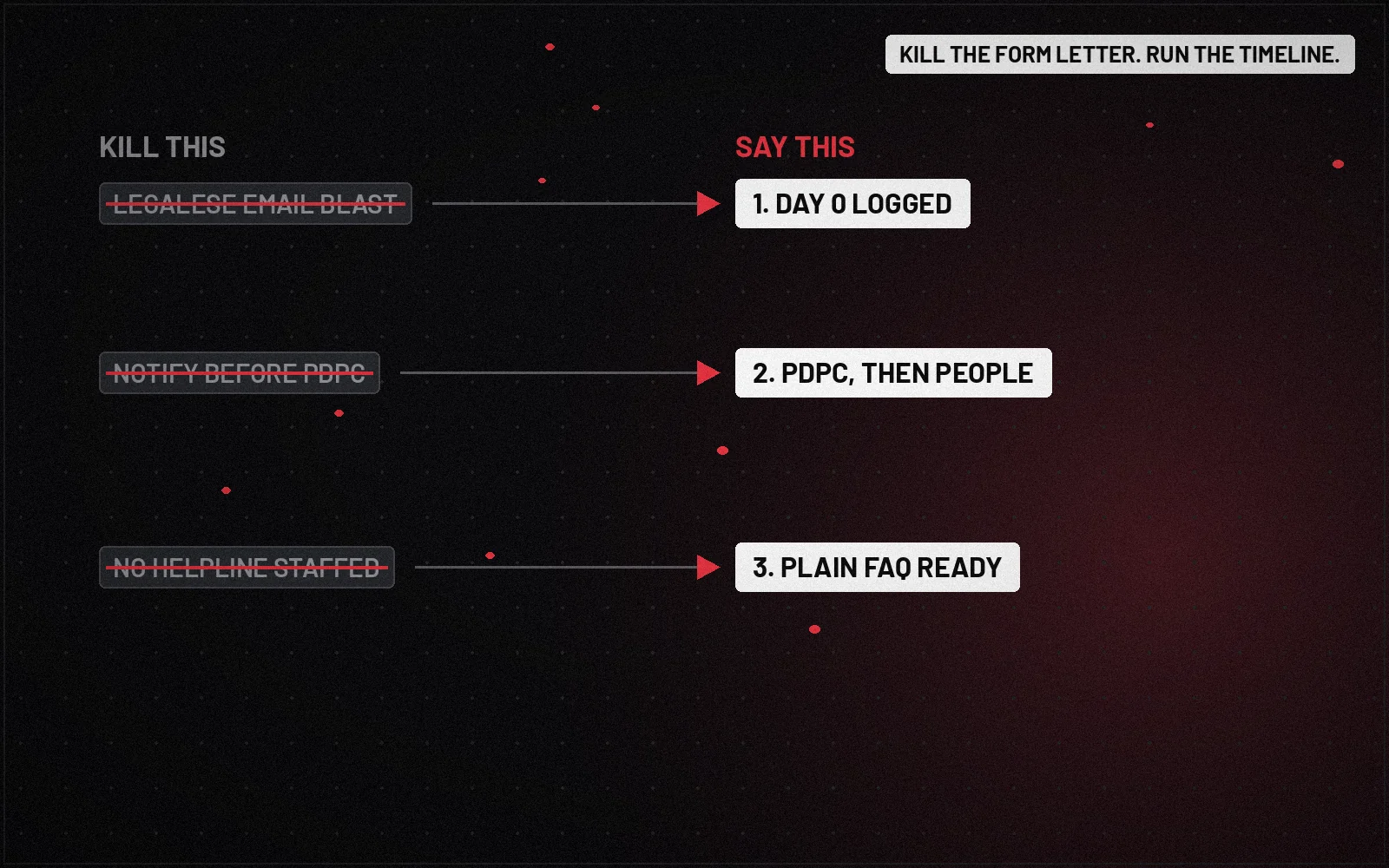
Clocks paraphrase PDPC’s guide for planning—not a complete legal restatement. “Day 0” = credible grounds a breach occurred.
| Phase | Clock (PDPC guide) | Comms / trust actions | Artefacts ready |
|---|---|---|---|
| 0 — Detect | Immediate internal report | Freeze public comment; name spokesperson; open war-room channel | Holding line v0 (“We are assessing a possible personal-data incident; we will update when facts are confirmed. Contact: …”) |
| 1 — Contain | Parallel to assessment | Do not claim “fully contained” unless IT/Legal agree in writing | Known/unknown sheet; kill list v1 |
| 2 — Assess | Within 30 calendar days of credible grounds | Translate assessment into audience maps (customers / staff / partners); prep FAQ skeletons without publishing | Assessment memo (Legal/DPO); draft individual notice; draft PDPC fact spine |
| 3 — Determine notifiable | Decision timestamp starts the 3-day clock | Sequence lock: Commission notification path before or with individual send as required | Determination note with date/time; approval signatures |
| 4 — Notify PDPC | As soon as practicable, ≤ 3 calendar days after determination | Align any media statement with filed facts; no extra adjectives | Filed packet; authorised-representative contacts |
| 5 — Notify individuals | As soon as practicable, same time or after PDPC | Send clear, actionable notice; stand up response inbox/hotline; brief employees same window | Final notice; FAQ; partner brief; social fence |
| 6 — Evaluate | After stabilisation | Archive what was said; retire temporary pages; feed lessons into breach management plan (PDPC encourages plans before the next incident) | Post-mortem for board; updated playbook—not a press release |
How tone becomes the trust narrative
PDPC’s guide notes that effective notification helps individuals protect themselves and can build trust when the organisation shows accountability. Tone rules that usually survive counsel review:
- Lead with reader agency. “Here is what you should do this week” beats three paragraphs of corporate sorrow.
- Separate facts from empathy. One short empathy line, then facts, remediation, and self-help steps.
- Name uncertainty honestly. “We are still confirming the exact number of accounts” beats false precision you will retract.
- Match channels. If customers live in-app, do not hide the notice in a PDF only Legal loves.
- Keep silence consistent. A warm customer email plus a joking founder tweet is how trust dies in public.
Reuse the same war-room muscle (freeze, RACI, kill list, one spokesperson) from our POFMA night-before, Online Safety Act brand-admin, and IMDA consultation packs. Different statutes; shared ops hygiene.
Buyer note: when external crisis / PA support helps
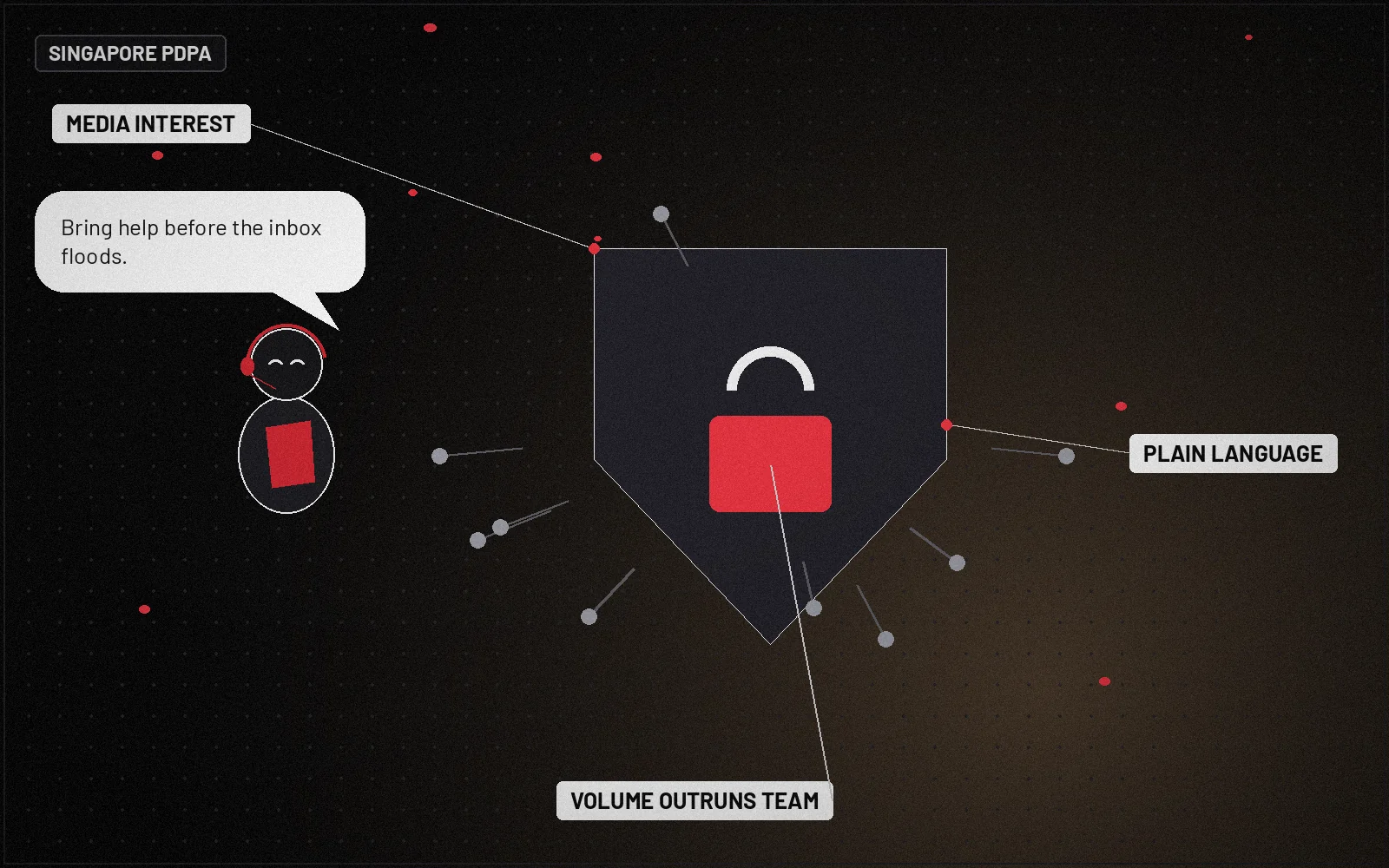
Bring a crisis rapid response or Singapore public affairs desk when notification volume or media interest outruns in-house capacity, when plain-language craft must track a counsel-owned fact spine across APAC time zones, or when leadership needs a facilitator who will not invent legal conclusions. It is not a substitute for DPO assessment or PDPC filing. Scope external hours as craft + coordination under Legal accountability—the buyer hygiene in our GR vs public affairs Singapore split.
Closing: the email is the minimum; the narrative is the test
PDPA breach communications Singapore work is won before send: assessment trail, kill list, RACI, and no brand improvisation past the Commission clock. The statutory notice is the floor. Consistent facts for customers, employees, and partners are the product.
Confirm clocks and prescribed data classes against pdpc.gov.sg and counsel before you publish. Then write the notice a reasonable person would want to receive. For where PDPC sits next to IMDA, MAS, and POFMA on a desk map, see the Singapore regulator map (IMDA, MAS, PDPC, MDDI, POFMA).