
Investor and stakeholder communications Singapore fails when the first letter tries to be a press release, a legal memo and a reassurance note at once. A regulatory story hits: an SGX query, a PDPC decision, an MAS statement, a POFMA correction, a cyber notice. Investors, employees, customers and partners each ask one hard question. The letter that works opens with the fact, states the impact you can defend, names the next step with an owner, and matches the channel you are allowed to use.
This guide is for corporate affairs, public affairs, communications and regulatory leads who draft or clear those letters in Singapore — tone, ladder and channel hygiene, not the disclosure call itself. Pair with Cyber Incident Communications for Singapore Operators and Issues Management Before the Crisis Call. Hub: Singapore crisis and issues communications.

Why the first letter is usually the wrong letter
The first draft almost always fails for the same four reasons:
- It leads with emotion. "We take this seriously" is not a fact an investor can price or an employee can act on.
- It mixes audiences. A board paragraph lands in the staff note; a soft customer line lands on SGXNET.
- It over-promises. Timing, remediation and "no material impact" appear before counsel will stand behind the numbers.
- It ignores the channel. A private stakeholder email that carries material price-sensitive detail before the market has seen it is not a tone choice. For listed issuers it is a disclosure problem under SGX Listing Rule 703 and the Exchange's Corporate Disclosure Policy.
Singapore's continuous disclosure rules make that last failure expensive. Practice Note 7A reminds issuers that those obligations sit under Section 203 of the Securities and Futures Act, and that a breach can be an offence for the issuer and its officers. Communications owns the sentences; counsel and the company secretary own what may leave the building.
What counts as a Singapore regulatory story
A regulatory story is any public or soon-to-be-public matter where a Singapore authority, exchange or statutory body is already in the narrative, or will be within hours: SGX RegCo queries and material Rule 703 announcements; MAS or PDPC decisions and notifiable PDPA breaches; POFMA or online safety notices that become public; cyber incidents that force customer letters the same day. If the matter is still confidential, incomplete and covered by a Rule 703(3) safe harbour, do not invent a public letter to "get ahead of it". Map audiences quietly and wait for counsel's disclosure call. Keep the Singapore regulator map for communicators on the desk.
The one rule: fact, impact, next, channel
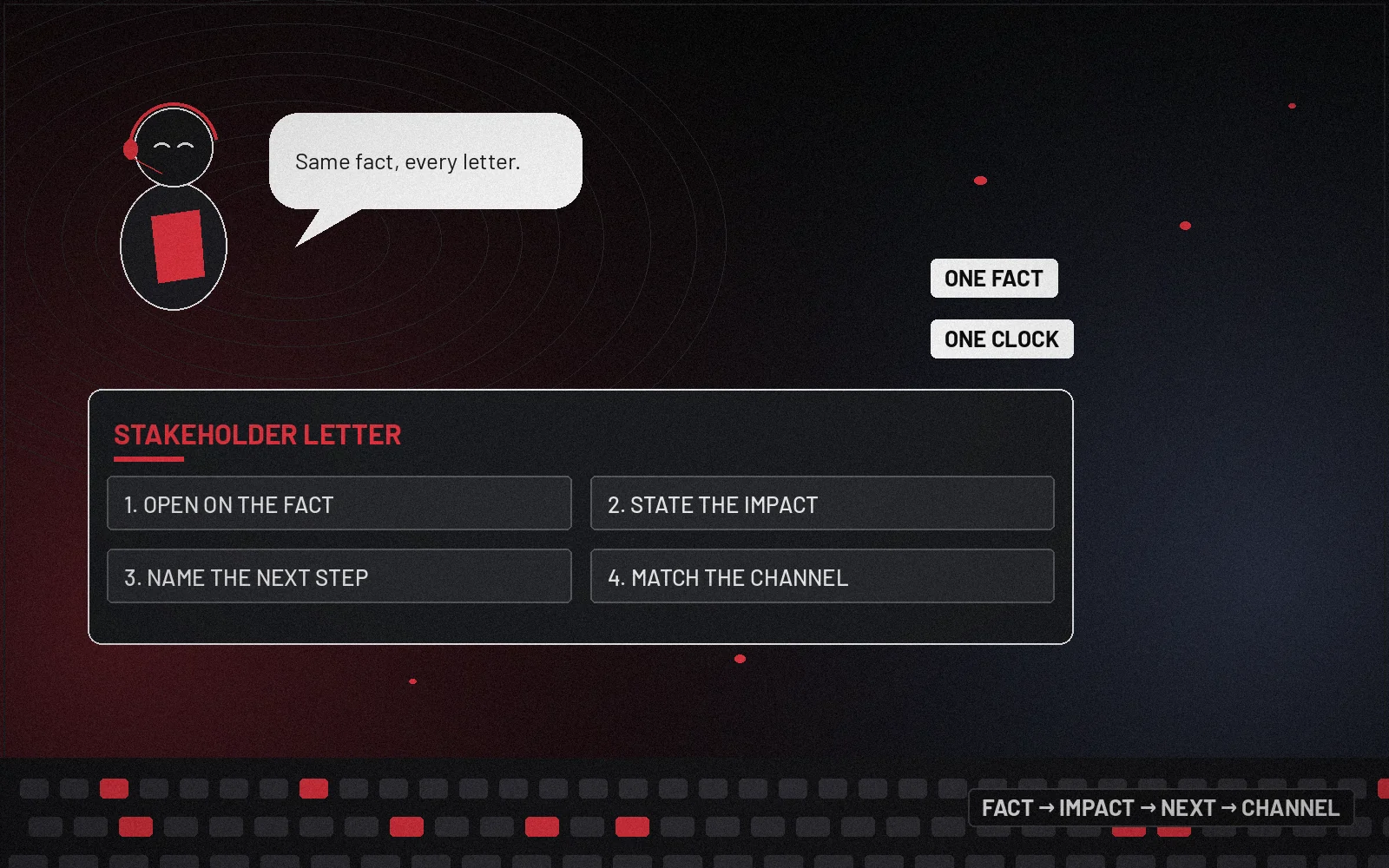
Every investor or stakeholder letter carries four parts in this order.
- 1. Fact. What happened, in the same words the company will use on the public record. No adjectives counsel has not cleared.
- 2. Impact. What is known to be affected, and what is still being assessed. Separate "known" from "under review".
- 3. Next. The next concrete step, with an owner or named process, and a time window you can keep. Prefer "we will update by Thursday 17:00 SGT" over "as soon as possible".
- 4. Channel. Why this audience is hearing it this way, and where the same fact already sits (or will sit) on the public record.
That is the whole letter. A holder note can say it in eight sentences. A staff note can say it in six. If a paragraph does not serve one of the four parts, cut it.
Three numbered parts you can brief in five minutes
- 1. Open on the fact the company will defend on the record.
- 2. State impact as known vs still assessing; never invent "immaterial".
- 3. Name the next step and the channel that matches this audience.
The stakeholder letter ladder (original matrix)
Not every audience gets the same letter. They get the same fact, graded by what they need to do next. Build the ladder before the first send.
| Audience | Must receive | Must not receive | Primary channel | Owner signs |
|---|---|---|---|---|
| Market / investors (listed) | Material fact via SGXNET first | Soft private colour ahead of the market | SGXNET, then IR note that mirrors it | Company secretary + IR + counsel |
| Board / audit / risk | Full fact pack, options, counsel view | Public-facing slogans | Board portal / sealed pack | CEO or company secretary |
| Employees | What changed for their work, who to ask, what not to say | Speculative root cause, unreleased numbers | Internal email / intranet after public fact if material | Comms + HR |
| Customers / users | What they must do, support path | Internal investigation detail | Direct notice, in-product, support script | Comms + product / DPO |
| Partners / distributors | Contractual and operational next steps | Investor talking points they will forward | Named account email | Partnerships + counsel |
| Media | Public fact only, one spokesperson | Side briefings that add numbers | On-record statement matching the public record | Spokesperson + counsel |
How to use it in 15 minutes. Fill one row per audience that will hear the story today. If two rows disagree on the fact sentence, stop and fix the fact before anyone sends. The longer map lives in stakeholder maps for Singapore market entry; this ladder is the send-order for a live regulatory day.
Worked example: PDPC-notifiable breach that also hits investors
A Singapore-listed consumer platform finds unauthorised access to a customer database on Monday morning. Counsel and the DPO assess a notifiable PDPA breach. The PDPC expects notification as soon as practicable and no later than three calendar days after the organisation decides the breach is notifiable, with affected individuals notified as soon as practicable at the same time or after (PDPC notification timing; breach guide). IR and counsel also decide the incident is material under Rule 703.
Wrong staff note at 09:40. "A sophisticated attack may have exposed some data. We take privacy seriously. Do not speak to the press. More soon." No fact the company will put on SGXNET. No customer action. No next step with a clock.
Right sequence.
- 1. Contain and assess with the cyber / DPO track running in parallel.
- 2. Agree one fact sentence for SGXNET and every downstream letter.
- 3. File on SGXNET first if the information is material price-sensitive or needed to avoid a false market (Rule 703; Practice Note 7A). Appendix 7A expects public disclosure via SGXNET; copies may go to media at the same time, not instead of the Exchange.
- 4. Notify the PDPC and affected individuals on the notifiable path, using the CARE steps in the PDPC guide (Contain, Assess, Report, Evaluate).
- 5. Tell employees the same fact, plus restricted systems, who takes press calls, and the kill list below.
- 6. Tell partners only the operational slice: what pauses, who to contact, when the next update lands.
The letters differ in length and next steps. They do not differ on the fact.
Channel discipline under Singapore listing rules
Appendix 7A treats timely disclosure of material information as fundamental to a fair market. Material information is announced when it arises, including during trading hours, with trading-halt mechanics when needed. Public disclosure runs through SGXNET. Selective disclosure to favoured holders, analysts or journalists is the failure mode the policy exists to stop.
If it is material, the market hears it first or at the same instant as anyone else you brief. Private IR colour after the announcement may clarify process; it may not add new material facts. Staff and partner letters must not quietly expand the fact set. If you cannot yet announce, you also cannot "pre-brief" a friendly stakeholder with the material detail. Unlisted companies do not sit under Rule 703, but the same ladder still stops three conflicting stories leaving on the same afternoon. After the dust settles, use the Singapore corporate reputation scorecard frame; do not invent a recovery narrative in the first letter.
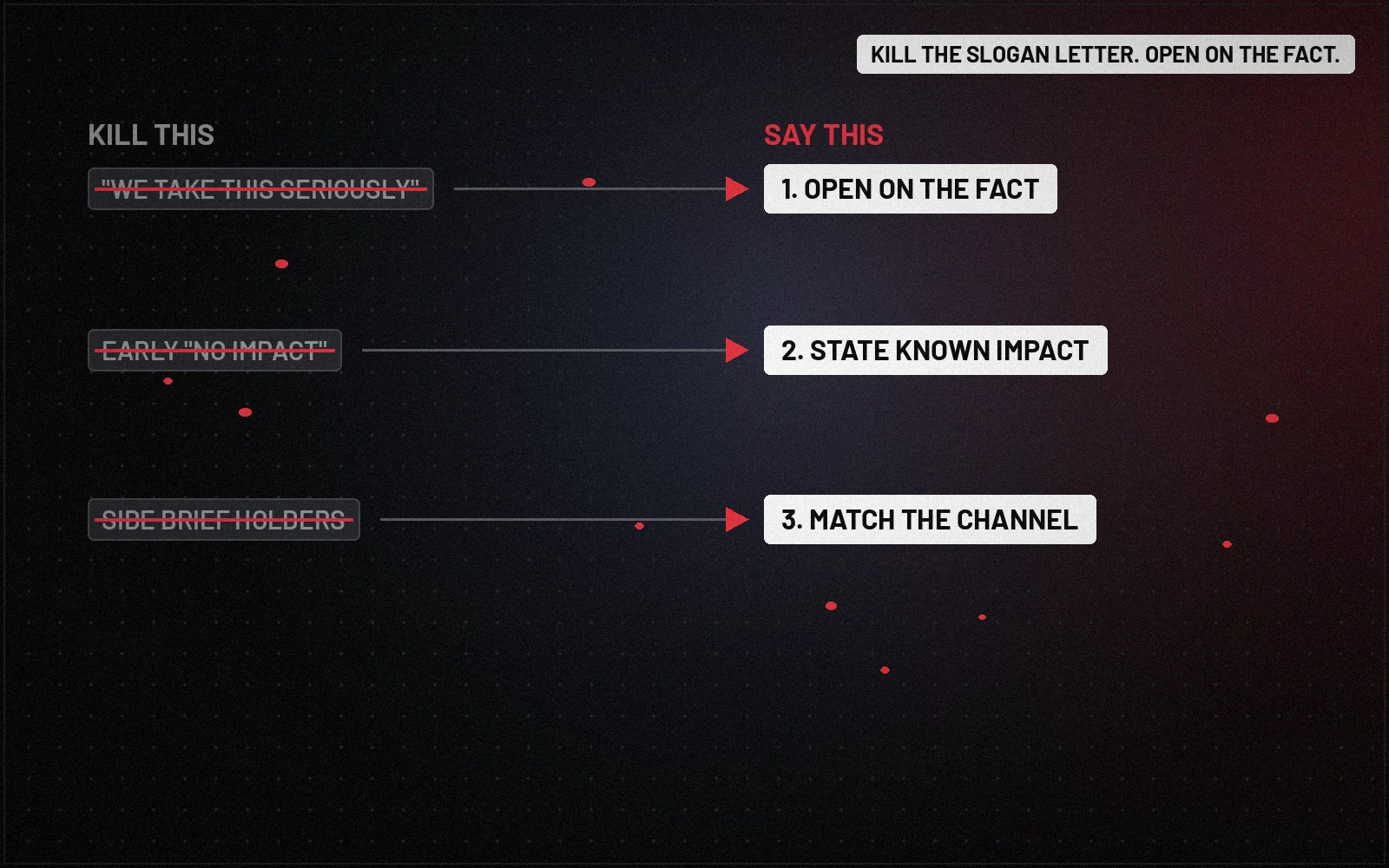
Kill this | Say this (investor and stakeholder letters)
| Kill this | Say this | Why |
|---|---|---|
| "We take this very seriously." | "Here is what happened, what is affected, and what we do next." | Seriousness is assumed; the reader needs the fact. |
| "There is no material impact." | "Impact on [X] is under assessment; we will update by [time]." | "No material impact" is a disclosure call, not a comfort phrase. |
| "A sophisticated actor breached us." | "Unauthorised access to [system] was detected on [date]." | Attribution belongs to forensics, not the first letter. |
| "Off the record for our top holders…" | "The public announcement is on SGXNET; this note mirrors it." | Side colour on material facts breaks the disclosure policy. |
| "Please reassure your teams." | "Use these three sentences; do not add root cause." | Reassurance without a script becomes a second story. |
| "As soon as possible." | "Next update by Thursday 17:00 SGT, or sooner if the assessment changes." | A clock you can keep beats a vague promise. |
Kill the habit of writing the apology before the fact. Say the four parts out loud before anyone hits send: fact, impact, next, channel.
Desk notes: Singapore IR and corporate affairs
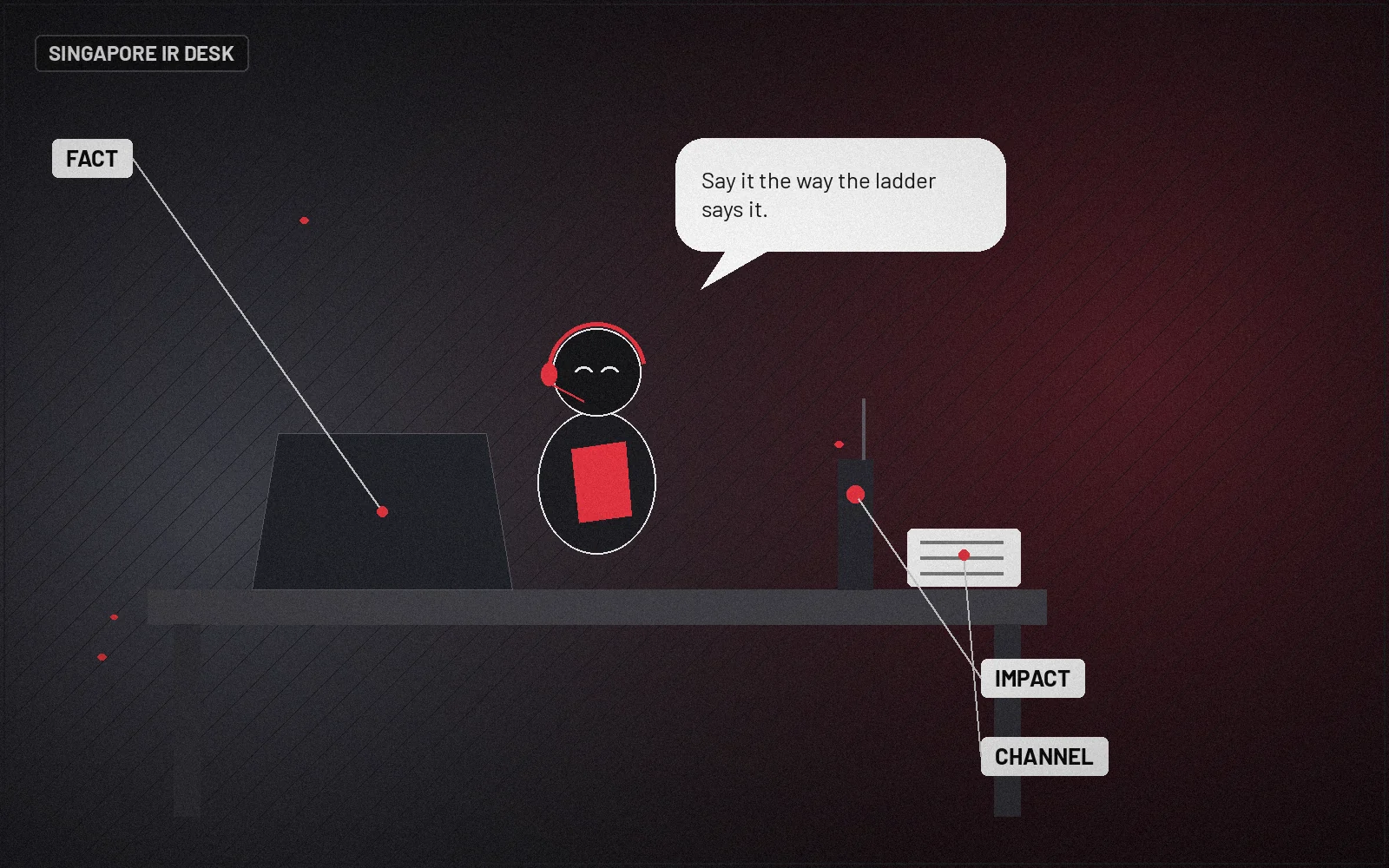
Communications owns the letter ladder, the kill list and one locked fact sentence at the top of every draft. IR owns the SGXNET mirror and the holder note: private Q&A after a material announcement must not invent numbers absent from the filing. Regulatory affairs maps which authority is already in the story; for POFMA nights use POFMA Directions: What Corporate Comms Should Prepare the Night Before, and for PDPA breach narrative keep PDPA breach communications Singapore beside the customer letter. Legal / company secretary owns materiality and halt requests. Jakarta / Manila desks may draft customer or partner letters for Singapore-affected users, but they use the Singapore fact sentence unchanged.
Monday field kit: the letter-ladder drill
Run this every Monday with IR, communications, legal and one business owner (45 minutes). Lock one fact sentence of ≤30 words that counsel would put on a public record. Fill the ladder for investors, employees, customers and partners, and strike any row that would send a material fact before the public channel. Read the six kill lines out loud and replace any matching phrase from last month's drafts. Write a next-update clock each audience can keep; if two audiences disagree on the same fact's clock, align them. If the fact sentence changes twice in one drill, you are still investigating.
Who this is for / who should skip
For you if you lead corporate affairs, public affairs, communications, IR or regulatory work in Singapore and you clear letters when a regulator, exchange or statutory body is already part of the story.
Skip if you need a legal opinion on whether a specific fact is material under Rule 703, whether a breach is notifiable under the PDPA, or how to answer an SGX RegCo query. Those questions go to counsel with the listing rules and the PDPC guide in hand. This article is about the letters you send after that call is made.
What to do next
Print the stakeholder letter ladder. Fill one row for investors, employees, customers and partners for a scenario your desk actually fears. Lock one fact sentence with counsel. Run the Monday drill once. Any letter that opens with a slogan, claims "no material impact" without a disclosure decision, or briefs a private audience ahead of the public record goes back for a rewrite before it leaves the building.
For Singapore crisis and issues support when the regulatory story is already live, start with our Singapore crisis and issues communications team or go straight to contact. For retainer scoping before the next midnight call, see Crisis Retainers in Singapore: What "24/7" Should Mean in the SOW.
FAQs
What should an investor letter say when a Singapore regulatory story hits?
Open with the fact that will appear on the public record, state the known impact and what is still under assessment, name the next step with a time you can keep, and point to the channel (usually SGXNET for listed issuers). Do not lead with seriousness slogans or early "no material impact" claims.
Can we brief major shareholders privately before an SGXNET announcement?
Not with material information. Appendix 7A expects public disclosure of material information via SGXNET. Selective disclosure to favoured holders is the failure the policy is written to prevent. Private notes after the announcement may mirror the filing; they must not add new material facts.
How do PDPA breach notices fit with investor communications?
If the breach is notifiable, the PDPC path runs on its own clock. If the same facts are material for the market, SGXNET and the investor letter must stay consistent with the customer notice on the shared fact, while each channel carries the next steps its audience needs.
Who signs off the first stakeholder letter?
Counsel and the company secretary on materiality; IR on investor wording; communications on employee, customer and partner wording; the DPO where personal data content is involved. One shared fact sentence sits above all of them.
What stops conflicting letters fastest?
Lock the fact sentence, fill the ladder, apply the kill list, then send in channel order. Any draft that fails fact–impact–next–channel does not go out.