
Product recall communications in Singapore work when they do three things in a fixed order. They name the exact product and batch so a customer can check a pack in ten seconds. They tell every buyer one clear action: stop using it, return it, get a refund. And they close the loop, with recovered quantities and a completion report that matches what you told the regulator. Everything else, including the apology, the brand line and the reassurance, comes after those three.
This guide is for corporate affairs, communications, regulatory and quality leads at importers, brand owners, distributors and retailers in Singapore who have to speak when a product comes off the shelf. It covers sequence, notices and who speaks for whom. Testing, root-cause analysis and legal strategy sit with your quality team and counsel. If you already keep an issues register, a recall plan belongs in it: see Issues Management Before the Crisis Call.

Why recalls in Singapore are a communications job from minute one
Singapore imports most of what it eats and uses, so many recalls start somewhere else. The Singapore Food Agency notes that over 90 per cent of the country's food is imported, that 28 food recalls took place in 2022, and that most of them came from SFA's own surveillance and overseas notifications (SFA: Safeguarding Food Safety Through Food Recalls). In practice, the first you hear of a problem is often an email from a supplier or a foreign regulator's alert, late in your day, and a Singapore reporter or customer may already have seen it.
Three regulators cover most consumer recalls, and each one shapes what you say and when.
Food: the Singapore Food Agency (SFA). All importers except shell-egg importers must submit a Food Recall Plan at the first licence renewal and every two years after, and SFA says every food and food-contact trader should have one ready (SFA: renew your import licence). SFA's standard recall procedure covers both voluntary recalls and recalls SFA directs: inform SFA, consolidate the product facts, stop distribution and sale, notify the trade, the public and industry bodies, retrieve and dispose of the product, then report on what you did to prevent a repeat. When SFA directs a recall, it can also test incoming consignments of the product, report findings to overseas authorities and suspend the source from exporting to Singapore, and it issues consumer advisories where needed (SFA). Since 31 October 2025, SFA's Food Businesses Portal has a section for recall and traceability information exchange.
Therapeutic products: the Health Sciences Authority (HSA). The timelines are written down. A critical defect must be reported to HSA within 48 hours, excluding Sundays and public holidays, and a non-critical one within 15 calendar days (HSA: report product defects). You do not need HSA's approval to recall, but you must notify HSA at least 24 hours before the recall starts, meaning before any notice goes to customers or the public. For a Class 1 recall, the Dear Purchaser Letter goes out within one day of the recall starting and the recall is completed within a week. For Class 2, it is three days and three weeks (HSA: recall products).
Household electrical, electronic and gas products, and general consumer goods: the Consumer Product Safety Office (CPSO). CPSO is overseen by the Competition and Consumer Commission of Singapore (CPSO: overview). It runs the Consumer Protection (Safety Requirements) Regulations, which cover 33 categories of "Controlled Goods" that must be registered and carry the SAFETY Mark (CPSO: CPSR overview). Under those regulations, CPSO can require a supplier to recall Controlled Goods and keep it informed of progress, and can take steps to warn users itself (Consumer Protection (Safety Requirements) Regulations). For general consumer goods, the Consumer Goods Safety Requirements Regulations let CPSO declare goods unsafe by public notice in at least four daily newspapers, one each in English, Malay, Chinese and Tamil, and direct suppliers to stop supply and inform users.
The common thread: the regulator sees your facts before the public does, and your public notice will be read beside theirs. That is why the first rule is about precision, not tone.
The one rule: say the batch, say the action, close the loop
Three parts you can brief in five minutes
- 1. Say the batch. Brand, product name, pack size, batch or lot number, expiry or best-before date, and where it was sold. Add a photo of the pack and a second photo showing where the batch code is printed. If a customer cannot check their pack in ten seconds, the notice has failed, however well it is written.
- 2. Say the action. One instruction, in plain words: do not eat it, stop using it, unplug it, return it to any outlet, or call this number. Then the remedy: refund, replacement or repair, with or without a receipt. People act on instructions, not on reassurance.
- 3. Close the loop. Track what was delivered against what came back, by batch and by channel. HSA asks for exactly this in its completion report, a reconciliation of delivered and returned quantities, plus an effectiveness check that customers received, understood and followed the instructions (HSA). Use the same discipline for food and consumer goods even where it is not spelt out. The closing update to staff, trade and media should quote the same numbers you reported.
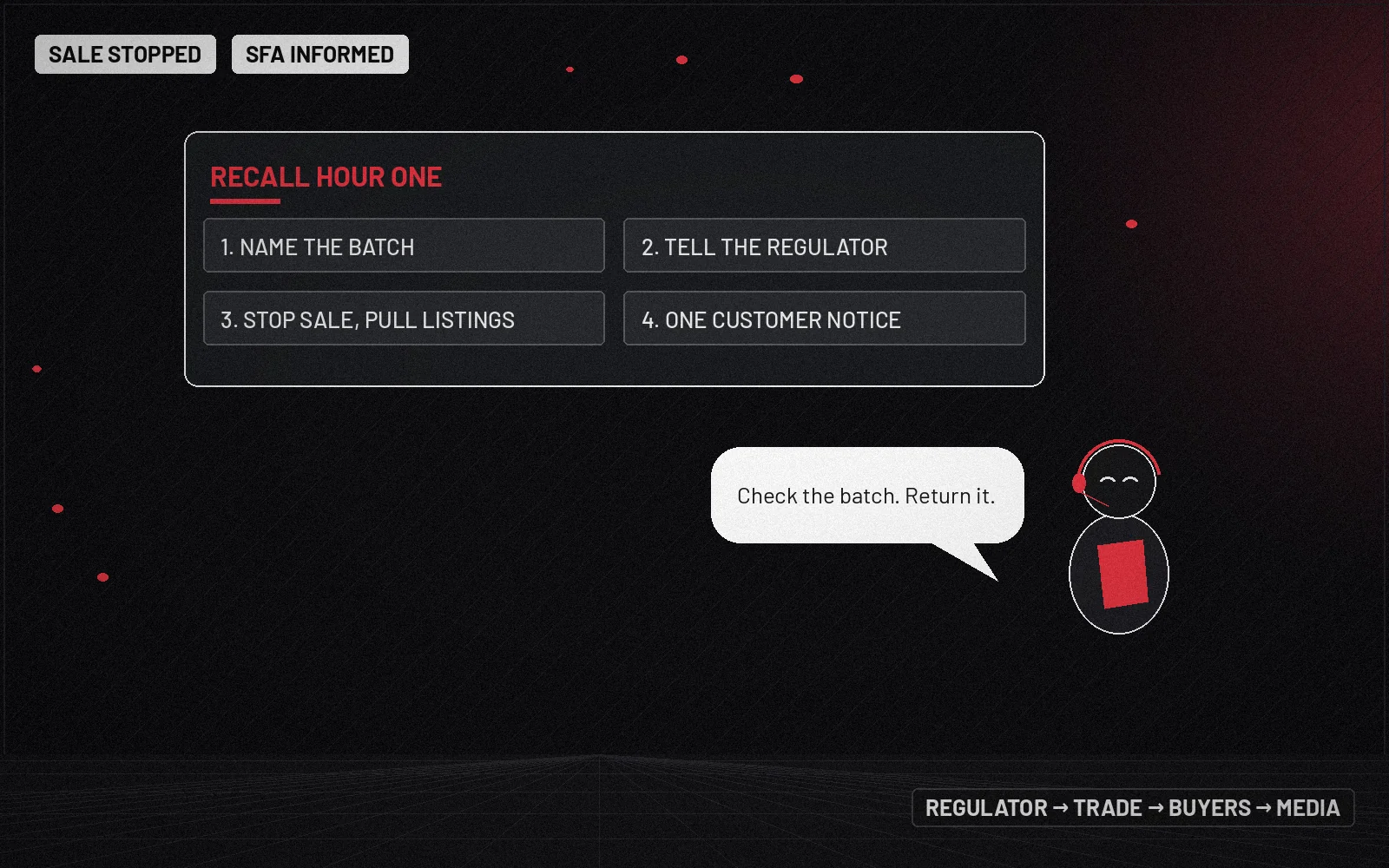
The first 72 hours (original matrix)
Clock times below run from the moment you decide a recall is likely. Adjust them to your regulator's rules; HSA's timings above are fixed, the rest are working targets.
| Window | Audience | What they get | Owner |
|---|---|---|---|
| Hour 0–2 | Regulator (SFA, HSA or CPSO) | Product facts, affected batches, quantities in market, the hazard, your intended action | Regulatory or quality lead |
| Hour 0–2 | Internal: CEO, quality, sales, customer service, legal | One-page fact sheet and the holding line; nobody speaks outside the sheet | Corporate affairs |
| Hour 2–6 | Retailers, distributors, e-commerce sellers | Stop-sale instruction with batch details, shelf-pull and listing-removal request, return route | Sales or trade lead |
| Hour 6–24 | Consumers | Recall notice on your site, retailer shelves and social channels; hotline and refund route live | Corporate affairs and customer service |
| Hour 6–24 | Media | Same notice, a named spokesperson and the hotline; facts only | Corporate affairs |
| Day 2–3 | Regulator, trade, board | First progress update: units recovered by channel, open issues, next update time | Regulatory lead and corporate affairs |
| Close | Regulator, trade, public | Completion report and a short closing note that matches it | Regulatory lead |
For therapeutic products, the regulator row is fixed: HSA hears at least 24 hours before customers do. Build the plan backwards from that.
Who speaks for whom along the supply chain
A recall in Singapore usually involves an overseas manufacturer, a local importer or registrant, distributors and several retailers, including online sellers. Settle in advance who says what.
- The importer or registrant speaks for the product. It holds the batch data, talks to the regulator and issues the recall notice. In a food recall SFA directs, SFA expects the importer to dispose of warehouse stock and work with retailers to clear the market (SFA).
- Retailers speak for their shelves and customers. They confirm the product is off sale and handle returns. Give them your notice text so their wording matches yours.
- Online sellers speak for their listings and buyers. SFA's guidelines for food sold on e-commerce platforms ask sellers to remove the affected listings, post a notice where possible and contact every customer who bought the product (SFA: guidelines for selling food online). That makes online order data your fastest route to individual buyers.
- The overseas parent speaks for the global picture. If the recall is multi-country, agree the Singapore line before the parent's global statement goes out, so local reporters do not find two versions.
If you are a listed company, counsel and the company secretary decide whether the recall is material under SGX Listing Rule 703. Keep the investor line consistent with the consumer notice; see Investor and Stakeholder Communications in Singapore.
The recall notice checklist (original element)
This list follows the fields HSA expects in a Dear Purchaser Letter and the steps in SFA's online-seller guidelines, adapted for any consumer notice. Every item answers a question customers will otherwise phone in.
| # | Field | Test before it goes out |
|---|---|---|
| 1 | Headline with brand, product and the word "recall" | Would a shopper scrolling past know it is about their product? |
| 2 | Photo of the pack and a photo of where the batch code sits | Can they find the code without reading the text? |
| 3 | Batch or lot numbers, expiry or best-before dates, pack sizes | Typed exactly as printed on the pack |
| 4 | Where and when it was sold | Outlets, online stores and date range |
| 5 | What is wrong, in one sentence | States the hazard, no technical jargon |
| 6 | What to do now | One verb first: "Do not eat", "Stop using", "Unplug" |
| 7 | Health line, where relevant | "If you have eaten it and feel unwell, see a doctor" |
| 8 | Remedy and return route | Refund or replacement, receipt needed or not, where to return |
| 9 | Contact | Hotline, hours and email that are staffed when the notice goes live |
| 10 | Languages | English plus Chinese, Malay and Tamil where your buyers need them |
HSA also expects a return response card in the Dear Purchaser Letter, with space for the purchaser's signature and date. That card is how you prove the trade acted. For retail and online buyers, the equivalent is a logged return or refund.
Worked example: an allergen label recall at a snack importer
This is a composite case. A mid-sized Singapore importer brings in cereal bars from an overseas factory and sells them through two supermarket chains, a convenience chain and its own online store. On Thursday at 7pm, the factory emails: one production lot was packed in wrappers that leave out peanut from the allergen statement. Allergen labelling is one of the recall risks SFA asks food companies to manage (SFA).
Thursday, 7pm to 9pm. The quality lead confirms the lot number, best-before date and quantity shipped, and finds 4,800 bars delivered to the four channels. The regulatory lead informs SFA with those facts and the importer's intention to recall at consumer level. Corporate affairs writes a one-page fact sheet and a holding line: "We are recalling one batch of [product], lot [code], because the label does not declare peanut. If you have a peanut allergy, do not eat it. Return it to the store for a full refund."
Thursday, 9pm to midnight. Sales sends stop-sale instructions to each retailer's buyer and store operations contact, with a pack photo and the lot code. The online store pulls the listing and the system lists every buyer of that lot.
Friday morning. The recall notice goes live on the website, the online store and social channels, in English and Chinese. Online buyers get an email and SMS with the same text. The customer service team has a script built from the fact sheet. A reporter calls at 10am and gets the notice, the hotline and a named spokesperson, who says what happened, what customers should do, and that SFA has been informed. She does not speculate about how the wrong wrappers were used.
Saturday. First progress update to SFA and the retailers: 3,950 bars recovered from shelves and stores, 210 returned by customers, the rest under trace. The update for staff and the board uses the same numbers.
Close. When recoveries stop rising, the importer reports to SFA, including the corrective action at the factory, and posts a short closing note. Its numbers match the report.
What made it work: nobody waited for the root cause to name the batch, and every audience got the same facts.
Mistakes we see most often
- Leading with reassurance. "Out of an abundance of caution" before the batch number tells people you care more about the brand than about their pack.
- Vague identifiers. "Selected batches" sends everyone to the hotline. Print every affected code.
- Notices that outrun the regulator. For therapeutic products the order is a rule: HSA at least 24 hours before customers. For food and consumer goods, a regulator who learns of your recall from social media is a bad start.
- Guessing the cause. "A supplier error" on day one becomes a correction on day three. State the defect, not the blame.
- Refunds that require a fight. Asking for a receipt on a $3 snack bar keeps product in homes.
- Silence after the notice. No progress update looks like no progress.
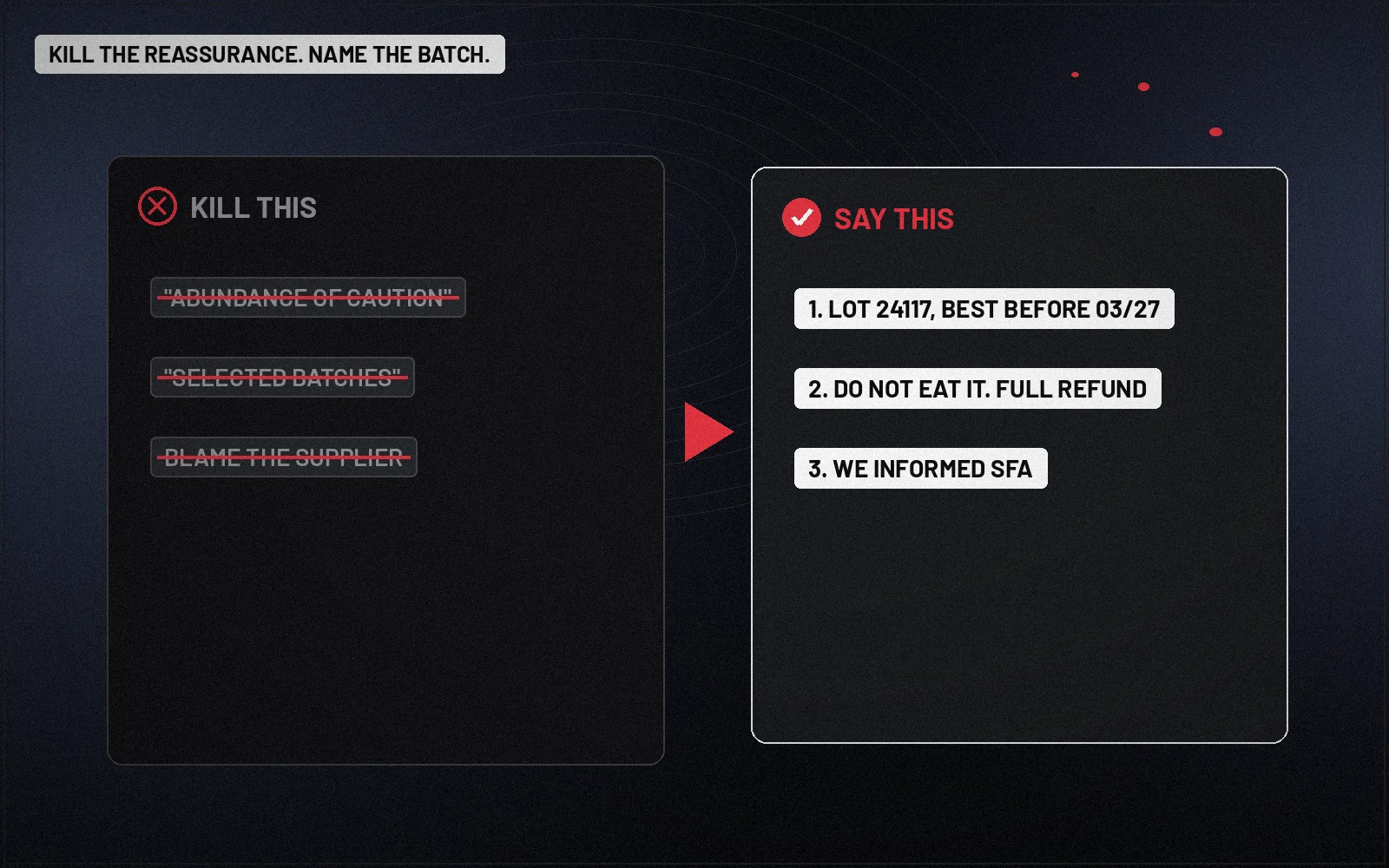
Kill this | Say this (recall statements)
| Kill this | Say this |
|---|---|
| "Out of an abundance of caution" | "We are recalling lot 24117 because the label does not declare peanut." |
| "Selected batches may be affected" | "Lots 24117 and 24118, best before 03/2027, 40g pack." |
| "There is no cause for alarm" | "If you have a peanut allergy, do not eat it." |
| "Please contact us if you have concerns" | "Return it to any store for a full refund. No receipt needed." |
| "A supplier error" | "We have informed SFA and stopped all sales of this product." |
Decision framework: how loud should the recall be?
Match the reach of your communications to the risk and to how far the product has travelled. HSA's recall levels are a useful model even outside health products (HSA).
| Question | If yes | If no |
|---|---|---|
| Could the defect seriously harm someone who uses the product? | Consumer-level recall, public notice, media line ready, hotline staffed | Go to the next question |
| Did the product reach consumers you cannot contact one by one? | Public notice on site, shelves and social channels; consider paid notices | Direct contact with known buyers and the trade |
| Is the product still only with wholesalers or distributors? | Trade-level recall with stop-sale and quarantine; no public notice needed unless the regulator asks | Treat as a retail or consumer recall |
| Has a regulator or overseas authority already published an alert? | Publish your notice the same day so customers find your instructions, not just the alert | Agree the timing with your regulator |
| Is the product sold under your brand in other countries? | Align the Singapore notice with the parent's global statement before release | Singapore line only |
Desk notes: Singapore, regional and board
Singapore desk. Write for the shopper in the aisle: short sentences, the batch code in large type, the instruction first. Translate where your buyers need it; the CGSR's four-language newspaper rule for unsafe-goods notices shows how far a Singapore recall can need to reach. Keep the hotline open at weekends until returns slow.
Regional desk. If the same lot went to other markets, each country's regulator will ask its own questions on its own clock. One master fact sheet, translated, prevents five versions of the defect description.
Board desk. Directors want three numbers: units in market, units recovered, and the date you expect to close. Give them the same figures the regulator gets. For a wider view of how recalls affect reputation over time, see Corporate Reputation Management in Singapore.
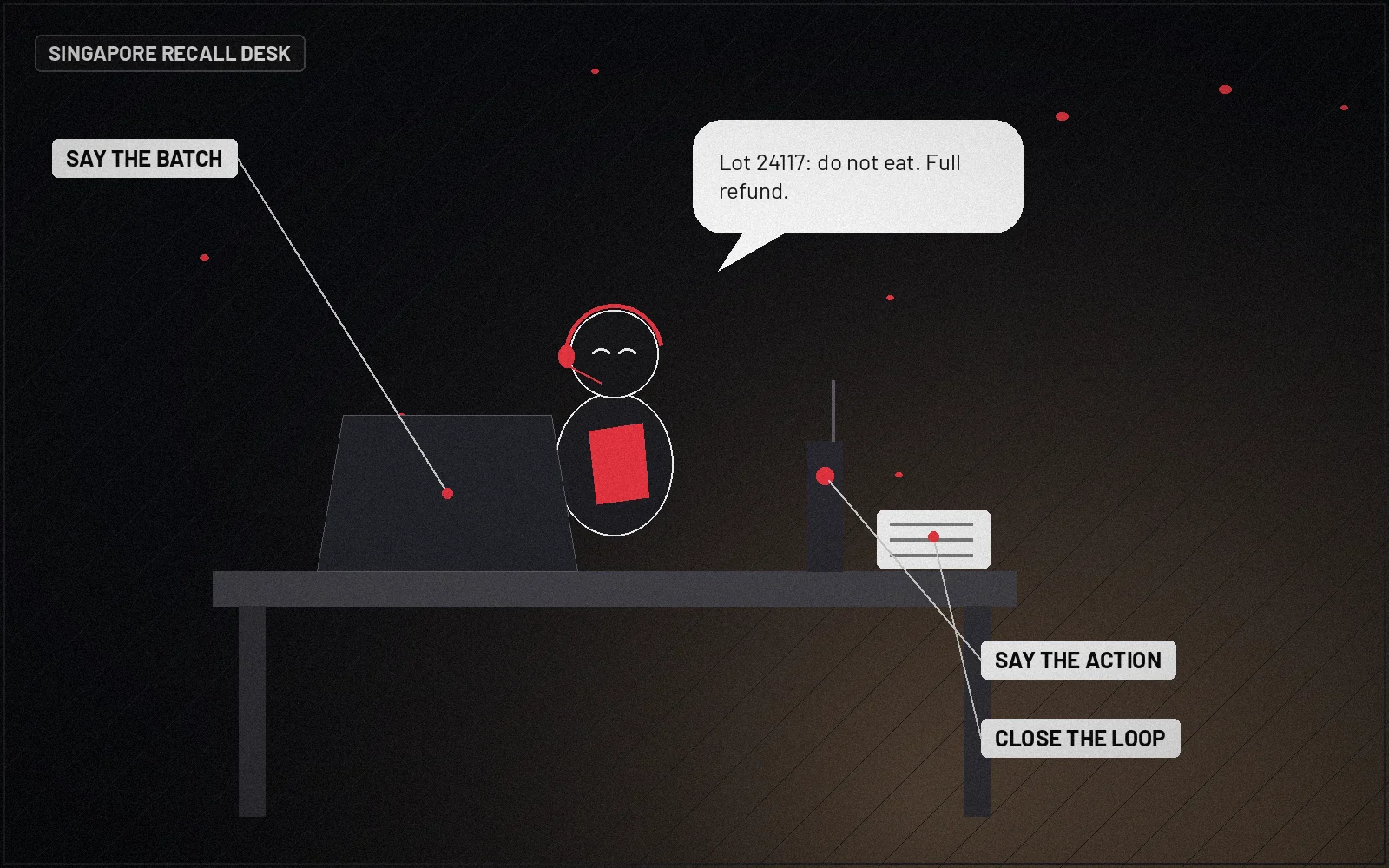
Monday field kit: the recall dry run
Take one live product. Ask your quality lead for its batch codes and where they are printed, ask sales for the list of every outlet and online store that carries it, and time how long it takes to produce a stop-sale email and a consumer notice using the checklist above. Then check that the hotline number on the notice rings somewhere at 9pm on a Friday. Most teams find their gap in the first hour. For a 24/7 back-up arrangement, see Crisis Retainer in Singapore, and for regulator-facing media work, Media Relations in Regulated Sectors.
Who this is for / who should skip
For: corporate affairs, communications and regulatory leads at Singapore importers, brand owners, distributors, retailers and online sellers of food, health products, appliances or general consumer goods.
Skip if: you need the technical recall procedure itself (use SFA's, HSA's or CPSO's own guidance and your quality manual), or your issue is a cyber incident or workplace accident, which have their own playbooks: cyber incident communications and workplace safety incident communications.
What to do next
Pull your recall plan out this week and check it against the three-part rule: can you name the batch, give one action and prove the loop closed? Draft the notice template and the trade stop-sale email now, with blanks only for the batch details. If you want a team to run the dry run with you or stand behind your desk during a live recall, talk to our Singapore crisis and issues communications team or contact us.
FAQs
Do we need the regulator's approval before announcing a recall?
For therapeutic products, HSA's approval is not needed, but HSA must be notified at least 24 hours before the recall starts, excluding Sundays and public holidays. For food, SFA's standard recall procedure starts with informing SFA. For Controlled Goods, CPSO can require a recall and progress reports. In every case, tell the regulator before the public.
Should we say what caused the defect?
Say what the defect is and what customers should do. Leave the cause until your investigation confirms it. HSA, for example, asks for a root-cause investigation and corrective action plan after the initial defect report, not in it.
How many languages should a Singapore recall notice use?
English at minimum, plus the languages your buyers read. Under the Consumer Goods Safety Requirements Regulations, CPSO's public notices declaring goods unsafe go into daily newspapers in English, Malay, Chinese and Tamil, a good benchmark for a product sold widely.
When can we say the recall is finished?
When the regulator has your completion report and the recovered quantities have stopped rising. For therapeutic products, HSA expects a Product Recall Completion Form with a reconciliation of delivered and returned quantities, and a certificate of destruction within three months of completion.
Should we tell the media if the regulator has not published anything?
If consumers have the product and could be harmed, yes. A public notice reaches people a hotline cannot. If the product is still only in the trade, a trade-level recall and a ready media line are usually enough.