
House Appropriations approved the proposed ₱7.2-trillion FY 2027 budget around 14 September 2026. Plenary sponsorship and debates opened 15 September, with a target finish near 25 September and second/third reading early October. That is live appropriations storytelling season: Unprogrammed Appropriations, DepEd gaps, and "scrutinize every centavo" rhetoric after flood-graft accountability weeks. Spreadsheet screenshots will not win the feed. Narrative frames for budget fights will.
Budget season rewards the side that can explain one line item in one human paragraph. Advocacy and civic brands that only post PDF pages lose swing audiences before the vote calendar moves.
Neuwark Communications builds message ladders, frame families, and stakeholder sequencing for budget fights—without slogan spam. Soft path: Services · Contact · About · Insights.
Why the ₱7.2T GAB is a story fight, not a spreadsheet fight
The number is big enough to stun and useless enough to confuse. "₱7.2 trillion" does not tell a parent why classrooms stay short, or why Unprogrammed Appropriations feel like a blank check after graft headlines. Story fights are won by frames that turn line items into human stakes.
Street-smart test: if a swing voter cannot retell your point in one sentence at dinner, you do not have a frame. You have a spreadsheet with a logo.
Flood-graft hangover is a standing constraint. Audiences arrive primed to hear "corruption" in every large number. If your frame ignores that hangover, opponents will supply it for you. If your only answer is more tables, you confirm the stereotype that transparency is paperwork theater.
Frame families: accountability, care, competence, future
Build four frame families and assign every asset to one primary frame. Mixing all four in one post creates mush.
- 1. Accountability — every peso has an owner; Unprogrammed lines need sunlight.
- 2. Care — education, health, and disaster recovery as human outcomes, not department codes.
- 3. Competence — delivery calendars and measurable outputs, not vibes.
- 4. Future — what this budget makes possible for the next cohort of students and workers.
Do:
- Lead with one frame per asset
- Attach one proof block (number + human sentence)
- Keep slogans as labels, not as the argument
- Prepare opposition counters for each frame
Don't:
- Dump the entire GAB PDF into a carousel
- Use "scrutinize every centavo" without naming which centavo
- Invent outrage that you cannot sustain for two weeks
- Copy legacy budget-frame posts without the 2027 facts
Unprogrammed Appropriations and DepEd gaps in human sentences
Unprogrammed Appropriations become a trust problem when audiences hear "money without a clear job." Translate: "These lines can move without the same public debate as the main program—here is what we want locked, dated, and named."
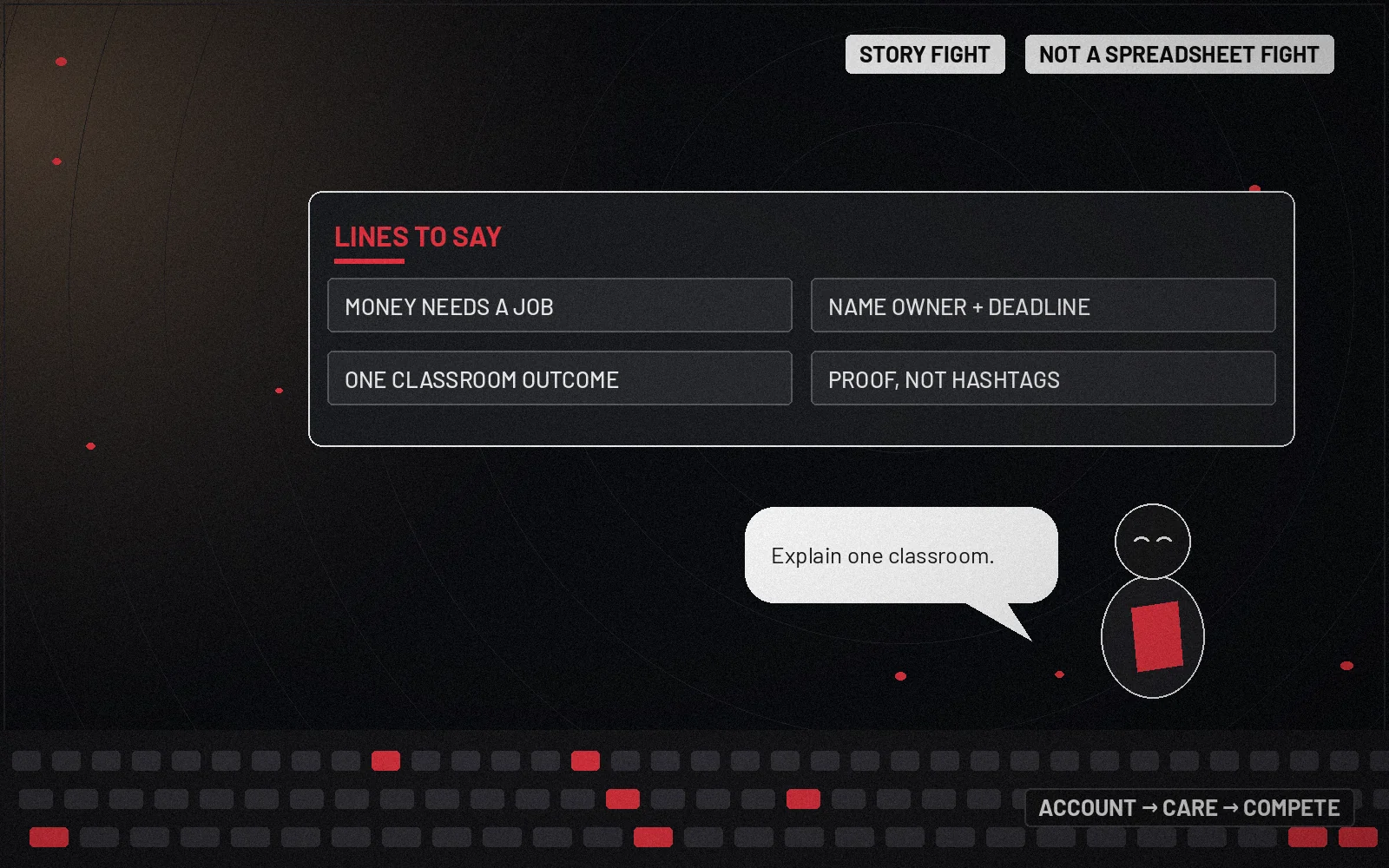
DepEd gaps become a care and competence story: "If classrooms and learning recovery stay short while the headline number grows, the story is not ambition—it is mismatch." One paragraph beats a 40-slide deck.
Practice lines teams can actually say:
- "A large budget that cannot explain one classroom outcome will lose the middle."
- "Unprogrammed does not mean invisible—make the owner and the deadline public."
- "Accountability after flood-graft means proof calendars, not louder hashtags."
Flood-graft hangover as a standing narrative constraint
After accountability weeks, audiences discount rosy infrastructure language. Your budget frames must assume skepticism is the default. That does not mean performative cynicism. It means proof-first messaging: owners, dates, audit paths, and what you will refuse to defend.
Link carefully to fundraising and accountability creative without turning every budget post into a donate ask. See Philippines accountability fundraising for the fundraising lane; keep this page on narrative frames for budget fights.
Stakeholder sequence: base, swing, institutional, media
- 1. Base — sharper accountability language; they already care.
- 2. Swing — care + competence; avoid jargon and faction score-settling.
- 3. Institutional — legislators, agencies, partners; one-pagers with sources.
- 4. Media — human paragraph + one chart max + named expert.
Sequence messages so base energy does not poison swing trust. Base memes that mock "budget literacy" often alienate the exact voters you need for pressure campaigns.
Distinct from legacy budget-fights hub and accountability fundraising
- Legacy narrative frames hub → narrative-frames-for-budget-fights
- Flood-graft fundraising → separate article
- Unpopular policy narrative craft → Singapore ministerial pay narrative
- 2027 GAB plenary frames → this page
Deepen the craft with live ₱7.2T facts. Do not republish the legacy hub under a new slug.
Message ladders that survive plenary week
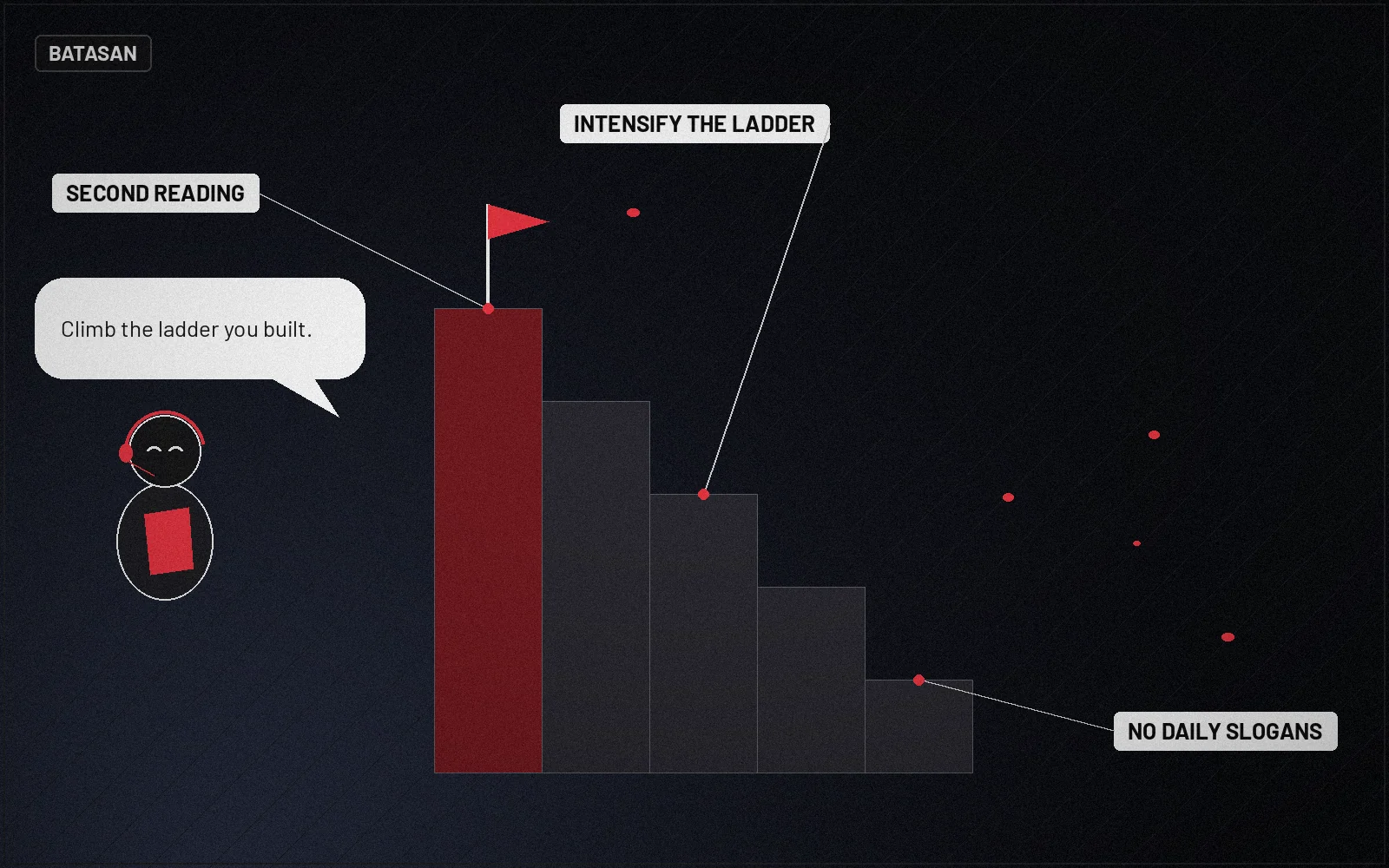
Plenary weeks reward repetition with variation—not twenty unrelated slogans. Build a ladder:
- 1. Core frame sentence — one human paragraph the principal can say cold
- 2. Proof block — one number + one outcome sentence
- 3. Ask — what the audience should do this week (call, share, attend, donate—pick one)
- 4. Counter — the opponent line you expect and the calm reply
Every channel pulls from the ladder. Social shortens it. Earned media expands proof. SMS keeps the ask clean. If channels invent freestyle frames, you lose narrative discipline by Wednesday.
For the ₱7.2T 2027 GAB, assign owners to Unprogrammed Appropriations language and DepEd gap language so two teams do not publish contradictory "centavo" rhetoric. Contradiction is how institutional audiences dismiss you as noise.
Visual systems: charts that do not become wallpaper
Advocacy charts fail when they try to show the entire budget. Show one comparison the eye can finish in three seconds: gap vs headline growth, programmed vs unprogrammed share, or classroom outcome vs spend story. Then write the human paragraph under it. The paragraph is the product; the chart is the prop.
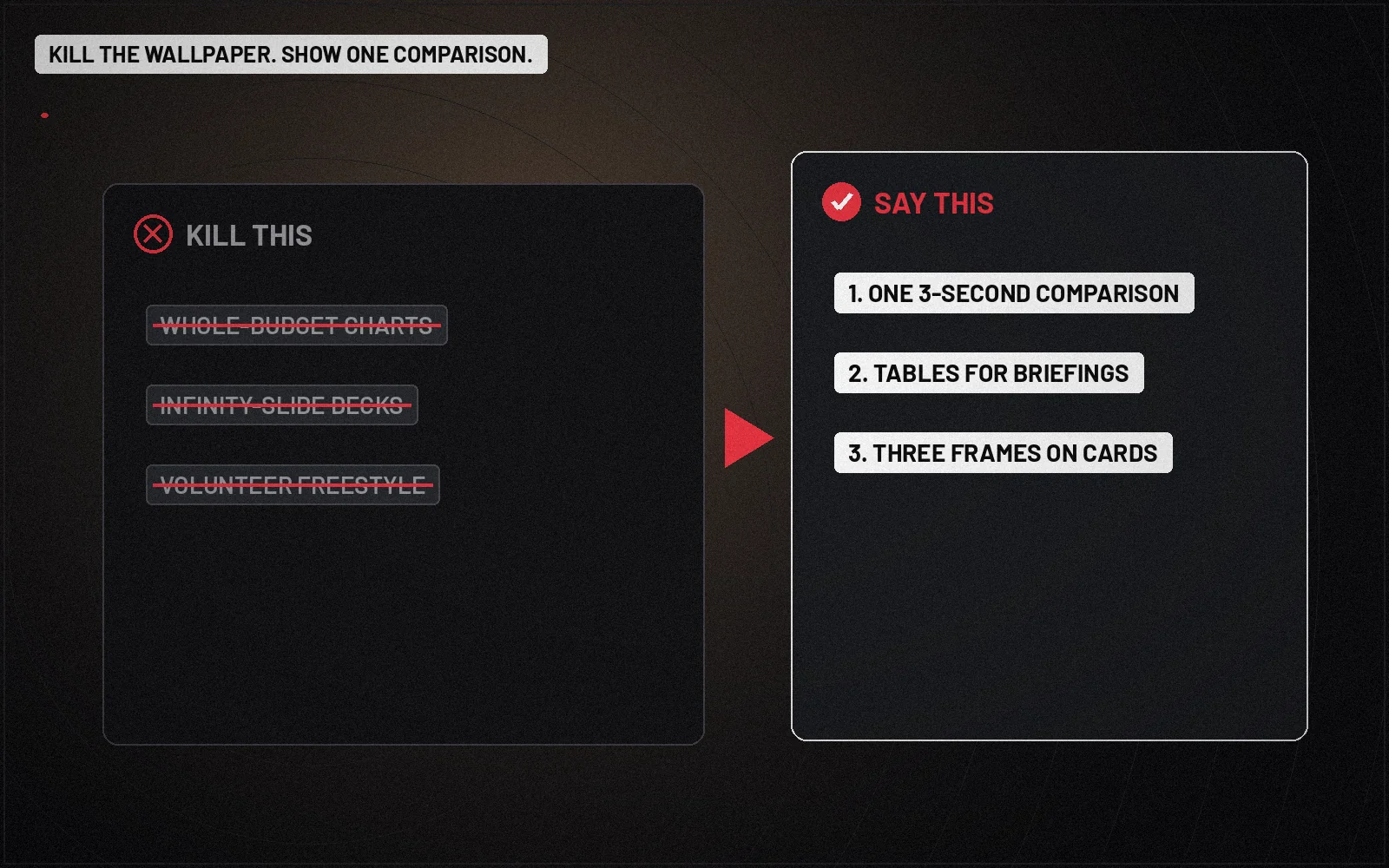
Ban decorative infinity-slide decks for public channels. Save deep tables for institutional briefings. Public channels need retellable frames. That is the entire job of narrative frames for budget fights.
Field and volunteer kits should include three approved frames on paper cards. Volunteers inventing budget takes on Facebook Lives will create cleanup work you cannot afford during plenary.
Opposition and media: play the long week, not the clip
Budget fights are week-long narratives. Optimizing only for one viral clip creates a hangover when the clip is clipped against you. Pre-clear what you will not say even if it would trend. Refusal lists are part of framing discipline—same craft as rapid-response calendars, applied to appropriations storytelling.
Media desks want a named expert, a human paragraph, and a single chart. Give them that package daily during debate windows. Flooding inboxes with full GAB PDFs trains desks to ignore you.
After flood-graft weeks, expect accountability questions on every infrastructure line. Answer with owners and dates. Performative outrage without a proof path burns credibility with swing audiences who already feel exhausted.
From frames to retainers
Agencies that only sell "content calendars" lose budget season. Sell frame systems: ladder, proof blocks, stakeholder sequence, and weekly refresh while plenary runs. That is advocacy PA clients renew. Soft CTA follows once the operating picture is clear.
Townhall and short-form: same frames, different breath
Townhalls need longer care and competence breath. Short-form needs the core frame sentence and one proof. Do not invent a third frame family for Reels. Fragmentation is how swing audiences hear five campaigns instead of one budget fight.
Principals should rehearse the human paragraph aloud. If they cannot say it without looking at a slide, the frame is not ready. Budget fights are oral before they are graphical.
Coalition partners need lockup rules for shared frames. If six logos appear above six different budget takes, media will cover the conflict inside the coalition—not the GAB. Align frames before the joint presser.
Closing the week without slogan spam
When second and third reading approach, resist inventing new slogans daily. Intensify the ladder you already built. Freshness comes from new proof blocks and timely counters—not from a new hashtag every morning. That discipline is what separates narrative frames for budget fights from content churn.
Internal alignment before external volume
Before you scale public frames, align finance, policy, and communications on which Unprogrammed lines you will highlight and which DepEd gaps you can defend with sources. External volume without internal alignment creates gotcha interviews. Budget fights are lost in gotchas as often as they are won in slogans.
Keep a shared source folder: DBM materials, House committee updates, and your approved human paragraphs. When plenary moves fast, the folder is the difference between a calm desk and freestyle inventiveness.
Donor and member communications during GAB week
Members and mid-tier donors will ask what the ₱7.2T fight means for your program. Answer with the same frame ladder—do not invent a donor-only dialect that contradicts public lines. Stewardship notes can add program proof; they should not invent a fifth frame family.
If you fundraise on accountability during budget week, separate the donate ask from the appropriations frame in the same asset when possible. Combined assets need extra screenshot gates so opponents cannot claim you are monetizing every plenary clip. Discipline here protects both narrative and revenue.
Soft CTA: budget-fight narrative / advocacy PA engagement
If your budget week still ships unread PDFs, you need narrative frames for budget fights—message ladders, not slogan spam. Neuwark builds advocacy PA for appropriations storytelling that swing audiences can retell.