

High-profile flood-control graft accountability continued into September 2026—including the arrest of former House Speaker Martin Romualdez around 8 September on plunder allegations tied to flood projects. Filipinos are watching. Progressive and civic organizations feel the surge of attention. The money question is crude and real: can you convert outrage into gifts without burning donors when the ask gets forwarded in a group chat?
Accountability advocacy fundraising Philippines is not the same job as a flood crisis 72-hour playbook. Crisis content saves people and clarifies ops. Fundraising content earns trust-safe revenue. Mix them carelessly and you get panic blasts that feel extractive by lunchtime.
Neuwark Communications builds advocacy fundraising ops and mid-tier stewardship—not panic ads. Accountability news is a window only if your ask survives the screenshot.
Accountability news vs crisis playbook: different money job
Flood crisis communications answer: Are people safe? What do we need in 72 hours? Who is coordinating?
Accountability fundraising answers: What are we funding? What proof do donors get? How does this gift change the next month of advocacy—not the next hour of adrenaline?
If your fundraising email reads like a disaster siren, you trained donors to expect emergencies forever. Mid-tier donors—the ones who stabilize payroll—hate that pattern.
Keep the existing flood crisis Insights piece in its lane. This article is about trust-safe revenue when accountability dominates the news cycle.
Trust-safe asks: screenshot survival as the creative brief
In the Philippines, the forward is the distribution channel. If your ask cannot survive a group chat without looking reckless, do not send it.
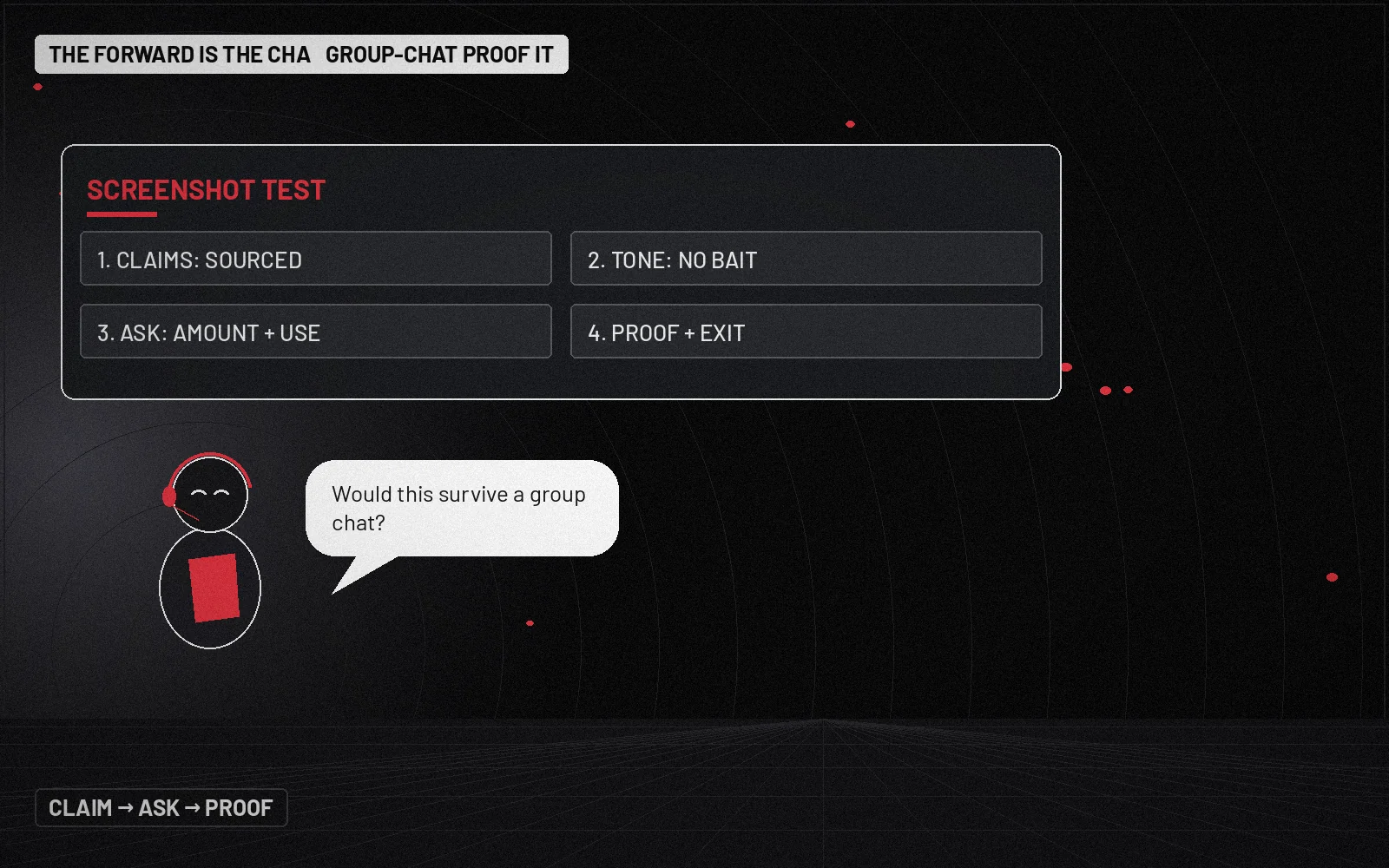
Screenshot test before you hit send:
- Claims — Sourced, dated, not vibes
- Tone — Anger without dehumanizing bait
- Ask — Specific amount ranges and use of funds
- Proof — What you already delivered; what this gift funds next
- Exit — How to unsubscribe or ask questions without shame
If a hostile page can crop your email into an opportunists meme, rewrite.
Proof discipline: what donors need before they forward
Outrage opens the door. Proof keeps the donor in the room.
Give them:
- A one-paragraph what-we-fund line that a non-activist auntie understands
- A recent deliverable such as a report, hearing attendance, community clinic, or legal aid hours—not a slogan
- A named stewardship contact for mid-tier gifts
- A promise of a report-back date—and then keep it
Donors who feel used during accountability seasons do not return for the quiet months when you actually need them.
Mid-tier window: convert outrage into second gifts, not one blasts
The cheap play is a blast with a giant red button. The money play is mid-tier stewardship: welcome, proof, second ask in 21 to 45 days, human follow-up for gift bands that actually fund staff.
Use accountability heat to:
- Reactivate lapsed mid-tier donors with proof, not guilt
- Offer a concrete project line such as transparency monitoring, civic education, or community flood preparedness advocacy—not a vague fight-the-bad-people slogan
- Route major interest to a call, not another form
See related mid-tier stewardship and trust-safe creative thinking in Insights, and fund the operating system via services under Public Affairs and Advocacy and Research and Audience Insights.
Channel rules: SMS, email, social without panic theater
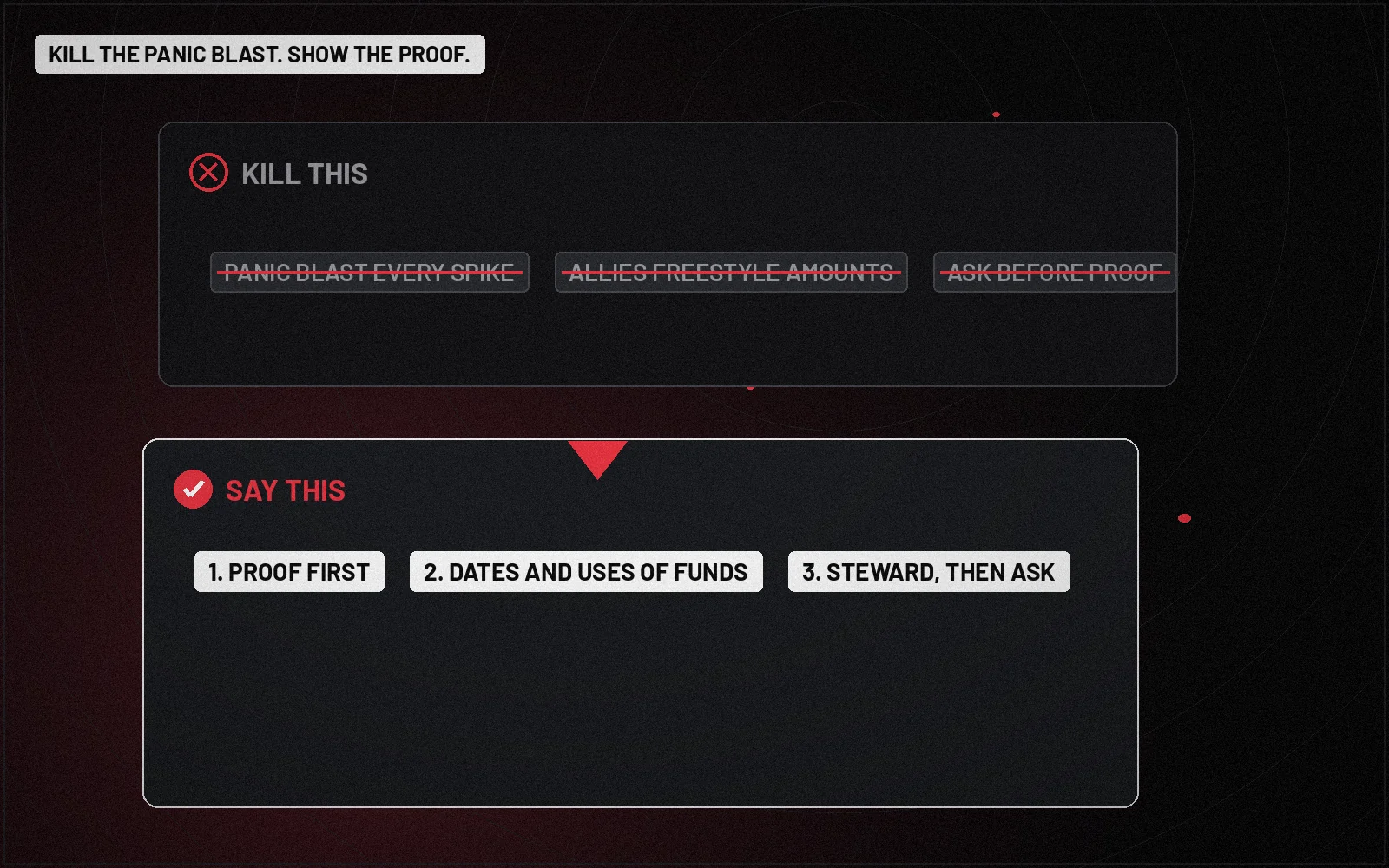
Do this
- Proof first, ask second
- Quiet urgency with dates and uses of funds
- Stewardship before the next blast
- Align spokespeople so every ally is not freestyling amounts
Not this
- Panic blast every news spike
- Unsourced claims that collapse under one fact-check
- Guilt spirals and dehumanizing bait
- Copying flood crisis 72-hour content into donation emails
SMS should respect quiet hours and consent. Social should avoid unverified allegations dressed as fundraising copy. Email should assume the screenshot.
What not to copy from flood crisis 72-hour content
Do not lift evacuation language, unverified casualty claims, or operational hotlines into donation asks. Do not imply that a mid-tier gift replaces government accountability work overnight. Do not use grief aesthetics to mask a weak program case.
Crisis content and fundraising content can share values. They should not share the same paragraphs.
Soft CTA: advocacy fundraising ops + stewardship retainer
Neuwark builds advocacy fundraising ops and mid-tier stewardship for Philippine progressive and civic organizations—asks that convert accountability attention into revenue without burning trust. If your current plan is blast harder, contact us or start with About.
FAQ
Is it ethical to fundraise off arrests and graft news? It is ethical if you fund real work, tell the truth, and steward donors. It is extractive if you sell rage without a program.
Should we name every official in every ask? Only with sourced, careful language legal has cleared. Fundraising is a terrible place for speculative allegations.
What is the fastest trust win this month? A screenshot-safe ask with proof, a mid-tier thank-you path, and a scheduled report-back. Boring. Bankable.
Accountability news is a fundraising window only if your ask survives the group chat forward. Build accountability advocacy fundraising Philippines systems for the season—not just the spike.
Operator appendix: thirty-day readiness sprint
Use the next thirty days as a communications build, not a brainstorm spiral.
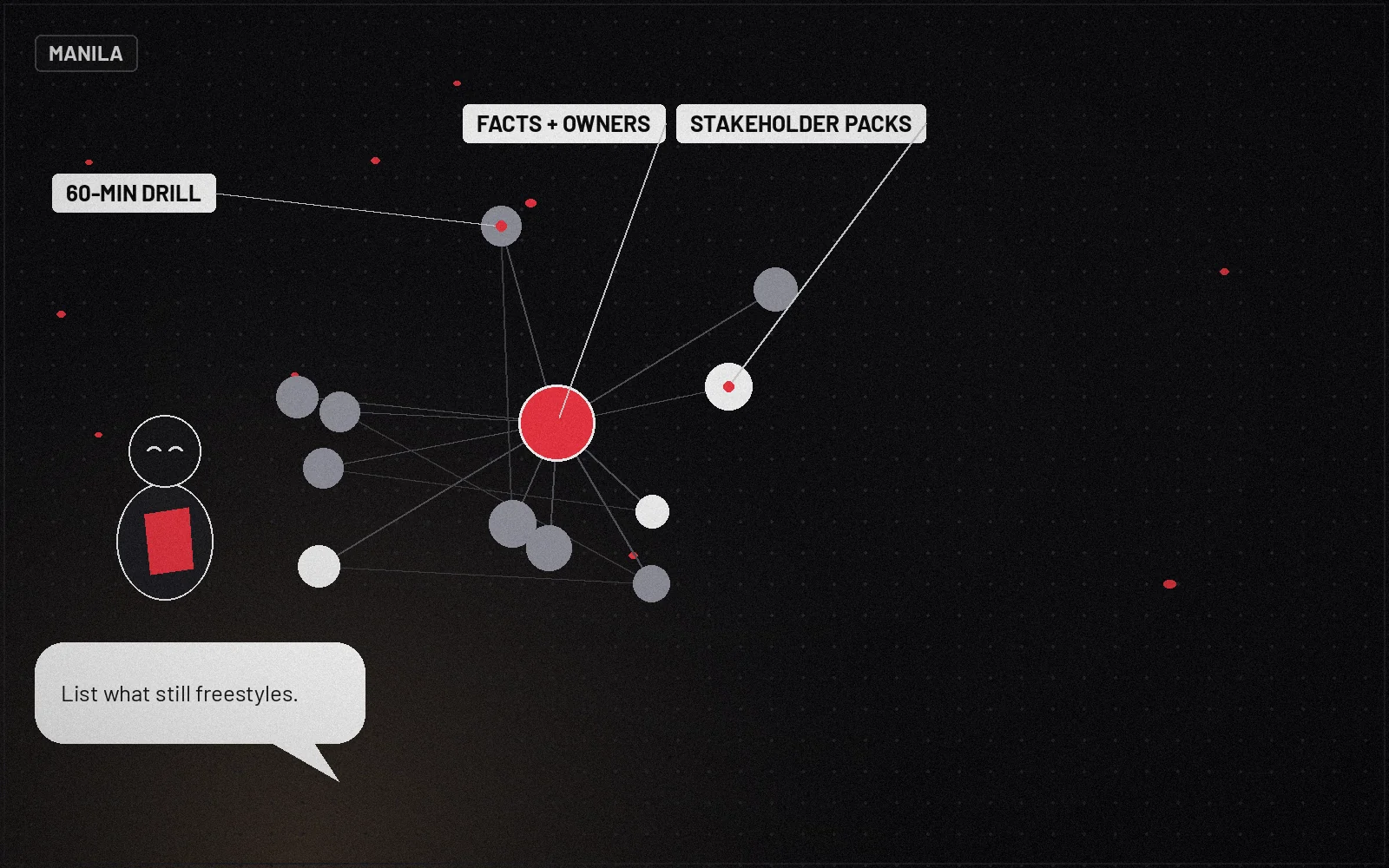
Week 1 — Facts and owners. Lock the legal and compliance facts you can stand behind in public. Name one decision owner and one backup for external lines. Put both names in a channel description, not a forgotten email thread that dies when someone goes on leave.
Week 2 — Stakeholder packs. Write three one-pagers: partners or workforce, customers or buyers, and leadership or investors. Same facts, different jobs to be done. Version-stamp each page so call centers and distributors are not inventing a fourth story at midnight.
Week 3 — Channel kit. Ship the trade or consumer FAQ, the retailer or seller note, social holding lines, and a kill list for creative that will age badly under the news cycle. Brief agencies and in-house creators in the same meeting so freestyle dies early and stays dead.
Week 4 — Tabletop. Run a sixty-minute drill: a hostile headline, a confused staff question, and a buyer or donor email arrive the same morning. Who answers first? What stays internal? What updates by end of day? Record the gaps without blame, then close them.
Close the sprint by listing what legal, operations, and brand still freestyle under pressure. Those gaps are exactly what a public-affairs, crisis, or fundraising retainer is for. Boring drills protect revenue and trust when the news cycle refuses to stay boring.
Regional teams should also map which legal entity owns which sentence. A headquarters note that contradicts a local site plan creates two truths—and staff always find both. Align entity-level owners, keep a shared glossary for operational phrases, and store the latest approved lines where managers actually look on a phone at seven in the morning.
Finally, schedule a thirty-minute retro after the first real news spike. What line worked? What rumor outran you? What proof was missing? Fold the answers into the next version of the pack before the calendar moves on without you.
Operator appendix: thirty-day readiness sprint
Use the next thirty days as a communications build, not a brainstorm spiral.
Week 1 — Facts and owners. Lock the legal and compliance facts you can stand behind in public. Name one decision owner and one backup for external lines. Put both names in a channel description, not a forgotten email thread that dies when someone goes on leave.
Week 2 — Stakeholder packs. Write three one-pagers: partners or workforce, customers or buyers, and leadership or investors. Same facts, different jobs to be done. Version-stamp each page so call centers and distributors are not inventing a fourth story at midnight.
Week 3 — Channel kit. Ship the trade or consumer FAQ, the retailer or seller note, social holding lines, and a kill list for creative that will age badly under the news cycle. Brief agencies and in-house creators in the same meeting so freestyle dies early and stays dead.
Week 4 — Tabletop. Run a sixty-minute drill: a hostile headline, a confused staff question, and a buyer or donor email arrive the same morning. Who answers first? What stays internal? What updates by end of day? Record the gaps without blame, then close them.
Close the sprint by listing what legal, operations, and brand still freestyle under pressure. Those gaps are exactly what a public-affairs, crisis, or fundraising retainer is for. Boring drills protect revenue and trust when the news cycle refuses to stay boring.
Regional teams should also map which legal entity owns which sentence. A headquarters note that contradicts a local site plan creates two truths—and staff always find both. Align entity-level owners, keep a shared glossary for operational phrases, and store the latest approved lines where managers actually look on a phone at seven in the morning.
Finally, schedule a thirty-minute retro after the first real news spike. What line worked? What rumor outran you? What proof was missing? Fold the answers into the next version of the pack before the calendar moves on without you.