
Budget fights are not won by the side with the densest table. They are won by the side that makes the table feel like someone’s life.
Progressive campaigns often walk into appropriations season with righteous numbers and no frame. Opponents walk in with a simple story—“waste,” “discipline,” “too much, too soon”—and suddenly your spreadsheet sounds like a hobby.
Neuwark Communications builds political narrative systems where money talk becomes public meaning. This piece is evergreen operator craft for budget and appropriations fights in the Philippines and across APAC—not a live hearing recap.
Why numbers alone lose
Most voters do not budget like accountants. They budget like households: rent, food, fare, school, medicine, contingency for the next flood or layoff.
When you speak only in billions, you invite the other side to translate for you. They will translate unkindly.
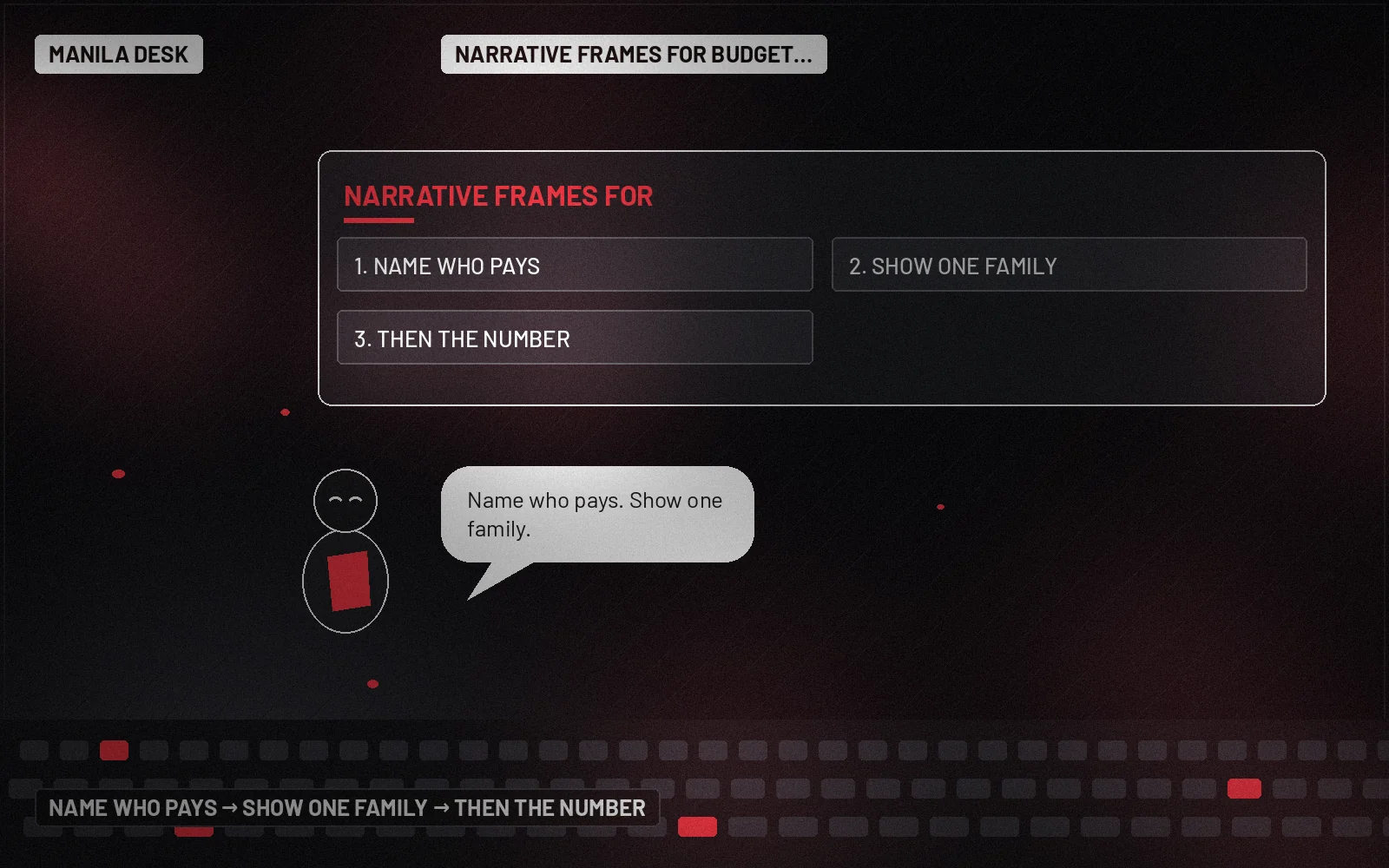
A working frame does three jobs:
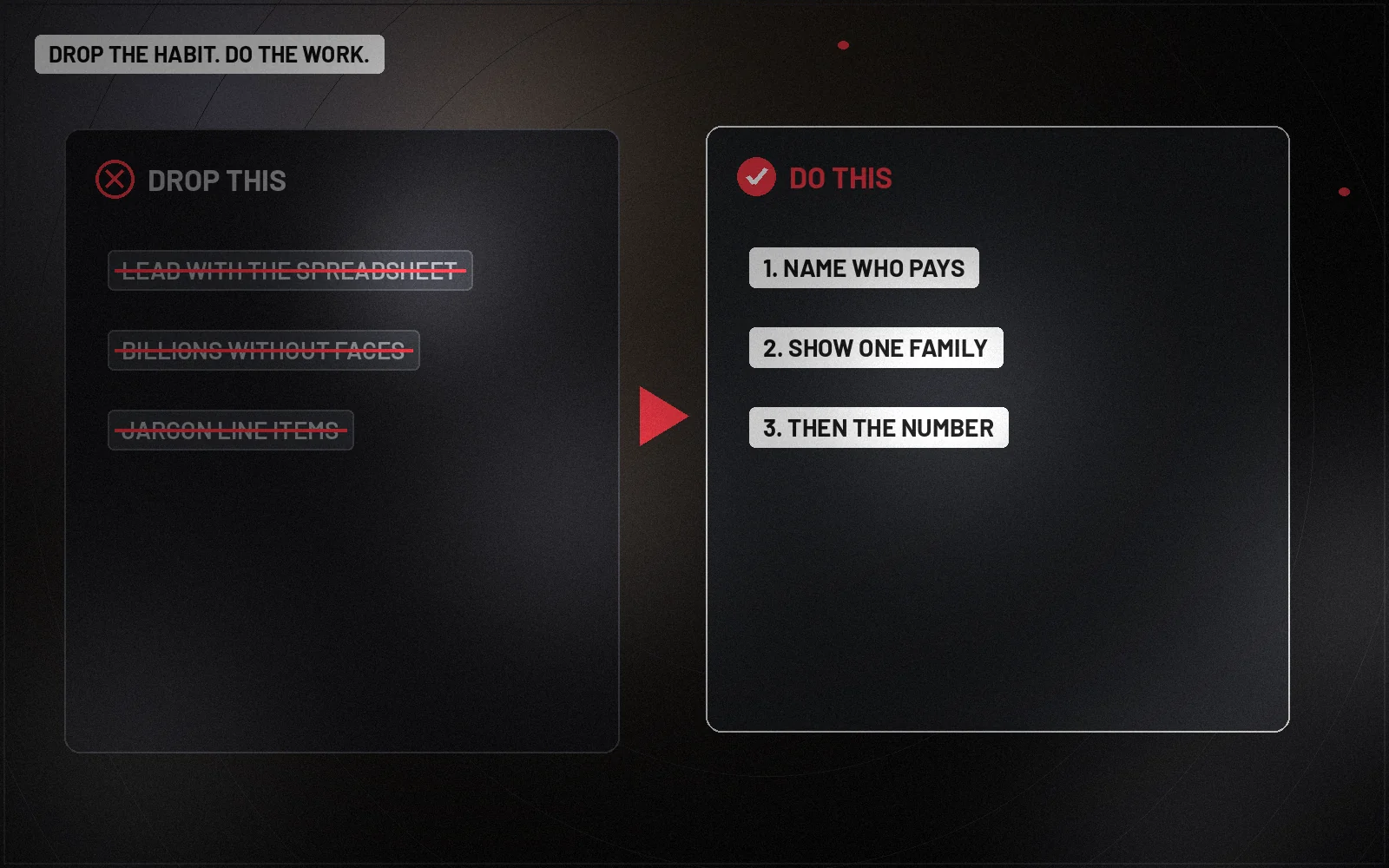
- Names who benefits and who pays
- Explains what breaks if the choice goes wrong
- Offers a next step people can repeat without a briefing binder
The trap of technocrat progressive voice
Precision matters. Sounding like a Ministry PDF does not. You can be accurate and still human. Lead with the lived consequence, then show the line item that causes it.
Four frames that travel in budget fights
Pick a primary frame per fight. Mixing all four in one press release makes you sound undecided.
Frame 1 — Fairness (who gets helped first)
Core claim: public money should reduce hardship for people who already carry the most risk.
Proof types:
- Who currently pays informal costs (fare spikes, private tutors, clinic fees)
- Distribution tables explained in household terms
- Geographic equity without turning regions into villains
Watch-out: fairness language collapses if your coalition looks captured by a narrow interest with no public story.
Frame 2 — Competence (can they deliver)
Core claim: the issue is not “big vs small government.” It is whether the state can execute without leakage.
Proof types:
- Delivery timelines and past completion rates
- Procurement and audit mechanisms you will actually use
- Named managers or units accountable for output
Watch-out: competence frames require receipts. Aspiration without a delivery sketch becomes slogan.
Frame 3 — Future (investment vs deferral)
Core claim: cutting this line looks thrifty today and expensive tomorrow—flood damage, skill gaps, health debt, climate exposure.
Proof types:
- Cost of inaction in local terms
- Multi-year comparison people can feel
- Youth and workforce angles that are not cringe lectures
Watch-out: “future” can sound elite if today’s kitchen-table pain is ignored. Pair with a near-term relief bridge.
Frame 4 — Capture (who the budget is really for)
Core claim: the fight is not austerity theater; it is whether funds are steered to patrons, contractors, or the public.
Proof types:
- Pattern of allocations vs need maps
- Conflict disclosures and revolving-door notes (verified)
- Oversight asks that are concrete
Watch-out: capture frames without ethics in your own oppo and fundraising will boomerang. See our oppo ethics discipline—same mirror test.
Building a message ladder that survives vernacular
National English talking points often die in the first barangay meeting. Build the ladder on purpose.
Rung 1 — Kitchen sentence (10 seconds)
“This budget chooses medicine over another delayed project that floods our street twice a year.”
Rung 2 — Barangay proof (30 seconds)
One local fact, one name-safe story, one number.
Rung 3 — City / district contrast (60 seconds)
What neighboring areas got; what you were promised; what the hearing changes.
Rung 4 — National frame (press / digital)
Policy mechanism + fairness/competence/future/capture primary frame + ask (call, attend, share testimony).
Rung 5 — Expert annex
For journalists and allies: methodology, tables, legal notes. Link it. Do not lead with it on TikTok.
Translate rungs carefully. A Tagalog or Cebuano kitchen sentence that changes the policy meaning is not localization—it is a new (wrong) campaign.
Hearing days, social days, field days
Budget communications is a calendar sport.
Before hearings
- Lock primary frame and do-not-say list
- Prep three clips: human impact, mechanism, ask
- Brief surrogates with the ladder, not the full binder
During hearings
- Clip criteria ready (what counts as usable)
- Rapid fact card for misquotes
- Partner channel for same-hour amplification
After hearings
- Same-night explainers in vernacular
- Field cards for weekend canvass
- Donor note that connects money fight to program delivery—not just outrage
If your digital team posts “We are outraged” without a frame and ask, you spent attention on vibes.
Operator checklist before the hearing clip drops
- Primary frame chosen (one)
- Kitchen sentence approved in priority languages
- Three proof points with dates/sources
- Opponent’s likely frame pre-rebutted in one line each
- Visual system: charts readable on mobile; no microscopic tables as images
- Clip owners named (cutter, poster, field liaison)
- Coalition partners have the packet before the rumor mill does
- Ask is singular for the next 48 hours
Visual rules for budget creative
- One idea per graphic
- Annotate the one number that matters
- Avoid rainbow explosion dashboards
- Put household translation in the caption, not only in the fine print
People screenshot. Write for the screenshot.
Failure modes progressive budget teams repeat
Moral thunder without a mechanism. Anger mobilizes the already convinced. Persuasion needs “how this works.”
Letting opponents own “fiscal responsibility.” Responsibility can mean preventing future damage. Say so.
Internal wonk wars on public channels. Disputes about line items belong in caucus, not in dueling threads that confuse your base.
No local validators. A Manila presser does not automatically convince a provincial household paying fare increases.
Forgetting implementation season. Winning a line item and disappearing is how cynicism grows. Plan the delivery narrative when you plan the fight.
Metrics worth reviewing weekly in season
- Share of voice on your primary frame vs opponent frame
- Clip completion / save rates on explainers
- Field objection log: which budget myths appear at doors
- Partner message fidelity (are they still on the kitchen sentence?)
- Donor and member conversion on the singular ask
If objections shift and your creative does not, you are decorating, not fighting.
PH + APAC context without the crisis cosplay
Appropriations calendars, disaster spending, education and health lines, and infrastructure leakage debates recur across election cycles. Treat them as standing narrative infrastructure. Build frame libraries, validator lists, and chart templates before the week turns hot.
APAC audiences often juggle bilingual media diets. Keep meaning stable across languages. “Discipline” in one tongue can mean cruelty in another if your examples only punish the poor.
Sample kitchen sentences you can adapt (not copy blindly)
Fairness: “This line keeps clinic hours open so a night-shift parent does not lose a day’s wage for a morning queue.”
Competence: “We are not asking for a bigger rumor. We are asking for a budget with named owners and dated deliveries.”
Future: “Skipping drainage maintenance is not savings. It is a bill that arrives as floodwater.”
Capture: “Follow the allocation pattern. Need maps one way; patronage maps another.”
Rewrite with local nouns. A sentence that could fit any country fits no voter.
Debate and interview discipline during budget weeks
Candidates and spokespeople get pulled into line-item trivia. Bring them back to frame.
Technique:
1. Answer the number briefly if you have it 2. Name the frame in plain language 3. Give one household consequence 4. Return to the ask
If you only duel trivia, the audience remembers heat, not meaning. If you only sermonize, they assume you cannot do math. Hold both.
Charts that do not insult the audience
- Label axes in words humans use
- Show the comparison that matters (this year vs last; district vs district; promised vs delivered)
- Avoid 3D effects and ornamental icons
- Put the takeaway in the title of the graphic, not a separate essay
A chart without a takeaway title is decoration.
Donor and member communications in money season
Donors hear budget fights as either soap opera or spreadsheet. Give them a third option: program risk.
Explain what program stalls if the line fails. Explain what oversight you support if the line passes. Ask for a concrete help action—testimony bank, validator intro, share of kitchen sentence—not only cash. Mid-tier donors especially want agency, not just a receipt.
What Neuwark builds for money fights
We design narrative frames, message ladders, and content systems so budget politics reads as public life—not elite paperwork. Progressive campaigns deserve numbers that travel with dignity and force.
Closing move
Choose a frame. Write the kitchen sentence. Prove it locally. Clip it the same day. Ask for one action.
The spreadsheet is evidence. The frame is how evidence becomes power.
Neuwark Communications works political and advocacy communications across the Philippines and APAC—including budget-season narrative systems. If your money fight still sounds like a PDF, start a conversation →