
As House plenary debates on the ₱7.2-trillion 2027 General Appropriations Bill ran through mid-to-late September 2026, search demand spiked on budget, DepEd, Unprogrammed Appropriations, and flood-control follow-the-money queries. Most advocacy orgs still send that intent to a homepage hero or a PDF nobody finishes. That is not a media problem. That is a money leak.
Paid search landing pages advocacy means the ad promise and the first screen agree. If the ad says “budget transparency” and the landing page says “About Us,” you bought a bounce. Neuwark Communications builds intent-matched LPs, proof blocks, and donate/lead sinks that turn appropriations-week searches into pipeline—not vanity CTR. Soft path: Services · Contact. Distinct from the legacy hub paid search advocacy landing pages and from the budget-frames piece budget fight narrative frames PH 2027 GAB.
Budget-week intent vs homepage dump: the money leak
Budget week is when citizens, journalists, and mid-tier donors type exact phrases into Google: “2027 GAB Unprogrammed Appropriations,” “DepEd budget gap,” “flood control follow the money.” Paid search captures that curiosity. Homepages punish it.
A homepage is a museum lobby. It tries to explain the whole organization before it answers the query that brought someone in. SEM waste shows up as high CTR, short sessions, and “we’re getting awareness.” Awareness without a next step is a story you tell yourself when the invoice arrives.
Intent-matched LPs do three jobs in the first scroll: restate the query in human language, prove one claim with one piece of evidence, and offer one clear ask (donate, lead, petition, or briefing). Everything else is decoration. Decoration is fine after conversion architecture exists. Teams that reverse the order—brand film first, ask later—pay for cinema and get exits.
In the Philippines, budget season also collides with monsoon recovery narratives and accountability fatigue. Searchers arrive skeptical. Your LP has about eight seconds to prove you are not another slideshow. That is why proof sits above the fold and why “About Us” never belongs as the first H1 on a paid destination. Progressive brands that treat SEM as a branding toy burn cash; brands that treat it as a money page build lists and gifts while plenary is still live.
Query clusters: GAB, DepEd, Unprogrammed Appropriations, flood follow-money
Build clusters, not one mega-page. Budget season rewards specificity.
Cluster A — GAB / plenary. Queries about what is in the 2027 budget, House appropriations debate timing, and when plenary finishes. LP angle: plain-language explainer plus how your org tracks votes or line items. Cite PhilStar plenary coverage or DBM fiscal notes by date so the page feels live, not evergreen wallpaper.
Cluster B — DepEd / education gaps. Searchers want numbers they can forward to a group chat. LP angle: one chart or one paragraph on the gap, plus a volunteer or petition sink. Avoid turning education into abstract “invest in the future” copy with no peso figure.
Cluster C — Unprogrammed Appropriations. Technical phrase, political heat. LP angle: definition in one human paragraph, why it matters for accountability, soft CTA to a briefing list. This is where spreadsheet-only posts fail and human sentences win.
Cluster D — Flood / infrastructure follow-money. Post-graft hangover still shapes trust. LP angle: process transparency without conspiracy tone. Link to Philippines accountability fundraising only when the ask is fundraising-adjacent; otherwise keep the LP educational and conversion-clear.
Map each cluster to a unique H1, unique proof block, and unique UTM. If four ads share one homepage, you cannot learn which intent paid. Cluster discipline is how small SEM budgets punch above weight in APAC advocacy. When media buyers insist on “one efficient URL,” show them the bounce rate. Efficiency without match is just cheaper waste.
LP modules: proof, ask, FAQ, quiet compliance
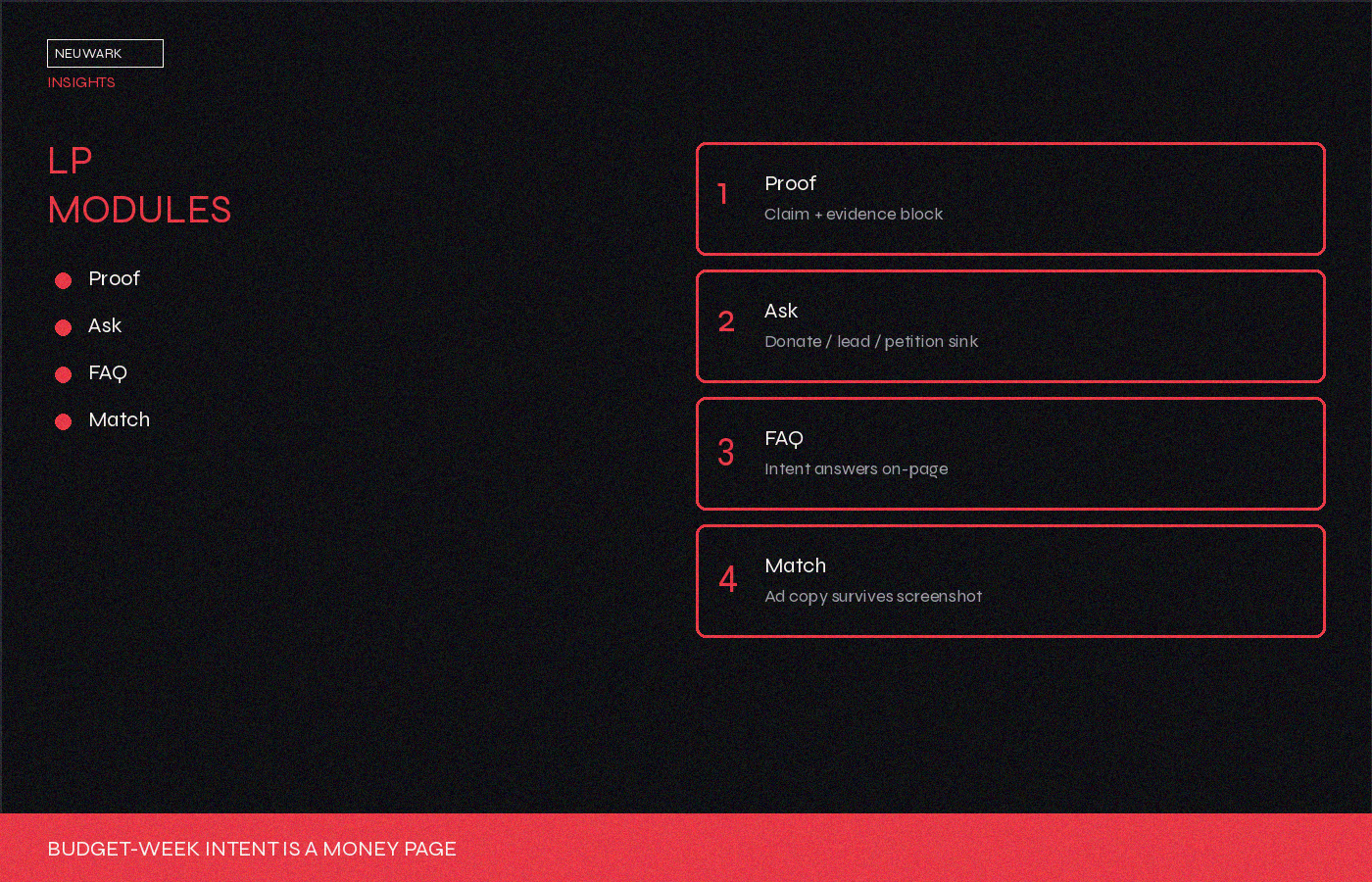
Ship modules, not mood boards.
Proof module. Claim plus evidence above the fold. Evidence can be a DBM figure, a PhilStar plenary cite, or your own tracked line item—named and dated. Screenshots of spreadsheets without a sentence fail the forward test. People forward paragraphs, not unexplained tables.
Ask module. One primary CTA. Donate, join briefing list, download tracker, or book a partner call. Secondary links go below. Two equal buttons fight each other and both lose. Put the ask after proof, not before—trust first, then conversion.
FAQ module. Three to five questions that match People Also Ask style language. This also feeds GEO work in our GEO FAQ campaign SEO play. Do not duplicate that article’s job here; leave a cite-ready FAQ strip on the LP so searchers who scrolled past the H1 still get answers without bouncing to a PDF.
Quiet compliance. No invented statistics. No “guaranteed” outcomes. No implied government endorsement. If you cite flood-control controversies, stay process-first. Quiet compliance protects SEM accounts and brand trust the same week. For policy-sensitive categories, clear the claim ladder with counsel before you scale spend. A landing page that converts illegally is not a win—it is a future crisis memo.
Ad↔LP message match that survives a screenshot
Run the screenshot test before you unlock budget:
- 1. Crop the ad creative and the LP H1 into one image.
- 2. Ask a colleague who did not write either: “Do these belong together?”
- 3. If they hesitate, rewrite until the answer is boringly yes.
Message match is not synonym stuffing. It is promise continuity. “Follow Unprogrammed Appropriations in plain language” on the ad needs the same phrase—or a clear equivalent—in the first 100 words of the LP. When the match breaks, Quality Score and trust both drop. Platform algorithms punish mismatch; humans punish it faster in group chats.
For progressive brands in PH, SG, and MY, also match tone: street-smart, not lecture. Budget fights already feel dense. Your LP should feel like a sharp briefing, not a syllabus. If a high-school senior cannot restate your H1 after one read, the message is not ready for paid. Translate jargon once, then keep the translated version everywhere—ads, LP, email follow-up—so the journey never reintroduces fog.
Also match the ask. An ad that says “sign the petition” should not land on a donate-only page. An ad that says “get the tracker” should not bury the download under a newsletter modal. Continuity of ask is continuity of respect.
Measurement: qualified lead, not vanity CTR
CTR is a thermometer, not a business. Define success before launch:
- Qualified lead: email or WhatsApp opt-in with intent tag (briefing, volunteer, or donor)
- Donate start: click-to-payment without bounce in under 30 seconds
- Partner inquiry: form with org name and role filled
- Content depth: scroll to proof plus FAQ (proves they stayed for substance)
Kill rules matter. If an ad drives cheap clicks but zero qualified actions after a fair spend threshold, pause it. If an LP converts but creative fatigues, refresh creative—not the whole URL. Tie this discipline to paid media ops in algorithm shock retainer playbook when platforms wobble mid-flight.
Report weekly, not quarterly. Budget week moves too fast for a post-mortem after plenary ends. A Monday scorecard with qualified leads by cluster beats a Q4 deck that says “we were in market.” Share the scorecard with finance and program leads so SEM is not treated as a branding toy. When leadership sees cost per qualified briefing signup next to cost per homepage bounce, the homepage dump argument usually ends.
Add one more operational habit: label every session with the cluster UTM and the creative ID. Without that join key, you will argue about “search worked” while nobody can say which promise paid. Paid search landing pages advocacy is a measurement craft as much as a copy craft.
Distinct from the legacy paid-search hub and budget-frames article
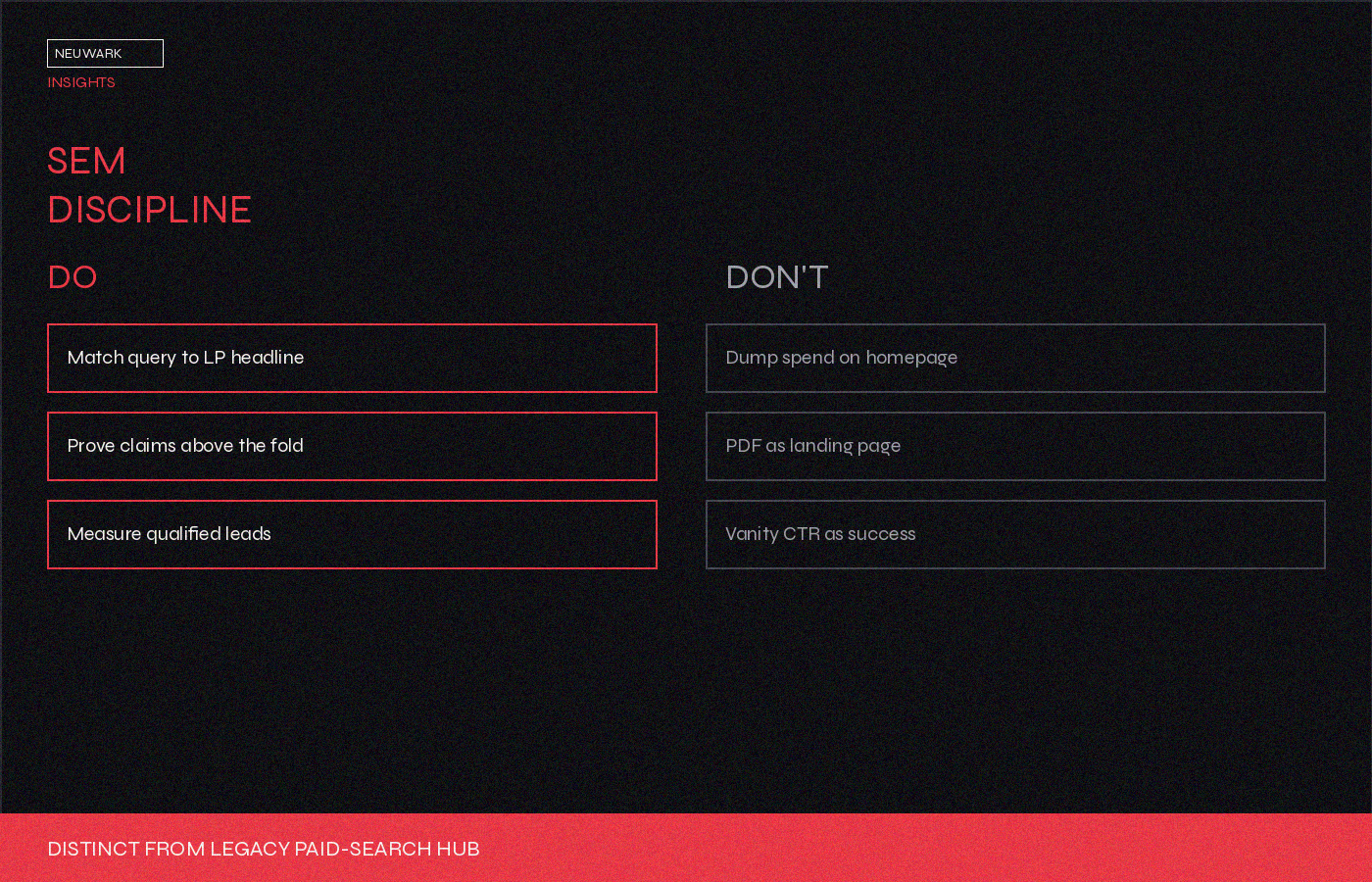
This piece is the budget-week intent → money page system: query clusters, LP modules, screenshot match, qualified-lead measurement. It is not a rewrite of the evergreen paid search advocacy landing pages hub, and it is not the narrative-frames story in budget fight narrative frames PH 2027 GAB. Frames win the story. LPs convert the searcher who already typed the story into Google. You need both. Browse more playbooks on the Insights hub. Credibility on About.
Do: match query to LP headline; prove claims above the fold; measure qualified leads; keep compliance quiet and dated; build one URL per cluster. Don’t: dump spend on the homepage; use a PDF as the landing page; treat vanity CTR as success; invent numbers to “win” the week; force four intents onto one template.
Soft CTA: paid search advocacy LP engagement
If your September SEM invoice bought homepage bounces during GAB plenary week, you do not need “more creative.” You need paid search landing pages advocacy that match intent, prove one claim, and convert one ask. Neuwark Communications designs those pages, wires measurement, and keeps compliance quiet enough for board review.
Start with one cluster—pick Unprogrammed Appropriations or DepEd. Ship one LP. Run the screenshot test. Measure qualified leads for seven days. Then scale. Soft path: Services · Contact · Insights.