
Paid search does not fail because Google is unfair. It fails because you sent a person who typed a precise question to a homepage that still thinks it is a brochure.
Advocacy teams across the Philippines and APAC buy keywords for housing, wages, climate bills, and reproductive health—then drop traffic on a page built for brand storytelling. Bounce looks like “the audience is not ready.” Usually the page was not ready.
Neuwark Communications treats landing pages as intent infrastructure. The ad promised an answer. The page must deliver that answer before it asks for a signature, a volunteer shift, or a gift.
Why advocacy paid search dies on the wrong page
Searchers are not scrolling your About story. They arrive with a job to do.
When query and page disagree, three things happen fast:
- Trust snaps — they assume the campaign is bait-and-switch, even if the policy is solid.
- Quality score tanks — platforms punish mismatch; CPCs rise while conversions fall.
- Field teams inherit confusion — people who did convert show up expecting the promise in the ad, not the vague ask on the homepage.
Progressive campaigns often over-invest in creative and under-invest in message match. The creative team wins the auction. The page loses the person.
Intent is not a persona worksheet
Forget fluffy personas for a minute. Classify the click by job:
- Learn — “what is the bill,” “how does the program work,” “who qualifies.”
- Compare — “who voted how,” “what opponents claim,” “cost vs benefit.”
- Act — “sign,” “attend,” “donate,” “volunteer near me.”
One URL cannot serve all three at peak quality. If budget is thin, build one page per primary job and keep secondary jobs as short modules—not competing heroes.
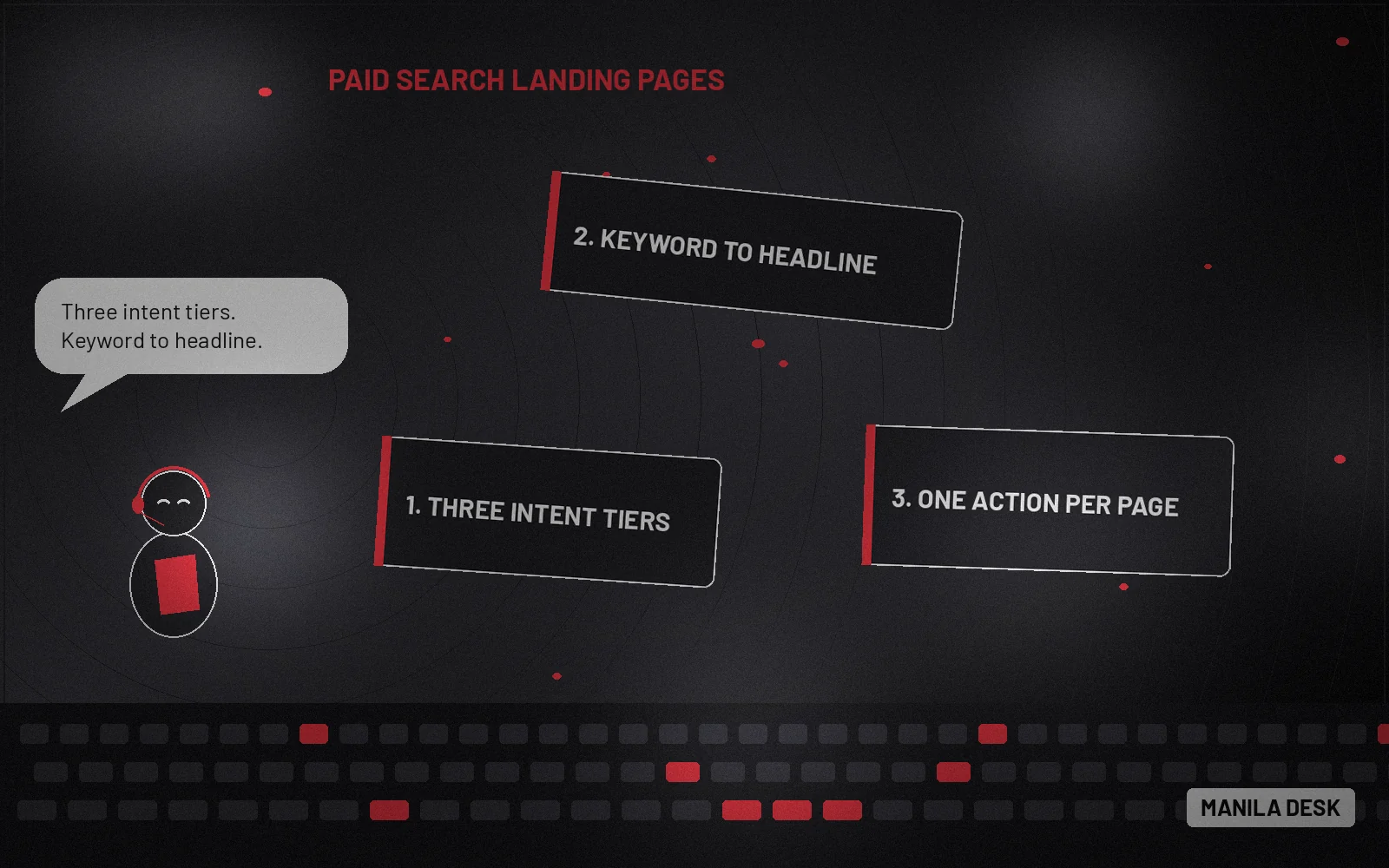
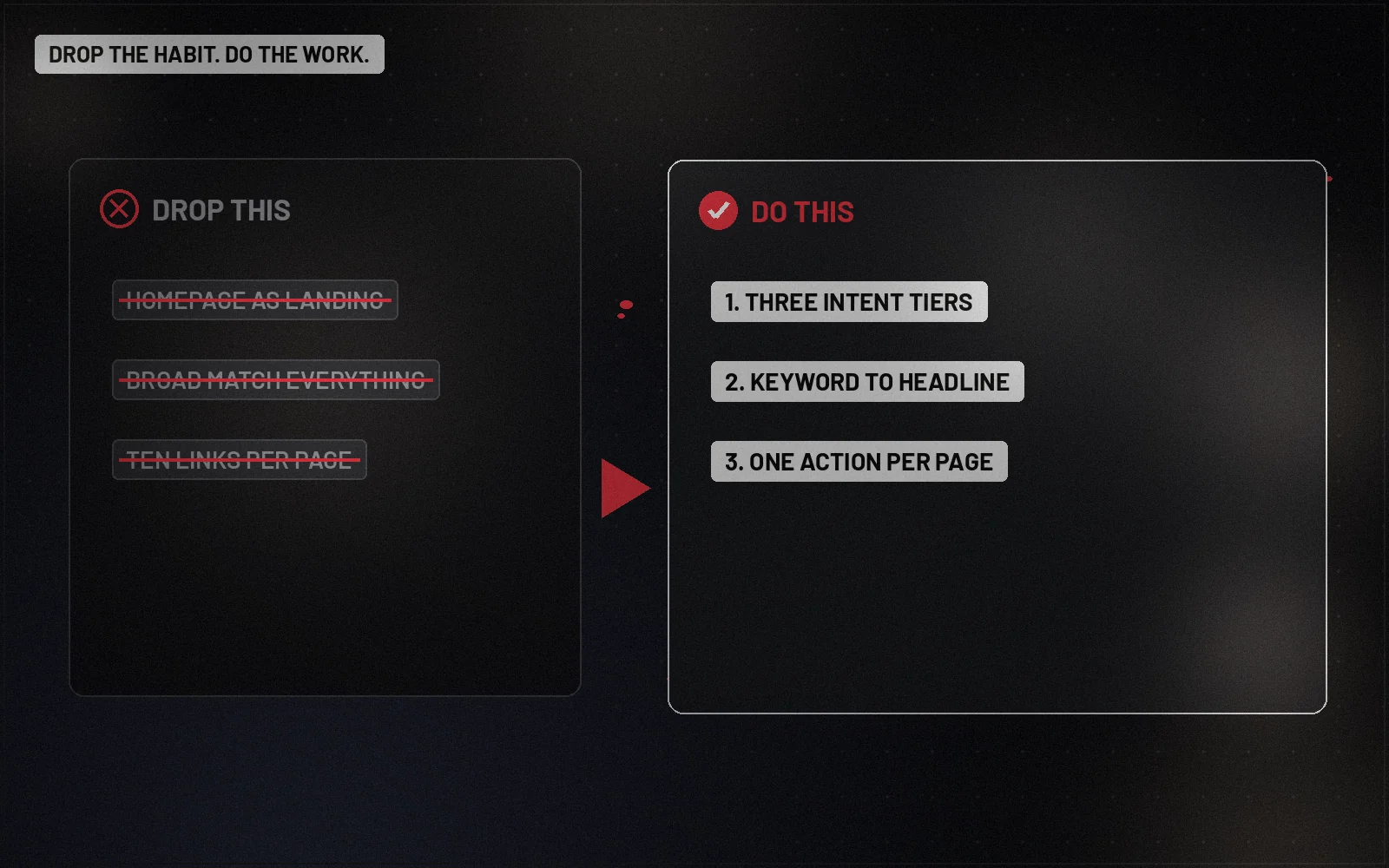
The three intent tiers that keep spend honest
Tier 1 — Learn pages (education without condescension)
Headline mirrors the query language. First screen answers the question in plain Tagalog or English—whichever the keyword set used.
Structure that works:
- One-sentence definition
- Why it matters this week (local proof, not slogans)
- Three bullets a high school student can repeat
- FAQ block that captures long-tail questions search engines and AI overviews love
- Soft act: “Get the one-pager” or “See the timeline”
Do not open with a candidate photo collage. Learn intent wants clarity first, affiliation second.
Tier 2 — Compare pages (respect the skepticism)
Compare intent is where progressive campaigns get nervous—and where they should get sharper.
People typing oppositional or “is it true that…” queries are not automatically hostile. Many are deciding. Give them:
- A fair restatement of the opposing claim
- Your counter with sources and dates
- A “what this means for your barangay / city” bridge
- A single primary ask after the argument lands
If you refuse to acknowledge the opposing frame, the searcher will finish the comparison elsewhere—often on a page that hates you.
Tier 3 — Act pages (one ask, zero fog)
Act pages are ruthlessly short above the fold:
- Promise from the ad, repeated
- Proof you are real (org, coalition, past wins, compliance note)
- Form or button with minimal fields
- What happens after submit (SMS, email, call window)
Every extra paragraph between the ad promise and the form is a tax on conversion.
Message-match stack: from keyword to form
Run this stack before you unlock budget.
1) Keyword clusters map to page jobs
Group keywords by language and intent, not by internal org chart. “Sahod” and “minimum wage hike” may need different proof modules even if policy is one bill.
2) Ad copy borrows the page H1
If the ad says “See how the housing bill protects renters,” the H1 cannot say “Join the movement.” Say the housing line. Put the movement line lower—or on a different page.
3) Proof blocks match the fear in the query
Fear of cost → cost table or myth-bust. Fear of corruption → oversight mechanism. Fear of irrelevance → local named impact.
4) Form fields match the next human action
If SMS organizers will follow up, take a mobile number with consent language. If the next step is an event RSVP, take barangay or city—not a 12-field donor CRM dump.
5) Speed and prepaid reality
Many PH and APAC users arrive on mid-range phones and uneven data. Compress images. Skip autoplay video above the fold. Make the form usable on a cracked screen in a jeepney.
GEO and SEO: write pages engines can quote
Advocacy paid search and organic discovery now share a problem: answer engines paraphrase you. If your page is slogans, the paraphrase will be slogans. If your page has crisp definitions and dated facts, you earn citations.
Build a GEO-friendly module on every learn/compare page:
- H2 phrased as a question people actually type
- 40–60 word direct answer under it
- Bullets with specifics (numbers, dates, jurisdictions)
- One outbound link to a primary source when you cite law or budget lines
For Philippine campaigns, include vernacular variants thoughtfully. A Tagalog FAQ section that restates the English policy correctly beats a machine-translated paragraph that changes the meaning of “means testing.”
Local modifiers that earn their keep
City, province, and district modifiers convert when the page shows local proof—not just a geotargeted ad pointing at a national blob page. If you buy “Cebu” traffic, put Cebu evidence on the page: clinic hours, flood timeline, wage data, school stats—whatever the issue owns.
Operator checklist before you spend
Use this as a go / no-go gate.
Message match
- Ad primary text appears in H1 or first 100 words
- Keyword language appears naturally (no stuffing)
- One primary CTA; secondary CTA visually quieter
Trust
- Org identity visible without scrolling forever
- Privacy note near the form
- No mystery redirects through three domains
Proof
- At least one checkable claim with date
- At least one human-scale story or validator (not celebrity fluff by default)
- Opponent claim handled on compare pages
Ops readiness
- Lead destination named (CRM list, sheet owner, SMS tool)
- Response SLA written (same day / 24 hours)
- Counsel or message lead signed off on legal-sensitive lines
Tech
- Mobile load usable under rough network conditions
- UTM parameters consistent
- Thank-you page fires the event you think it fires
If any row fails, pause spend. Cheap clicks into a broken page are expensive confusion.
Metrics that matter more than vanity CTR
Track weekly:
- Intent completion rate — % who finish the job (download, FAQ expand + scroll, form submit)
- Message-match QA score — human review of top ads vs pages (sample ten pairs)
- Cost per qualified action — not raw CPC
- Downstream show rate — % of form fills who answer the follow-up SMS or attend
- Complaint / unsubscribe rate — especially if SMS follows the form
A landing page that converts forms but poisons the SMS list is not a win. It is deferred churn.
Common failure modes progressive teams repeat
Homepage gravity. Leadership wants “brand consistency.” Searchers want answers. Consistency belongs in colors and voice—not in forcing every URL to be the homepage.
Policy essay pages. A white paper is not a landing page. Link out to the essay after the act.
Too many CTAs. Sign, donate, volunteer, follow, share—five asks is zero asks.
Ignoring vernacular search. English-only pages for Tagalog-dominant queries waste money and signal elitism.
No post-click ownership. Marketing buys the click. Organizing ignores the lead. The page gets blamed for a handoff failure.
PH + APAC notes operators forget
- Payment and trust cues differ — some audiences need familiar local payment or verification patterns before they trust a form; others will bounce at anything that looks like a data grab. Test, do not assume Manila norms apply to every market.
- Platform policies on political ads change. Landing pages still need clean disclosures and accurate claims even when the ad review is the louder headache.
- Coalition campaigns need page ownership. If five logos sit above the fold and nobody owns the lead list, expect five weeks of arguing after the first spike.
What Neuwark builds into paid search pages
We design advocacy landing systems as part of the message architecture—not as a freelance page bolted on after media buys start. That means keyword-to-frame maps, compare modules that do not flame-throw, and forms that organizers can actually work.
If your CPCs climb while “the creative is fine,” look at the page. Creative cannot rescue a mismatch.
Closing move
Pick one cluster. Write one job page. Match the ad. Instrument the thank-you. Answer the lead.
Then expand.
Paid search for progressive advocacy is not a branding channel with a search costume. It is a promise machine. Keep the promise on the first screen—or stop buying the click.
Neuwark Communications builds political and advocacy communications systems across the Philippines and APAC—message, media, and conversion paths that respect how people actually search. If your landing pages are burning intent, start a conversation →