
Workplace safety incident communications in Singapore come down to three things in a fixed order. The injured worker's family hears it from you, in person or by a call from a senior person, before anyone else. Every statement says what happened, what you have done and who is helping, and never guesses at the cause while MOM investigates. And the facts you give staff, clients and reporters match the notification you filed with MOM, word for word where it counts.
This guide is for corporate affairs, communications, regulatory and HSE leads at Singapore employers, main contractors, occupiers and developers who have to speak in the hours after a serious workplace accident. It covers sequence, statements and who speaks for whom. It does not cover emergency response, investigation or legal strategy. Those belong to your WSH team, operations and counsel. If you already run an issues register, this slots into it: see Issues Management Before the Crisis Call.
Why the first statement carries more weight in Singapore
Singapore runs one of the safest workplace records in the world, which is exactly why a serious accident here draws attention. MOM recorded 36 workplace fatalities in 2025, a record-low rate of 0.96 per 100,000 workers, according to its Workplace Safety and Health Report 2025. Construction, manufacturing and transportation and storage still account for more than half of fatal and major injuries. When an accident is rare, every one of them is a story, and the first quote travels.
Four features of the Singapore system shape what you can and should say.
The regulator hears first, by law. If an employee dies in a work accident, the employer must notify the Commissioner for Workplace Safety and Health as soon as reasonably practicable and submit an incident report within 10 days (MOM: report a work-related accident). The occupier carries the duty when a self-employed person or member of the public dies at the workplace, or when a member of the public is injured and taken to hospital, and for any Dangerous Occurrence. Non-fatal injuries that lead to medical leave, hospitalisation or light duty must be reported within 10 days of the employer's first notice (MOM: what and when to report). The notification asks for the date, time, place, the injured person's details, the employer and occupier, and a brief description. That brief description is your first official account of the event. Everything you say publicly has to sit comfortably beside it.
Enforcement is public. MOM publishes lists of companies with demerit points, companies under its Business Under Surveillance programme, worksites issued with Stop Work Orders and offenders convicted under the WSH Act on its reports and statistics page. Reporters, clients and tender panels can read them. Your statement will be checked against them for months.
The consequences reach the business model. For construction and manufacturing, a full Stop Work Order carries 10 demerit points, and a prosecution for an accident that killed one person carries 25. Reaching 25 points within 18 months bars the company from hiring new migrant workers for three months (MOM: demerit point system). Companies with fatal accidents can be assessed for the Business Under Surveillance programme, and entering it can disqualify a construction firm from public-sector tenders. The WSH Act's general penalties for a company go up to $500,000 for a first conviction and $1 million for a repeat offender (MOM: liabilities and penalties). Clients, lenders and investors know this. Expect them to call.
There is often footage. Since 1 June 2024, construction sites with a contract sum of $5 million and above must install video surveillance where high-risk work is carried out (MOM press release, 27 May 2024). Assume an investigator will see what happened. A statement that hints at a cause the footage does not show is the worst sentence you can publish.
The one rule: family first, facts not cause, one record
Every workplace incident statement runs on three parts, in this order.
- 1. Family first. The injured or deceased worker's next of kin hear it from a senior person in the company, directly, before staff group chats, social media or a reporter can reach them. For migrant workers, that means a call to family overseas in their language, arranged with the employer, the dormitory operator if relevant, and the embassy where needed.
- 2. Facts, not cause. Say what happened, when, where, who was hurt (only with the family's consent), what you have done (work stopped, MOM notified, support arranged) and that MOM is investigating. Do not say why it happened. Not "equipment failure", not "an isolated incident", and never "the worker did not follow procedure".
- 3. One record. The staff note, the client email, the holding statement and the spokesperson's answers all carry the same core facts as the MOM notification. If the facts change, the record changes everywhere at once.
Three parts you can brief in five minutes
- 1. Family first: a senior leader calls the next of kin before anyone else hears it.
- 2. Facts, not cause: what happened, what you did, who is helping. MOM decides why.
- 3. One record: the MOM notification is the master; every other message matches it.
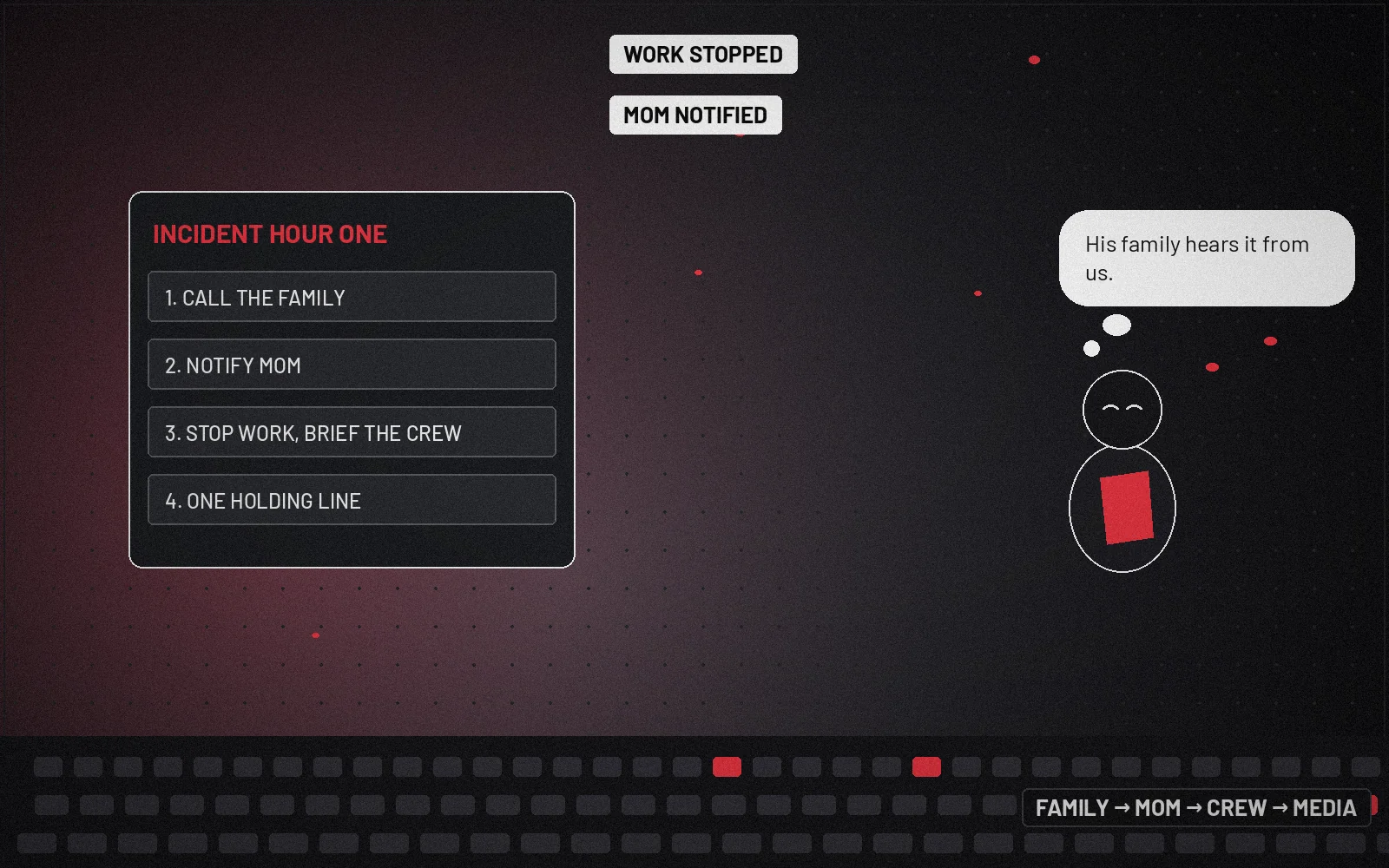
The first-24-hours sequence (original matrix)
This is the sequence sheet we build with clients before anything happens, so that nobody has to invent it at the gate. Fill in real names and phone numbers. Any row without an owner means the plan is not ready.
| Hour | Audience | What they get | Channel | Owner |
|---|---|---|---|---|
| 0–1 | Emergency services, site team | Emergency response, area secured, work stopped in the affected zone | Site protocol | Site manager / HSE |
| 0–1 | Next of kin | What happened, where the worker is, a named company contact, transport and support | Phone call from a senior leader, then in person | CEO or country head + HR |
| 0–2 | MOM | Notification with date, time, place, people, brief description | MOM e-service | Employer (HR / HSE); occupier where it is their duty |
| 1–3 | Principal, main contractor, occupier | Same facts, who is notifying MOM, who speaks to media | Call between named leads | Project director + comms |
| 2–4 | Workers on site and in dormitories | What happened, that work has stopped, counselling and who to talk to, not to post photos | Toolbox briefing in their languages, supervisors | Site manager + HR |
| 2–4 | All staff | Short factual note, support available, who handles external questions | Leader email or intranet | CEO + comms |
| 2–6 | Media (on request) | Holding statement matching the MOM notification | Spokesperson, written first | Comms + counsel |
| 4–8 | Clients, insurers, lenders | Facts, continuity, the named contact | Account call, then email | Account owners + finance |
| Same day | SGX (if listed and material) | Disclosure under Listing Rule 703 if counsel judges it material | SGXNet | Company secretary + counsel |
| 24 hours | All of the above | One update: what has changed, what has not | Same channels | Comms |
How to use it. The family row and the MOM row run in parallel and both come before anything public. If the media is already at the gate before the family has been reached, the spokesperson confirms only that there has been an accident, that emergency services responded and that the company is contacting the family. For multi-party sites, the call between principal, contractor and occupier decides one thing above all: whose name is on the statement. Two statements with different facts from the same site are a gift to every reporter on the story.
Who speaks for whom on a multi-party site
On a Singapore construction or facilities site, the employer of the injured worker is often a subcontractor, the site is run by a main contractor, and the development belongs to a developer or occupier with a brand people recognise. Reporters will call the brand. This is the split we recommend, agreed in writing before work starts.
| Party | Legal duty to MOM | Speaks about | Does not speak about |
|---|---|---|---|
| Employer (often a subcontractor) | Notifies a worker's death; reports injuries | Its worker, the family, support | Site-wide causes, the project |
| Main contractor / occupier | Notifies deaths or injuries of the public, and Dangerous Occurrences | The site: work stopped, MOM on site, cooperation | The worker's personal details |
| Developer or client brand | None for the notification, unless it is also the occupier | Its expectation that the contractor cooperates fully, and support for the family | Cause, blame, the contractor's record |
The developer is the party most tempted to distance itself in the first statement. Do not. "Our contractor is responsible" reads as washing your hands of a death on your site. Say you are in contact with the contractor and the family and that you expect full cooperation with MOM.
Worked example: a fall at a mid-sized site
A hypothetical but typical case. A subcontractor's work permit holder falls from height at a $40 million commercial project. He is taken to hospital and dies that evening. The main contractor runs the site. The developer is an SGX-listed property company.
The version that goes wrong. A supervisor's photo of the scene is in a workers' group chat within 20 minutes and on social media within the hour. The developer's press office, called by a reporter, says the accident "involved a subcontractor's worker" and that "safety is our top priority". The subcontractor's director tells a second reporter the worker "was not wearing his harness properly". The family in Bangladesh learns of the death from a cousin who saw the post. By the next morning there are three versions of the event, one of which blames a dead man, and the developer's line is quoted under a headline about a fatality.
The version that holds.
- 1. Within the hour, the subcontractor's managing director calls the family through an interpreter, names a company contact and confirms that the company will cover travel and repatriation costs. HR starts the work injury compensation track.
- 2. The subcontractor notifies MOM. The main contractor stops work in the zone and confirms that it has done so.
- 3. A 15-minute call between the three parties' leads agrees that the main contractor issues the site statement, the subcontractor speaks only about its worker and the family, and the developer issues one supporting line.
- 4. Supervisors hold toolbox talks in Bengali, Tamil and Mandarin. Workers hear what happened, that counselling is available, and that photos of the scene are not to be shared out of respect for the family.
- 5. Holding statement from the main contractor: "A worker was seriously injured in a fall at our site this afternoon and later passed away in hospital. Our thoughts are with his family, whom we are supporting. Work in the area has stopped. MOM has been notified, and we are cooperating fully with its investigation."
- 6. The developer's counsel and company secretary assess whether the incident is material for SGX. They decide it is not, and the investor relations team prepares a factual answer for analysts who ask.
The facts are the same in both versions. Only the order, the owners and one forbidden sentence changed.
Mistakes we see most often
Blaming the worker. Even if early accounts suggest a procedural breach, the cause is for MOM to find. Saying it publicly hurts the family, invites a different account from co-workers, and looks like the company protecting itself.
"Isolated incident." You do not know that yet, and MOM's enforcement lists may soon show otherwise. Say what you have done instead.
Moving people or evidence to "tidy up". MOM lists deliberately attempting to cover up fatal or serious accidents, including removing the injured or deceased from the scene, among the offences that can debar an employer from hiring migrant workers. Communications must never describe the scene as other than it was.
Naming the worker without consent. The family decides whether a name goes public. Until they do, say "a worker" and his role.
Going silent after day one. MOM investigations take time. A short update at 24 hours and at milestones (work resumes, the family's wishes on a memorial) keeps the story yours.
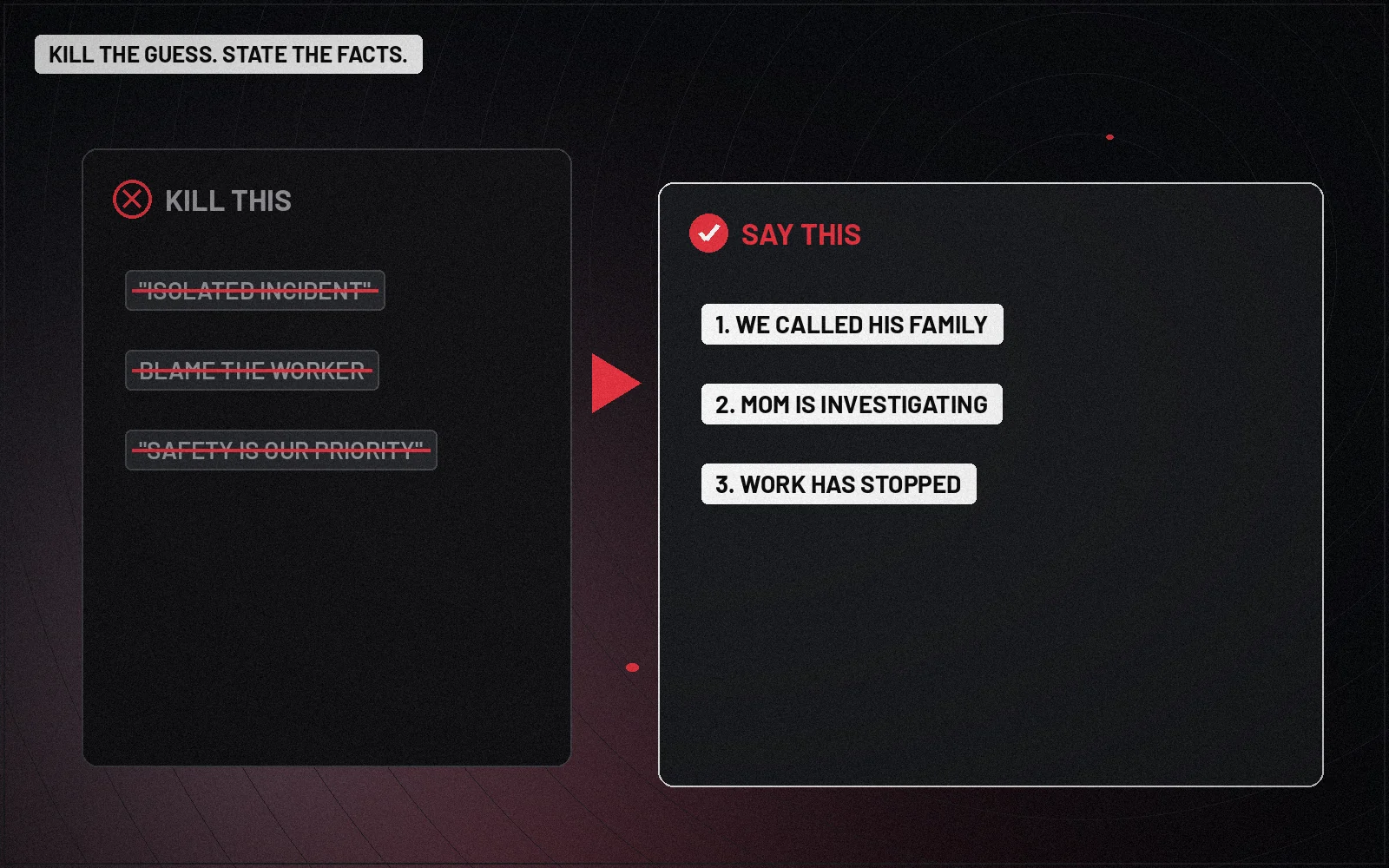
Kill this | Say this (workplace incident statements)
| Kill this | Say this | Why |
|---|---|---|
| "Safety is our top priority." | "Work in the area has stopped and MOM has been notified." | Actions beat slogans on the day someone was hurt. |
| "This was an isolated incident." | "MOM is investigating, and we are cooperating fully." | You do not know yet, and the enforcement lists are public. |
| "The worker did not follow procedure." | Say nothing on cause. | Blame before findings hurts the family and the company. |
| "The worker was employed by a subcontractor." (as the lead line) | "Our thoughts are with his family, whom we are supporting." | Distancing reads as indifference. |
| "No comment." | The holding statement, read in full. | A short factual line ends the call faster than a refusal. |
Kill the slogans, the guesses and the distancing. Say the three parts in order: family first, facts not cause, one record.
Decision framework: proactive statement or holding line?
Not every workplace injury needs a press statement, and issuing one for every case would be wrong. Use four questions.
- 1. Did someone die, or was a member of the public hurt? If yes, prepare to issue a statement proactively once the family has been reached.
- 2. Is it already visible? Emergency vehicles on a main road, photos online, or a reporter's call: hold a statement ready and use it on request within the hour.
- 3. Is a listed company or a recognised brand involved? If yes, counsel checks SGX materiality and the brand agrees its supporting line with the contractor.
- 4. Has MOM issued a Stop Work Order? If yes, clients and partners hear it from you the same day, before they see it on MOM's public list.
If all four answers are no, there is no media statement. The family, MOM, workers, staff and the client still get their messages, in the same order.
Desk notes: Singapore, regional and board
Singapore desk. Communications owns the sequence sheet, the holding statement, the staff note and the multi-party call. HSE owns the MOM notification and the facts. HR owns the family and the compensation track. Counsel reviews every external sentence. For working with reporters on regulated topics, see media relations for regulated sectors in Singapore.
Regional desks. When the worker's family is overseas, the home-country team or embassy contact may be the one who reaches them. Agree in advance who calls and in which language.
Board and leadership. The WSH Council's Code of Practice on Chief Executives' and Board of Directors' WSH Duties sets out what leaders own on safety. Use it to brief the CEO before the first call to the family and before any board update. For investor and lender letters, see Investor and Stakeholder Letters When a Singapore Regulatory Story Hits.
Monday field kit: the incident dry run
Run this once, 45 minutes, with HSE, HR, communications, counsel and one site manager. Fill the 24-hour matrix with real names and mobile numbers, and strike any row without an owner. Confirm who notifies MOM for each type of incident on each of your sites, employer or occupier. Write the holding statement now, with blanks only for time, place and role. Read the kill list against it. Agree the multi-party split with your main contractors in writing. Check that supervisors can brief workers in their languages, and that someone senior is named to call a family overseas. Last, put the crisis retainer or on-call comms number in the site emergency sheet, next to the ambulance.
Who this is for / who should skip
For you if you run corporate affairs, communications, regulatory or HSE at a Singapore employer, contractor, occupier or developer, especially in construction, manufacturing, logistics, marine or facilities, and you want the first 24 hours planned before you need them.
Skip if you need emergency response procedures, an investigation method, or advice on liability and defence. Those go to your WSH team and counsel. For a broader approach to telling staff hard news, see retrenchment communications in Singapore.
What to do next
Print the 24-hour matrix and the multi-party split, fill them in for your highest-risk site, and run the dry run with one site manager this month. Fix any row that lets the public hear before the family, guesses at a cause, or lets two parties issue different facts. If you want a second pair of eyes on your incident plan, holding statements and contractor agreements, talk to our Singapore crisis and issues communications team or go straight to contact.
FAQs
Who must notify MOM after a workplace accident in Singapore?
For a worker's death, the employer must notify MOM as soon as reasonably practicable and submit an incident report within 10 days. The occupier notifies MOM when a self-employed person or member of the public dies, when a member of the public is injured and sent to hospital, and for Dangerous Occurrences. Injuries that lead to medical leave, hospitalisation or light duty are reported by the employer within 10 days.
Should we name the worker in our statement?
Only if the family agrees. Until then, refer to "a worker" and his role. Respect for the family is the first test reporters and the public apply.
Can we say what caused the accident?
No. Say what happened and what you have done, and that MOM is investigating. Early accounts are often wrong, footage may exist, and blame before findings damages trust with workers, the family and the regulator.
Does a listed company have to announce a workplace fatality on SGX?
Not automatically. Counsel and the company secretary assess whether the incident is material under Listing Rule 703, for example because of a Stop Work Order on a major project. Prepare a factual line for analysts either way.
What should we tell workers on site?
What happened, that work has stopped in the affected area, where to get support, and not to share photos or speculate online. Brief them in their own languages through their supervisors, the same day.