
Retrenchment communications Singapore goes wrong for a simple reason: the people losing their jobs hear it last. They find out from a calendar invite titled "Quick sync", a badge that stops working, a reporter's call, or a Reddit thread. The order that works is the reverse. Brief the union first if you have one. Tell affected employees in person and in private, with HR on hand. Then give remaining staff, MOM, clients and the media one story that matches what those employees were told.
This guide is for corporate affairs, communications, HR and country leads who have to plan the announcement after the business decision is made. It covers sequence, scripts and channel discipline, not whether to retrench, how to select roles, or what to pay. Those calls belong to leadership, HR and counsel. Pair it with Issues Management Before the Crisis Call and, for listed companies, Investor and Stakeholder Letters When a Singapore Regulatory Story Hits.
What Singapore actually expects from you
Two documents set the frame, and communications teams should read both before drafting anything.
The first is legal. Under the Employment Act, employers with businesses registered in Singapore and at least 10 employees must notify MOM within 5 working days after an employee is told of their retrenchment (MOM: Mandatory Retrenchment Notifications). MOM also invites a voluntary early alert while plans are still being worked out, which can open referrals to outplacement support. Smaller employers are exempt from the mandatory notice but strongly encouraged to file.
The second is the Tripartite Advisory on Managing Excess Manpower and Responsible Retrenchment (TAMEM, updated January 2023). It is guidance, not statute, but the Tripartite Alliance for Fair and Progressive Employment Practices (TAFEP) will engage employers who do not follow it, and MOM says so in Parliament. For a communicator, TAMEM is effectively the brief. It asks employers to:
- Communicate early to all employees, before any public notice, about the business situation, how the exercise will run, the factors considered and the support offered.
- Notify the union early, before affected employees, and where the collective agreement provides for it, the norm is one month before.
- Tell affected employees in person unless that is impractical, with managers prepared to deliver the news sensitively.
- Have HR (and union representatives) on site to answer questions, and keep an open channel afterwards.
- Not walk people out abruptly or have them escorted by security without a legitimate reason.
Read that list as a sequence and a tone guide. Most public backlash over Singapore layoffs comes from breaking one of those five lines, not from the decision itself.
The one rule: union first, in person, one story outside
Every retrenchment announcement runs on three parts, in this order.
- 1. Union first. If you are unionised, the union hears it before the people affected, on the timeline your collective agreement sets. If you are not, the equivalent is your leadership and line managers being fully briefed and scripted before day one.
- 2. In person, in private. Affected employees hear it from a prepared manager in a private room or a live one-to-one call, with HR available the same hour. Not a group email. Not a mass video call where cameras go off one by one.
- 3. One story outside. Remaining staff, MOM, clients, partners and the media get the same core facts the affected employees heard: why, how many roles roughly, which areas, what support. Nobody outside hears a detail the affected team has not.
Three parts you can brief in five minutes
- 1. Union first: brief the union (or your managers) before anyone affected.
- 2. In person: a prepared manager, a private room, HR in the next room.
- 3. One story outside: the same facts for staff, MOM, clients and media.
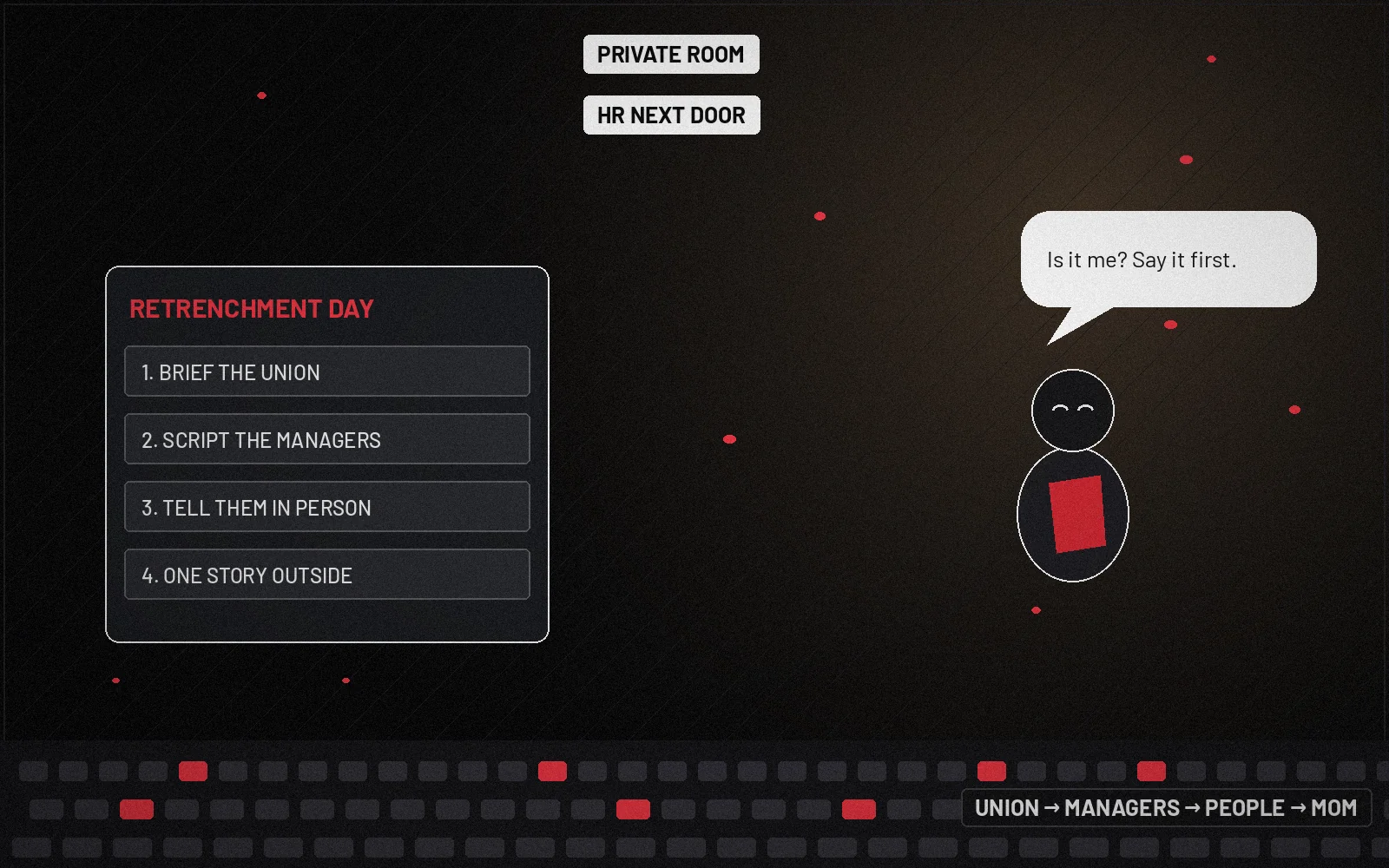
The announcement-day sequence (original matrix)
This is the send order we build with clients before the date is locked. Fill it in with real names and times. If any row has no owner, the plan is not ready.
| Step | Audience | What they get | Channel | Owner | Timing |
|---|---|---|---|---|---|
| 0 | MOM (optional early alert) | Plan in progress, request for support | MOM e-service | HR | While plans are being worked out |
| 1 | Union (if unionised) | Business case, numbers, selection criteria, benefit proposal | Meeting, then written note | HR + business head | Per collective agreement; norm is one month before employees |
| 2 | Line managers | Script, FAQ, list of their people, escalation contact | Closed briefing, in person | HR + comms | 24–48 hours before step 4 |
| 3 | All employees (early context) | Business situation, that an exercise is coming, how it will run | Leader town hall, then intranet note | CEO / country head | Before any individual notice |
| 4 | Affected employees | Their role, notice period, benefit, support, next steps, who to call | In person or live one-to-one call | Line manager + HR | Day one, morning, one by one |
| 5 | Remaining staff | What happened, which teams, what changes for them, what not to say externally | Leader note + team huddles | CEO + managers | Same day, after step 4 is finished |
| 6 | MOM (mandatory) | Mandatory Retrenchment Notification | MOM e-service | HR | Within 5 working days after step 4 |
| 7 | Clients and partners | Continuity: who their contact is now, what does not change | Named account email or call | Account owners | Same day or next morning |
| 8 | Media (only if asked or if it is already public) | Holding statement matching step 5 | Spokesperson, written | Comms + counsel | Ready before step 4; used on demand |
How to use it. Steps 3 and 4 can sit close together, but step 3 must not reveal individual names, and step 4 must be finished before step 5 goes out. If your company is listed and the exercise is material, counsel decides whether SGX disclosure comes first under Listing Rule 703. That can force the sequence tighter. Plan for it rather than discovering it on the morning.
Worked example: 40 roles at a regional hub
A non-listed, unionised technology company runs its APAC operations hub in Singapore with about 400 staff. Leadership decides to close a support function, affecting about 40 roles. The collective agreement asks for one month's notice to the union.
The version that goes wrong. HR sends a 9 a.m. Thursday invite to 40 people: "Org update". Fifteen minutes in, a slide reads "your role is impacted". Cameras go off. By 10:30 a.m. building access cards stop working and security is at the lift lobby. At noon, a screenshot of the slide is on social media. At 3 p.m. a reporter calls the switchboard. Remaining staff learn the scale from the post. Nobody has told the client whose account manager was in the call.
The version that holds.
- 1. Five weeks out: HR files a voluntary early alert with MOM and opens talks with the union on numbers, criteria and benefit.
- 2. Two days out: the 12 managers with affected people get a closed briefing, a one-page script, an FAQ and a named HR partner each.
- 3. Day one, 9 a.m.: the country head tells all staff, in person and streamed, that the support function will close, why, and that affected colleagues will be spoken to individually this morning.
- 4. 9:30 a.m. to noon: managers meet each affected employee one to one in booked rooms. HR and a union representative sit in a room next door. Each person leaves with a letter, their notice period, the benefit, outplacement contacts and a direct number. Laptops are returned on a date agreed in that conversation, not that minute.
- 5. 1 p.m.: a leader note to remaining staff says the same thing the affected group heard, plus what changes for adjacent teams and who handles press.
- 6. 2 p.m.: account owners call the three clients served by the function.
- 7. Within five working days: HR submits the Mandatory Retrenchment Notification.
The facts are the same in both versions. Only the order and the room changed.
Channel discipline: what goes where
Three channel rules prevent most of the damage.
Never use the all-hands channel for individual news. A group call or group email that tells people they are affected is the screenshot you will see online by lunch. TAMEM's default is in person for a reason.
Do not change systems before the conversation. Access, email and laptop cut-offs that run before or during the meeting turn a hard conversation into a security story. If there is a genuine security risk for a specific role, counsel and IT handle that case on its own, and the employee hears why.
Write the media holding line before day one, and do not send it unprompted. Most retrenchments in Singapore are not news. If a reporter does call, the line matches the staff note: what happened, roughly how many roles, the support offered, and that MOM has been or will be notified. It does not include names, a severance figure you have not confirmed, or "this does not affect our commitment to Singapore" unless that is a decision you can show. For handling reporters on regulated topics, see media relations for regulated sectors in Singapore.
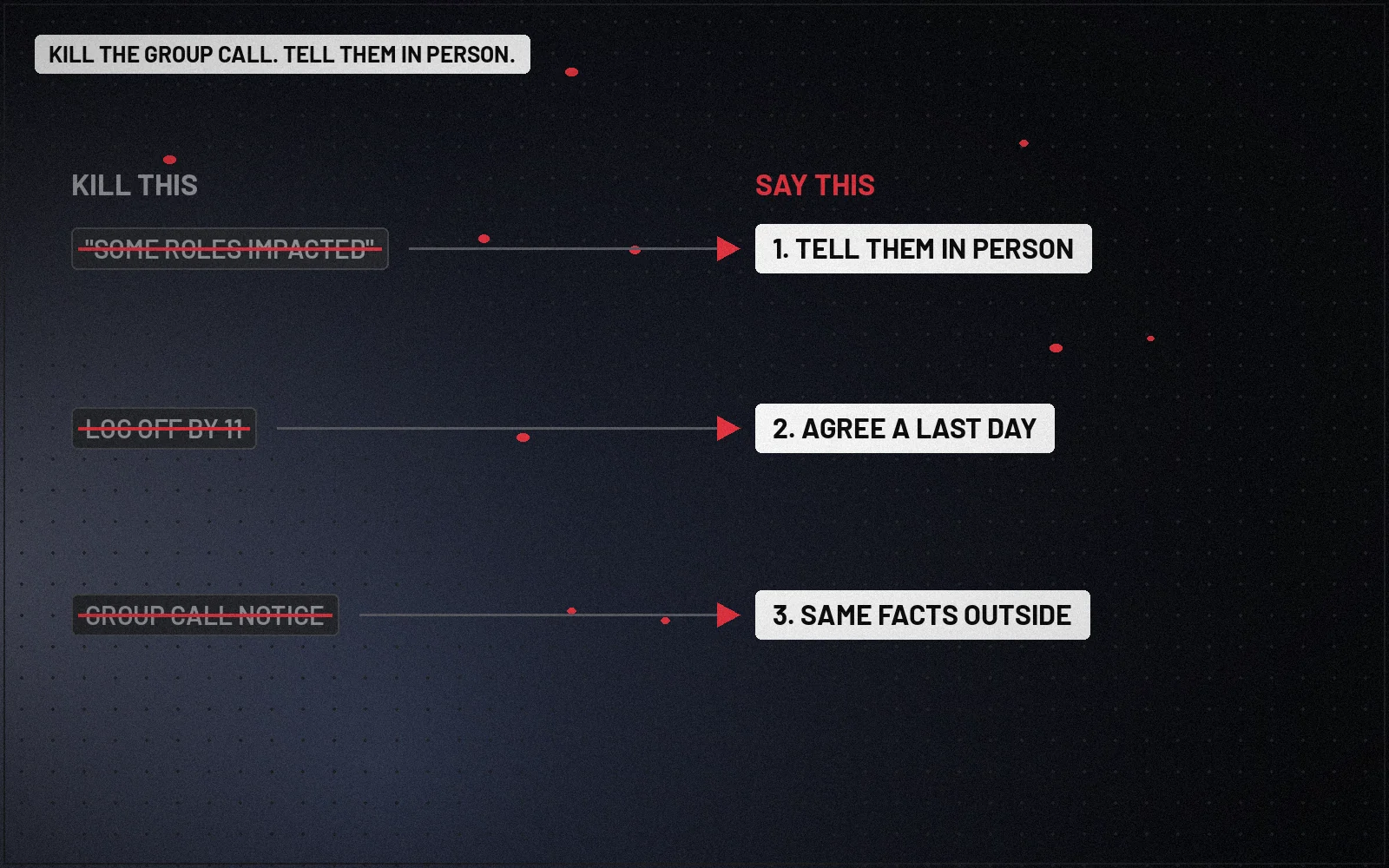
Kill this | Say this (retrenchment announcements)
| Kill this | Say this | Why |
|---|---|---|
| "As part of our strategic realignment, some roles are impacted." | "We are closing the regional support team. Your role is one of the roles affected." | People need to know, in one sentence, whether it is them. |
| "This was a difficult decision." (as the opener) | "Here is what is happening, why, and what support you have." | Leaders' feelings are not the first fact. |
| "Please log off by 11 a.m." | "We will agree a last working day and a return date for your laptop today." | Abrupt exits are the exact behaviour TAMEM warns against. |
| "We cannot share more at this time." (to remaining staff) | "Here is what changes for your team, and who to ask." | Silence inside becomes the story outside. |
| "No comment." (to a reporter) | "We have told affected colleagues in person, are providing support, and have notified MOM." | A short factual line ends the call faster than a refusal. |
| "Our people are our greatest asset." | Say nothing. Show the support package instead. | The line reads as irony on the day. |
Kill the euphemisms, the cut-offs and the slogans. Say the three parts in order: union first, in person, one story outside.
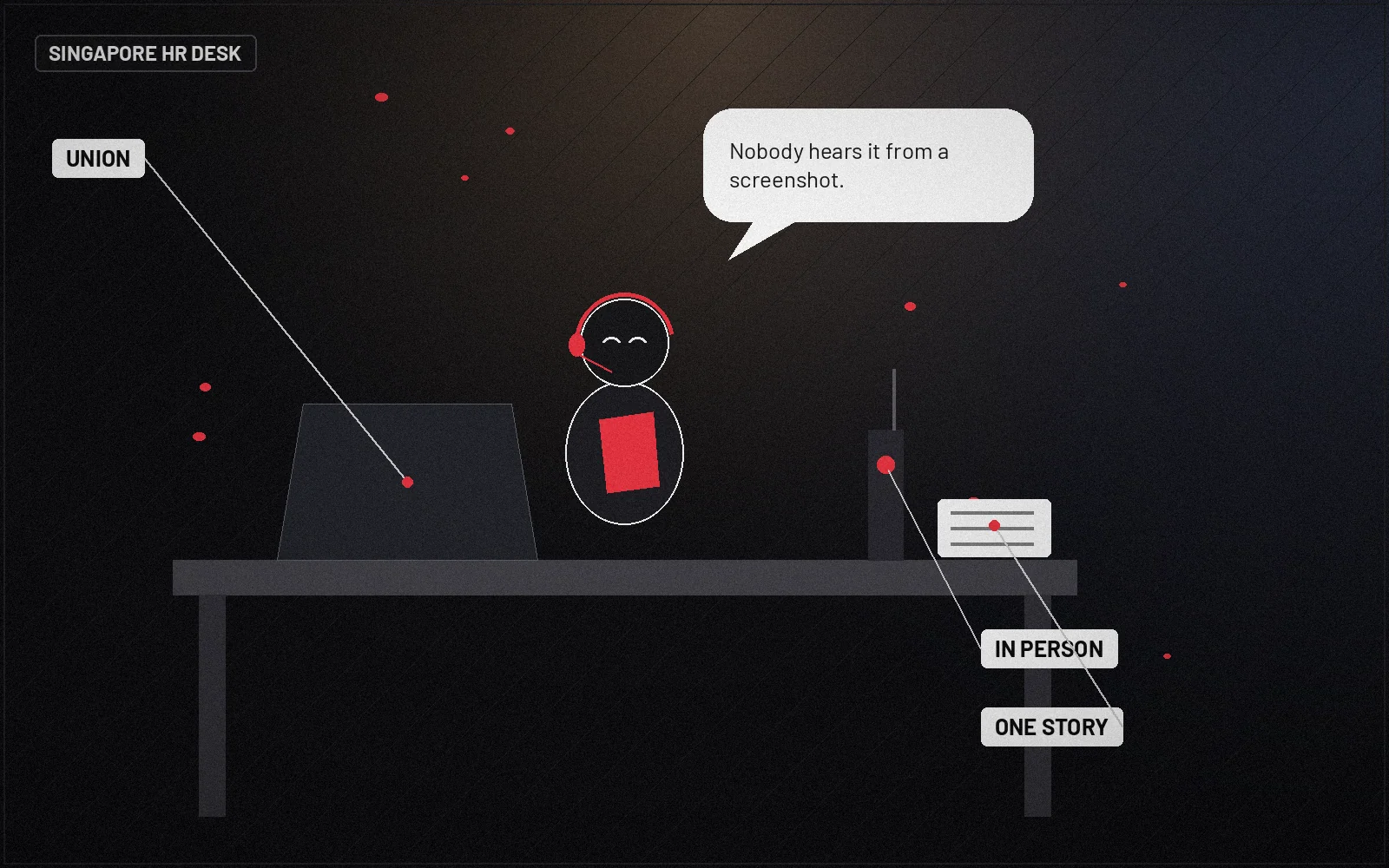
Desk notes: Singapore, Manila and regional teams
Singapore desk. Communications owns the sequence sheet, the manager script, the staff note and the holding line. HR owns the union track, the letters and the MOM filings. Counsel reviews every external sentence and any listed-company disclosure. TAFEP's responsible retrenchment page is a useful one-page refresher to send managers before the briefing.
Manila and other regional desks. If the same decision affects staff in the Philippines or elsewhere, those countries have their own notice rules and their own clocks. Do not let the Singapore day-one timing leak a regional decision before local teams have been told. Agree one core fact sentence across countries and let each country run its own sequence.
Client-facing teams. Account owners get a two-line client script by the night before. Clients should never learn about a team change from the affected employee's LinkedIn post.
Monday field kit: the retrenchment dry run
Run this once, 45 minutes, with HR, communications, counsel and two line managers, before the date is locked. Fill the sequence matrix with real names and times, and strike any row without an owner. Have one manager read the script aloud to HR acting as the employee, and time it. If the "is it me" sentence comes later than the first 60 seconds, rewrite it. Read the kill list against your draft staff note and replace every match. Check with IT that no access changes are scheduled before the conversations end. Write the holding line and agree who answers the phone. Last, confirm who files the MOM notification and on which date, counting five working days from the first individual conversation.
Who this is for / who should skip
For you if you run corporate affairs, communications, HR or a country office in Singapore and you have been asked to plan how a retrenchment is announced, or you want a plan on the shelf before you need one.
Skip if you need advice on whether a retrenchment is lawful, how to pick roles, what benefit to pay, or how a collective agreement applies to you. Those go to HR, counsel and, where relevant, your union. This article is general communications guidance, not legal advice.
What to do next
Print the sequence matrix and fill it in for a scenario your business could plausibly face. Run the dry run with two managers. Fix anything that tells people by group channel, cuts access before the conversation, or sends a detail outside that affected employees did not hear first. If you are planning a Singapore exercise now and want a second pair of eyes on the sequence, scripts and holding line, talk to our Singapore crisis and issues communications team or go straight to contact.
FAQs
Do we have to tell MOM about a retrenchment in Singapore?
Yes, if your business is registered in Singapore and you have at least 10 employees. The Mandatory Retrenchment Notification is due within 5 working days after the affected employee is told. Smaller employers are encouraged to file too. MOM also offers a voluntary early alert while plans are being made.
Who should hear about a retrenchment first?
If you are unionised, the union, before affected employees, on the timeline in your collective agreement (TAMEM says the norm is one month where the agreement provides for it). Then all employees get early context, and affected employees hear their individual news in person. Clients, partners and the media come after that.
Can we announce retrenchments by email or a group video call?
TAMEM says individual notification should be in person unless that is impractical. A live one-to-one call is the fallback for remote staff. A group email or mass call telling people they are affected is the format most likely to be screenshotted and shared.
Should we put out a press release?
Usually not. Prepare a short holding line that matches the staff note and use it if a reporter asks or the news is already public. Listed companies should ask counsel whether the exercise needs an SGX announcement first.
What should the staff note to remaining employees say?
What happened, which teams are affected, why, what support the affected colleagues have, what changes for the reader's own team, and who handles external questions. Keep it consistent with what affected employees heard that morning.