
Cybersecurity incident communications Singapore teams lose the first hours when they treat every audience as a presser. The fix is sequencing, not more holding lines. Ops gets the facts that keep systems safe. Affected customers and employees get what they need to act. Regulators get what the law and your licences require. Media and the open public come last—or never, if the incident does not earn a public statement.
This guide is for corporate affairs, public affairs, communications and regulatory leads at Singapore operators—banks, platforms, healthcare, logistics, telcos, and anyone whose outage or data exposure becomes a trust event by lunchtime. It is an audience-order playbook, not a technical IR runbook and not legal advice. For trust narrative and compliance-email shape after a PDPA-triggering breach, use PDPA breach communications Singapore. For spoken lines, use data-breach spokesperson lines (street-smart). For after-hours ownership see the 24/7 crisis retainer SOW; for pre-crisis rhythm, issues management before the crisis call. Hub: Singapore crisis and issues communications.
The one rule that stops the wrong audience first
Singapore operators sit under more than one communications clock. CSA’s Cybersecurity Act frames obligations for Critical Information Infrastructure owners, including prescribed incident reporting to the Commissioner—CSA’s forms page describes awareness-to-report windows measured in hours for designated CII owners, not “when marketing is ready.” Separately, the PDPC Guide on Managing and Notifying Data Breaches under the PDPA and the Notification of Data Breaches Regulations set assessment and notification duties when personal data is in play: assess promptly; if notifiable, notify the Commission as soon as practicable and no later than three calendar days after that determination; notify affected individuals as soon as practicable, at the same time or after notifying the Commission. Sector regulators may add their own lanes. None of those clocks is a licence to blast a journalist WhatsApp group before ops has containment facts.
So the rule is simple:
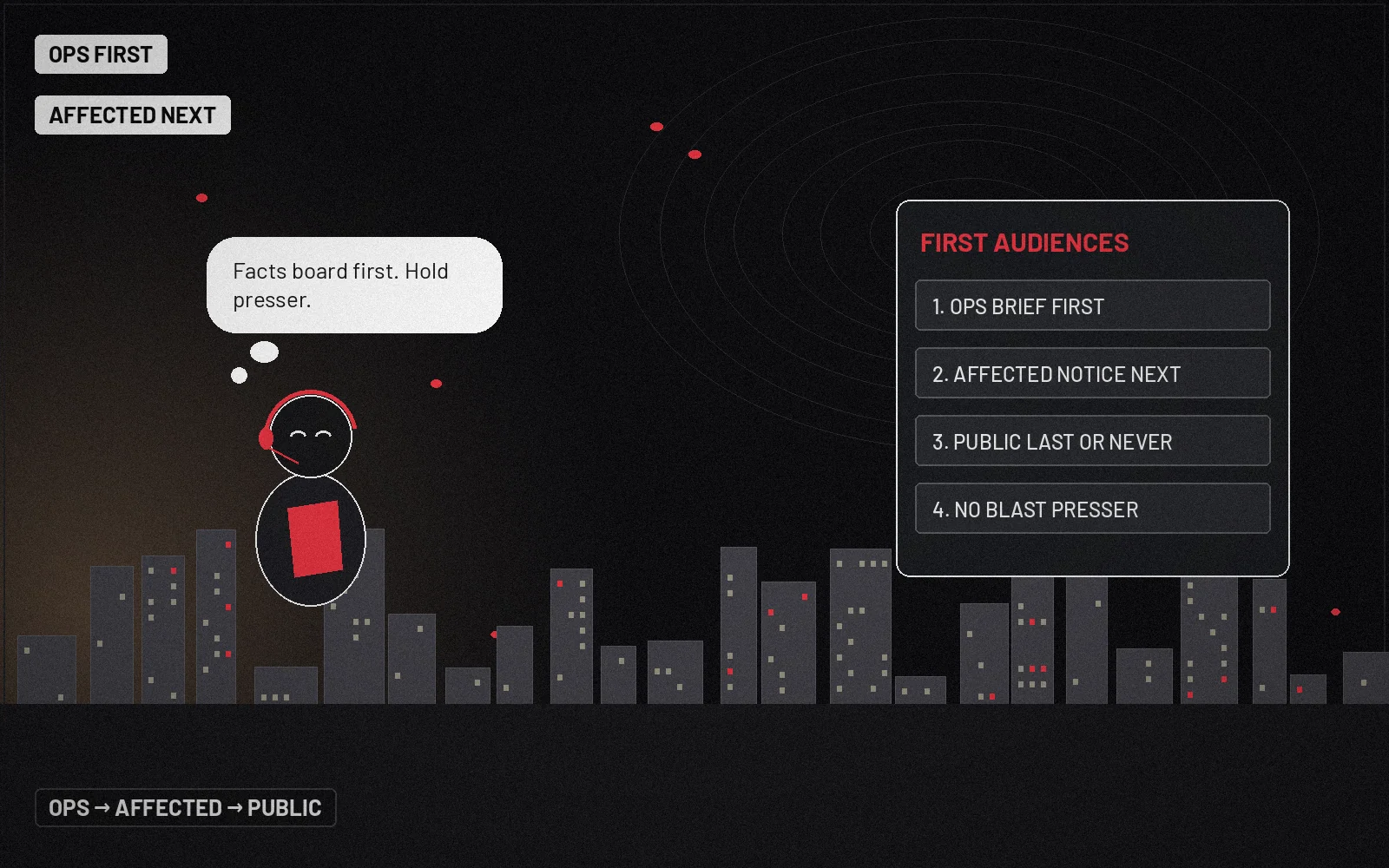
- 1. Ops first. Internal incident command, technical containment, and the people who can stop the bleed get the first brief—before any external story.
- 2. Affected next. Customers, employees, partners, and anyone who must change behaviour or protect themselves get a cleared notice after ops facts are stable enough to be true.
- 3. Public last (or never). Media and open public statements only when the incident is already visible, legally notifiable in a way that requires public notice, or strategically necessary—and only after ops and affected audiences have been sequenced.
The rest of this article is how you run that rule without inventing numbers or letting a draft presser outrun the IR bridge.
What “ops first” actually means (and what it does not)
Ops first is not silence forever—it is refusing a public narrative while the bridge is still naming the asset.
Ops owns (first brief)
- Containment status in plain language: what is offline, what is isolated, what is confirmed safe to run.
- Scope hypotheses: systems, data classes, geographies—marked as confirmed / suspected / unknown.
- Decision clock: next technical checkpoint time, and who can update the facts.
- Need-to-know list: who on the IR bridge may speak to which internal audience.
Comms owns (alongside ops, not ahead of it)
- A one-page audience map for this incident (see the matrix below).
- A kill list of phrases nobody may say until cleared (“nationwide outage,” invented user counts, speculative root cause).
- Channel discipline: which internal channels are live (bridge, Slack/Teams war room, executive SMS) and which are frozen for rumour.
Ops first does not mean
- Hiding a notifiable PDPA breach from the assessment clock.
- Skipping CSA / sector reporting where your designation or licence requires it.
- Waiting for perfect forensics before briefing affected people who need to reset credentials now.
If your Singapore desk is still sorting which agency owns which lane, keep the Singapore regulator map (IMDA, MAS, PDPC, MDDI, POFMA) next to the IR bridge. Audience order fails when the team cannot name the regulator that expects a call.
Affected next: customers, employees, partners—before the open public
Affected audiences are people who must do something or who will be harmed if they hear it from a screenshot first.
Affected typically includes
- Customers whose accounts, payments, bookings or personal data may be exposed or unavailable.
- Employees and contractors who must change access, work offline, or field inbound questions.
- Partners and processors who share systems or data flows with you.
- Board / owners who need decision-grade facts, not a press draft.
Affected notices must
- Say what is known, what is unknown, and what the recipient should do in the next hour.
- Match counsel’s PDPA / sector assessment—do not invent “no personal data involved” to calm a room.
- Arrive through channels you already own (app banner, email, in-product message, employee intranet)—not through a journalist’s tip line.
Affected does not include every LinkedIn follower, trade WhatsApp group, or sector reporter. Those are public audiences. They wait.
For trust-preserving breach-notice shape, cross-read PDPA breach communications Singapore. For spoken lines, use street-smart spokesperson lines after this matrix names who speaks when.
Public last (or never)
A public statement is a product. Ship it only when it earns its place.
Public may be required or wise when the outage is already visible, individual notification will become public, a CII / essential-service disruption creates legitimate questions you must answer with cleared facts, or rumours invent a worse story than the truth you can stand behind.
Public should wait or never ship when ops still marks root cause and scope as unknown, only a narrow internal cohort is affected and containment is holding, or the draft exists mainly to “own the narrative” before any affected person has been told.
When you do speak publicly, one cleared line beats three speculative paragraphs.
Audience sequencing matrix: first hours (RACI + clock)
Use this as the operating agreement on the bridge. R = Responsible (does the work). A = Accountable (signs). C = Consulted. I = Informed. Times are indicative hour-bands from awareness—not statutory deadlines. Your CSA / PDPC / sector clocks override any band below; put counsel on the A cells that touch notification law.
| Audience / workstream | Hour 0–1 | Hour 1–4 | Hour 4–24 | Comms | Ops / IR | Counsel / DPO | Exec sponsor |
|---|---|---|---|---|---|---|---|
| IR bridge stand-up + facts board | R/A | Update | Update | C | A / R | C | I |
| Internal ops / SOC / on-call brief | R | R | R | C | A / R | I | I |
| Executive / board flash (decision facts) | — | R | R | R | C | C | A |
| Employee / contractor need-to-know | — | R (if access impact) | R | A / R | C | C | I |
| Affected customers / users notice | — | Draft | Send if ready | A / R | C | A | I |
| Partners / processors | — | Notify if shared systems | Follow-up | R | C | A | I |
| PDPC assessment / notifiability | Start clock | Assess | Notify if required | C | C | A / R | I |
| CSA / CII / sector regulator report | If designated: start | Submit as required | Supplement | C | R | A | I |
| Media / public statement | Freeze | Draft only if visible | Publish only if earned | A / R | C | A | A |
| Rumour / leak response | Monitor | Holding line only | Public only if earned | A / R | C | A | C |
How to read it: a journalist call at Hour 0.5 gets “we are assessing; affected parties and required regulators first”—not a presser. If PDPC notifiability is confirmed, counsel owns the A on timing; comms owns the A on words affected people hear. Nobody is accountable for a public line they did not clear against the facts board.
Three numbered parts you can brief in five minutes
- 1. Ops first. Bridge, containment facts, kill list, and need-to-know—before any external story.
- 2. Affected next. Customers, employees and partners who must act get cleared notices after facts are stable enough to be true.
- 3. Public last (or never). Media and open statements only when visibility, law or strategy requires them—and never ahead of ops and affected audiences.
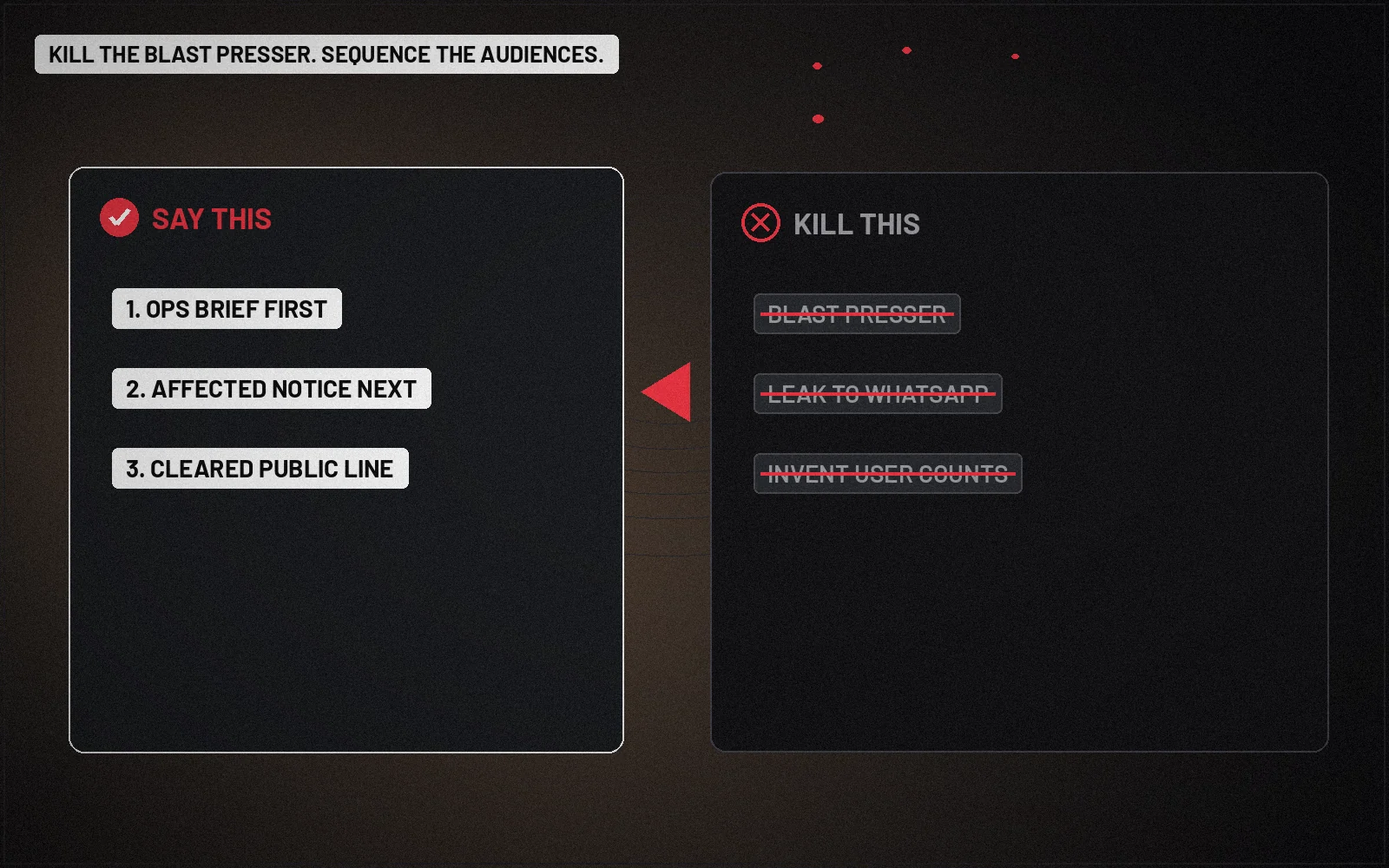
Kill this | Say this (first audiences)
| Kill this | Say this | Why |
|---|---|---|
| “Blast a presser so we own the narrative.” | “Ops brief first; affected notice next; public only if earned.” | Early pressers invent scope and burn trust. |
| “Leak a soft version to a friendly chat.” | “One cleared channel; no WhatsApp freelancing.” | Soft leaks become the public record before facts harden. |
| “Invent a user count to sound transparent.” | “Say confirmed scope only; mark unknowns as unknown.” | Invented numbers become enforcement and lawsuit exhibits. |
| “Tell media before we tell affected users.” | “Affected next; public last.” | People who must reset passwords should not learn it from a headline. |
| “Wait for perfect forensics before any notice.” | “Ops facts first; then affected actions that cannot wait.” | Perfect forensics can arrive after harm. |
| “One global holding line for every regulator.” | “Match PDPC / CSA / sector clocks; do not merge them into PR.” | Different statutes, different audiences, different words. |
Kill the habit of treating the open public as Audience Zero. Say the three-part rule out loud before anyone drafts: ops first, affected next, public last—or never.
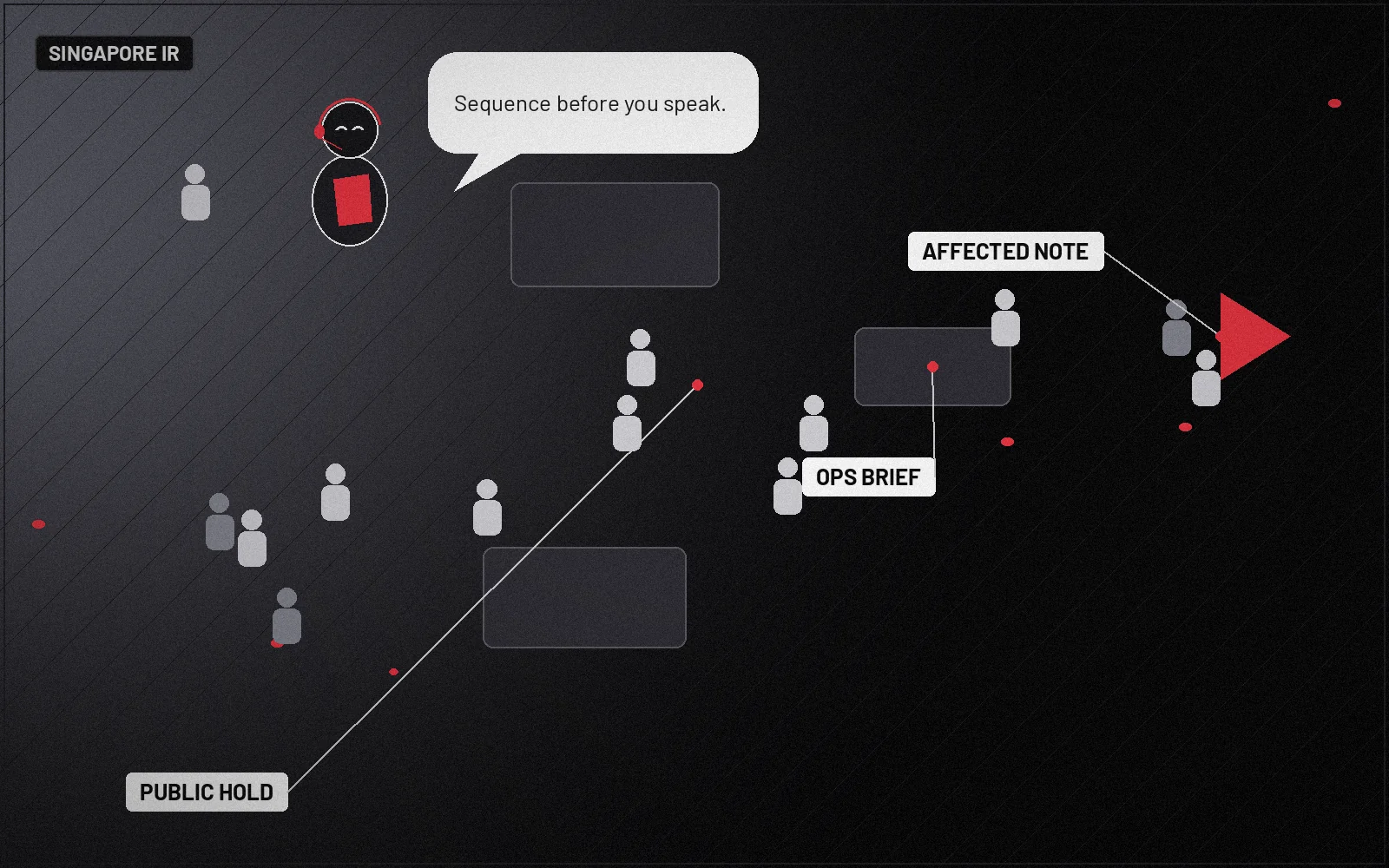
Desk notes: Singapore incident desk
Singapore ops / IR desk. Keep a facts board with three columns only: confirmed, suspected, unknown. If a sentence cannot sit in one column, it is not ready for any audience. Pair the board with your counsel’s PDPA assessment checklist and, if you are a designated CII owner, CSA’s prescribed reporting form path on csa.gov.sg.
Corporate affairs / public affairs desk. Your job in Hour 0–1 is audience map and freeze list, not creative. Draft the affected notice in parallel only after ops marks at least one confirmed impact. Keep the crisis retainer SOW contact card on the bridge so escalation is a phone number, not a Monday meeting.
Regulatory desk. Name the clocks aloud: PDPC assessment window, any CSA/CII awareness-to-report window, MAS or other sector filings if they apply. Do not let a marketing calendar overwrite a statutory one. For agency geography beyond cyber, the regulator map still applies.
Issues desk (pre-crisis). Recurring near-misses belong in issues management before the crisis call, not only IR.
Monday field kit checklist
Run this every Monday so the first hours of a real incident do not invent process.
Bridge readiness — 15 minutes
- [ ] Facts-board template pinned (confirmed / suspected / unknown).
- [ ] Audience map named for this week’s on-call comms + IR leads.
- [ ] Kill list refreshed from last quarter’s near-misses.
- [ ] Channel freeze list: which war-room tools are authoritative.
Regulatory clocks — 10 minutes
- [ ] PDPC assessment owner named (DPO / counsel); eservice path bookmarked.
- [ ] If CII / designated: CSA reporting path confirmed on csa.gov.sg forms.
- [ ] Sector regulator owner named; no silent leave hand-offs.
- [ ] Reminder: process discipline, not legal advice.
Audience assets — 15 minutes
- [ ] Affected-customer notice skeleton (what happened / what we know / what you should do / how we update).
- [ ] Employee need-to-know skeleton (access changes, inbound owners, rumour rule).
- [ ] Partner / processor contact tree for shared systems.
- [ ] One-sentence public holding line marked “use only if earned.”
Shared close — 5 minutes
- [ ] After-hours / retainer numbers still correct.
- [ ] Last incident’s cleared lines archived.
- [ ] Matrix A/R names match who is actually on call.
If the Monday kit takes more than 45 minutes, your templates are too long or nobody is refusing bad lines.
Who this is for / who should skip
For you if you own or advise cybersecurity incident communications for a Singapore operator or enterprise and you need audience order in the first hours—not another slide of jargon.
Skip if you need a full PDPA notification letter, a technical IR playbook, or spoken Q&A only—use the linked pieces and keep counsel on statutory clocks. Not legal advice.
Common traps
- 1. Public as Audience Zero. Drafting the presser before the ops brief.
- 2. WhatsApp freelancing. Soft leaks that become the record.
- 3. False precision. Invented counts, causes, or “no data involved” claims.
- 4. Clock confusion. Merging PDPC, CSA and sector deadlines into one PR timeline.
- 5. Perfect-forensics delay. Withholding action guidance affected people need now.
- 6. Silent matrix. A RACI nobody named is theatre.
What to do next
Print the audience sequencing matrix. Put names in every A and R cell for this week’s on-call. Run the Monday field kit once without adding new slides. If a draft still tries to ship a presser before ops and affected audiences are sequenced, kill it and rewrite under the three-part rule: ops first, affected next, public last—or never.
Educational note: this is communications process guidance for Singapore operators, not legal advice. Confirm PDPA, Cybersecurity Act / CSA, and sector duties with counsel for your designation and facts.
FAQs
Does cybersecurity incident communications Singapore always require a public statement?
No. Many incidents stay inside ops, affected parties and regulators. Public statements are for visibility, legal notice that will become public, or a cleared strategic need—not for narrative vanity.
Who gets briefed before customers?
Ops and the IR bridge first. Then executives who must decide. Then employees who must change access or field questions. Then affected customers. Media waits unless the incident is already public.
How do PDPC and CSA clocks fit this sequence?
They sit on the matrix as counsel-owned A cells. Audience order does not pause statutory assessment or CII reporting. It stops you from inventing a press story while those clocks run.