
A public consultation response Singapore desk files when a ministry or statutory board opens a window is not a media kit. Regulators ask for clear, reasoned comments tied to specific sections—often in a fixed template, soft-copy format, and by a hard clock. Press-release tone (slogans, unverified claims, “we welcome this exciting journey”) gets skimmed or discarded. Policy-tone writing—identity, section pins, evidence, workable alternatives—gets considered.
This article is for corporate communications, public affairs, government-relations, and association secretariats who must turn member or business input into a submission that survives legal review and reads like something a policy officer can use. It is educational process hygiene—not legal advice, not lobbying advice, and not a substitute for counsel when you are commenting on draft legislation or licence conditions.
Educational note (YMYL): Consultation windows, confidentiality rules, and summary-of-responses practices differ by agency and by paper. Always follow the live consultation notice on REACH or the agency’s own page. Nothing here guarantees that a comment will be accepted, published, or change the final instrument.
Neuwark Communications supports Singapore public-affairs drafting from our account office at Level 39, Marina Bay Financial Centre Tower 2, 10 Marina Boulevard, Singapore 018983 (contact +63 923 859 6587 · hello@neuwarkcommunications.com). Soft path: Singapore public affairs · Singapore government relations · Contact. Related: IMDA consultation talking points · IMDA code consultation checklist · Singapore regulator map · GR vs public affairs buyer split · Stakeholder maps for market entry · Issues management before the crisis call.
Direct answer: what makes a Singapore consultation response “policy-grade”?
| Press-release habit | Policy-grade habit |
|---|---|
| Opens with brand praise and adjectives | Opens with who you are, who you represent, and which consultation + sections you address |
| Argues “innovation” in the abstract | Ties each ask to a drafting problem, compliance friction, or unintended effect—with an illustration |
| Hides proprietary worry in vague fear language | Marks confidential annexes properly when the notice allows, and keeps the main body usable |
| Ships a PDF that looks like a brochure | Uses the agency template / Word or PDF soft-copy rules, subject line, and clock stated on the notice |
| Treats “submit” as the end | Logs receipt, prepares for clarification calls, and tracks the summary of responses |
Singapore consultation notices are blunt about this. The Ministry of Finance’s Finance (Income Taxes) Bill 2026 consultation asked respondents to identify themselves and their organisation, be clear and concise, use the provided template, focus on drafting clarity and compliance, and explain points with illustrations, examples, data, or alternative formulations. MDDI and IMDA’s Digital Infrastructure Bill consultation required soft-copy Word or PDF by a fixed deadline, a prescribed email subject line, and cautioned that late submissions may be rejected. Same discipline shows up in IMDA consultation papers that ask for reasoned explanations and clear section references—see IMDA’s consultation papers listing.
Who this is for / who should skip
| Use this structure | Hand off |
|---|---|
| PA / GR / Corp Comms drafting association or corporate submissions | Teams seeking legal opinions on whether a clause should pass—counsel only |
| Secretariats consolidating member views into one file | Anyone who wants an agency to invent outcome claims or competitor attacks |
| Regional hubs filing into MDDI / IMDA / MOF / ACRA windows listed on REACH | Pure media campaigns with no consultation owner or version control |
How Singapore public consultations actually route
REACH (public consultation index) aggregates ministry and agency exercises so feedback goes to the agency concerned. The notice—not a generic “write to REACH”—tells you the clock, channel (FormSG, email + template, soft-copy to a named address), and whether a summary of responses will be published.
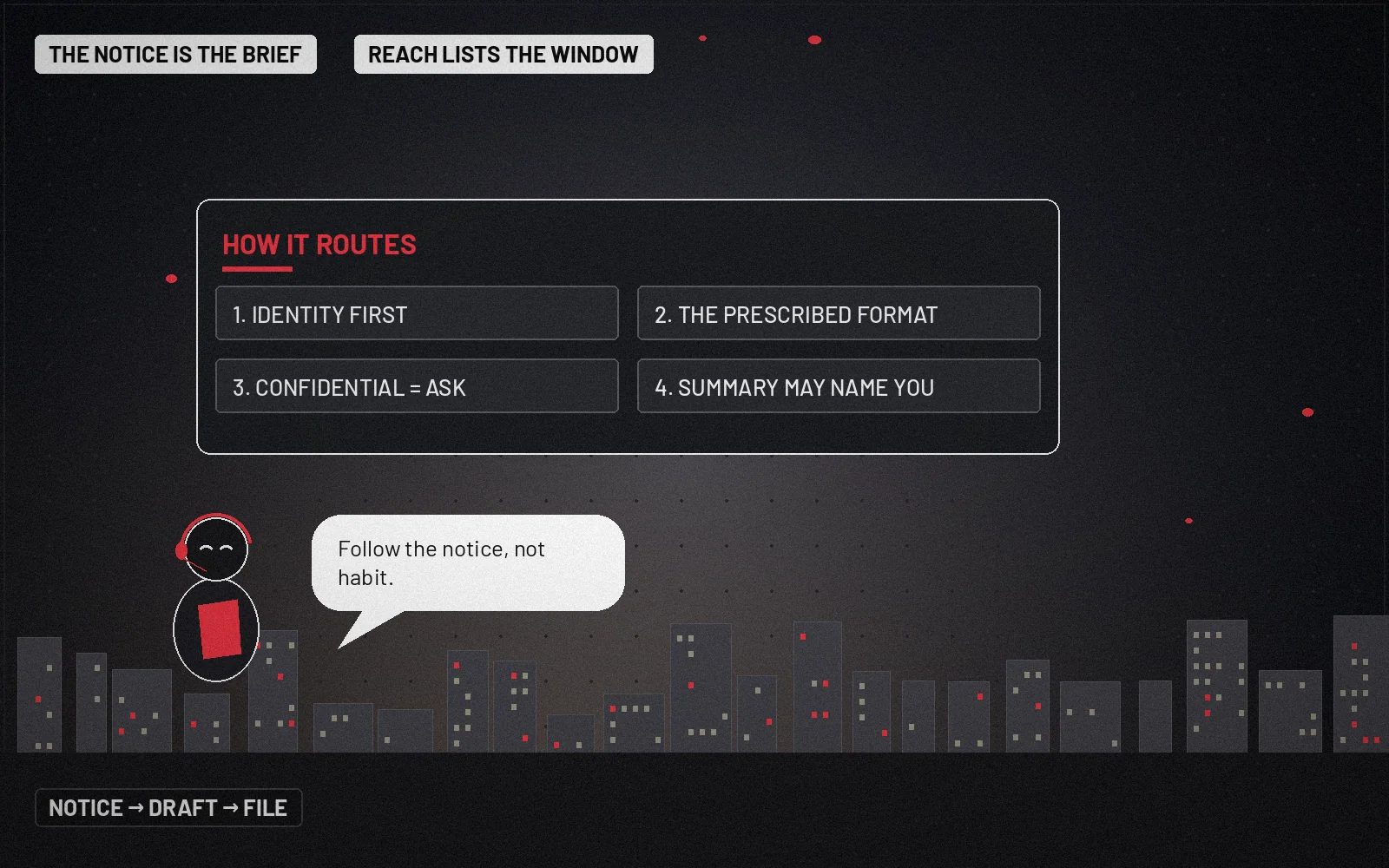
Patterns that keep showing up across 2025–2026 notices:
- 1. Identity first. Name, organisation, contact—so officers can clarify.
- 2. Format discipline. Excel template (MOF income-tax bill), FormSG (some standards consultations), or Word/PDF soft-copy with a required subject line (Digital Infrastructure Bill: soft copies to DigitalInfrastructure@mddi.gov.sg by 22 July 2026, 10am, with subject “Public Consultation on the Draft Digital Infrastructure Bill [name…]”).
- 3. Confidentiality is a privilege, not a default. MDDI/IMDA reserved the right to publish submissions and identities; confidential treatment must be marked, annexed, reasoned—and whole-submission confidentiality is typically refused.
- 4. Closing notes exist. After the Digital Infrastructure Bill window closed, MDDI/IMDA published a summary of responses (25 respondents) explaining where they adjusted definitions, transitional thinking, and harmonisation with the Cybersecurity Act—useful as a teaching sample of what “constructive feedback” looks like when it lands.
None of those facts invent your outcome. They tell you the hygiene bar before you write.
Original element 1 — Public consultation response structure table
Reuse this as your internal skeleton. Map each row to the agency’s template fields when a template exists; otherwise keep the order.
| Section | Purpose | What to include | What to avoid |
|---|---|---|---|
| Cover / identity | Let officers know who can clarify | Legal name, entity type (company / association / individual), contact email/phone, consultation title + URL | Anonymous brand slogans; wrong entity name vs letterhead |
| Scope statement | Show you read the paper | 2–4 sentences: which parts you address; what you do not address | Re-litigating unrelated past consultations |
| Executive summary (≤1 page) | Give a policy officer the map | Numbered asks (max 5–7); each ask = problem → effect → proposed fix | Adjective stacks; “we strongly urge” without a fix |
| Section-by-section comments | Make comments usable in a markup | Quote or cite clause/para; state support / oppose / clarify; give reasons + illustration; offer alternative wording where drafting is the ask | Mixing five clauses in one paragraph; attacking unnamed competitors |
| Evidence annex | Separate proof from argument | Data you can stand behind; member survey method notes; operational examples with sensitive names redacted | Invented statistics; screenshots of private chats |
| Confidential annex (if allowed) | Protect proprietary detail | Clear “CONFIDENTIAL” label; short public paraphrase in main body; reasons for treatment | Marking 90% of the file confidential when the notice forbids it |
| Implementation / transition asks | Help operationalisation | Phased timelines, guidance needs, double-reporting risks with other Acts | Demanding exemptions with no rationale |
| Closing hygiene | Submission logistics | Word/PDF version named correctly; subject line exact; clock confirmed; who pressed send | Last-minute PDF with broken bookmarks and no owner |
Submission hygiene checklist (print this)
- 1. Confirm the live notice on REACH or the agency page—channel, clock, timezone (Singapore), format.
- 2. Lock one Accountable owner (usually Legal or PA) and one Comms editor for plain English.
- 3. Build a comment matrix: clause → member/business input → draft line → counsel status.
- 4. Strip press language: no “delighted,” no unverified market-size claims, no client names unless authorised.
- 5. Run confidentiality rules from this notice—not last year’s.
- 6. File soft-copy; save sent mail / FormSG receipt; diary the expected summary-of-responses window if stated.
- 7. Brief internal spokespeople: consultation comments are not media quotes until cleared.
For code- and IMDA-adjacent windows, pair this table with the IMDA code consultation checklist and street-smart talking points. For who owns the room before a filing becomes an issues story, see issues management Singapore.
Original element 2 — Worked mini-example (fictional association outline)
Scenario (illustrative only): An unnamed industry association of digital-service providers drafts a response to a generic IMDA/MDDI-style consultation that proposes new licensing thresholds and incident-notification duties for a class of infrastructure-adjacent services. No real consultation outcome is claimed. Process cues mirror patterns on REACH notices such as the Digital Infrastructure Bill consultation (soft-copy, subject line, confidentiality annex rules) and MOF-style guidance to be clear, concise, and illustrative (Finance Income Taxes Bill 2026 guidelines).
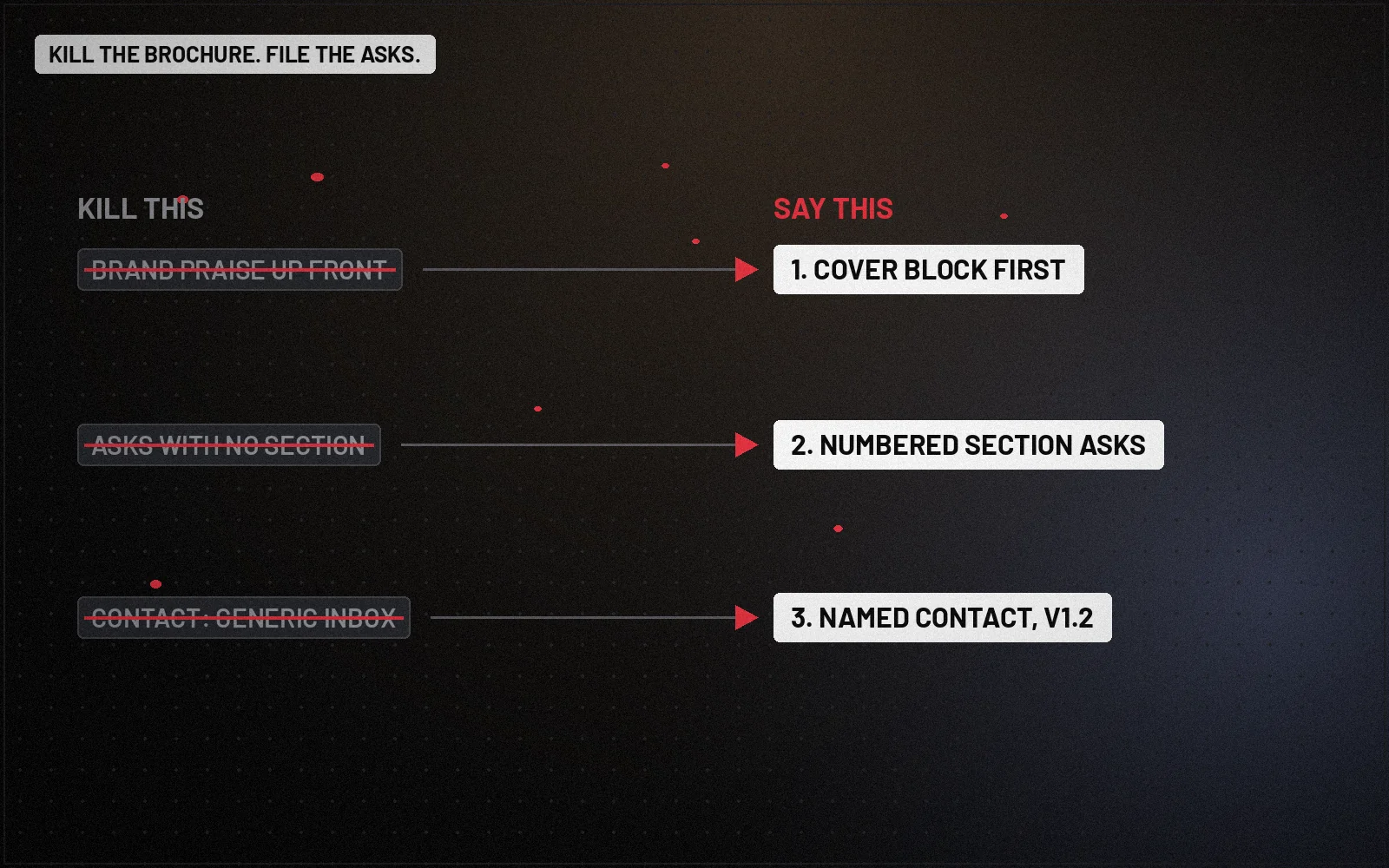
Cover block (fictional)
- Respondent: [Association Legal Name], representing [N] member companies in [segment] operating in Singapore
- Contact: secretariat@example.org (illustrative)
- Consultation: Draft [Instrument Title] public consultation — soft-copy submission
- Date / version: v1.2 counsel-cleared
Executive summary asks (illustrative numbering)
- 1. Clarify scope thresholds for which operators fall in-scope (problem: ambiguous revenue / capacity tests create uneven compliance planning).
- 2. Align incident clocks with existing cyber / data pathways where definitions overlap (problem: dual reporting without a lead agency wastes the first hours).
- 3. Phase transition for documentation standards already recognised in industry audits (problem: overnight re-papering without accepting existing evidence).
- 4. Publish implementation guidance before licence applications open (problem: application forms that ask for undefined metrics).
- 5. Confirm confidential annex treatment for member cost models (problem: public file would expose pricing).
Sample section comment (policy tone, not press)
> Clause / para: [X] — definition of in-scope service > Position: Clarify > Reason: As drafted, it is unclear whether [service pattern A] that only serves intra-group users meets the threshold tests. Without clarity, members cannot schedule licence readiness or capital planning. > Illustration: A member operating a captive facility solely for group workloads would interpret the current wording as [ambiguous outcome A or B]. > Suggested formulation: Limit in-scope facility services to those offered to unrelated third parties, or define “serve other parties” expressly. > Not requested: Blanket exemption language without criteria.
What this outline deliberately omits
- Celebrity quotes, campaign visuals, or “Singapore’s innovation future” filler
- Named competitors or attacks on other respondents
- Invented fine amounts, licence counts, or “the agency will accept X” predictions
- Confidential cost tables in the public body (those stay in a marked annex if the notice allows)
Treat this as a training skeleton. Replace every bracket with counsel-approved facts for your live paper.
Common traps that make Singapore responses look like PR
| Trap | Why it fails | Fix |
|---|---|---|
| Brochure PDF | Officers markup Word/Excel; design-heavy files slow review | Follow stated soft-copy rules; keep layout boring and navigable |
| One mega-essay | No section pins → unusable | One comment block per clause cluster |
| Emotion as evidence | “Members are worried” without mechanism | State the operational friction + one concrete illustration |
| Late file | Notices may reject late submissions (explicit on some MDDI/IMDA windows) | Work backwards from the stated Singapore clock; freeze 24h early |
| Whole-file confidentiality | Often refused; may return the file unread for substance | Public core + thin confidential annex with reasons |
| Media leak of draft | Turns a consultation into an issues fire | Version control; need-to-know; see issues continuum |
| Ignoring the summary habit | You miss how agencies write closing notes | Read past summaries on the same agency before drafting style |
Decision framework: file, wait, or escalate internally
Use this before you burn association political capital:
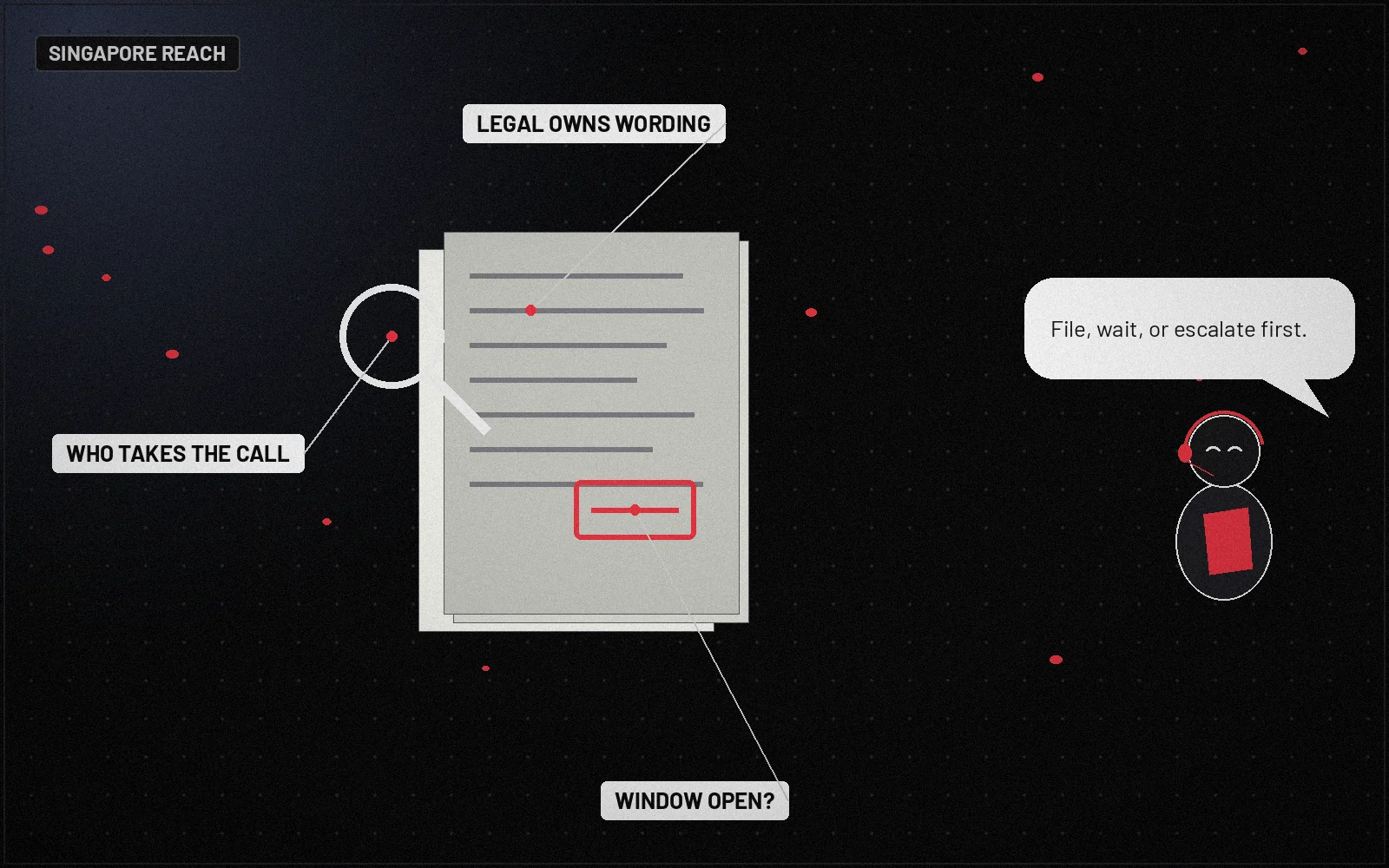
- 1. Is the window open and are you in-scope? If no, do not file a speculative paper that confuses the record.
- 2. Do you have section-level input? If you only have brand praise, skip or file a short identity + “no comment on drafting” note only if strategy requires presence.
- 3. Does Legal own the formulation? Comms owns clarity; counsel owns statutory risk.
- 4. Will a public summary name you? Check the notice; prepare internal lines if identities may be disclosed.
- 5. Is this GR or PA? Buyer language differs—see government relations vs public affairs in Singapore. Consultation drafting is usually PA/GR process with Legal on the markup.
- 6. After filing, who owns the clarification call? Put a name on the cover page who can answer within one Singapore business day.
Map stakeholders who care about the same instrument with stakeholder maps for Singapore market entry and keep regulator lanes straight with the Singapore regulator map.
FAQs
Where do I find open Singapore public consultations?
Start with the REACH public consultation list, then open the agency’s linked notice for clocks and channels. IMDA also maintains a consultation papers page for its own exercises.
Can I submit anonymously?
Most notices ask you to identify yourself and your organisation so they can clarify comments. Follow the specific paper; do not assume anonymity.
Will my submission be published?
Many notices reserve the right to publish all or parts of submissions and to disclose identities, with a process for confidential annexes. Read the invitation-for-feedback section of your paper—for example the confidentiality paragraphs on the Digital Infrastructure Bill REACH page.
Is a press release an acceptable “response”?
No. Use the stated template or soft-copy format, pin to sections, and write for policy officers—not headlines.
Does filing a consultation response replace a government-relations programme?
No. A consultation file is one artefact. Ongoing GR/PA hygiene—meeting notes, follow-ups, public silence rules—is separate work.
What to do next
Pick one live or upcoming window on REACH. Build the structure table into a blank comment matrix today—identity, scope, five numbered asks, section pins, evidence annex, confidentiality check—then fill facts with counsel. If you need a Singapore public-affairs desk to pressure-test tone before you hit send, start at Singapore public affairs or contact Neuwark (hello@neuwarkcommunications.com · +63 923 859 6587).