
When Infocomm Media Development Authority (IMDA) opens a public consultation on a code of practice—or a draft Bill that will later spawn codes—most corporate teams treat it as a legal inbox item. That is how you miss the window, publish the wrong tone on LinkedIn while the file is still open, or discover at T-1 that Product never saw the draft that Legal marked “sensitive.”
This is a reusable IMDA codes compliance communications checklist for Singapore-based communicators: process hygiene before a consultation closes, not a reading of any single statute. As of 25 September 2026, there is no IMDA code consultation we can verify as open today. Recent closed windows—including IMDA’s review of the Code of Practice for Info-communication Facilities in Buildings (COPIF) (comments due 12 noon, 18 May 2026) and the draft Digital Infrastructure Bill (comments due 22 July 2026, 10am; MDDI and IMDA published their closing note on 8 September 2026)—show the same operating pattern you will need for the next one.
Educational note (YMYL): This article is operator guidance for corporate and public-affairs teams. It is not legal advice, not a substitute for Singapore counsel, and not an official IMDA, MDDI, POFMA Office, or Online Safety Commission position. Codes, Bills, and consultation instructions change—confirm the live paper, email address, deadline, and confidentiality rules before you send anything.
Neuwark Communications runs Singapore public-affairs and crisis drills from our account office at Level 39, Marina Bay Financial Centre Tower 2, 10 Marina Boulevard, Singapore 018983. Soft path: Public affairs · Crisis rapid response · Contact. Related reading: brand safety agency Singapore AI likeness ads, Singapore energy security corporate communications, unpopular policy narrative Singapore ministerial pay.
Why communicators own part of the consultation clock
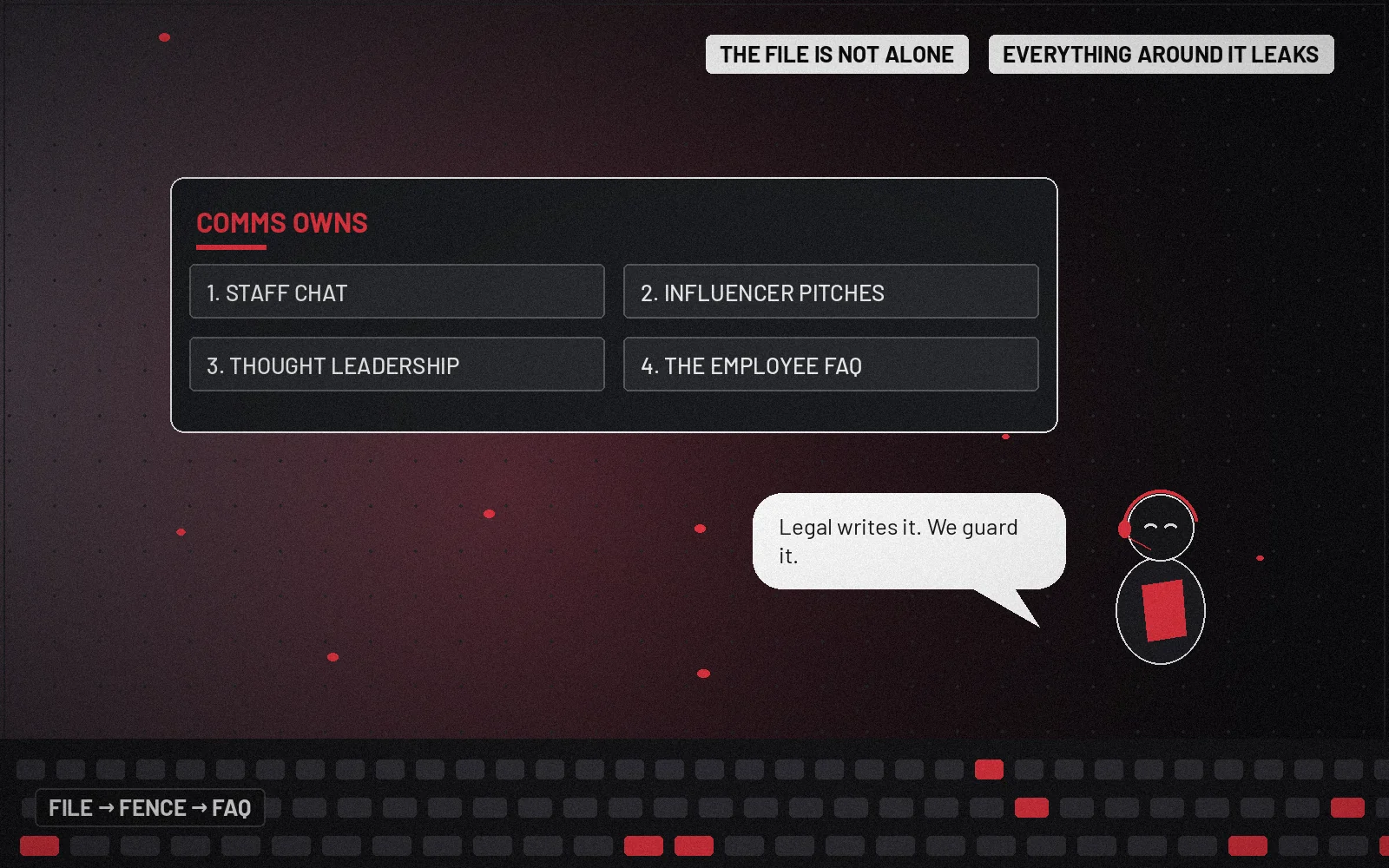
Legal owns the submission text. Communicators own everything that can leak around it: employee Slack chatter, influencer pitches, “thought leadership” drafts, media exclusives, and the internal FAQ that stops a well-meaning engineer from posting a hot take on a live regulatory file.
Singapore’s digital regulatory stack sits under the Ministry of Digital Development and Information (MDDI)—formerly MCI, renamed effective 8 July 2024—with IMDA among its agencies. The POFMA Office sits within IMDA and administers the codes of practice issued under POFMA. Separately, the Online Safety Commission began operations on 29 June 2026, the same day specified provisions of the Online Safety (Relief and Accountability) Act 2025 took effect—adjacent pressure for platforms and publishers, not a substitute for IMDA code hygiene.
If your brand operates in Singapore (en-SG audiences, local staff, SG-regulated product, or regional HQ narrative), treat every IMDA/MDDI consultation as a comms control window, not only a counsel deadline.
Who this is for / who should skip
| Use this checklist | Skip or hand off |
|---|---|
| Corporate comms / public affairs leads at firms that may be named in, or affected by, an IMDA code or Bill | Purely overseas entities with no SG operations, staff, or product—still verify with counsel if you publish into SG |
| Product marketing leads whose roadmap language could pre-empt a draft rule | Teams that only need a one-line “we follow all laws” boilerplate (too thin for consultation weeks) |
| Agencies coordinating multi-stakeholder replies for trade associations | Anyone seeking case outcomes, fine amounts, or guaranteed regulator reactions—those are not published here |
Original element: pre-close consultation ops pack
Below is the artefact pack we run with clients before an IMDA (or joint MDDI/IMDA) consultation closes. Steal the structure; fill with your counsel’s reading of the live paper.
1) Role matrix (Comms / Legal / Policy / Product)
| Role | Owns before close | Signs off | Must not dump onto others |
|---|---|---|---|
| Comms / Public affairs | Holding lines, employee FAQ, media fence, social kill list, stakeholder map | External narrative tone; what staff may say | “Legal will handle all talking” while LinkedIn stays ungoverned |
| Legal | Substance of submission; confidentiality annex; privilege calls | Final soft-copy filing text | Expecting Comms to invent policy positions overnight |
| Policy / GR | Issue ranking; association alignment; meeting notes hygiene | Whether to submit at all vs silent ops | Briefing desks in ways that brief regulators by accident |
| Product / Engineering | Feature-claim inventory; roadmap language audit; open beta copy | Technical accuracy of any annex | Shipping marketing pages that contradict the draft position mid-window |
If one row is empty, your submission may be clean while your public surface is not—and that is a communications failure, not a Word formatting failure.
2) Document pack list (build before T-14)
- 1. Live consultation PDF + any annexes (version-stamped; store hash or download date).
- 2. One-page company interest statement (why you care; no spin).
- 3. Claims inventory: every public product claim that touches the draft code’s subject (connectivity, online safety, data centres, media, etc.).
- 4. Stakeholder map: employees, investors, customers, association, journalists who will ask.
- 5. Draft submission skeleton matching the structure the live paper requests. Some papers prescribe one—the draft IMDA (Amendment) Bill consultation asked for a cover page with particulars, table of contents, summary of major points, statement of interest, comments and conclusion—while others, such as the COPIF paper, ask for concise, reasoned comments that identify the section addressed.
- 6. Confidentiality annex procedure: what may go in a marked annex vs what must stay open.
- 7. Employee FAQ (short; approved phrases only).
- 8. Kill list (see below) posted where social calendars live.
- 9. Soft-copy export checklist: Word or PDF, required email subject line, correct channel (an online form, Consultation@imda.gov.sg, or a consultation-specific MDDI address—use the paper’s channel, not habit).
- 10. Post-submit silence protocol until the authority publishes a closing note or invites further engagement.
3) Timeline reverse calendar (T-14 / T-7 / T-2 / T-0)
| Mark | Clock meaning | Comms actions | Legal / Policy actions |
|---|---|---|---|
| T-14 | Two weeks before published deadline | Freeze speculative thought-leadership on the exact consultation topic; open war-room channel; inventory live campaigns | Confirm deadline (noon vs 10am matters); assign drafter; list confidential annex candidates |
| T-7 | One week out | Circulate employee FAQ; brief spokespeople; pause influencer briefs that touch the file | First full draft; escalate red issues to exec |
| T-2 | Forty-eight hours out | Dual-control social publish rights; media “no exclusive on open file” fence | Freeze text except counsel edits; prepare soft-copy package |
| T-0 | Deadline day | No celebration posts; confirm send receipt/time; keep FAQ live | Submit by stated local time; archive proof of send |
Worked example (process only): The COPIF consultation paper took comments through an online form, accepted soft copies at Consultation@imda.gov.sg under a prescribed email header as an alternative, and set the cut-off at 12 noon, 18 May 2026. The Digital Infrastructure Bill window ran 1–22 July 2026 with a 10am cut-off to DigitalInfrastructure@mddi.gov.sg. Your reverse calendar should bake in time of day, not only the calendar date.
4) Public-comment vs silent-ops decision tree
- 1. Will the eventual code or Bill materially bind your licence, product, or infrastructure posture in Singapore? If yes → default toward a reasoned submission (alone or via association).
- 2. Do you have operational evidence the authority asked for? If yes → submit; if no → do not invent case studies.
- 3. Would a public submission create customer panic disproportionate to the draft? If yes → prefer association channel or confidential annex (only where the paper allows) + tight employee FAQ.
- 4. Is the window shorter than your approval chain? If yes → escalate at T-14 or accept silent ops deliberately—not by accident.
- 5. Document the choice. Silent ops is a decision. “We forgot” is not.
5) Internal FAQ for employees (template prompts)
- What is open for comment, in one plain sentence?
- Are we submitting? (Yes / via association / no—chosen reason.)
- What may staff say if a journalist asks?
- What must staff not post on personal or company channels while the window is open?
- Who is the single internal owner for rumours?
Keep answers short enough to fit a phone screen. Long FAQs do not get read in a consultation week.
6) What NOT to post while consultation is open (kill list)
- Speculative “IMDA is about to ban X” threads.
- Screenshots of draft annexes marked confidential or commercially sensitive.
- Product roadmap teasers that imply the draft rule already finalised in your favour.
- Gotcha comparison posts naming peers’ alleged non-compliance.
- Humour memes that trivialise online harm, falsehoods, or safety—especially with the Online Safety Commission operating since 29 June 2026.
- “We already comply with the new code” claims before the code exists.
- Influencer seeding that asks creators to lobby the consultation without Legal’s sign-off.
- Media exclusives that pre-empt your own submission’s careful wording.
Post the kill list next to the social calendar, not only in a SharePoint folder nobody opens.
How IMDA / MDDI consultations typically work (comms-relevant bits)
Patterns that keep recurring—always re-read the live paper:
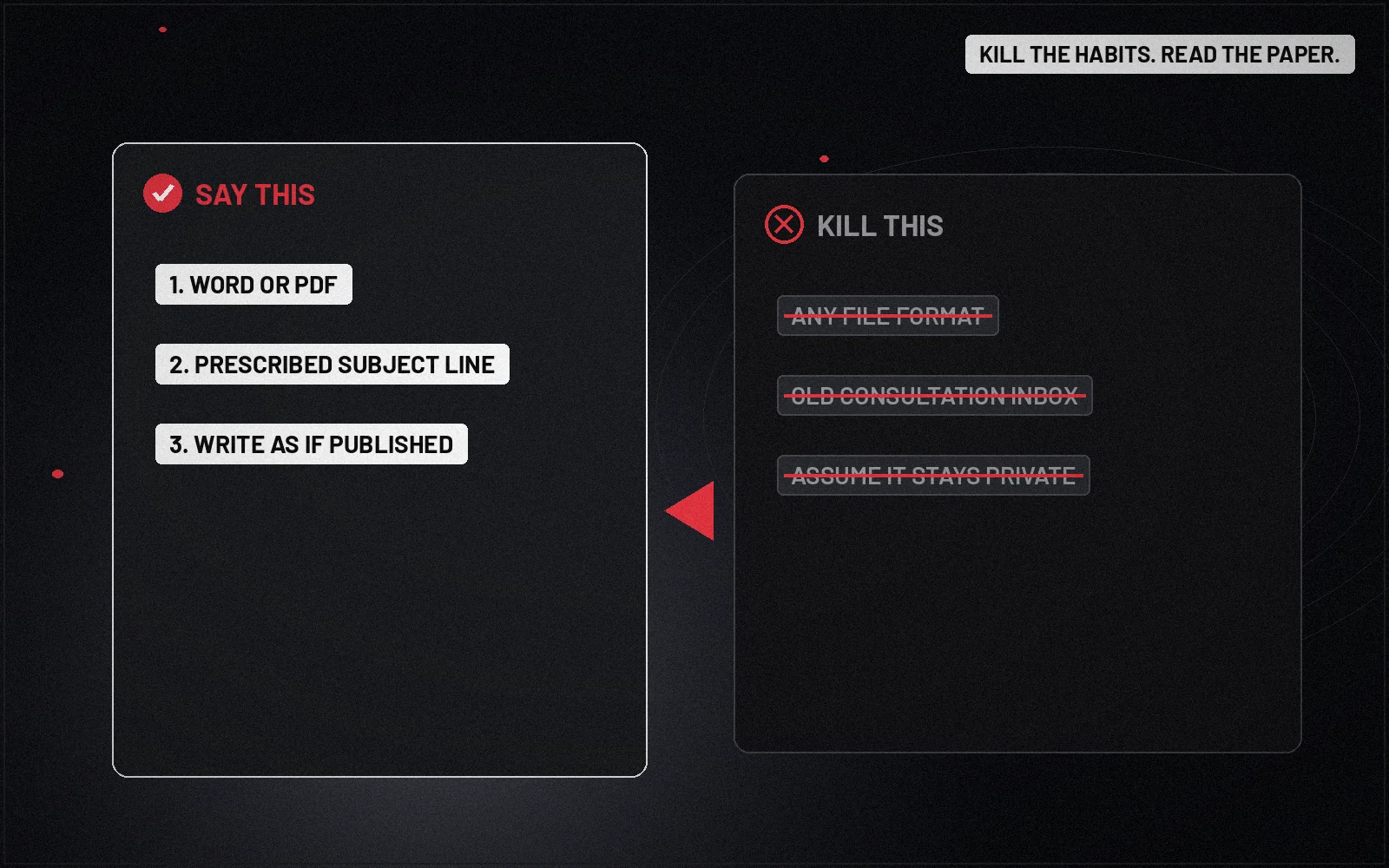
- Soft copy only, usually Microsoft Word or PDF.
- Prescribed email subject including the consultation name and submitter identity.
- Particulars required: name/organisation, correspondence address, contact number, email.
- Late submissions may be rejected: the Digital Infrastructure Bill paper reserved the right to reject them, and the IMDA (Amendment) Bill paper said they would not be considered—do not plan a T+1 “oops” send.
- Authorities commonly reserve the right to publish all or parts of submissions and to disclose identities; confidentiality requests need a separate marked annex with reasons, and both the COPIF paper and the Digital Infrastructure Bill consultation said they would not accept a submission seeking confidential treatment of all, or a substantial part, of it.
For communicators, that means: write every “public” paragraph as if it could appear on a .gov.sg page with your company name attached.
Singapore-first framing for regional HQs
Regional HQ teams in Marina Bay or elsewhere often draft in “APAC English” and forget en-SG specificity. For IMDA codes compliance communications, lock:
- Singapore as the primary jurisdiction in the first screen of any employee note.
- Separate talking points for PH/MY/ID markets—do not paste one ASEAN blob.
- NAP discipline if you cite presence: our Singapore account office address is public; phone remains +63 923 859 6587 (no invented +65). Email for this desk: hello@neuwarkcommunications.com.
Pair this checklist with your crisis fence when a consultation story becomes a headline—see crisis rapid response and the haze / energy narrative playbooks already on Insights.
Common traps (and how to avoid them)
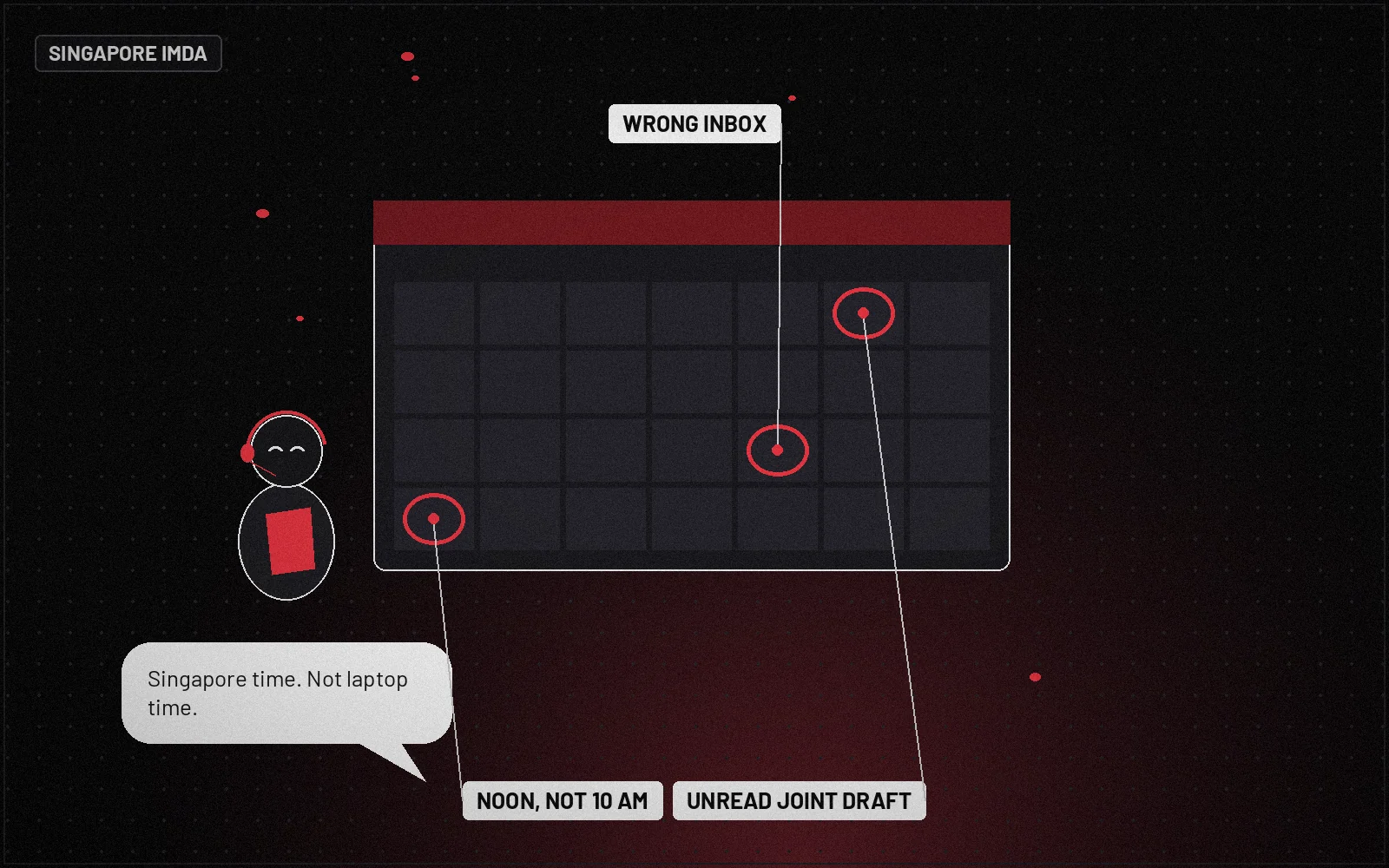
- 1. Deadline blindness — noon vs 10am; Singapore time, not your laptop’s travel TZ.
- 2. Wrong inbox — habit-sending to last quarter’s consultation address.
- 3. Thought leadership during the window — sounds smart; often pollutes the file.
- 4. Association free-riding without reading the joint draft — your logo still rides the tone.
- 5. No employee FAQ — staff invent positions on Blind/LinkedIn.
- 6. Confusing IMDA codes with POFMA Directions or OSC remedies — adjacent, not identical; keep the fences clear.
Soft next step
If you are building a Singapore regulator calendar (IMDA, MAS-adjacent narratives, PDPC, POFMA adjacency), use this pack as the standing T-14 ritual. For hands-on public-affairs process design—not legal opinions—start at Public affairs or Contact.
FAQs
What is “IMDA codes compliance communications” in practice?
It is the corporate communications system that runs around IMDA codes of practice and related consultations: role clarity, timelines, employee language, media fences, and submission hygiene—so Legal’s filing is not undermined by public noise.
Is there an IMDA code consultation open on 25 September 2026?
We could not verify an open IMDA code consultation on publish day. Recent closed examples (COPIF review; Digital Infrastructure Bill) illustrate the process. Monitor the IMDA consultations listing, the MDDI newsroom and REACH’s public consultation listing for the next window.
Should we always submit a public comment?
No. Use the decision tree above. Sometimes association channels or deliberate silent ops are wiser—document why.
How does this relate to POFMA or the Online Safety Commission?
The POFMA Office sits within IMDA and administers the codes of practice issued under POFMA; the Online Safety Commission (operating since 29 June 2026 under the Online Safety (Relief and Accountability) Act 2025) is a related but distinct online-harm redress track. Do not mash them into one holding line.
Can Neuwark draft our IMDA consultation reply?
We support communications process, narrative fences, and stakeholder hygiene for Singapore public affairs. Legal conclusions and formal regulatory submissions remain with your Singapore counsel.
If consultation season is your operating reality, bookmark our public affairs agency Singapore hub and government relations consultancy Singapore page for retainer, engagement hygiene, and response shapes.