
IMDA consultation talking points should do one thing: let your people say something true, short, and safe while the file is still open. Legal owns the submission. Comms owns every sentence staff, spokespeople, and social desks say around it.
This is the language companion to our communicator’s checklist before an IMDA code consultation closes. That checklist covers roles, the document pack, the reverse calendar, and the kill list. This piece turns them into lines you can say and write.
Educational note: This is operator guidance, not legal advice and not an IMDA or MDDI position. Consultation papers set their own channels, deadlines, and confidentiality rules. Read the live paper and confirm every line with counsel.
Why do consultation weeks need their own sentences?
Because the risk is not the submission. The risk is everything around it. An engineer’s hot take. A “thought leadership” post. A product teaser that implies the draft rule is already final.
The parent checklist says it straight: write every public paragraph as if it could appear on a .gov.sg page with your company name attached. Authorities commonly reserve the right to publish submissions. So assume your words travel.
Short sentences travel better. They also get misquoted less.
Which IMDA consultation talking points can corporate comms say?
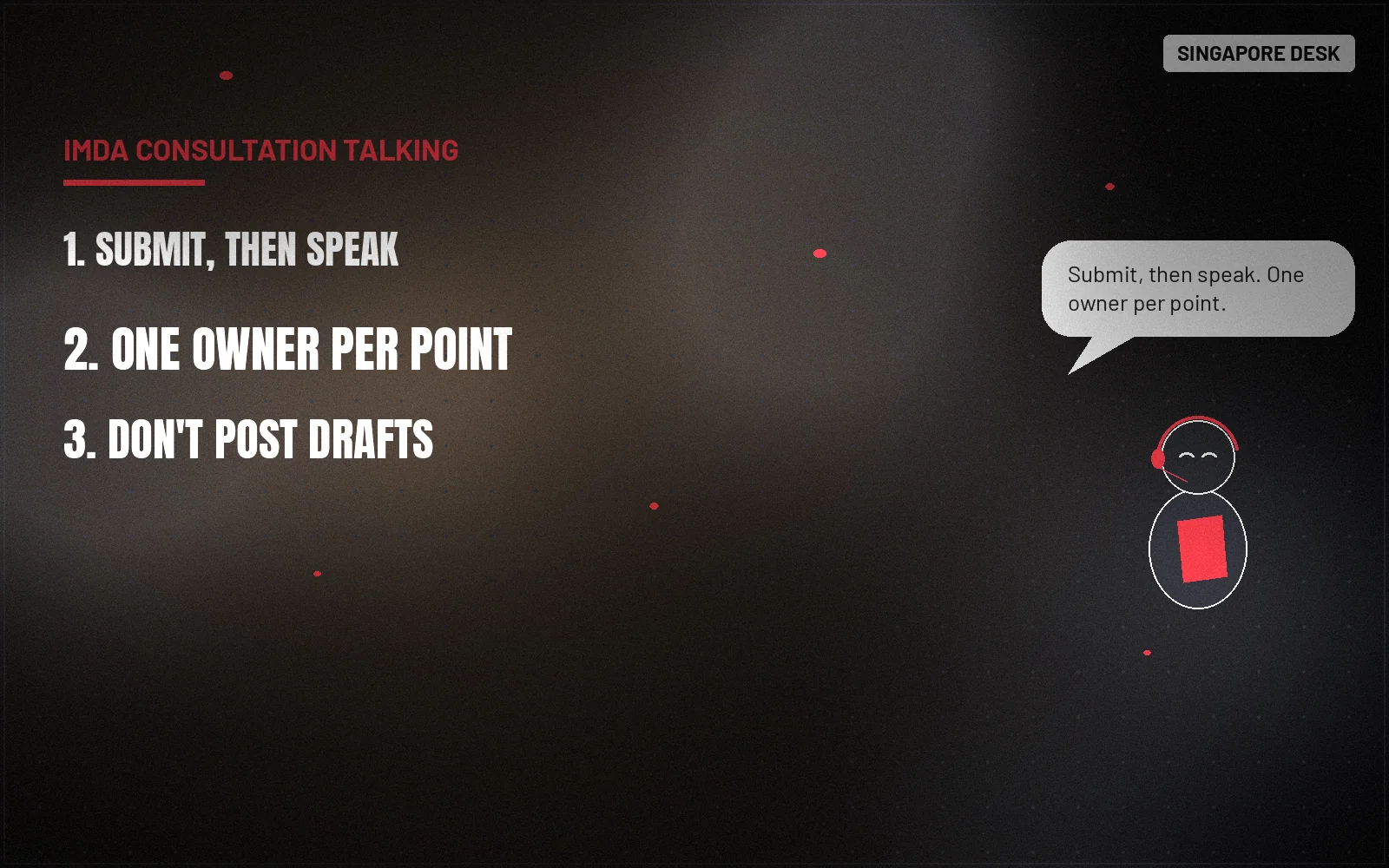
Four lines cover most questions. Each one is checkable. None of them argues the substance in public.
| Job | Say this |
|---|---|
| Acknowledge | “We are aware of the consultation and are reviewing the paper.” |
| Process | “We are preparing our response through the channel the paper sets out.” |
| Owner | “Our policy lead is the contact for questions on this.” |
| Boundary | “We will not comment on the substance while the consultation is open.” |
If you are not submitting, say that honestly: “We are following the consultation and will review the outcome.” Silent ops is a decision. The parent checklist asks you to document why.
If you submit through an industry association, say so plainly: “We are contributing through our industry association.” Do not claim the association’s view as your own until you have read the joint draft.
Which lines sound safe but are not?
Good code consultation holding lines state the process. These four sound harmless. They are not.
| Sounds safe | Why it breaks | Say instead |
|---|---|---|
| “We support the spirit of the code.” | Spirit is not a position. Counsel cannot defend it. | “We are responding through the channel the paper sets out.” |
| “The draft is unworkable.” | Sounds like a fight. It becomes the quote. | “We will not comment on the substance while the consultation is open.” |
| “Industry is aligned.” | You do not speak for industry unless the association letter is signed. | “Our view is in our own response. Association letters are separate.” |
| “Nothing changes for customers.” | You cannot know that until the final text. | “Any customer changes will be explained after the final code is published.” |
Never promise an outcome. Promise an owner and a filing date.
What should staff never post while the window is open?
The parent kill list, turned into a table people will actually read.
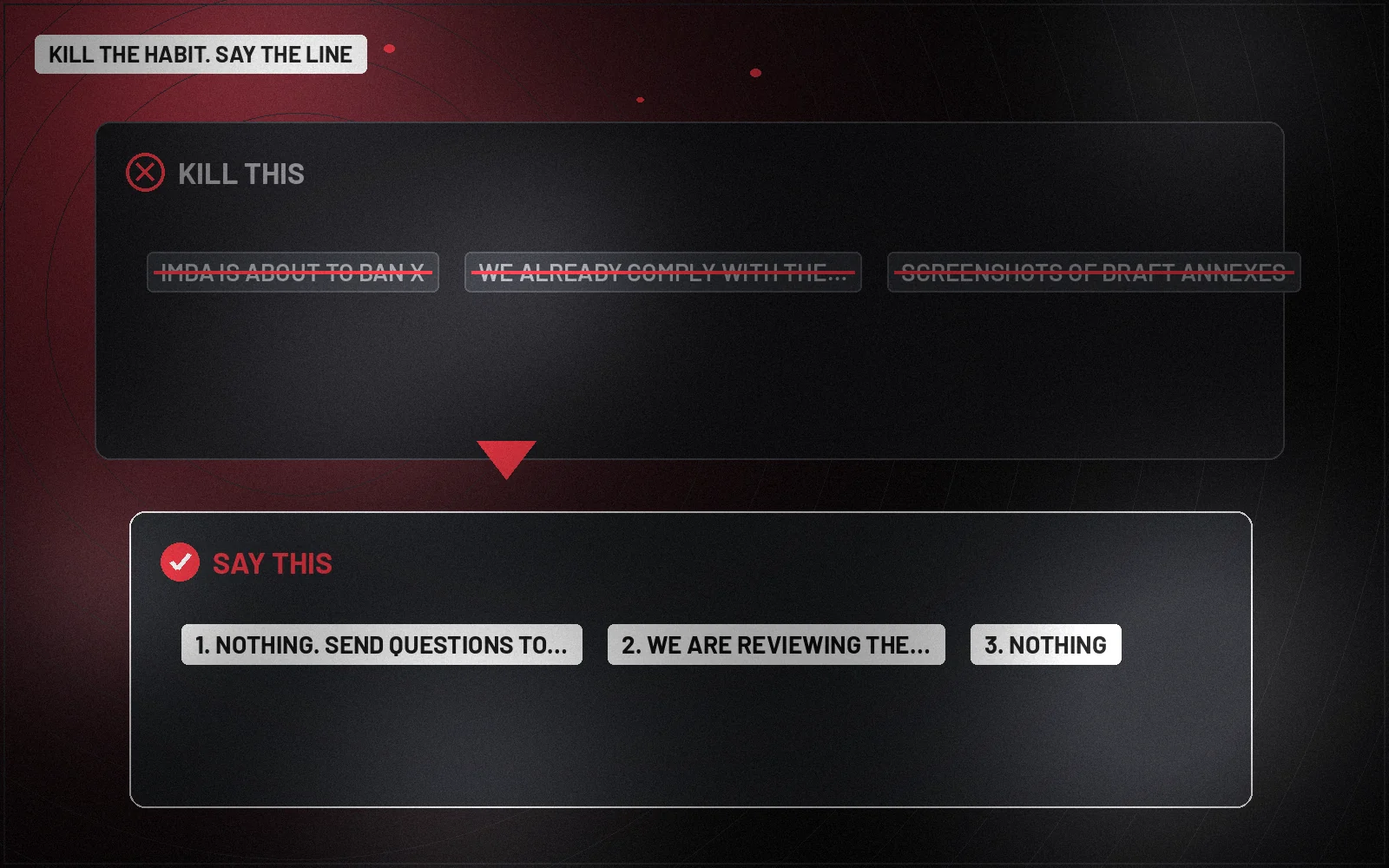
| Don’t post | Why it burns you | Post this instead, or nothing |
|---|---|---|
| “IMDA is about to ban X” | Speculation on a live file, with your logo attached | Nothing. Send questions to the policy lead. |
| “We already comply with the new code” | The code may not exist yet | “We are reviewing the consultation paper.” |
| Screenshots of draft annexes | May breach confidentiality you asked for | Nothing. |
| Roadmap teasers that assume the outcome | Implies the rule is settled in your favour | Ship the teaser after the authority publishes its response. |
| Peer comparison posts | Gotcha posts about other firms’ compliance look like lobbying theatre | Nothing. |
| Jokes about online harm or falsehoods | Trivialises the subject the paper is about | Nothing. |
| A founder “hot take” on the draft | Legal has not signed it, and it reads as your position | Nothing until the window closes. |
| Clause-by-clause arguments in comments | Turns a filing into a public fight | Nothing. The argument belongs in the response. |
Pin this table next to the social calendar. A shared folder nobody opens is not a kill list.
How do you answer a journalist without briefing the regulator by accident?
Use the same four lines. Then stop talking.
The trap is the follow-up. “But do you support the proposal?” is where people freelance. The answer is the boundary line, said again, calmly: “We will not comment on the substance while the consultation is open. Our response will go through the proper channel.”
Do not offer an exclusive on an open file. The parent checklist flags media exclusives as a way to pre-empt your own careful wording.
What does the employee FAQ look like in phone-screen English?
The parent checklist asks five questions. Here are answers that fit on a phone screen. Fill in your own facts.
| Question | Answer shape |
|---|---|
| What is open for comment? | “A public consultation on [topic]. The paper is here: [link].” |
| Are we submitting? | “Yes.” / “Yes, through our association.” / “No. We are following it.” |
| What can I say if asked? | “We are reviewing the paper. Please contact our policy lead.” |
| What must I not post? | “Anything about the substance, drafts, or our position until the window closes.” |
| Who handles rumours? | “Our policy lead. Send screenshots, not replies.” |
Five answers. Under 80 words. That is the FAQ that gets read.
What should the first four sentences of the response say?
Legal owns the submission. Comms can still help lock its opening before anyone writes the long version. Four sentences. One job each.
| Sentence | Job | Pattern |
|---|---|---|
| 1. Answer | What you want the code to do | “We ask IMDA to [specific change] because [one operational reason].” |
| 2. Proof | One checkable fact | “This is based on [named public source or filed figure], cited in the annex.” |
| 3. Boundary | What you are not claiming | “This is not a request to weaken [named consumer or safety duty].” |
| 4. Process | Keeps later lines consistent | “Any public line after the window closes will match this text.” |
If sentence 1 cannot be read aloud in one breath, it is not ready.
What changes on deadline day?
Deadline day is about timing and silence. The parent checklist’s worked examples show why: one paper closed at 12 noon, another at 10am. Time of day matters, not just the date.
Three lines for deadline day:
- Internal: “Submission sent at [time]. Proof of send is archived. No posts about it.”
- If asked: “We have responded through the channel set out in the paper.”
- After close: “We will review the authority’s response when it is published.”
No celebration posts. No “we made our voice heard” graphics. Keep the FAQ live until the authority publishes a closing note or invites further engagement.
Monday field kit
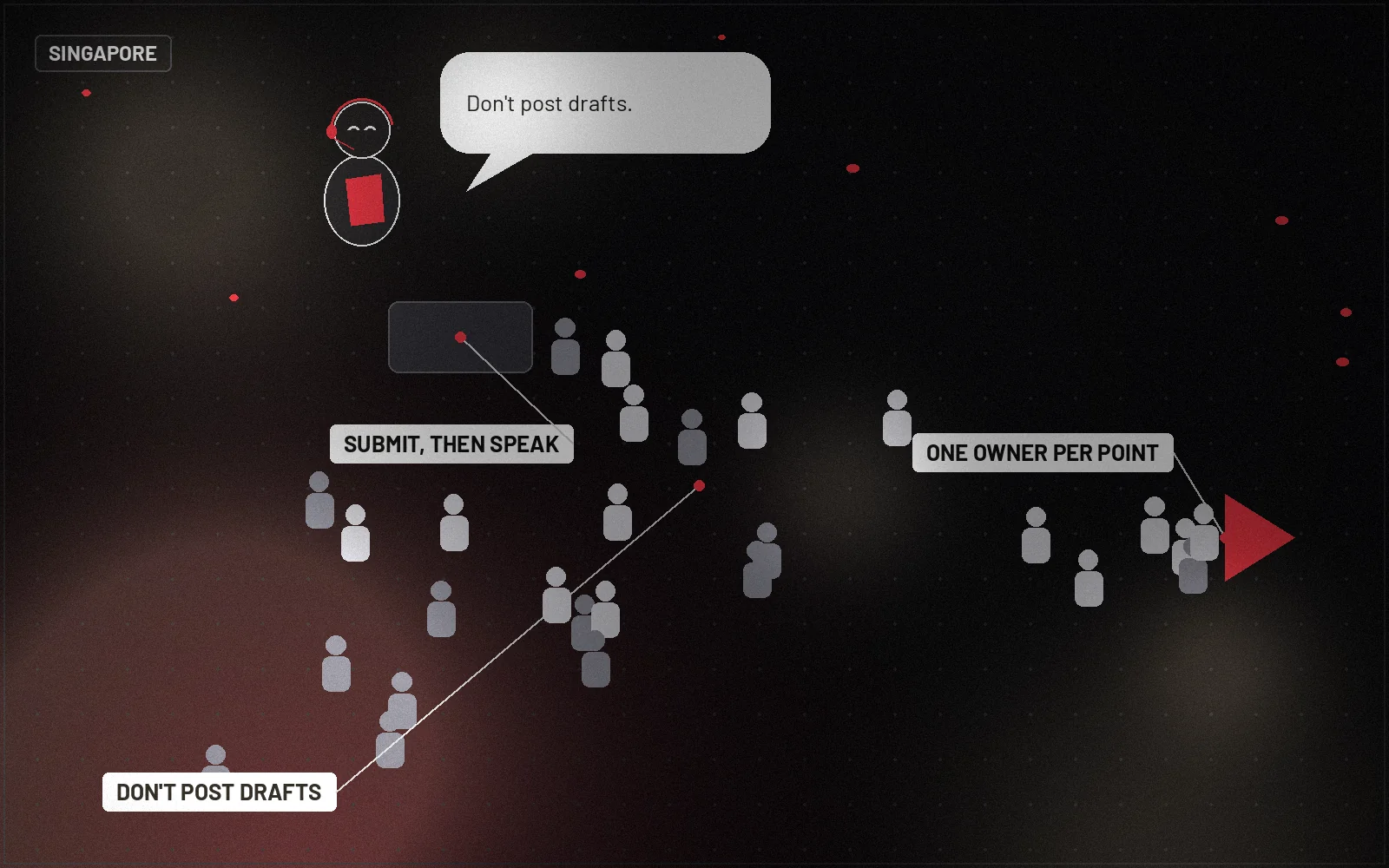
- Write the four-line block with your policy lead’s name. Get counsel to pre-clear it.
- Put the do-not-post table beside the social calendar and in the community managers’ phone notes.
- Ship the five-answer employee FAQ before the next window opens.
- Brief spokespeople on the follow-up trap. Practise the boundary line twice.
- Put the paper’s deadline time of day, in Singapore time, into every calendar invite.
FAQs
What are IMDA consultation talking points?
They are short, pre-cleared lines staff and spokespeople use while an IMDA or MDDI consultation is open. They acknowledge the consultation, name the process and owner, and set a boundary on the substance.
Should we post about our submission after we send it?
Usually not while the window is open. The parent checklist recommends a post-submit silence protocol until the authority publishes a closing note or invites further engagement.
Can staff share the consultation link?
Sharing the official paper is usually fine. Adding opinions about the substance on a live file is where risk starts. Check your own policy with counsel.
Is an IMDA consultation open right now?
Check the live listings on the IMDA and MDDI sites and REACH. Our parent checklist could not verify an open IMDA code consultation on its publish date, so use these lines for the next window.
Who signs the English?
Legal signs the substance. Comms signs the tone and the channel. Government relations maps who receives the response. If one signature is missing, the sentence does not travel.
What to do next
Build the block and the FAQ before the next window opens. For roles, the reverse calendar, and the full kill list, see the IMDA consultation checklist. For scope language between GR and PA, see street-smart English for Singapore GR vs public affairs. For night-shift lines, see POFMA holding lines. For breach wording, see data breach spokesperson lines for Singapore.
Need a consultation-season partner? Start at Singapore public affairs, Singapore government relations, or Contact. More in Insights.