
A face in an ad is now a claim. If you cannot say whose face it is, and who allowed it, you do not have a creative file. You have a future complaint.
AI likeness ads English Singapore buyers can paste is one brief block: source, consent, disclosure, kill rule, incident line. Five fields. Plain words. No model-card poetry.
This is the language companion to our Singapore AI-likeness brand-safety playbook. That piece covers the September parliamentary answer, advertiser verification, and the clearance stack. This one gives you the sentences a buyer pastes into the brief and the launch note.
Street-smart APAC English: short sentences a tired operator can say out loud.
Communications craft, not legal advice. Confirm advertising, consent, and likeness rules with Singapore counsel.
Why does AI likeness ads English Singapore teams use start with consent?
Because “AI made it” is not a defense.
The parent piece puts it plainly: in Singapore, consent and honesty still are. The advertising code’s honesty and genuine-endorsement expectations did not disappear because a pixel approximated a person. A caption that says “AI generated” helps honesty. It does not create consent.
So the English starts with the rights story, not the render.
What must the brief say before anyone generates a face?
| Field | Kill this | Say this |
|---|---|---|
| Source | “AI talent, generic Asian woman.” | “No generated likeness of a real person unless we have written consent and a file name for that consent.” |
| Disclosure | “Only if someone asks.” | “If the person is generated, the ad says so on screen in the opening frame and in line one of the caption.” |
| Lookalike | “Inspired by [celebrity].” | “No lookalike of a named person. No ‘in the style of’ a face we do not own.” |
| Kill | “Fix after launch.” | “If consent or disclosure is missing, the ad does not ship. No ‘we’ll add a sticker later.’” |
| Incident | “Deny it’s them.” | “Pause the ad. Save the file and the brief. Comms and Legal own the next line.” |
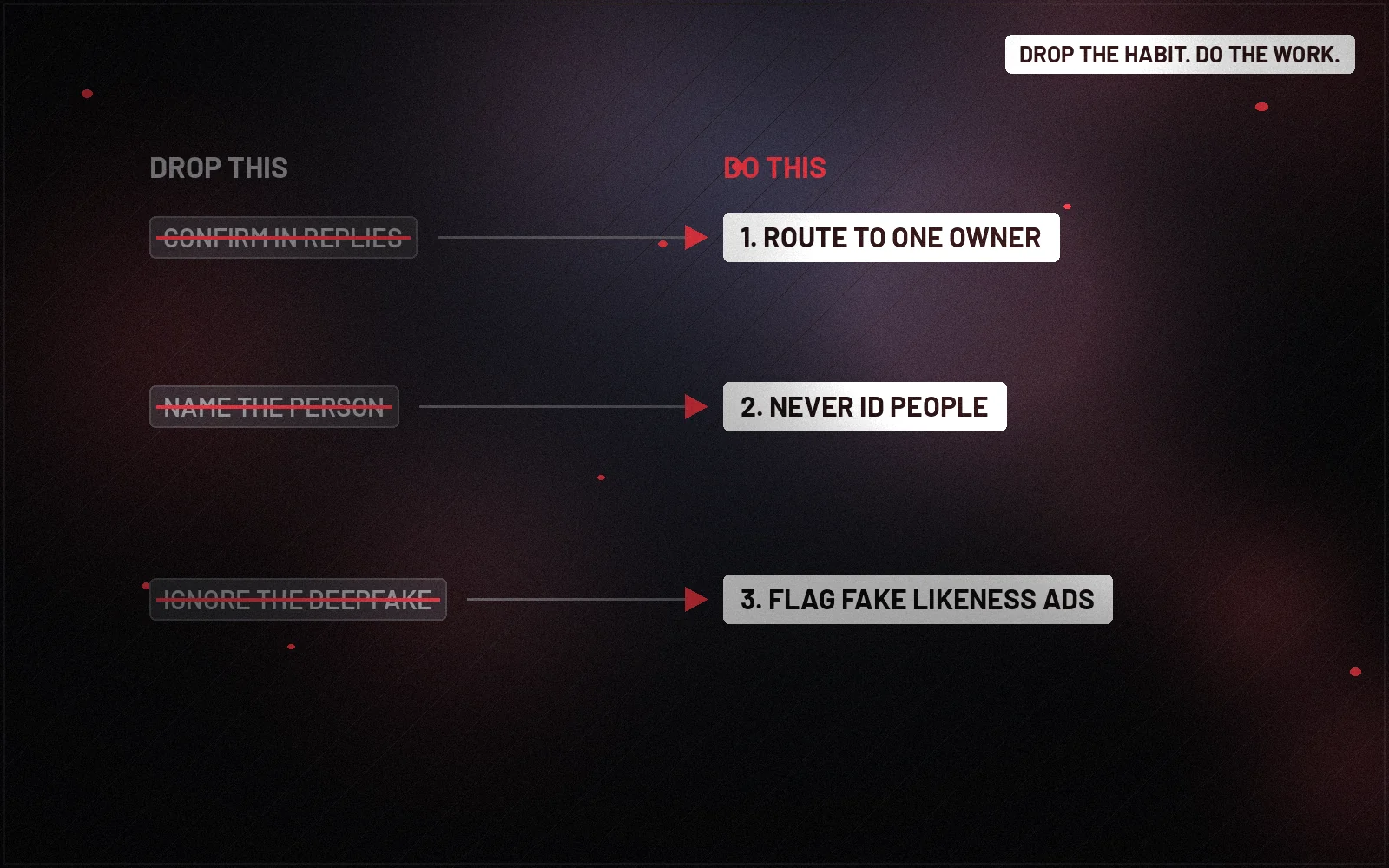
That table is the AI likeness brief block. Paste it above the creative direction, not below it. If the designer reads the mood board first, the face is already made.
Why doesn’t a disclosure fix a missing consent?
Because they answer different questions.
Disclosure answers “is this real?” Consent answers “did this person agree?” A generated face disclosure line tells the viewer the truth about the image. It does not tell anyone the likeness was licensed.
- Say: “This image is generated. It is not a photograph of a real customer.”
- Say: “This person consented in writing on [date]. The consent file is with Legal.”
- Kill: “Our AI is ethical.”
- Kill: “It’s not really her.”
- Kill: “AI-generated, so no endorsement is implied.” Viewers decide what is implied. Not the caption.
The parent piece’s objection list has the same answer: unauthorized likeness stays unauthorized with a caption.
What goes in the buyer’s launch note?
The parent piece lists intake questions every Singapore brief should answer before flight. Here they are as a paste block:
Face or voice: [photo / consented talent / generated].
Consent file: [file name], dated [date]. Legal holds it.
Disclosure: opening frame and caption line one, on every placement.
Would a reasonable viewer think a real person endorses this? [No, because…]
Ad account and paying entity: [names].
Pull owner: [name]. Pull time: [the time you agreed].
Archive: exact served version saved at [location].
If any line says “we’ll figure it out in the edit,” the flight waits.
What do you say when a scam ad steals your face?
This is the other half of the parent piece. Designated platforms must verify advertisers and remove scam impersonation ads under enhanced online criminal harms codes. Your job is the English around the pull.
- Say: “That ad is not ours. We have reported it to the platform. Our official ads run only from [account name].”
- Say, to staff: “Screenshot it, report it, send it to [owner]. Do not reply to it.”
- Kill: “We are not responsible for fake ads.”
- Kill: “Nobody should believe that anyway.”
Your response time is a brand-safety measure, not a social media awareness task. Write the reply before the scammer does.
What does the comment moderator pin?
- “Likeness questions go to [owner], not the comments.”
- “We do not identify people in replies.”
- “If you see an ad using our name that is not from [account name], report it to the platform and tell us.”
Remove junior reply access on the ad’s post while a complaint is open. One reply only: “Thanks. We are checking this with our team. Updates will be posted here.”
Monday field kit
- Audit live ads for faces. Mark each one photo, consented talent, or generated.
- Kill any generated face that lacks on-screen disclosure.
- Kill any lookalike brief that names a person.
- Paste the incident line and the launch-note block into the buyer’s template.
- Store consent file names next to the creative ID.
- Write the scam-impersonation reply and pin it in the social desk’s drafts.
FAQs
What is AI likeness ads English Singapore buyers can paste?
It is a short brief block that makes a buyer treat a face as a rights object: source, consent, disclosure, kill rule, and incident line. It sits above the creative direction so no face is generated before consent is on file.
Do we disclose every generated background?
This kit is for faces and voices. Backgrounds follow the parent playbook and your counsel’s advice on what a viewer could mistake for real.
Does an “AI generated” label make a lookalike acceptable?
No. A label helps honesty, but it does not create consent, so a lookalike of a named person still needs the person’s written agreement or it does not run.
Can we test a generated face in a small account first?
Treat it as production. The parent piece warns that tests escape and small accounts still create screenshots, so the same brief block applies.
What to do this week
If a face cannot survive the sentence “who allowed this,” it does not run.
Neuwark Communications writes clearance briefs and disclosure kits under Media & Paid and Digital & Social. If your buyers are generating faces before anyone checks consent, talk to us at Contact. More in Insights.
Related: Singapore AI-likeness brand-safety playbook · brand safety brief English · OSA brand-admin English · creative test brief English