
On 10 September 2026 MDDI answered Parliament on unauthorized AI-generated likenesses and voices in paid ads. ASAS/SCAP still governs honesty, consent, and genuine endorsements. Enhanced Online Criminal Harms Act codes from 17 August 2026 require designated platforms to verify advertisers and pull scam impersonation ads. OSC inauthentic-material relief remains phased. In Singapore, “AI made it” is not a brand-safety defense—consent and honesty still are.
That combination turns brand safety agency Singapore into a high-intent money query this month. Brands are not searching for vibes. They are searching for clearance retainers before a deepfake testimonial becomes evidence. Soft path: Services · Contact.
Why “brand safety agency Singapore” is a money query this month
Local SEO money pages win when policy risk and commercial search language meet. Singapore’s September restatement did three things for paid teams:
- 1. Reminder that AI likeness/voice ads still sit under existing honesty and consent rules
- 2. Reinforcement that platforms must verify advertisers and remove scam impersonation creatives
- 3. Signal that OSC inauthentic-material powers are arriving in phases—not as an excuse to wait
Searchers type the category they can buy: brand safety agency Singapore, AI ad clearance Singapore, advertiser verification hygiene. If your page is a global case-study gallery, they bounce. If your page converts that search into a clearance retainer CTA, you get the brief.
Interlink without cannibalizing: brand safety paid media audit framework for the APAC audit spine, and brand safety for progressive paid media for advocacy-adjacent hygiene. This page is the Singapore local money door.
AI likeness ads: consent, honesty, and what ASAS/SCAP still require
Street-smart translation for creative teams:
- If a face or voice looks like a real person, you need the rights story—not a model card
- “AI generated” does not erase endorsement and honesty rules
- Genuine endorsement still means the person actually endorses, not that a pixel approximates them
- Disclosures help; they do not legalize unauthorized likeness
Build a creative intake that asks: whose likeness, what consent evidence, what disclosure, what platform inventory, what pull plan if a complaint lands. That intake is product. Selling “AI-first creative” without it is how you buy a Parliamentary PQ as your next case study.
Platform advertiser verification under enhanced OCH Act codes
Designated platforms must verify advertisers and remove scam impersonation ads under enhanced OCH Act codes. Brand teams feel this as:
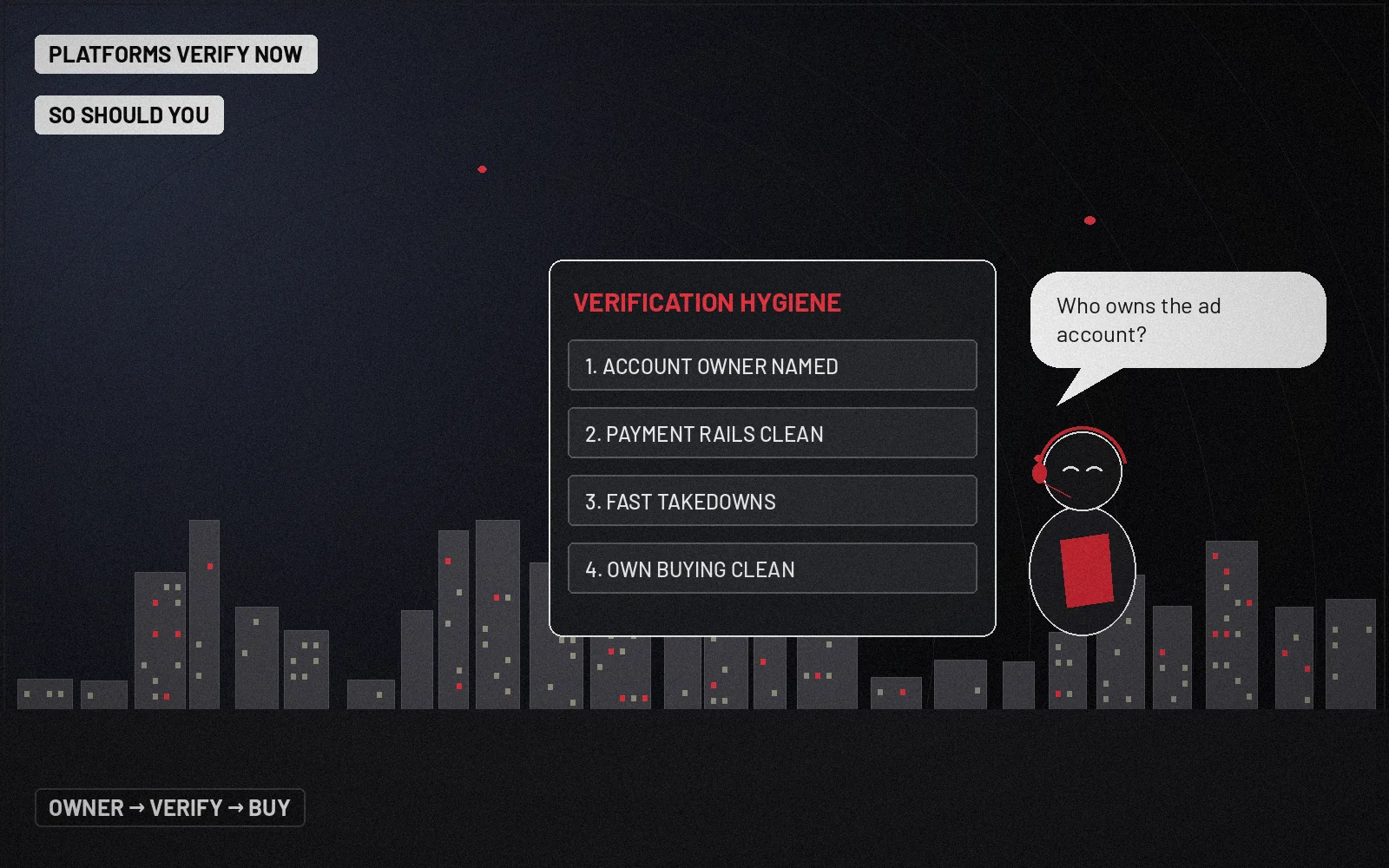
- More friction on account setup and payment rails
- Faster takedowns when impersonation creatives appear
- Higher expectation that your own media buying is clean
Advertiser-verification hygiene is now part of brand safety agency Singapore retainers: who owns the ad account, who can launch, what identity docs sit behind the entity, how you monitor lookalike scam ads that steal your creative. If a scammer runs your CEO’s face tomorrow, your response time is a brand-safety KPI—not a social media “awareness” task.
Creative clearance stack that survives a Parliamentary PQ
Clearance that survives scrutiny is boring on purpose:
- 1. Rights file (likeness/voice/talent)
- 2. Claim substantiation (ASAS/SCAP honesty)
- 3. AI disclosure brief (where shown, how worded)
- 4. Inventory exclusions and placement rules
- 5. Escalation path for complaints and platform pulls
- 6. Archive of versions actually served
Do not store clearance in a Slack thread. Store it where legal and media can retrieve the same PDF at 11 p.m. Pair with ethical retargeting discipline when audience tactics get political heat—see retargeting ethics for progressive campaigns.
What OSC inauthentic-material phasing means for paid teams now
Phased powers tempt teams to wait. Waiting is how you ship a deepfake testimonial “just for testing” that escapes into live inventory. Treat phasing as a warning light: build the stack while enforcement is still ramping, so you are not inventing process under a notice.
Practical now:
- Ban unauthorized likeness tests in production ad accounts
- Require dual approval for any AI-synthesized person or voice
- Monitor for impersonation ads using your marks
- Train media buyers on pull SLAs
Retainer scope: clearance briefs, inventory hygiene, disclosure kits
A brand safety agency Singapore retainer should include:
- Creative clearance briefs for AI and non-AI ads
- Advertiser verification hygiene checks
- Inventory and placement audits
- Disclosure kits that travel across platforms
- Incident response when scam lookalikes appear
- Quarterly tabletop on a synthetic-endorsement complaint
Sink CTAs into Digital & Social / Media & Paid on Services. Insights ranks; Services closes.
Soft CTA: brand safety agency Singapore clearance retainer
Singapore just restated the rules in public. Convert the search into a retainer before a deepfake testimonial becomes your next evidence file. Neuwark scopes brand safety agency Singapore engagements for clearance, verification hygiene, and AI-disclosure kits.
See Services, Insights, Contact, About. Home: [/](/). In Singapore, “AI made it” is not a defense—consent and honesty still are.
How MY and HK buyers use the same Singapore page
Regional media leads often Google Singapore first even when budgets sit in Kuala Lumpur or Hong Kong, because Singapore policy signals travel. Keep the page locally precise (ASAS/SCAP, OCH Act, OSC) while offering regional audit language that points to the APAC brand-safety framework. Do not dilute the Singapore money keyword into a vague “Asia creative safety” brochure. Precision converts. Fog loses the brief to whoever answers with a clearance checklist in the first email.
Intake questions every Singapore creative brief should answer before flight
Before any AI-assisted person or voice enters paid inventory, force written answers:
- 1. Whose likeness or voice is approximated, and do we have documented consent?
- 2. Would a reasonable consumer think a real person endorses this offer?
- 3. What ASAS/SCAP honesty issues sit in the claim line?
- 4. Where does AI disclosure appear across placements?
- 5. Which ad accounts and payment entities sit behind the flight?
- 6. What is the pull SLA if a complaint or platform flag lands?
- 7. Who archives the exact creative version that served?
If any answer is “we’ll figure it out in the edit,” you do not have brand safety agency Singapore clearance—you have a future screenshot. Agencies that sell speed without this intake are selling risk with a moodboard.
Competitive reality: why local SEO pages close retainers
Global networks will still win some RFPs on legacy relationships. Local money pages win the stressed search: a brand manager who just read the MDDI response and needs a partner who can talk ASAS, OCH Act codes, and OSC phasing without a twenty-slide education deck. Your page should:
- Use the phrase brand safety agency Singapore in title, early body, and FAQ naturally
- Show clearance artifacts (anonymized) instead of fake client logos
- Sink to Media & Paid / Digital & Social on Services
- Offer a 30-minute clearance diagnostic, not a “thought leadership coffee”
Internal links to the APAC audit framework and progressive paid-media hygiene prove you have depth without cannibalizing the Singapore head term. Precision is the product.
30-day build plan for the Singapore brand-safety money page
Week 1: Interview legal and media on real pull SLAs; draft intake questions; gather anonymized clearance samples. Week 2: Write the page; generate unique cinematic visuals; set Rank Math focus keyword to brand safety agency Singapore. Week 3: Interlink hubs; QA mobile CTA; train whoever answers inbound on OCH Act talking points. Week 4: Soft launch; run test queries; add FAQ; book one tabletop on synthetic endorsement.
Ship before the next deepfake testimonial trend—not during the complaint. If you need a partner to build the page and the retainer together, start on Contact. Brand safety agency Singapore is not a slogan for a homepage carousel. It is the search after Parliament reminds the market that AI is not a loophole.
Objections Singapore buyers raise—and street-smart answers
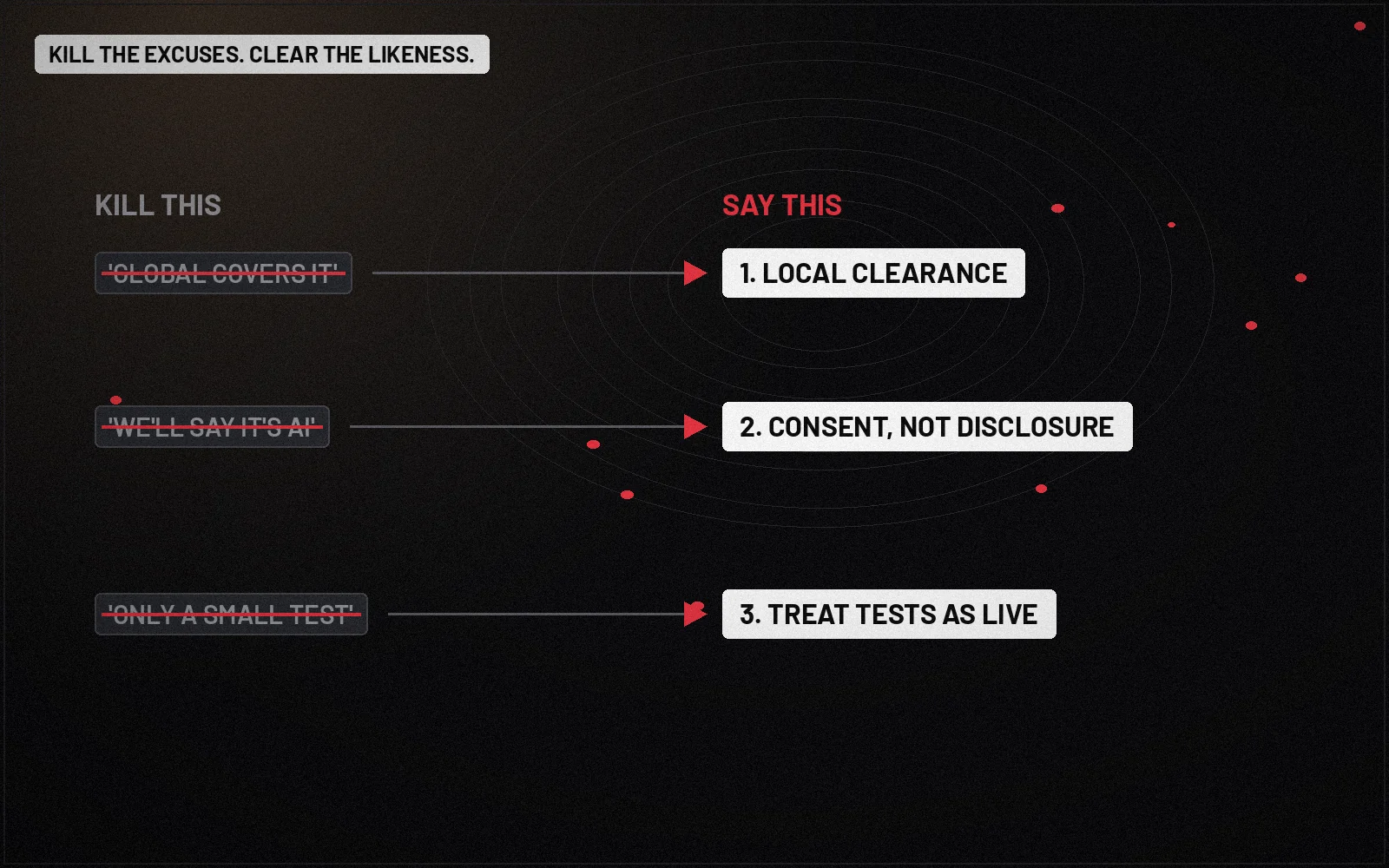
“Our global agency already covers brand safety.” Global coverage often means shared exclusion lists and a quarterly PDF. Ask who clears AI likeness overnight in SGT, who holds the rights file, and who talks to platforms when a scam ad steals your CEO’s face at 1 a.m.
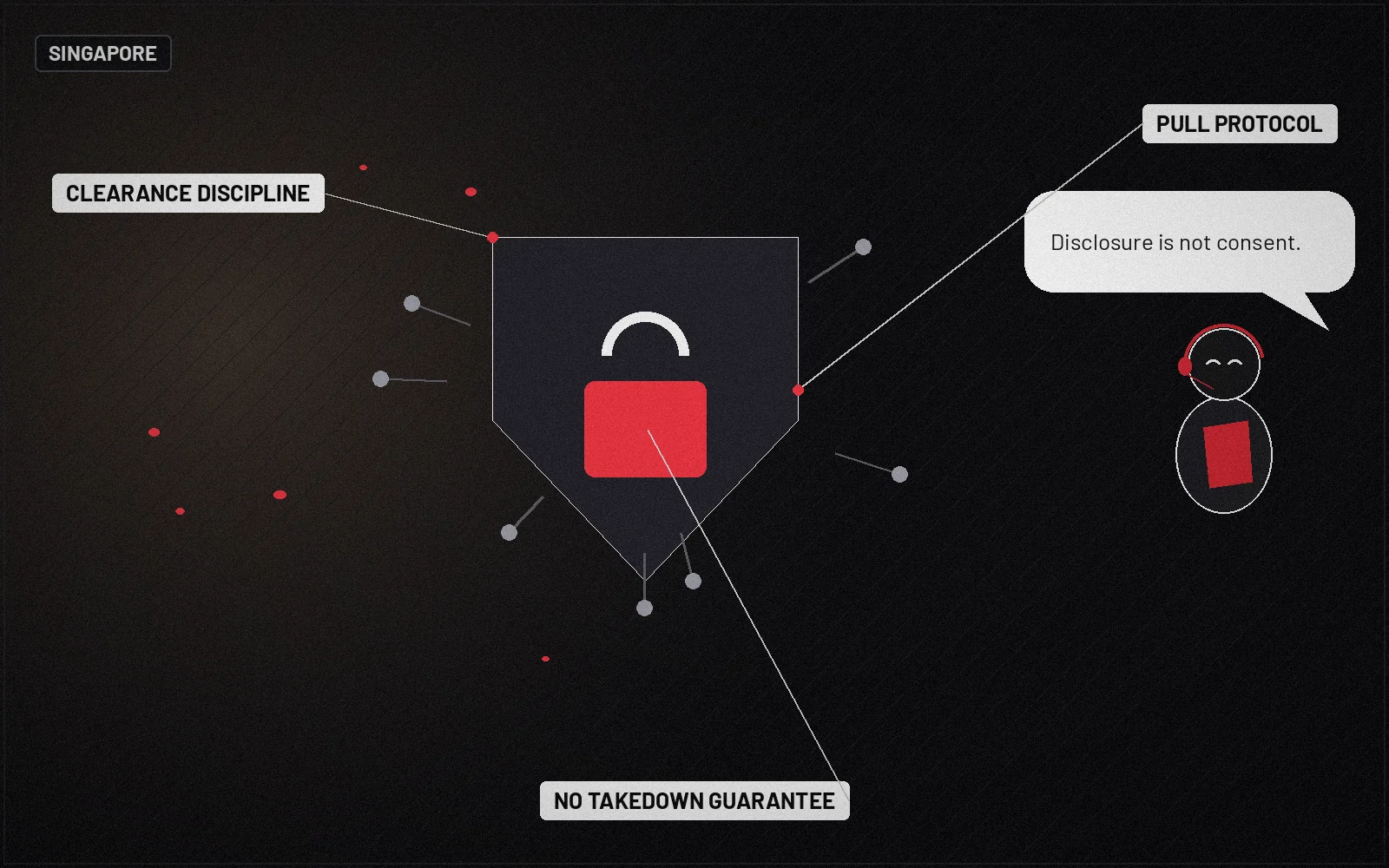
“We’ll disclose that it’s AI.” Disclosure helps honesty; it does not create consent. Unauthorized likeness stays unauthorized with a caption.
“It’s only a test in a small account.” Tests escape. Small accounts still create screenshots. Treat production-adjacent accounts as production.
“OSC powers are phased, so we have time.” Phasing is a runway to build process, not a permission slip to ship synthetic endorsements. Parliamentary attention already arrived.
“Can you guarantee no takedowns?” No honest partner can. Promise clearance discipline, verification hygiene, and pull speed—not weather control over platform enforcement.
Measurement that proves the retainer (not vanity)
Track:
- Number of creatives cleared through the AI-likeness intake before flight
- Time-to-pull on impersonation or complaint events
- Share of ad accounts with complete advertiser-verification docs
- Inbound briefs that mention brand safety agency Singapore or AI ads
- Repeat purchase of clearance retainers after the first quarter
If you only track impressions on the Insights page, you will optimize for curiosity. Optimize for cleared flights and faster pulls. That is how a brand safety agency Singapore engagement pays for itself before the next MDDI reminder.