
Thirty crops of one poster is not a test. It is a very expensive opinion.
Creative test brief English is the half-page a media buyer can paste into a launch note without calling anyone: concept name, distinct claim, kill rule, caption lock. Four fields. Plain words. No mood-board adjectives.
This is the language companion to our advocacy creative testing after Andromeda playbook. That one covers the concept matrix, spend floors, and screenshot gates. This one gives you the sentences that make the matrix readable at 11pm by the person holding the budget.
Street-smart APAC English: short sentences a tired operator can say out loud.
Why does creative test brief English matter after Andromeda?
Because they describe ads, not concepts.
The parent piece makes the point: near-duplicates get treated as one. A brief that says “Variant 1: blue background. Variant 2: red background.” is a brief for one concept wearing two shirts.
The English is where the collapse starts. Words like “fresh,” “punchy,” and “more emotional” let every designer ship crops. Name the promise, and crops stop passing as tests.
How do you name a concept so nobody confuses it with a crop?
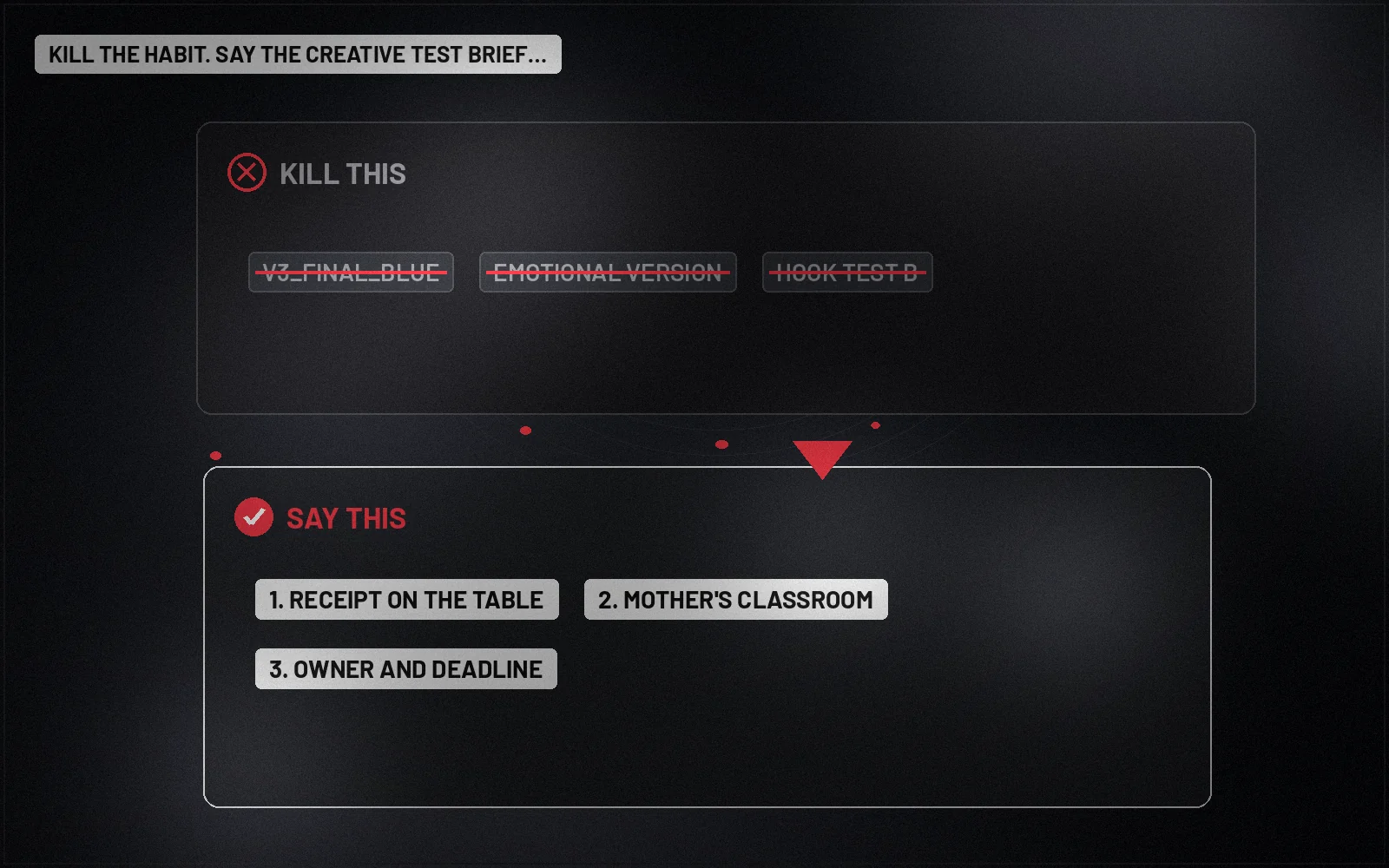
Name it after the promise, not the visual. Two to four words. A name the whole desk can say on a call.
| Kill this name | Why it fails | Say this name |
|---|---|---|
| “V3_final_blue” | Describes a file, not an idea | “Receipt on the table” |
| “Emotional version” | Every concept claims emotion | “Mother’s classroom” |
| “Hook test B” | Nobody remembers B by Thursday | “Owner and deadline” |
| “Urgent flood” | A mood, not a promise | “Relief with a receipt” |
These names are illustrative. Here is the test. If two concept names could swap places without anyone noticing, you have one concept. Merge them. Fund something new.
What makes a claim distinct enough to test?
One sentence no other card in the matrix could say.
The parent piece lists the real variables: promise, proof type, format job, audience job. Your claim line should change at least one of them.
Pattern: “This concept says [promise], proved by [proof type], for [audience].”
- Say: “This concept says every peso has an owner, proved by a named line item, for swing readers.”
- Say: “This concept says relief reached a named barangay, proved by a dated photo with consent, for past donors.”
- Kill: “This concept is more impactful.”
- Kill: “Same as A, but with a stronger hook.”
If the claim needs “but” or “stronger” to explain itself, it is a variant. Variants are fine after you have a winner. They are not a test.
How should a concept kill rule read so night ops actually use it?
Like an instruction a stranger could follow. When. What. Who. No adjectives.
The parent piece asks for kill reasons in one line the board can read. The brief should hold the concept kill rule before launch, not after the argument.
| Kill this rule | Say this rule |
|---|---|
| “Pause if it underperforms” | “Pause after the agreed learning spend if qualified actions are zero. Media ops pauses. No approval needed.” |
| “Watch the comments” | “Pause at once on any screenshot-gate flag: unsourced claim, trauma image, easy to clip against us. Gate owner decides.” |
| “Let’s see how it goes” | “Judge on qualified actions, not CTR. Review on the named day.” |
Write the spend floor as a figure your team agreed on, not one borrowed from a blog. If you have not agreed on one, that is Monday’s meeting.
Keep one brand-risk line even when a concept wins: “Kill even if cheap. Brand risk beats cost per action.” One sentence. It saves an awkward board call.
What is a caption lock, and why does the buyer need it?
A caption lock is the approved on-screen line and post text for a concept, frozen for the test window. Nobody “improves” it mid-flight.
If the caption changes on day two, you changed a variable. Now you are testing a concept and a rewrite at once. That is the “three variables and call it science” trap from the parent piece.
Caption lock block, ready to paste:
Concept: Receipt on the table.
On-screen line: “Every peso has an owner. Here is one.”
Post text: “We found the owner of this line item. Read the one-page note.”
Locked until: review day. Allowed edits: crop and caption size only.
Feeds play on mute. The on-screen line has to carry the claim with the sound off. If the claim only lives in the voiceover, most viewers never hear it.
What goes in an Andromeda tester brief?
Five fields. Each one in a sentence a buyer can paste.
| Field | Kill this | Say this |
|---|---|---|
| Objective | “Drive awareness and engagement” | “Find which of four promises earns briefing sign-ups” |
| Audience | “Everyone who cares” | “Past relief donors, PH, mobile” |
| Variants | “As many as possible for the algorithm” | “Four concepts. Two hooks each, max.” |
| Winner | “Best performer” | “Most qualified actions after the floor, no gate flags” |
| After the test | “Scale it” | “Graduate the winner. Keep one challenger in learning.” |
An Andromeda tester brief is boring on purpose. Boring briefs get followed at midnight.
Monday field kit
- Rename every live concept after its promise. Two to four words.
- Write one claim line per concept. Delete any that need “but.”
- Paste the kill rule into the brief: when, what, who.
- Lock one caption block per concept until review day.
- Read the brief to someone outside paid media. If they cannot say what each concept promises, rewrite it.
- Archive last month’s losers with their kill line, so nobody relaunches them.
Communications craft, not legal advice. Political-ad labels, claims about law or health, and consent for real people in creative need counsel in each market.
FAQs
What is creative test brief English?
It is the plain-language brief a media buyer can paste into a launch note: concept name, distinct claim, kill rule, and caption lock. It defines concepts by promise, so crop variants cannot pass as tests.
How many concepts belong in a small-budget test?
The parent playbook suggests three to five true concepts, each funded enough to learn. A few clearly different concepts teach more than many near-duplicates.
What is a concept kill rule?
It is a one-line instruction that says when a concept stops, what triggers the stop, and who pulls it. It should include a brand-risk trigger that applies even when the concept looks cheap.
Can we edit captions during a test?
Not the claim. Lock the on-screen line and post text for the test window, and allow only crop or caption-size changes, or you are testing a rewrite instead of a concept.
What to do this week
Rewrite one live test brief into four fields before the next launch. Name. Claim. Kill rule. Caption lock.
Neuwark Communications writes test matrices and briefs under Media & Paid and Creative & Brand. If your tests keep collapsing into one ad, talk to us at Contact. More in Insights.
Related: advocacy creative testing after Andromeda · brand safety brief English · Reel caption English · coalition caption pack English