
On 9 September 2026 Thailand opened consultation on draft secondary rules under the amended Alcoholic Beverage Control Act Section 32/1. Product-image bans, 5% logo-area caps, and 10pm–5am broadcast windows moved from rumor to paper. By 18 September, Nation Thailand framed BLACKPINK's LISA "mot kaeo" beer-bottle moment on The Tonight Show as the live global-vs-Thai visibility contrast brands must brief against. That contrast is not entertainment trivia. It is a public affairs agency Thailand problem: global virality is not a Thai compliance defense.
Alcohol-adjacent hospitality, entertainment, and lifestyle brands that treat a US late-night screenshot as policy will learn the expensive way. Information versus inducement is the line regulators and partners will argue. Public affairs is what translates "mot kaeo" into board-ready rules before the fine arrives.
Neuwark Communications builds Bangkok-ready narrative, stakeholder sequencing, and market-entry PA retainers for brands that need Thai-legal language—not imported talking points. Soft path: Services · Contact · About · Insights.
Why LISA's late-night moment is a Bangkok public-affairs event
A viral clip abroad creates three simultaneous pressures in Thailand: consumer expectation ("why can't we show that?"), partner anxiety ("will our Thai cut get blocked?"), and regulatory attention ("are you inducing?"). Boards that only watch US media desks miss the Bangkok clock. Partners and creators already forward the clip in LINE groups with a simple question: what is our Thai rule?
Street-smart truth: the clip is not the crisis. The crisis is the gap between global brand voice and Thai alcohol-comms law. If your Thai agency can only say "we'll check," you do not have a public affairs function. You have a translation desk.
Treat September 2026 as a drill. Section 32/1 drafts are in consultation while a global idol moment loops. That is the exact week market-entry and hospitality brands should lock narrative, not wait for the final gazette. Waiting is how you inherit someone else's apology.
Operational tells you are already late:
- Thai creative still uses product hero shots as default
- Logo area was never measured against a 5% cap
- Broadcast buys ignore the 10pm–5am window
- Creators get "just be careful" instead of a clearance card
- The board deck still cites a US late-night screenshot as "industry norm"
Fix the system before the first KC equivalent letter arrives. For Thailand, the letter may come with a fine attached.
Section 32/1 in plain language: images, logo caps, broadcast windows
Strip the statute voice. Brands need three human rules:
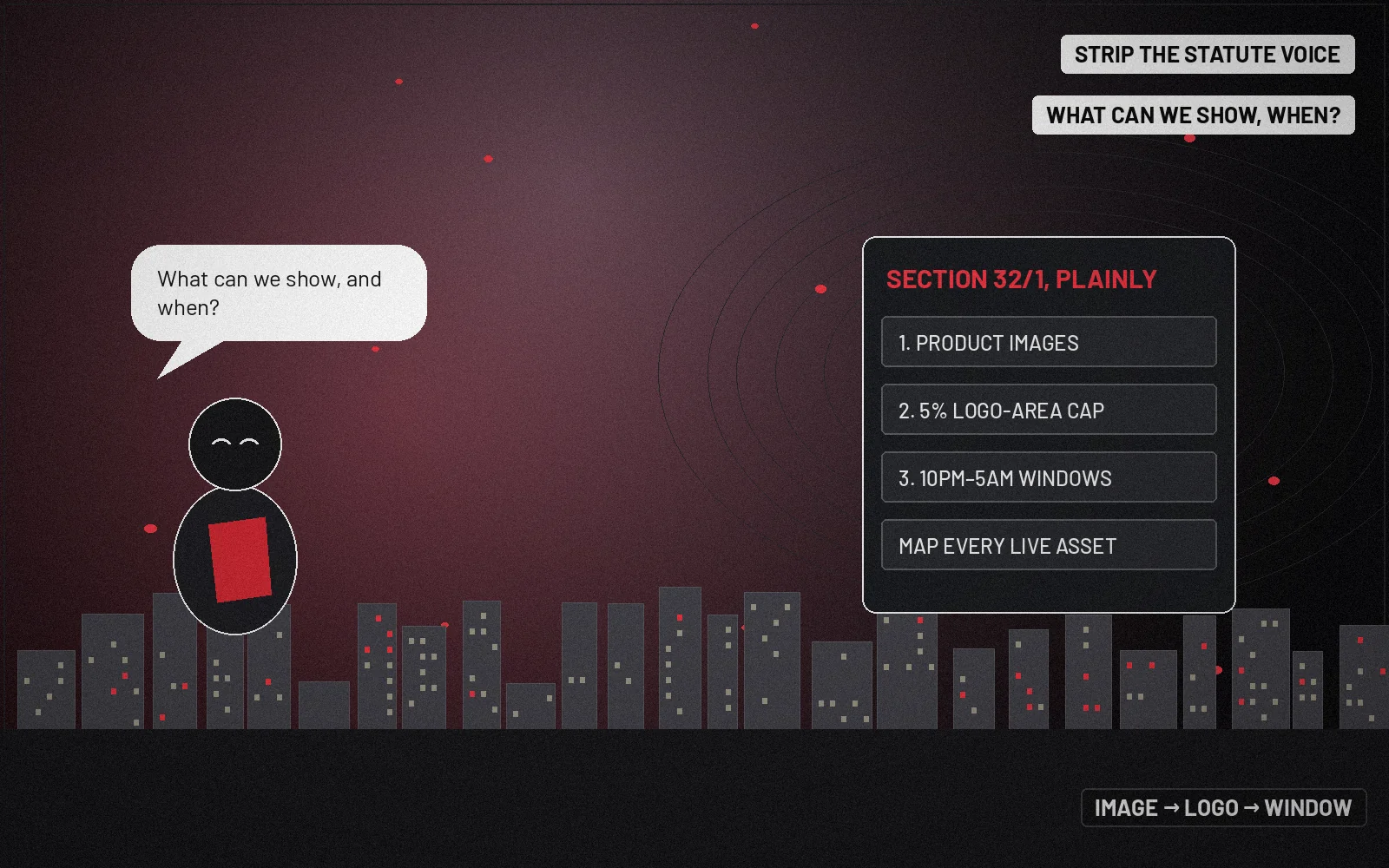
- 1. Product images — drafts tighten when and how alcohol products can appear. "Lifestyle with a bottle in frame" is not automatically safe.
- 2. Logo-area caps — a 5% logo-area logic forces designers to stop treating packaging as the hero. Measure before you ship creative.
- 3. Broadcast windows — 10pm–5am style windows punish daytime spill and "always-on" TV habits.
Plain language wins board rooms. Counsel can keep the statute book. Communications must answer: what can we show, when, and to whom—without sounding like we are daring regulators to test us.
Do:
- Map every live asset against image, logo, and window rules
- Separate "information" assets (facts, responsible-use) from "inducement" assets (aspiration, glamour, celebrity adjacency)
- Give media buyers a hard window checklist
- Update creator briefs with visual do/don'ts, not vibes
Don't:
- Assume global cutdowns are Thai-legal by default
- Hide alcohol cues in "subtle" lifestyle frames and call it clever
- Use celebrity adjacency as a compliance shield
- Wait for "final rules" while consultation drafts already shape partner risk
Pair this with Thailand's broader digital-commerce and influencer scrutiny—distinct from our Thailand influencer disclosure compliance piece, which covers OCPB disclosure, not alcohol Section 32/1 narrative.
Information vs inducement: the line brands get wrong
This is where brands lose money. Teams invent a third category: "aspirational information." Regulators and complainants hear inducement. If the creative needs a celebrity smile, a party glow, or a "join the night" energy to convert, you are not informing. You are inviting.
Test every asset with one question: would a reasonable viewer think we want them to drink more, drink sooner, or drink like this person? If yes, you are in inducement territory—regardless of the disclaimer font size.
Street-smart clearance questions:
- Is the product the hero or the context?
- Is the celebrity associated with consumption or with a separate brand story?
- Can the same message land without showing a bottle?
- Would you defend this frame in a Bangkok hearing without citing US TV?
Build clearance cards that creators and media buyers can screenshot. Cards beat Slack threads. Cards survive Friday night launches. Cards make public affairs agency Thailand retainers feel like operations, not philosophy.
Stakeholder sequence: regulators, partners, creators, boards
Sequence beats slogan warfare. One memo to everyone at once creates contradictory replies by Thursday.
- 1. Internal / board — one paragraph on what changed, what is at risk, what we will stop running.
- 2. Partners / hotels / venues — co-brand rules and logo-area measurement.
- 3. Creators / talent — visual do/don'ts and escalation path before post.
- 4. Media / broadcasters — window compliance and cutdown inventory.
- 5. Regulators / counsel — facts, not marketing tone; single contact owner.
Cross-check Indonesia and Vietnam spillover if your brand runs ASEAN cuts. Our public affairs agency Indonesia hub covers a different fine regime; do not copy-paste. Thailand alcohol-comms is its own narrative system.
Local SEO: "public affairs agency Thailand" as money page + offer
Searchers typing public affairs agency Thailand are not looking for a US case study. They want Bangkok-ready counsel: alcohol, hospitality, entertainment, market entry. This article exists so that intent lands on a page that sells retainers—narrative, clearance, stakeholder sequencing—not a homepage dump.
What the money page must prove:
- You understand Section 32/1 in human sentences
- You can sequence stakeholders without dual panic memos
- You distinguish influencer OCPB work from alcohol PA
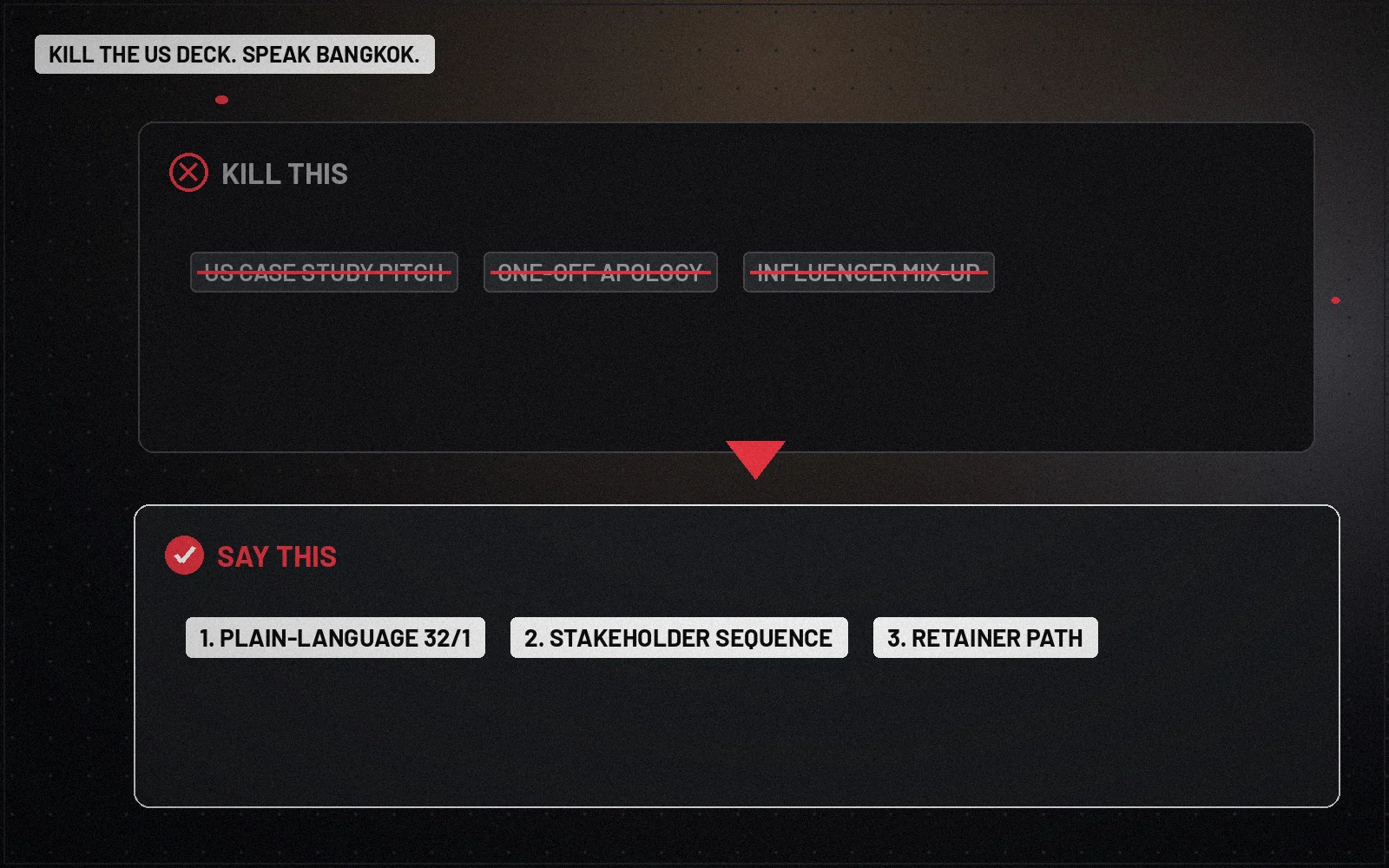
- You offer a retainer path, not a one-off apology
Link the offer to Public Affairs & Advocacy and Crisis & Rapid Response. Soft close through Contact.
Distinct from TH influencer OCPB and marketplace reputation pieces
Do not blur three Thailand problems into one blog:
- Influencer disclosure / OCPB → thailand-influencer-disclosure-compliance-ocpb
- Marketplace reputation / fine risk → separate emarketplace hub
- Alcohol Section 32/1 narrative → this page
Brand-safety adjacency in Singapore (AI likeness) is also a different product: brand safety agency Singapore. Reuse craft, not copy.
Market-entry briefs that survive a Bangkok partner call
Market-entry teams often arrive with a global brand book and a US legal memo. Neither answers the partner call: "Can we run this cut in Thailand next week?" A public affairs agency Thailand retainer exists to make that answer boring—dated, owned, and screenshot-safe.
Build a one-page Thailand alcohol-comms brief that includes:
- What Section 32/1 drafts currently constrain (images, logo area, windows)
- Which global assets are paused, adapted, or retired for TH
- Who clears creator posts before publish
- What "information" assets are pre-approved versus what requires counsel
- Escalation owner for regulator or partner complaints within two hours
Hospitality and entertainment brands should add venue language: co-branded nights, bottle service photography, and influencer seating charts are inducement risk even when the paid media team "wasn't involved." Public affairs owns the narrative across paid, venue, and talent—or nobody does.
ASEAN spillover matters. A Thai-compliant cut can still create pressure in Vietnam or Malaysia if partners forward it as the regional template. Keep country packets separate. Reuse principles; do not reuse frames blindly.
Boards ask for speed. Give them a decision tree instead of theater. Green / amber / red for each asset class beats a 40-slide risk deck nobody reads. Green ships. Amber needs clearance. Red is a hard no until rules or creative change.
Creator and talent rules without killing the brand
Talent deals collapse when briefs are vague. Replace "be careful with alcohol" with visual rules:
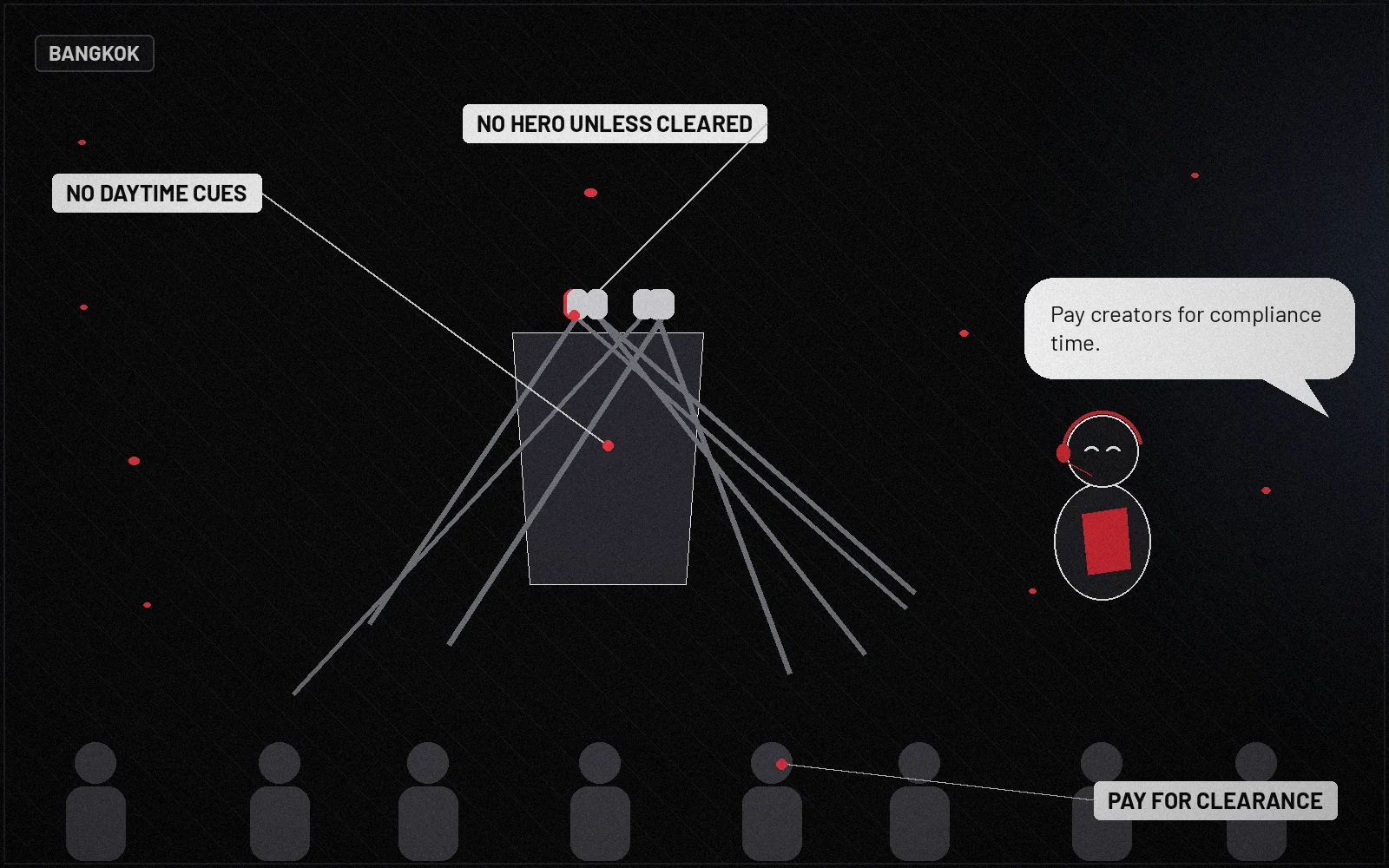
- No product hero in frame unless pre-cleared
- No consumption cues in daytime organic
- No US late-night clips as "inspiration boards" for Thai posts
- Mandatory clearance card attachment in the talent portal
Pay for compliance time. Creators who must guess will guess wrong under deadline. Brands that refuse to pay for a Thai-legal cut will pay for a takedown later. That is the money sentence boards understand.
When a global moment like LISA's "mot kaeo" loops, issue a 24-hour internal note: what we will not copy, what we will say if asked, and which partner questions get the cleared paragraph. Silence creates freelancers inventing policy in group chats.
Measurement without fake "compliance dashboards"
Measure what operations can change:
- Percent of live TH alcohol-adjacent assets with dated clearance
- Time-to-pause after a partner complaint
- Creator brief acknowledgment rate
- Number of amber assets cleared same week versus slipped
Do not invent a vanity "compliance score" that counsel will not defend. Prefer boring operational KPIs. Soft CTA still belongs after the system is clear—retainers renew on proof calendars, not on adjectives.
Soft CTA: public affairs agency Thailand engagement
If your Thai cut still treats global virality as permission, you need a public affairs agency Thailand retainer before the next late-night moment. Neuwark builds Bangkok narrative, clearance cards, and stakeholder sequencing for alcohol-adjacent and hospitality brands that cannot afford a US screenshot as policy.
Start with Services or Contact. Read more on the Insights hub, or learn About how we work across ASEAN desks.