
Thailand’s Office of the Consumer Protection Board (OCPB) opened public comment—running through 10 October 2026—on a draft Consumer Protection Act overhaul covering digital commerce, influencer marketing, labeling, and heavier penalties, including liability themes for advertising media owners. That is a live influencer disclosure compliance Thailand clock for every brand buying creator reach in the Kingdom.
If your influencer brief does not cover disclosure, you are buying reach and regulatory risk in the same invoice. Neuwark Communications builds influencer brief compliance kits and paid-media brand-safety audits for TH campaigns that need to stay screenshot-safe when rules tighten.
What OCPB’s draft overhaul signals for creator spend
The signal is not subtle: influencer marketing is moving from “platform culture” into consumer-protection hard law. Digital commerce, labeling, and media-owner liability themes mean brands, agencies, and platforms share more blast radius than a shrug and a #ad sticker applied after the fact.
Money implications:
- Creator spend without disclosure discipline becomes regulatory and boycott risk.
- Agencies and media owners may sit closer to liability than yesterday’s contracts assumed.
- Comment-window urgency — waiting until final gazetting to rebuild briefs is how you get caught mid-flight.
Treat the comment period as free intelligence. Read the draft themes. Update contracts now. Pair this with the operator craft in influencer brief templates for progressive PH campaigns—the checklist logic travels even when the statute is Thai.
Do not wait for a perfect English translation of every clause before you act. The commercial posture is clear enough: undisclosed commercial speech is moving from gray area to enforcement target. Brands that treat disclosure as optional styling will pay twice—once in penalties or pull-downs, once in trust.
Disclosure stack: caption, story, landing, agency contract
Disclosure is a stack, not a sticker:
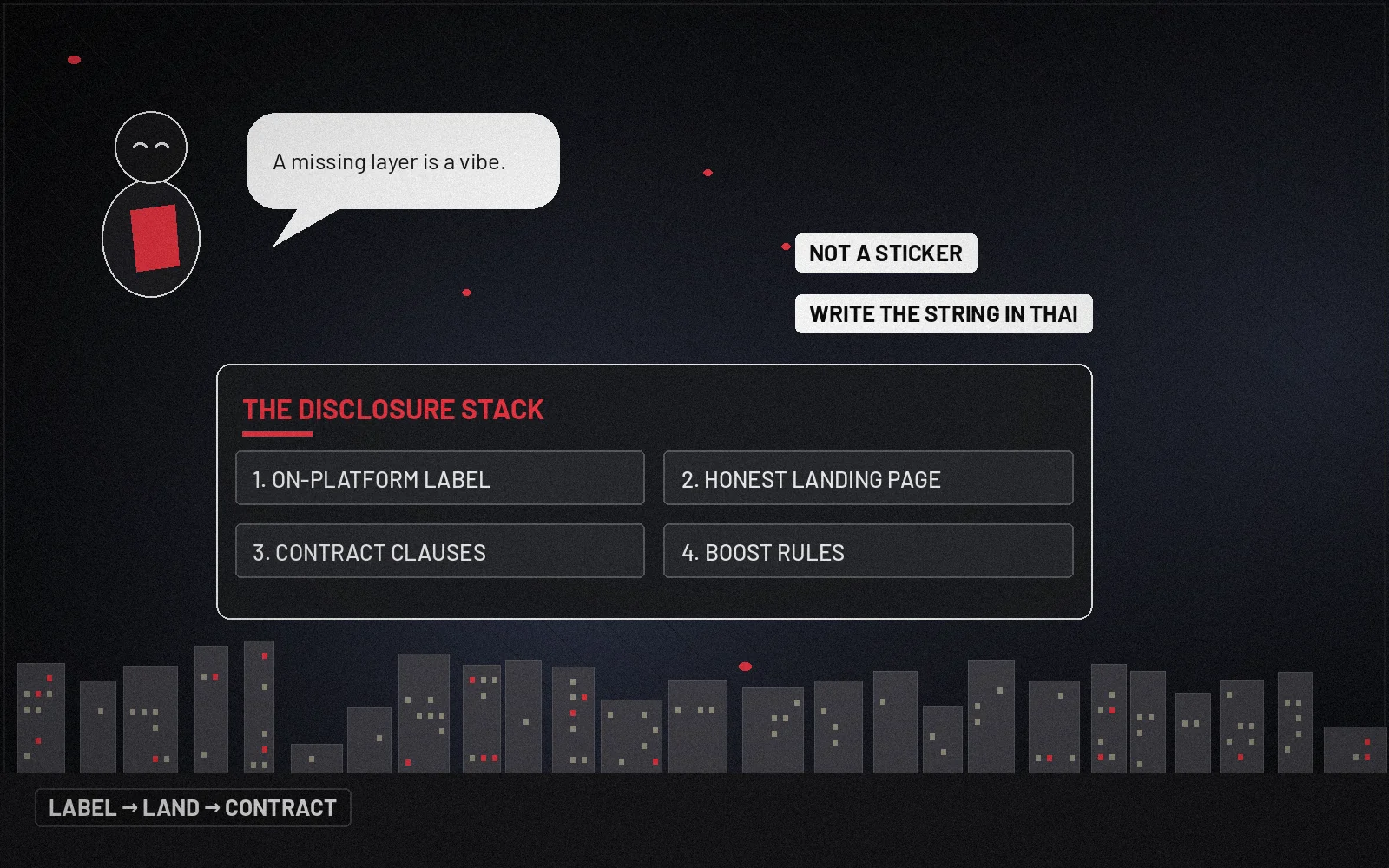
- On-platform label — caption, story sticker, live pin—whatever the surface requires, in language audiences actually see.
- Landing and PDP honesty — if the click lands on a paid partnership offer, the page should not play coy.
- Agency and creator contracts — disclosure clauses, kill rights, screenshot proof before payment, usage windows.
- Paid amplification rules — boosting an undisclosed post is how you scale a violation.
If any layer is missing, you do not have compliance. You have a vibe. Vibes do not survive OCPB-shaped enforcement.
Write the exact disclosure strings into the brief—Thai and English if both appear—so creators are not improvising under a ring light. Improvised disclosure is how you get tiny gray text that regulators and NGOs both screenshot.
Media-owner liability: why platforms and brands share the blast radius
Draft themes that pull advertising media owners closer to liability change the agency conversation. “The creator forgot” is a weak defense when contracts and briefing systems were yours to design. Brands should ask agencies for disclosure QA evidence the same way they ask for delivery reports.
This sits next to paid-media brand safety: you already police adjacency. Now police commercial speech labeling with the same seriousness. The screenshot that hurts you may be a missing disclosure, not a toxic placement.
Update SOWs: who checks disclosure before boost, who archives proof, who can force a takedown in 15 minutes, and who pays if a post must be killed mid-flight. Ambiguity is how partners point at each other while the comment section invents your policy.
Rebuild the influencer brief (checklist operators can run this week)
Ship a one-page brief addendum this week:
- Exact disclosure language (Thai + English as needed).
- Claims rules (what creators may not say about efficacy, price, scarcity).
- Kill / pull rights and timeline.
- Screenshot pack required before invoice clearance.
- Boost eligibility only after disclosure QA.
- Escalation owner inside the brand.
Borrow structure from progressive influencer brief templates and localize hard for TH surfaces (TikTok, YouTube, Instagram, Live, LINE VOOM where relevant). Train talent managers, not only legal. The person messaging the creator at 9 p.m. needs the rule in their pocket.
Audit cadence before comment closes—and after rules land
Now through 10 Oct 2026 — Sample live posts weekly for missing or weak disclosure; fix contracts; brief agencies.
After rules firm up — Convert draft themes into locked SOP; re-train creators; keep a monthly audit for always-on programs.
Publish an internal FAQ so brand managers stop inventing answers. Link it next to your media plans. Compliance that lives only in legal’s inbox never reaches the creator.
Paid amplification rules when disclosure is thin
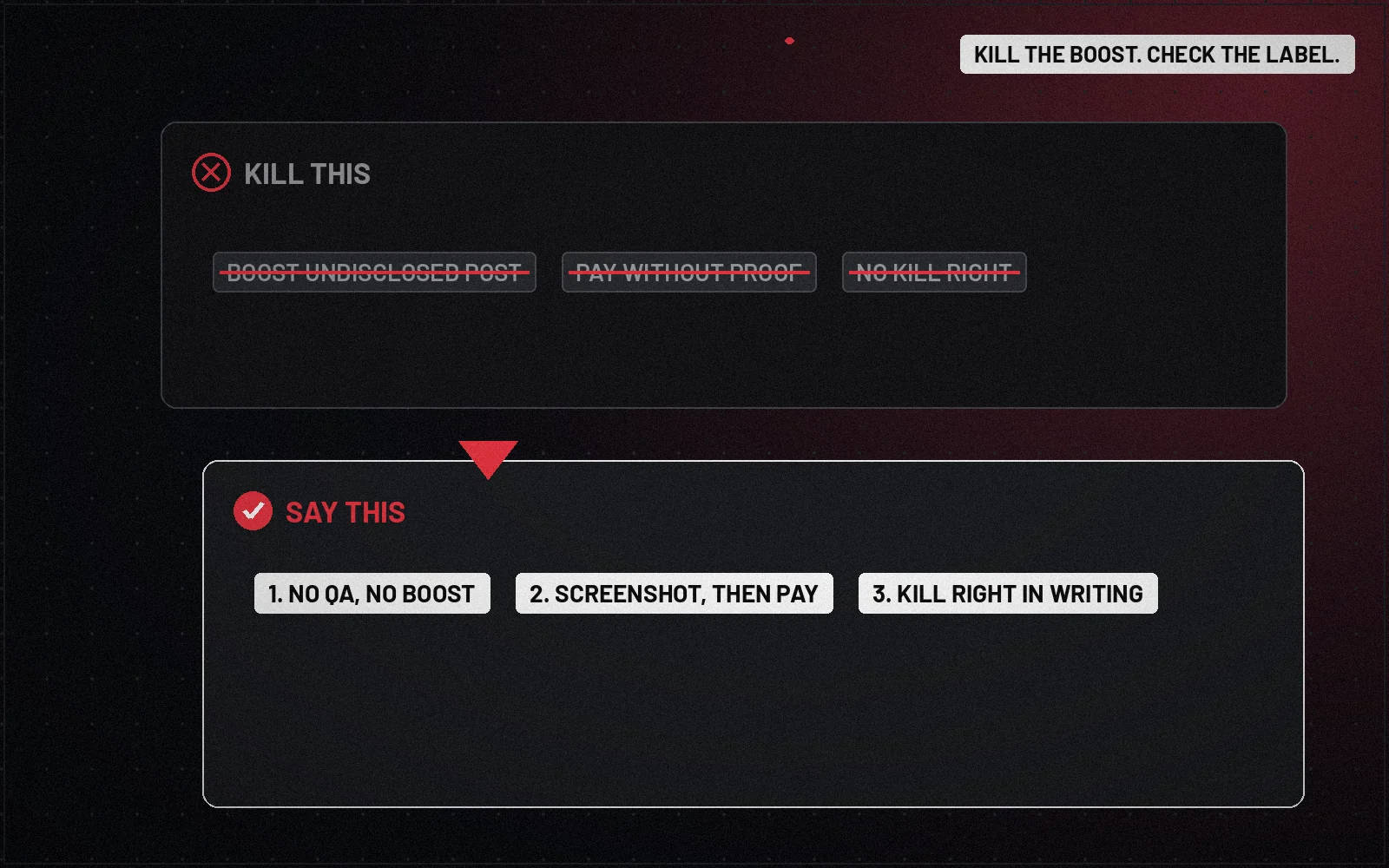
No disclosure QA, no boost. No screenshot proof, no payment. No kill right in writing, no campaign. Those three gates prevent most self-inflicted wounds. They also force agencies to treat disclosure as delivery, not decoration.
When a post must come down, use the same rapid-response discipline you would for any reputation event—holding statements for public noise, quiet pull for quiet misses. Not every failure needs a press note. Every failure needs a logged fix.
Also watch white-label “seed” seeding and affiliate chains where disclosure evaporates three forwards downstream. If you cannot see the path, you do not control the risk. Prefer fewer creators with proof over a fog of micro-seeds you cannot audit.
Operator checklist: 15 working days to OCPB-ready
Week 1 — Inventory active TH creator campaigns; score disclosure quality; list contract gaps.
Week 2 — Ship brief addendum + contract clauses; train agencies and talent managers; set boost gate.
Week 3 — Run a kill-drill on a dummy post; archive proof packs; brief leadership on residual risk.
Ongoing — Monthly audits; update SOP when final rules land; keep [Insights]({HUB}) playbooks linked in the agency portal.
Soft CTA
If disclosure still lives in a Slack “pls add #ad,” you are buying enforcement risk on purpose. Neuwark builds influencer brief compliance kits and paid-media brand-safety audits for Thailand and SEA campaigns. See services or start a conversation.
If your influencer brief doesn’t cover disclosure, you’re buying reach and regulatory risk in the same invoice.
What changes inside the agency briefing room
The briefing room has to stop treating disclosure as a caption afterthought. Put the disclosure string next to the key message. Put kill rights next to the usage window. Put screenshot proof next to the payment schedule. If it is not on the one-pager the talent manager forwards at night, it will not happen on the Live.
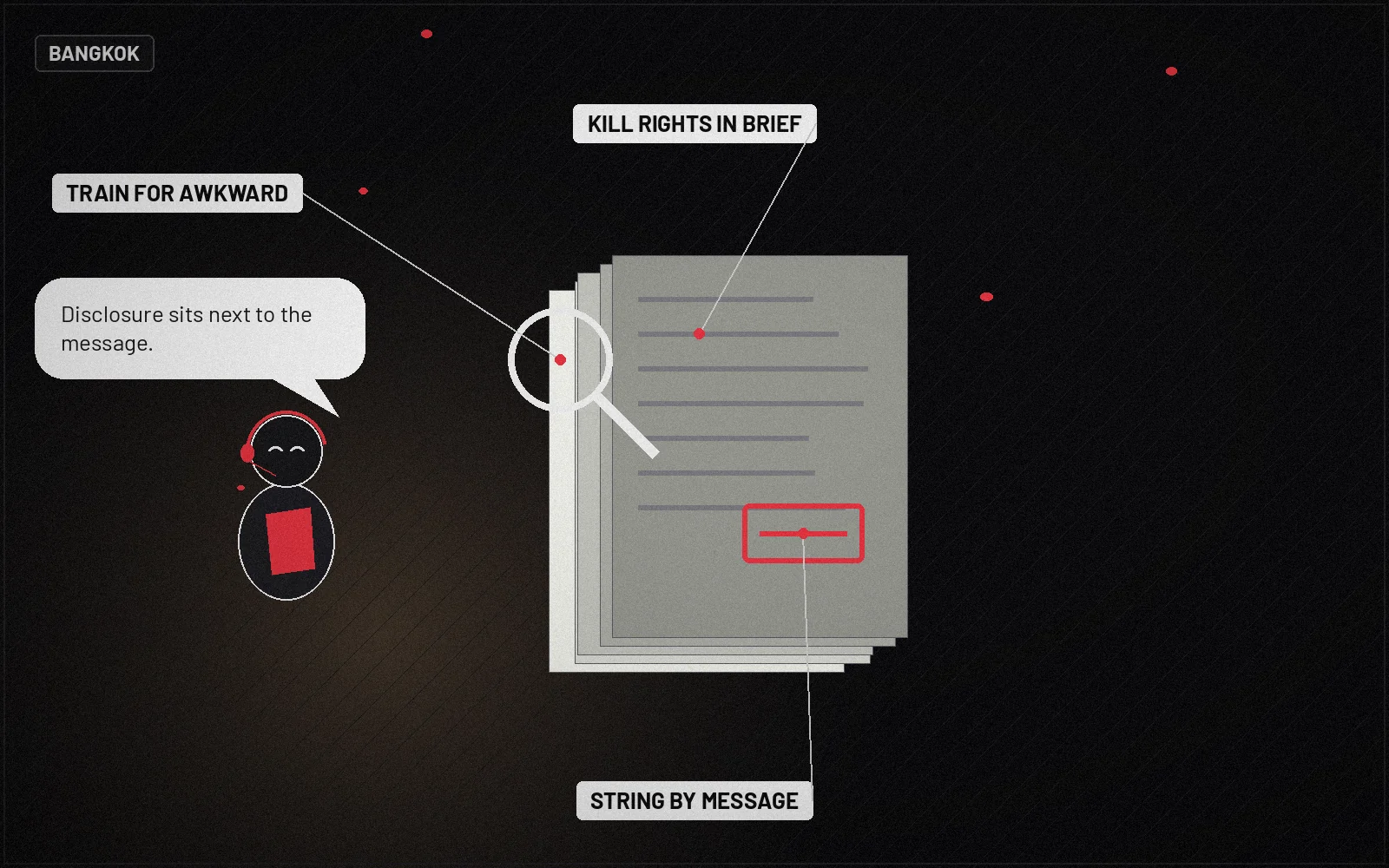
Train for awkwardness. Creators will ask whether disclosure “hurts performance.” Answer with evidence from markets that already enforce labeling: trust compounds; hiding sponsorship burns twice—once with audiences, once with regulators. Keep examples in the agency portal so the debate does not restart every Monday.
Connect disclosure QA to brand safety reviews you already run for adjacency. The same team that kills unsafe placements can kill undisclosed boosts. See brand safety for progressive paid media and influencer brief templates for reusable checklist DNA.
Comment window as a free stress test
Use the period through 10 October 2026 as a stress test. Pull a sample of live TH creator posts. Score disclosure visibility. Score claims hygiene. Score contract kill rights. Fix the worst third before the window closes. Then keep the audit monthly so “we cleaned it once” does not become the new myth.
When final rules land, update the SOP within two weeks—not two quarters. Laws that sit in legal’s shared drive never reach the creator. Laws that sit in the brief do.
Operator FAQ
Is #ad enough? Only if audiences can actually see it and contracts require it. Tiny gray text is not a strategy.
Who archives proof? Agency delivers; brand verifies before payment. No proof, no pay.
What about affiliates? If you cannot see the chain, you do not control disclosure. Prefer auditable partners.
Commercial next step — Influencer disclosure compliance kit + paid-media brand-safety audit for TH. Services · Contact · Insights hub.
Disclosure proof pack (what finance should demand before paying)
Before any creator invoice clears, finance and brand should see: the final live URL or handle, a timestamped screenshot of the disclosure as shown on-device (not a cropped desktop view), the brief page that mandated the disclosure string, and confirmation that boost did not start before QA. If any item is missing, payment waits. That single gate removes most “we forgot” failures.
Add a monthly sample audit for always-on programs: ten random posts, scored for visibility of disclosure, claim accuracy, and contract kill-right usage. Publish the score to the agency. What gets scored gets fixed. What stays vibes-based stays risky under Thailand’s consumer-protection overhaul.
Creator marketing remains a growth channel. It is also now a compliance channel. Build for both—or budget for the screenshot you did not want. For a kit and audit, see services or contact.
Disclosure is how commercial speech earns the right to keep speaking. Brands that treat it as optional will learn the cost in public. Brands that brief it, prove it, and audit it will keep buying reach without buying the next enforcement headline.