
A POFMA holding statement only works if a tired person can say it out loud at 2am without reading it twice. Build it from five parts: process, owner, boundary, channel, timebox. And never promise a takedown as the default, because under POFMA the primary tool is a correction direction, and correction directions do not require the post to be removed.
This is the language companion to our POFMA night-before checklist. That checklist covers direction types, roles, and the channel inventory. This piece fixes the words your team will actually say when everyone is exhausted.
Educational note: This is operator guidance for communications teams. It is not legal advice and not an official position of the POFMA Office. Follow the instrument your counsel has in hand, and confirm every public line with counsel before it goes out.
Neuwark Communications runs Singapore public-affairs and crisis drills from our account office at Level 39, Marina Bay Financial Centre Tower 2 (contact +63 923 859 6587). Soft path: Crisis rapid response · Singapore public affairs · Services · Contact.
Why does lawyer English fail at 2am?
Because fatigue kills comprehension first. A sentence with three clauses and a “notwithstanding” will be misread by someone who has been awake for twenty hours. Then it gets paraphrased in a group chat. Then the paraphrase gets posted.
Lawyer English is built to be precise on paper. A holding line has to be precise out loud. Those are different jobs. Counsel owns what the line means. Comms owns whether a human can say it without tripping.
The test is simple. Hand the line to the most tired person in the room. Ask them to say it back without looking. If they change a word, the line is too long.
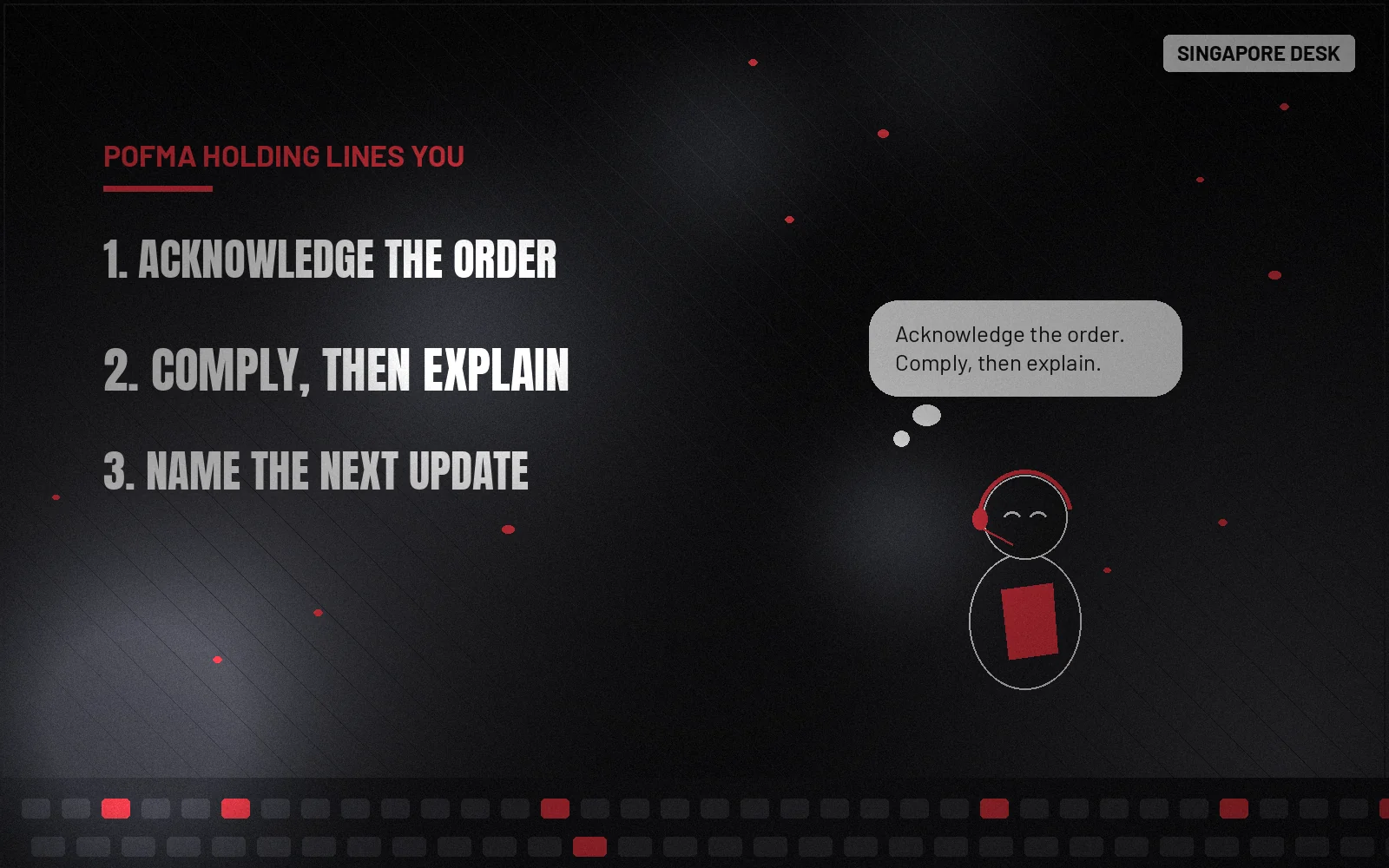
What goes into a five-part holding block?
Five short sentences. One job each. Nothing about the merits of the claim.
| Part | What it does | Example sentence |
|---|---|---|
| Process | Says what is happening, not who is right | “We have received a direction under POFMA and are acting on it with our counsel.” |
| Owner | Names one voice so nobody freelances | “Our head of communications is the only spokesperson on this matter.” |
| Boundary | Says what you will not do tonight | “We will not comment on the substance while we act on the direction.” |
| Channel | Tells people where updates will appear | “Updates will be posted on our company newsroom page.” |
| Timebox | Promises the next update, not an outcome | “Our next update will be by 10am today.” |
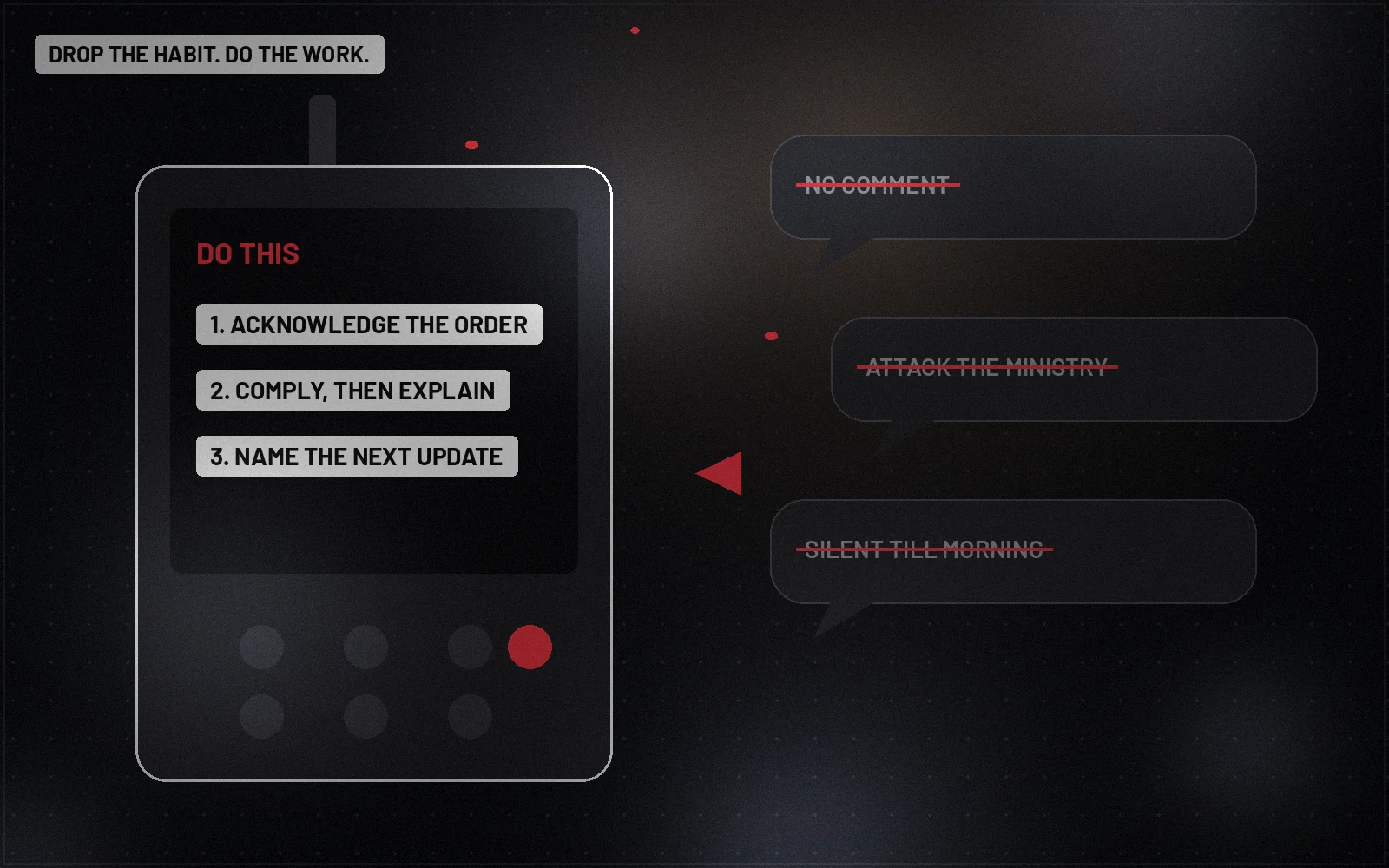
Put together, it reads like this:
We have received a direction under POFMA and are acting on it with our counsel. Our head of communications is the only spokesperson on this matter. We will not comment on the substance while we act on the direction. Updates will be posted on our company newsroom page. Our next update will be by 10am today.
Five sentences. Around 60 words. Readable in twenty seconds, even at 2am.
Why shouldn’t you promise a takedown?
Because takedown is not the universal rule, and saying it is can make your statement wrong.
The POFMA Office’s own summary is direct: POFMA’s primary tools are correction directions, and these do not require the online falsehood to be removed. In more serious cases, a stop communication or disabling direction may be used. Directions can only be issued if a false statement of fact has been or is being communicated in Singapore through the Internet, and it is in the public interest to issue the direction. Source: POFMA Office — Regulations. The Act itself is on Singapore Statutes Online.
So “we have taken the post down” may be false, or may not be what you were asked to do. The safer sentence is “we are complying with the direction as issued”. Then do exactly what the instrument says, as your counsel reads it. Not more. Not less.
Which verbs get people fired?
Most bad holding lines fail on one verb. Here are the usual suspects.
| Verb or phrase | Why it burns you | Say instead |
|---|---|---|
| “We deny” | Argues the merits in public while the direction is live | “We are acting on the direction with our counsel.” |
| “We have removed / taken down” | May not be what the direction requires | “We are complying with the direction as issued.” |
| “To clarify, the claim was…” | Repeats the disputed statement to a bigger audience | Do not restate it. Point to the required correction if one applies. |
| “We guarantee” | Promises an outcome you do not control | “Our next update will be by 10am.” |
| “The government ordered us to…” | Paraphrases a legal instrument in your own words | “We received a direction under POFMA; counsel is reviewing it.” |
| “No comment” | Sounds like hiding and invites guessing | Use the five-part block. |
Why is “no comment” not the line?
“No comment” tells reporters and staff nothing, so they fill the gap themselves. A process line says the same amount about the merits, which is nothing, but it shows you are awake, organised, and acting.
Silence is fine on the substance. Silence on process looks like panic.
What does a six-hour role sheet look like in textable sentences?
Write every role instruction as a text message someone can send from a phone. No paragraphs. Times below are illustrative. Use the clock on your own direction.
| Hour | Owner | Text they send |
|---|---|---|
| 0:00 | Legal | “Direction received. Reading now. Nobody posts until I reply.” |
| 0:15 | Head of Comms | “Freeze all scheduled posts on every channel. Reply DONE when frozen.” |
| 0:45 | Social lead | “Freeze done. Screenshots of affected posts saved in the shared folder.” |
| 1:30 | Head of Comms | “Holding block v1 attached. Legal, approve or strike by 3:00.” |
| 2:30 | CEO office | “Only the head of comms speaks. Staff: do not post or comment.” |
| 3:00–6:00 | Legal + Comms | “Complying with the direction as counsel reads it. Next update at the time we promised.” |
If a line cannot be sent as a text, it will not be followed at 3am.
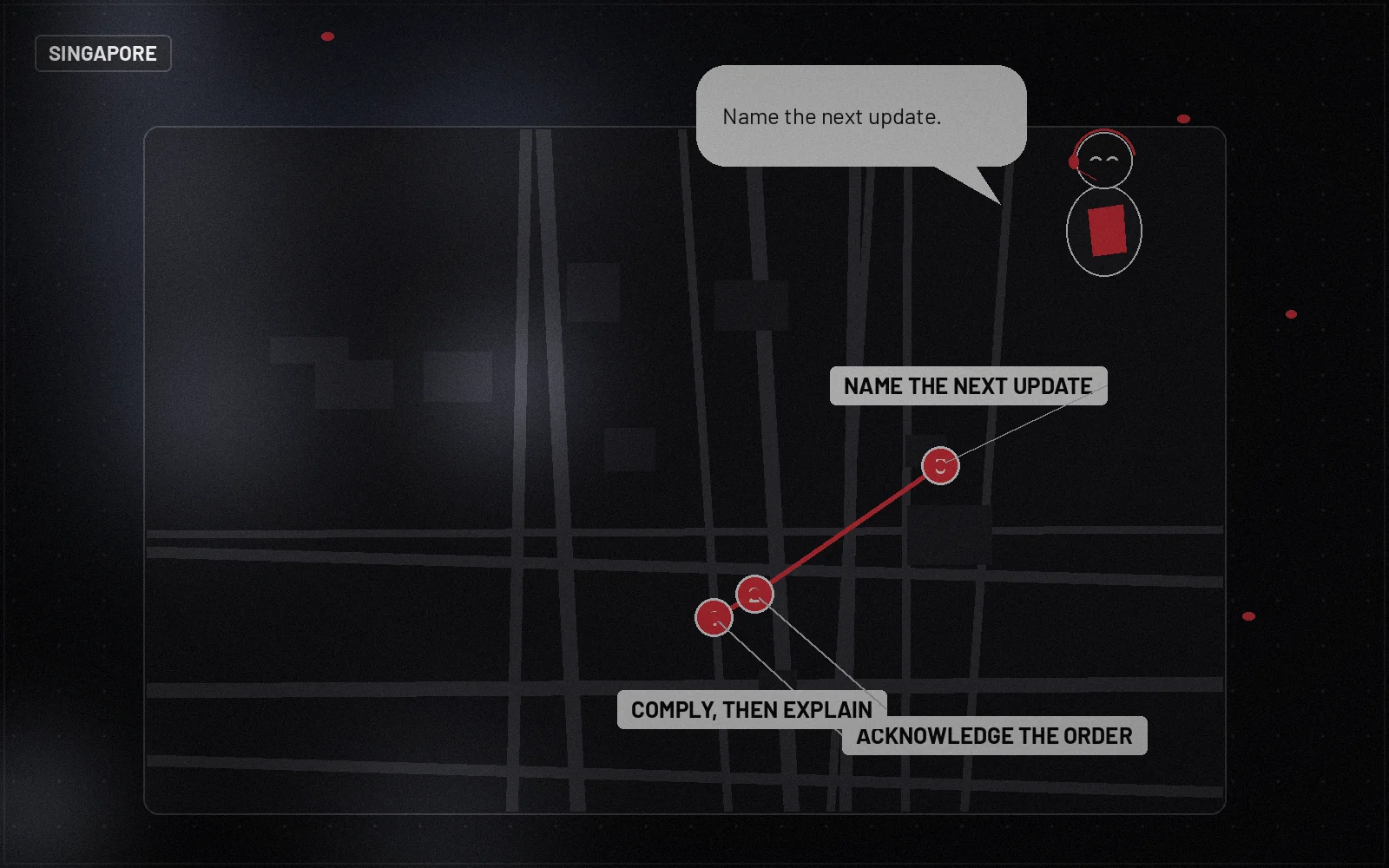
Monday field kit
Do these before you ever need them.
- Write your five-part block now, with blanks only for time and channel. Get counsel to pre-clear the wording.
- Paste the “verbs that burn you” table into your social scheduling tool and crisis folder.
- Pre-write the six role texts in each owner’s phone notes.
- Run a 30-minute read-aloud drill. The most junior person reads the block out loud. Cut anything they stumble on.
- Agree on the one channel where updates will live. Test that two people can post there at night.
FAQs
What is a POFMA holding statement?
It is a short public line you use while you act on a POFMA direction. It covers process, owner, boundary, channel, and next update time. It does not argue whether the original statement was true.
Does a POFMA direction always mean we must take content down?
No. According to the POFMA Office, correction directions are the primary tool and do not require the falsehood to be removed. Stop communication or disabling directions may be used in more serious cases. Do what the specific direction says, as your counsel reads it.
Can we just say “no comment”?
You can, but it usually backfires. Say nothing on the merits and still give a process line with a named spokesperson and a next update time.
Who should approve the holding statement?
Counsel approves what it means. The head of communications approves how it sounds and where it goes. Neither should sign alone.
What to do next
Write the block, clear it with counsel, and drill it out loud this week. For the rest of the night-before system, go back to the POFMA night-before checklist. If your brand pages also face online-harm notices, see Online Safety Act compliance comms for brand admins. For general templates, see our crisis holding statement templates. For who owns what between GR and PA, see the GR vs PA Singapore buyer split.
Need a Singapore drill partner? Start at Crisis rapid response, Singapore public affairs, Singapore government relations, or Contact. More in Insights.