
Most Singapore companies should not choose between a corporate communications consultancy in Singapore and an in-house team. They should split the work. Keep in-house whatever needs your company's judgement every day: the voice, the disclosure calls, the relationships with your regulators and your own people. Buy from a consultancy whatever needs surge capacity, outside eyes or skills you use a few times a year. Then write down the seam between the two before you need it, because the seam is where hybrid models fail.
This guide is for heads of corporate affairs, public affairs, communications and regulatory affairs at Singapore-listed companies, regional headquarters and regulated firms who are deciding what to build, what to buy and how to make the two work together. If you already know you need outside crisis support and are scoping the contract, read our guide on what "24/7" should mean in a Singapore crisis retainer alongside this one.

The short answer
Run a hybrid when three things are true: you have at least one senior communicator who sits close to the CEO and the board, your workload has real peaks (results, deals, incidents, consultations, launches), and some of the specialist work you need is too occasional to justify a hire. That describes most mid-size and large organisations in Singapore.
Go mostly in-house when the work is steady, highly confidential and tied to daily operations, such as a regulated firm focused on customer and regulator communication with few media peaks.
Go mostly external when you are a small team, a newly set-up regional office or a company that has not yet decided what its communications function should be. Even then, keep one internal owner. A consultancy cannot own your decisions.
Why the Singapore context changes the split
Three Singapore rule sets shape what you can hand to an outside firm. None stops you using a consultancy. All decide who holds the pen at specific moments.
Listed companies: the disclosure pen stays inside
Under SGX Mainboard Rule 703, an issuer must announce information that is needed to avoid a false market or that would likely materially affect the price or value of its securities. Rule 702 says announcements go out through SGXNET. The Corporate Disclosure Policy in Appendix 7.1 is blunt about media: if an issuer gives material information to the press but does not announce it on SGXNET, it is in breach of Rule 703. The same policy says information must not be released in a way that puts anyone in a privileged dealing position.
For a hybrid model, that means one rule. Your consultancy can draft, rehearse and pressure-test. It never decides what is material and never briefs a journalist on anything price-sensitive before SGXNET. Your company secretary, legal team and investor relations lead own that sequence. Write it into the contract and the RACI.
Personal data: you stay responsible for what your agency touches
Communications agencies handle more personal data than people assume: media lists, stakeholder maps, event registrations, customer complaint logs during an incident, employee FAQs with names attached. Under the Personal Data Protection Act 2012, an organisation has the same obligations for personal data a data intermediary processes on its behalf as if it processed the data itself (section 4(3)). If that agency has reason to believe there has been a data breach involving your data, section 26C(3) requires it to notify you without undue delay, and you then assess whether the breach is notifiable. If it is, section 26D gives you no more than three calendar days after that assessment to notify the PDPC.
PDPC's own guide on data protection clauses for processing agreements is a practical starting point for the contract. As the PDPC notes, the organisation that engaged the intermediary stays responsible for notifying affected individuals and the Commission. Your agency can help you write that notice. It cannot file it for you.
Board expectations: stakeholder engagement is a board-level duty
The Code of Corporate Governance 2018 asks listed companies to have an investor relations policy that allows an ongoing exchange of views with shareholders (Provision 12.2) and to have arrangements to identify and engage material stakeholder groups (Provision 13.1). SGX's Practice Guidance 12 goes further and says investor contact points should be run by the investor relations department or the company secretary. That is a clear signal: the relationship belongs to the company. Consultancies support it; they do not own it.
If you are an MAS-regulated firm, there is one more check. Ask your risk team whether the engagement falls under the MAS Guidelines on Outsourcing (or the banks' version), especially if the agency will run customer-facing channels or hold customer data. Classify it before contract signature.
The real cost of building in-house
The in-house option looks cheaper on a spreadsheet until you count what it takes to hire and keep senior people in Singapore.
If the person you want is not a Singapore citizen or permanent resident, the Employment Pass sets a floor. The minimum qualifying salary is currently S$5,600 a month for most sectors and S$6,200 for financial services, rising with age to S$10,700 and S$11,800 at 45 and above. For new applications from 1 January 2027, those floors rise to S$6,000 and S$6,600. The candidate must also pass the COMPASS points framework, and under the Fair Consideration Framework you must first advertise the role on MyCareersFuture for at least 14 consecutive days and fairly consider every applicant.
Those are floors, not market rates for a communications head who can handle a board, a regulator and a journalist in one afternoon. Add the time to hire, the risk of a bad fit, and the fact that one person cannot cover leave, results week and a crisis at once. That is the honest case for keeping a consultancy in the mix even with a strong internal team.
Build, buy or share: the work-type split
This is the core tool. Go through your actual workload, line by line, and decide where each type of work should sit. The table shows where we see the line fall for most Singapore organisations. Move a line if your situation is different, but write down why.
| Work type | Default owner | Why | What the consultancy does |
|---|---|---|---|
| Corporate voice and key messages | In-house | Must reflect daily strategy and CEO judgement | Pressure-tests and sharpens drafts |
| SGXNET announcements and timing | In-house (company secretary, legal, IR) | Rule 703 and the Corporate Disclosure Policy | Drafts media versions after release |
| Regulator relationships (MAS, PDPC, IMDA, sector agencies) | In-house | Relationships and accountability sit with the company | Briefing packs, consultation drafts, rehearsal |
| Employee and leadership communication | In-house | Trust depends on internal credibility | Surge writing during restructuring or incidents |
| Media relations, steady state | Shared | Contacts help; judgement on what to say stays inside | Pitching, monitoring, interview prep |
| Crisis and issues response | Shared, with in-house decision rights | Surge, 24-hour cover, outside perspective | War room support, holding lines, drills |
| Results, AGM and deal communications | Shared | Short, intense peaks | Q&A, rehearsal, extra writers |
| Public affairs and consultation responses | Shared | Specialist drafting, periodic demand | Policy-grade drafts and stakeholder mapping |
| Reputation research and audits | Consultancy | Outside view is the point | Interviews, perception research, scorecards |
| Training and media drills | Consultancy | Occasional, needs neutral trainers | Design and run the sessions |
| Regional or multi-language rollouts | Consultancy | Network and language reach | Adaptation and local review |
Two patterns jump out. The things you must keep in-house are fewer than expected, but they hurt most if lost. And most "shared" lines fail for one reason: nobody wrote down who decides.
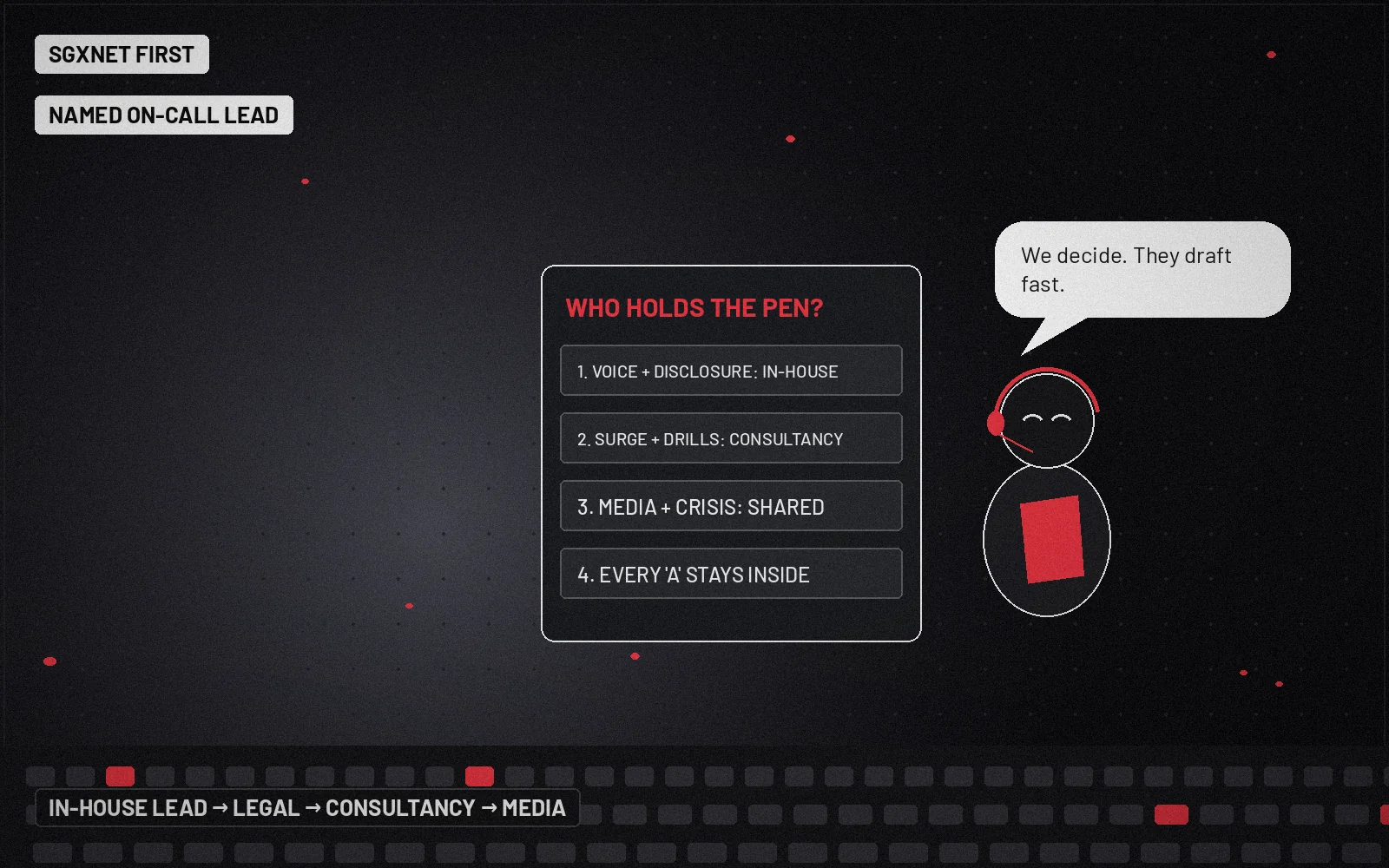
Write the seam: a hybrid RACI that survives a bad day
A hybrid model works on a quiet Tuesday and breaks on a Friday night incident unless the roles are on paper. Use a simple RACI for the moments that matter: R (does the work), A (accountable, makes the call), C (consulted), I (informed).
| Moment | In-house comms lead | Legal / company secretary | Consultancy | CEO / board |
|---|---|---|---|---|
| Is this material for SGX? | C | A/R | I | C |
| Holding statement in the first hour | A | C | R | I |
| Media interview request | A | C | R (prep) | C if CEO is the speaker |
| Data breach notice to customers | A | R (PDPC filing) | R (drafting) | I |
| Regulator briefing | A/R | C | C (pack) | C |
| Employee town hall script | A/R | C | C | C |
| Social media response to a rumour | A | C | R | I |
The column that matters is A, and in every row it sits with your company. The consultancy's value is in the R column: speed, craft and stamina. If the consultancy ever lands in the A column, you have outsourced the function, not hybridised it.
Worked example: a regional HQ that rebuilt the split
Take an illustrative case. A regional headquarters of a payments company in Singapore has a three-person communications team: a head of corporate affairs, one media and content manager, one internal communications lead. It also pays a full-service agency a monthly retainer that covers "media relations, crisis support and content".
The complaint is familiar. The agency produces content nobody uses, and during a weekend service outage it took two hours to get the right people on a call, because nobody had agreed who could approve a customer notice.
They rebuilt the split in four steps:
- 1. Mapped the workload. Over a quarter, they logged every request by type and hours. Steady content was eating most of the retainer; crisis, results and consultation work was less frequent but far more critical.
- 2. Moved steady content in-house. The media and content manager took over the routine blog and newsletter work, freeing retainer hours.
- 3. Re-scoped the consultancy. The new contract covered crisis surge with a named senior lead, results-week support, two media drills a year and drafting for public consultations. Steady pitching moved to a smaller, project-based fee.
- 4. Wrote the seam. A one-page RACI, a contact sheet with personal numbers, PDPA clauses based on the PDPC guide, and a rule that nothing price-sensitive leaves the building before SGXNET.
At the next incident, the holding statement went out inside the hour because the approver was named in advance. That is the whole point of a hybrid: the right people, already agreed, at the moment it counts.
The seven-question decision test
- 1. Do you have a senior communicator with direct access to the CEO and board? If not, hire or appoint one first. Everything else depends on this role.
- 2. How spiky is your workload? If more than a few weeks a year need double your normal output, surge capacity belongs outside.
- 3. Which skills do you use fewer than four times a year? Media training, perception research, consultation drafting and crisis drills are usually cheaper to buy.
- 4. How much of the work touches price-sensitive or personal data? The more it does, the tighter the in-house core and the stronger your contract clauses need to be.
- 5. Can your team cover a crisis on a weekend during leave season? If the honest answer is no, you need a named external lead on call.
- 6. Do you need regional reach? If you communicate across ASEAN markets, a consultancy network is often faster than building local presence.
- 7. Who will manage the consultancy? A consultancy without an internal owner drifts. Budget time for that person, not just money for the retainer.
If you answered "yes" to question 1 and "yes" to two or more of questions 2, 3, 5 and 6, a hybrid model is almost certainly right for you.
Mistakes that break hybrid models
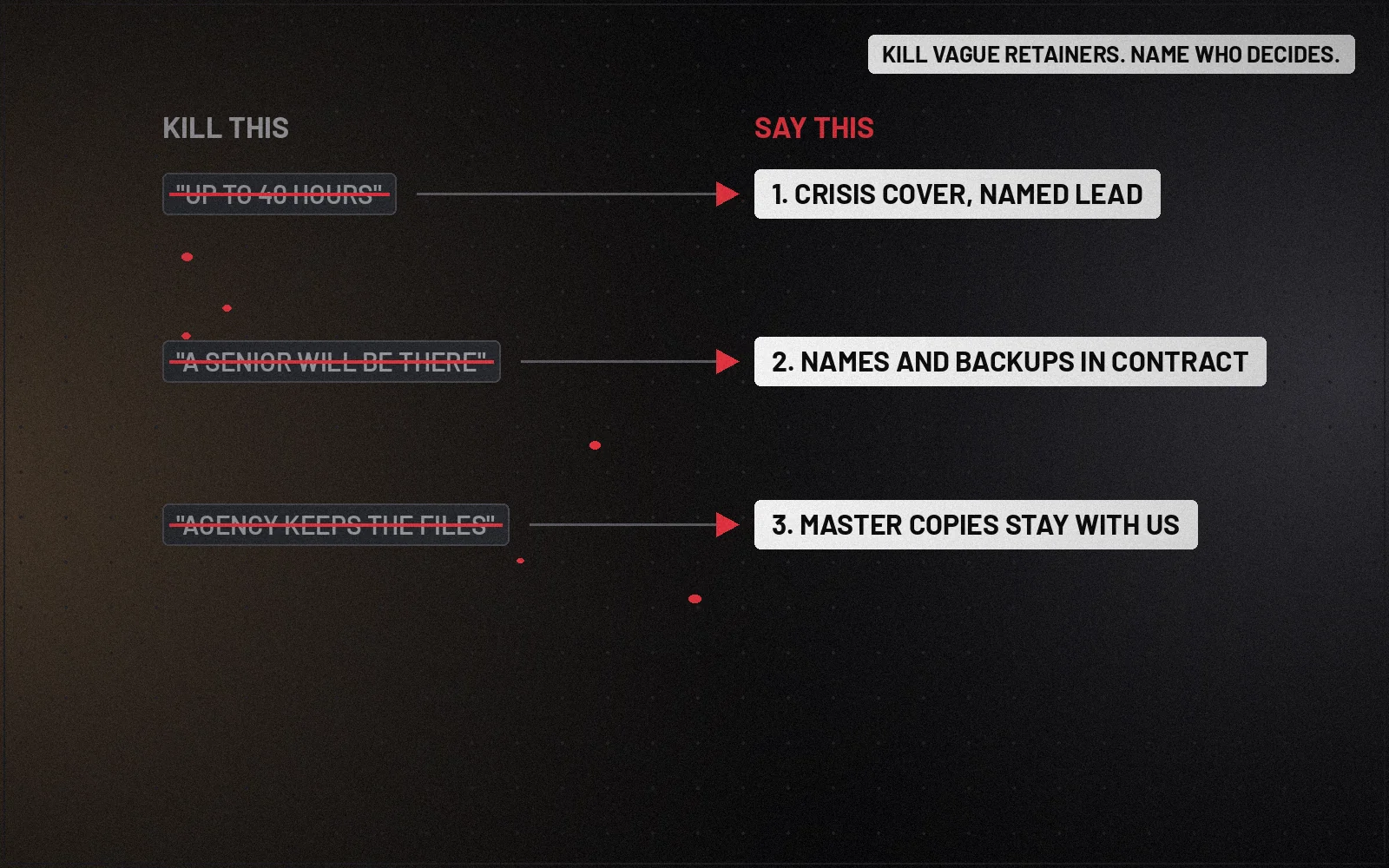
Buying hours instead of outcomes. A retainer that says "up to 40 hours of communications support" invites busywork. Scope by work type and deliverable: crisis cover with a named lead, results-week Q&A, four consultation drafts.
Letting the agency become the institutional memory. If your messaging house, media list and past statements live only on the agency's drive, you have a lock-in problem. Keep the master copies inside.
No named people. "A senior team member will be available" is not a crisis plan. Ask for names, phone numbers and backup names in the contract.
Skipping the data clauses. Agencies often hold stakeholder data with no written processing agreement. Under PDPA, that exposure is yours.
Briefing the press before the exchange. The Corporate Disclosure Policy treats it as a breach, whoever made the call.
Judging the agency on volume. Count avoided problems and faster decisions, not press releases. A good consultancy sometimes tells you not to say anything at all.
Your first 90 days of a hybrid set-up
Use this checklist when you start a new consultancy relationship or re-scope an old one.
Days 1 to 30: map and decide
- Log every communications request for a month by type, urgency and hours.
- Fill in the work-type split table with your own decisions and reasons.
- Name the internal owner of the consultancy relationship.
- Ask legal to check PDPA processing clauses and, for MAS-regulated firms, the outsourcing classification.
Days 31 to 60: contract and seam
- Scope the contract by work type and named people, not hours alone.
- Sign off the RACI for the seven moments above, plus any specific to your sector.
- Agree the disclosure rule in writing: nothing price-sensitive before SGXNET.
- Build a shared contact sheet with personal numbers and backups.
Days 61 to 90: test and adjust
- Run one drill with the consultancy: a weekend incident, timed from alert to holding statement.
- Review what the consultancy produced against what you actually used.
- Move one line in the split table if the evidence says so.
- Report the new set-up to the CEO in one page: who does what, what it costs, what it covers.
Who should skip the hybrid model
Skip it if your needs are small and steady, such as a single-market, unlisted business with few media peaks; a capable generalist hire may be enough. Skip it too if nobody can manage the consultancy, because an unmanaged retainer costs more than it returns. A fully outsourced model rarely holds up at listed or regulated firms: the disclosure, data and stakeholder duties above all point back to someone inside who decides.
Frequently asked questions
How do I choose a corporate communications consultancy in Singapore?
Choose on named people, not brand. Ask who will pick up the phone on a Saturday night, what they have handled in your sector, and how they deal with SGX disclosure and PDPA. Ask them to run a short drill with your team before you sign a long retainer.
Should a regional headquarters in Singapore build its own communications team?
Usually it should build a small senior core and buy the rest. The core covers voice, regulator relationships, employee communication and decision rights. A consultancy covers surge, specialist skills and regional reach.
Can a consultancy speak to the media on our behalf during a crisis?
It can, if you authorise it and agree the lines in advance. For listed companies, it must never share price-sensitive information before the SGXNET announcement. For most organisations, the strongest set-up has the consultancy preparing and rehearsing while a named company spokesperson does the talking.
What to do next
Run last quarter's workload through the work-type split. Within an afternoon you will see which lines belong inside, which outside, and where the seam is missing. If you want a second view on your split, your RACI or your crisis cover, our Singapore public affairs and strategy and messaging teams work alongside in-house corporate affairs leads, and you can talk to us about a short scoping session. For the next step after the set-up, see our guides on building a corporate reputation scorecard boards will open and the government relations vs public affairs buyer split.