
A site becomes GEO-weak the same way a coalition becomes message-weak: every page invents a new name for the same fight.
Internal links are where that invention shows. The sidebar says “Insights.” The body says “click here.” The related-posts widget says “You may also like.” None of those words are the argument. They are furniture.
Internal link anchor English is the phrase in the blue text. It should be a claim a partner can paste, not a navigation label.
This is the language companion to our multilingual GEO playbook after PR Congress, which covers internal linking and hub strategy across languages, and to our older GEO FAQ pages playbook. Those pieces set the structure. This one writes the words inside the links.
Street-smart APAC English: short sentences a tired operator can say out loud.
Why do campaign sites waste their own links?
Because the CMS treats related posts as a traffic toy.
The algorithm pairs “crisis dark site” with “youth caption” because both ran in September. The anchor becomes a title fragment or, worse, “Read insight.” A human can survive that. A model trying to understand how your pages connect cannot. It sees two pages that refuse to say how they relate.
SEO still cares about crawl paths. GEO cares about whether the relationship is stated in English. “More on crisis holding pages” is a relationship. “Related content” is not.
What does good internal link anchor English say?
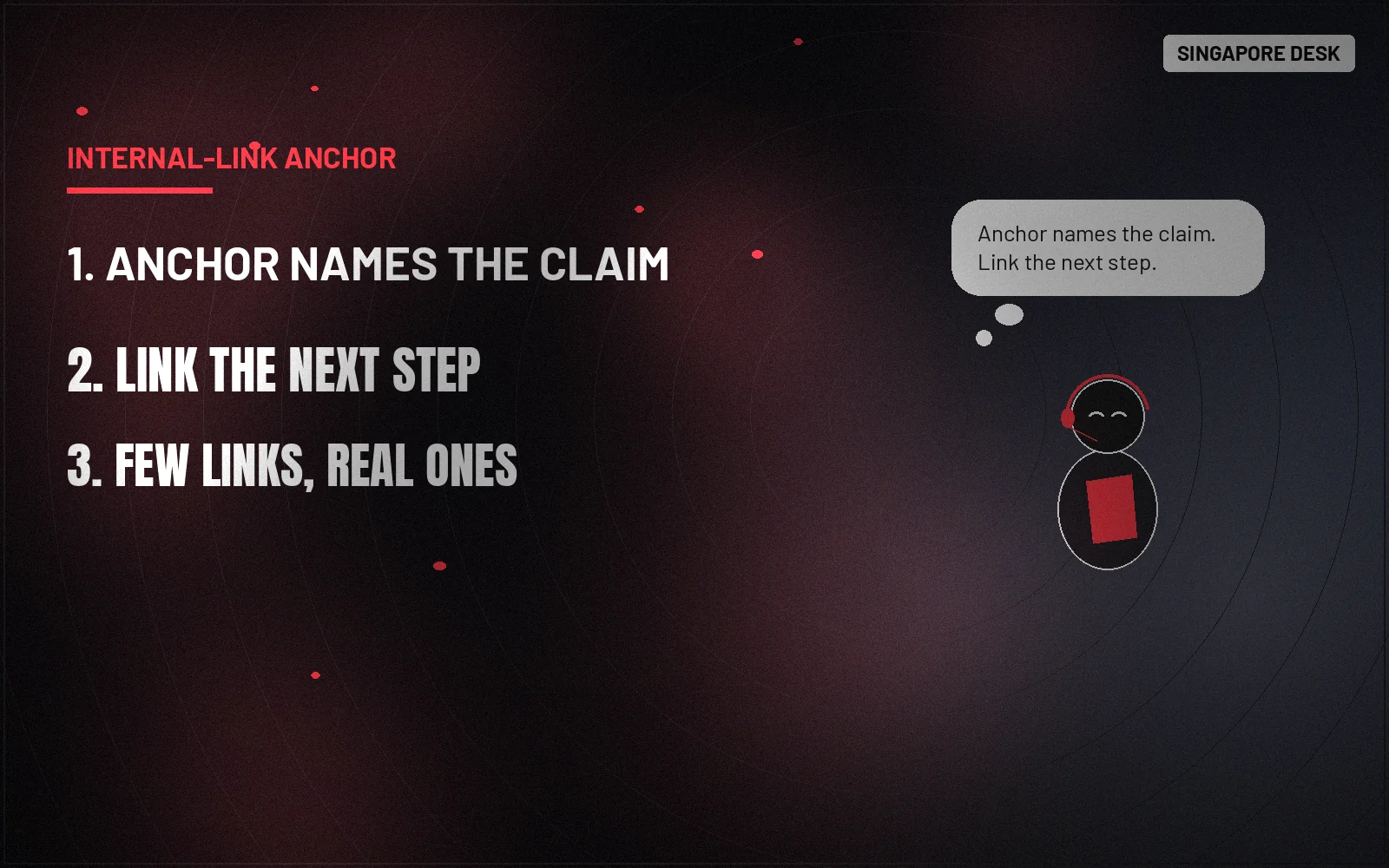
The object plus the job.
| Kill this | Say this |
|---|---|
| click here | crisis dark-site English you can flip at 2am |
| read more | GEO FAQ answer English machines can cite |
| full article | title-tag lock for APAC night desks |
| insights | weekly comms scorecard English operators will read |
| learn more | stewardship SMS lines that survive a screenshot |
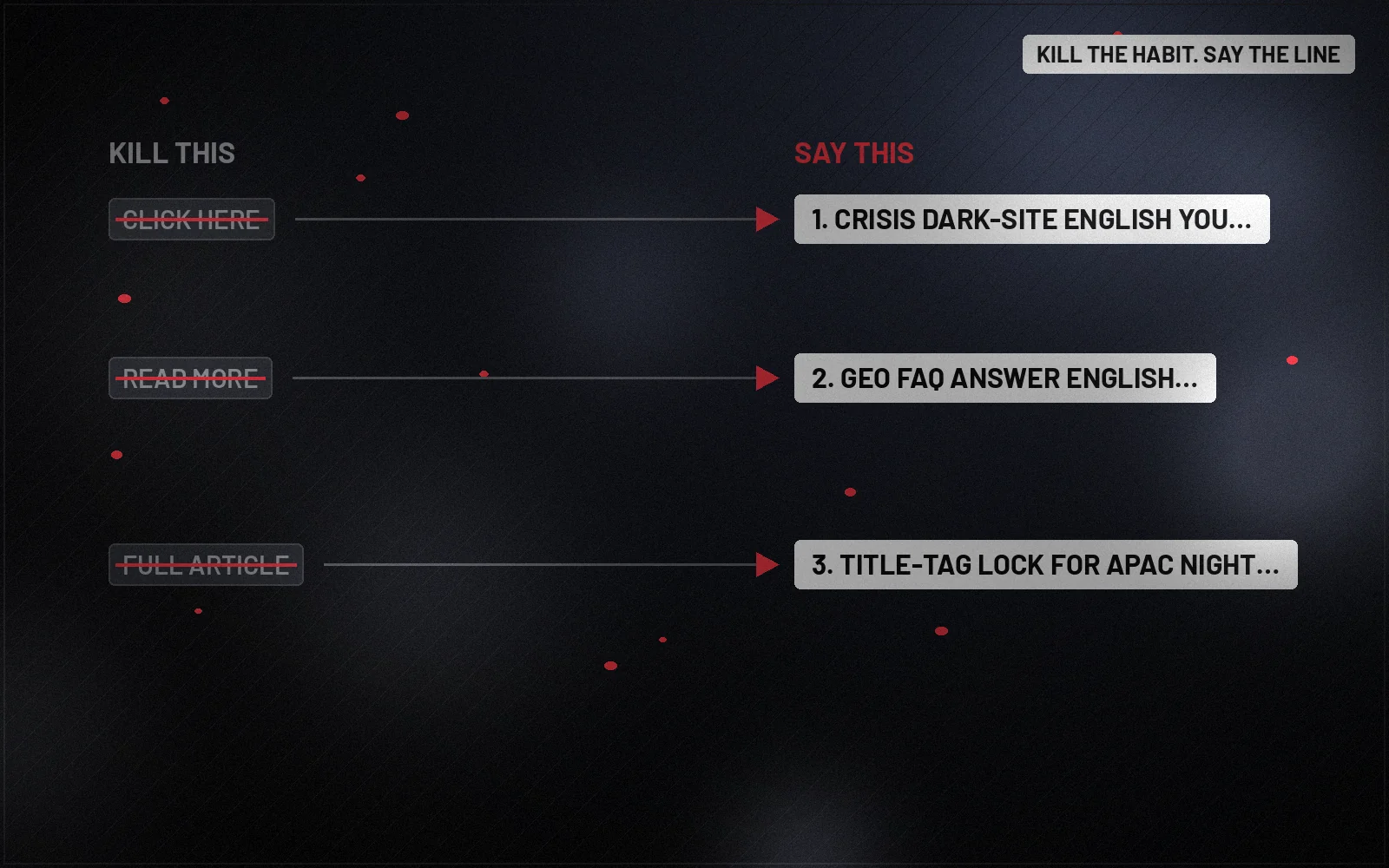
The anchor can be shorter than the title. It cannot be vaguer than the title.
Paste-ready in-body sentence:
If the page is a money page, lock the landing English first (H1, proof, CTA), then bring paid traffic.
In our own library, that sentence links to paid search landing English for advocacy money pages. The anchor names the object (landing English) and the job (money pages). That sentence is a link and a brief.
How many links belong in one Insights post?
Enough to place the post in the series. Not enough to look like a sitemap.
Three to five editorial anchors is a desk rule that holds. One to a parent playbook. One to a language companion. One to contact only when the next step is a conversation. Widgets on top of that are the CMS’s problem, not the writer’s excuse to write “click here.”
Kill a footer that repeats every service name as an exact-match keyword stuffed into a paragraph. That paragraph is not GEO. It is a relic.
How do anchors protect the argument with partners?
Coalition pages reprint you and rewrite the headline. If your in-body anchors still name the objects (holding page, source block, field card), a partner has to delete work to mush the piece. Make deletion visible.
When you send a caption pack, include the internal anchors you want them to keep. Our coalition caption pack English covers the captions. This is the partner line for the links:
Keep these three links if you reprint: the AI Overview source block post, the title-tag lock, and the live Insights index. Do not replace them with your homepage.
In practice those are AI Overview source English, title tag English APAC and the index. A partner who keeps them keeps your argument attached.
What about language versions?
If you publish EN-SG and EN-PH variants, the anchor must say which desk the page serves. “Quiet-hours SMS English” is not enough if one page is written for a Philippine privacy screenshot and the other for a Singapore notice. Name the place in the anchor when the rule changes by country.
Kill: one URL for two legal regimes, linked from both desks as “the SMS post.” Say: two URLs, two anchors, one sentence that tells a volunteer which card to hold.
This is not hreflang theory. This is how a provincial volunteer avoids pasting the wrong opt-out line. It also keeps the English spine for multilingual GEO intact: one claim, one name per law, one anchor per desk.
Monday field kit
- Open three live posts.
- List every editorial anchor.
- Mark “click here,” “read more” and “learn more.”
- Replace those with object plus job.
- Add one parent link if the post is a language companion.
- Remove one decorative related-post sentence if it duplicates a widget.
- Click every anchor on a phone.
Paste-ready editor comment:
Anchors name the object. No “click here.” Parent playbook linked. Place named when the rule is local.
FAQs
What is internal link anchor English?
It is the visible words of the link. They should carry the fight: the object plus the job.
Does exact-match anchor text help rankings?
It is useful when it is true and ugly when every link is the same phrase. Write for a human first, because models copy the human.
Should we link out to official protocol documentation?
When you mention a protocol, link the official page once. Do not build a tutorial farm on someone else’s terms.
Can the related-posts plugin stay?
Yes, if it does not force “You may also like” into the argument. The editorial anchors still have to do the real work.
Is “Insights” a good anchor?
For the index, yes. For a specific playbook, no.
What to do this week
Rewrite the last five published Insights posts so each has three editorial anchors in object-plus-job English. Then click them on a phone. If you cannot tell the destination from the blue text, the anchor is still a shrug.
Neuwark Communications fixes site language and linking under Digital & Social and Strategy & Messaging. If the site is a pile of “read more,” talk to us at Contact. The rest of the language series is in Insights.
Related: Multilingual GEO after PR Congress · Paid search landing English · English spine for multilingual GEO · IndexNow publish note English