

The 33rd National PR Congress (17–18 September 2026, Solaire Resort North; theme "Steward the Story: From Clout to Legacy") put media fragmentation, AI verification, and multi-channel attention on the main stage for about 300 Philippine communicators. The same mid-September window demands that budget, accountability, and ASEAN-chair narratives ship in EN–FIL — and often ID/TH/VI — for Discover, AI Overviews, and regional desks. Not one English blog mirrored by a free translator.
If your Filipino FAQ is an English page run through a free translator, you did not localize — you donated the citation to someone who did. Multilingual SEO advocacy APAC is the money product: cite-ready EN–FIL–ID–TH–VI–JA–KO discipline for answer engines. Neuwark Communications builds GEO + brand retainers that turn fragmentation into language systems. Soft path: Services · Contact · About · Insights.
Distinct from multilingual message discipline APAC, GEO FAQ campaign SEO, and answer engine GEO inbound.
Why PR Congress fragmentation is also a language/GEO problem
PR Congress named the job: stewardship across fragmented channels. Fragmentation is usually framed as platforms — TikTok vs news vs group chats. It is also languages. A budget fight that only exists in English loses Filipino searchers, regional desks, and AI Overviews that prefer cite-ready local answers.
Street-smart implication: English-only advocacy SEO is a Manila elite habit with a Discover penalty. Progressive teams that want APAC reach need multilingual GEO — not a translate button at the end of production.
Operational tells you are already late:
- Filipino pages are machine dumps of English posts
- No hreflang map between EN and FIL URL pairs
- ID/TH/VI versions do not exist even for ASEAN-chair themes
- FAQs answer English PAA only
- AI Overview citations go to competitors who wrote native short answers
When ~300 communicators leave a congress talking about fragmentation and AI verification, the market signal is clear: multi-channel attention without multi-language cite packs is half a strategy. Boards that fund "more content" without funding language owners will keep buying invisible English.
Pair ASEAN-chair narrative work with ASEAN chairship public affairs messaging Philippines — then localize the cite layer so the narrative can actually be found.
Cite-ready EN–FIL–ID pages vs dump-translate blogs
Cite-ready means a human in each language would trust the page as a source. Dump-translate means a model would still prefer the English original — and so will many Overviews.
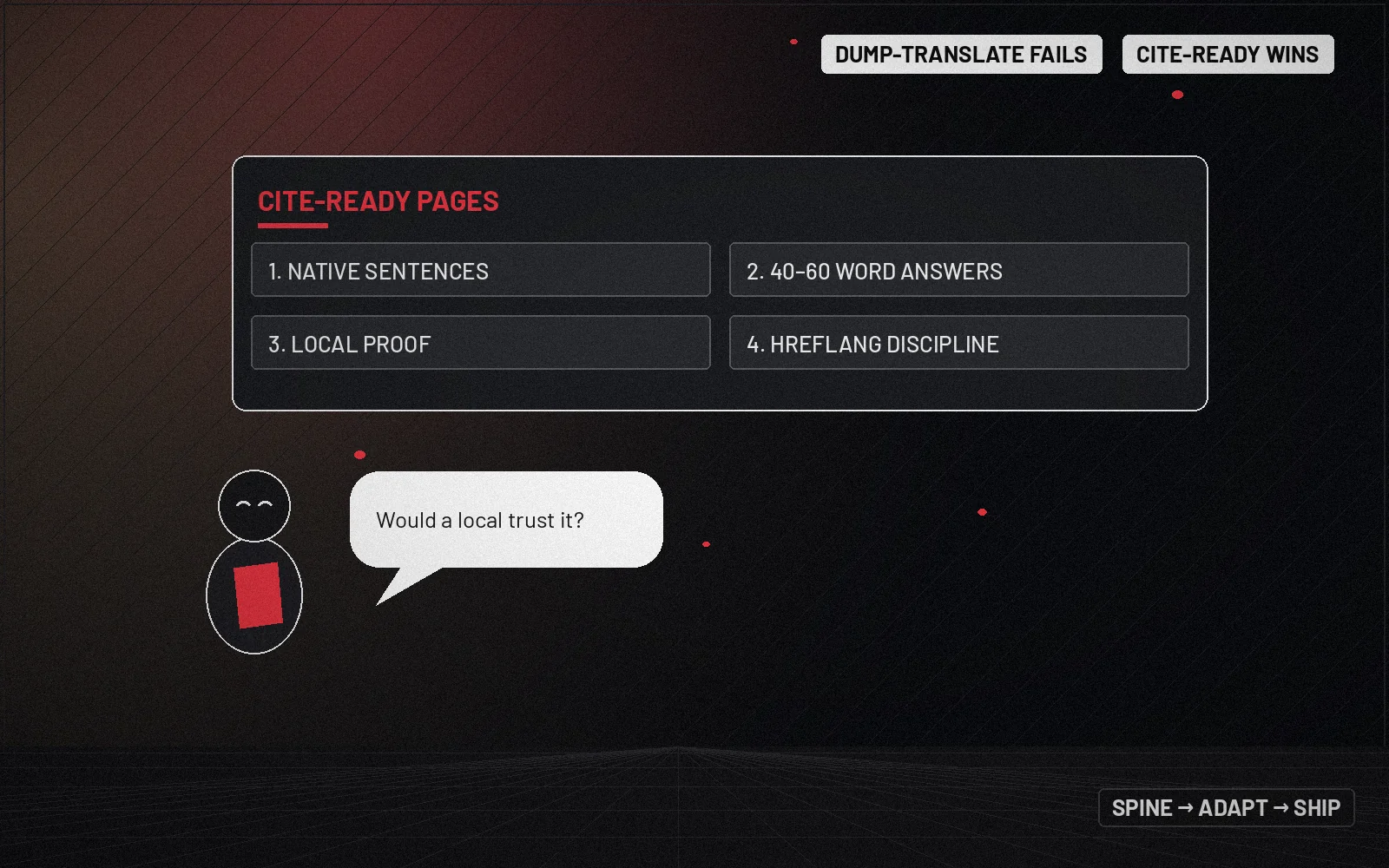
Build cite-ready pages:
- 1. Same spine, native sentences — one message architecture, language-native phrasing
- 2. Short answers first — 40–60 words that can be quoted
- 3. Local proof — PH examples in FIL; ID examples in Bahasa; do not paste Manila anecdotes into Bangkok pages
- 4. Hreflang discipline — each language URL declares its siblings
- 5. Refresh on spike weeks — budget plenary, PR Congress themes, ASEAN moments
Do not:
- Publish FIL as an afterthought PDF
- Use idioms that shame-translate
- Fake "localization" with a plugin and no editor
- Mix languages on one URL without a plan
Multilingual SEO advocacy APAC sells the system, not a one-off translation invoice. Progressive agencies that invoice "translate this blog" without hreflang, FAQ structure, and native edit are selling a PDF with worse SEO than the English original.
Quality bar: if a Filipino journalist would not cite your FIL page, an AI Overview should not either. Write for the journalist first. Machines follow.
Answer-engine hygiene: Overviews, Discover, regional desks
Google's AI optimization guidance rewards clarity, structure, and experience — not keyword stuffing. For advocacy GEO:
- Put the answer in the first screen
- Use FAQ blocks that match People Also Ask in each language
- Keep claims sourced and non-defamatory
- Avoid rumor amplification in any language
- Design for Discover: strong titles, clean meta, human photos without competitor logos
Regional desks still matter. An ID page that a Jakarta politics desk can cite is earned media adjacent. Multilingual GEO is not only bots — it is reporters and partners who search in their language at 11pm.
Also respect verification culture that PR Congress highlighted. AI-assisted drafts are fine. Unverified AI claims in three languages are a crisis multiplier. Native editors are a brand-safety control, not a nice-to-have.
Soft CTA: if your mid-September budget FAQ exists only in English, you are leaving FIL citations on the table. Contact.
Message discipline across languages without rewriting the spine six times
Message discipline is not six unrelated campaigns. It is one spine:
- Core claim
- Proof points
- Ask
- Risk lines you will not cross
Then language owners adapt tone and examples. This is where multilingual message discipline APAC and this GEO piece meet — discipline is the narrative OS; multilingual SEO is the discoverability OS. Do not merge them into one vague "localization" slide.
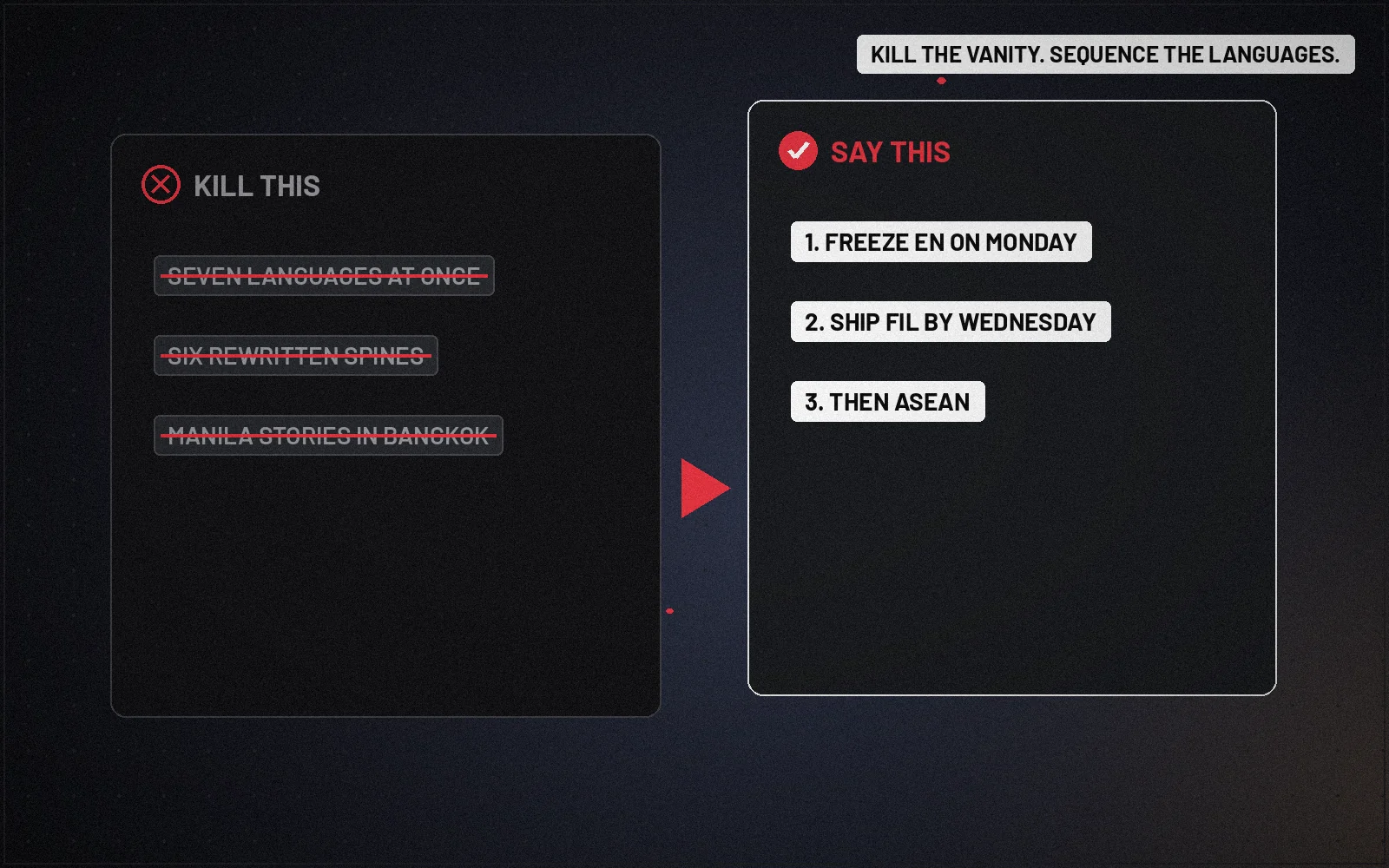
Street-smart production tip: freeze the English spine on Monday; ship FIL by Wednesday; ship ID/TH for ASEAN themes by Friday when the week demands it. Cadence beats perfection. Perfectionism is how small advocacy teams stay English-only forever.
When JA/KO enter the map for diaspora or Northeast Asia partners, do not auto-expand every PH budget FAQ. Expand by intent: which queries actually convert to partners, donors, or earned coverage in that language? Intent beats vanity language counts.
Production cadence that small advocacy teams can keep
Small teams cannot hire six native newsrooms overnight. Keep a cadence they can survive:
- Priority languages — EN + FIL first for PH orgs; add ID for ASEAN chair themes
- Shared FAQ bank — questions locked; answers language-owned
- Editor checklist — native speaker sign-off before publish
- Schema — FAQPage / Article where appropriate, language-aware
- Scoreboard — Search Console by language property or filter; do not invent fake AI Overview dashboards
If the cadence needs a 12-person localization department you do not have, shrink the language set — do not fake quality. Progressive clients renew honest systems.
Also budget time for URL hygiene: separate paths or subfolders, consistent slugs, and internal links that point users to the right language without a maze. Broken language switchers are a trust tax.
Distinct from multilingual-message hub, GEO FAQ, and agency GEO inbound
Keep clusters distinct:
- Multilingual message discipline — narrative OS across languages
- GEO FAQ / PAA — cite-ready FAQ for budget spikes (GEO FAQ campaign SEO)
- Agency GEO inbound — how agencies win answer-engine leads (answer engine GEO inbound)
- This piece — multilingual SEO advocacy APAC after PR Congress fragmentation framing
Cannibalization kills Rank Math focus. Sell the specific retainer: cite-ready multilingual answer pages + hreflang + production cadence for advocacy teams in PH and wider APAC.
EN–FIL first, then ASEAN languages — a practical sequencing matrix
Most PH advocacy teams should not start with seven languages. Start with a matrix:
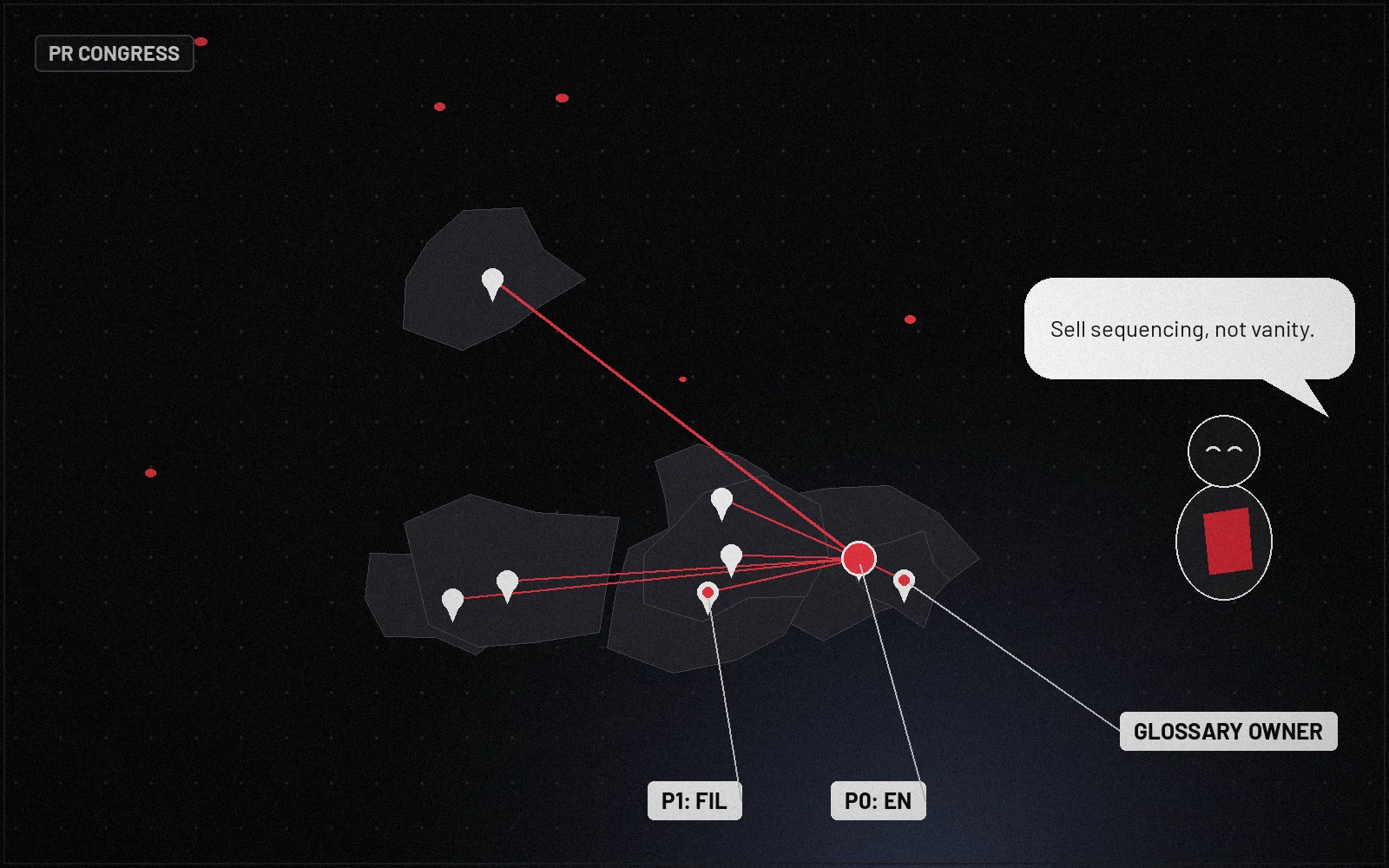
| Priority | Language | Why first | Ship trigger | |———-|———-|———–|————–| | P0 | English | Donor, diaspora, regional desks | Always | | P0 | Filipino | Domestic search + Discover | Always on money FAQs | | P1 | Bahasa Indonesia | ASEAN chair / regional solidarity | When ASEAN themes spike | | P2 | Thai / Vietnamese | Issue-specific partner routes | When partner asks convert | | P3 | Japanese / Korean | Diaspora or tech-policy adjacency | Only with native editor |
This matrix keeps multilingual SEO advocacy APAC commercially honest. You sell sequencing, not language vanity. Clients who demand "all ASEAN languages by Friday" get a counter-offer: cite-ready EN–FIL this week, ID next, others when editors exist.
Also document who owns glossary terms — "pork," "unprogrammed appropriations," "red flag" — so FIL and EN do not drift into different claims. Glossary drift is how coalitions accidentally contradict themselves across languages.
Internal linking and hub strategy across languages
Multilingual GEO fails when language pages are orphans. Link:
- EN money page ↔ FIL sibling
- FIL FAQ ↔ budget frames / earned ladder hubs where relevant
- Language switcher that does not dump users on homepage
- Soft CTAs to Services and Contact in each language's natural CTA voice
Do not clone every internal link blindly. Some hubs are EN-only for now; say so. Honesty beats a broken FIL link to an English wall of text with no context.
Soft CTA: multilingual GEO SEO advocacy engagement
After PR Congress named fragmentation as the job, do this week:
- 1. Audit which money pages exist only in English.
- 2. Ship one cite-ready FIL FAQ cluster for budget/accountability.
- 3. Draw a simple hreflang map for EN–FIL pairs.
- 4. Assign language owners — not a translate plugin.
- 5. Add one ID page if ASEAN-chair themes are in your Q4 plan.
Neuwark Communications productizes multilingual SEO advocacy APAC under Digital & Social and Research & Audience Insights. Start at Services or Contact. More GEO playbooks: Insights. About for credibility.
One-line reminder: if your Filipino FAQ is an English page run through a free translator, you did not localize — you donated the citation to someone who did. Buy cite-ready systems instead.