

Hitting publish is not the end of the post. It is the start of the record.
Someone has to write down what shipped, which URL is canonical, whether IndexNow went out, whether the URL is in the sitemap, and who owns the first correction. If that note does not exist, the page is live and the organization is guessing.
The IndexNow publish note is the English, not the protocol. The protocol is a checkbox. The note is how a Monday operator knows the checkbox was real.
This is the language companion to our Discover-grade publishing playbook on NewsArticle schema and IndexNow, which sets up the two rails and the same-day publish roles. It also sits next to our crisis dark-site SEO playbook, where a lost URL is the incident. This piece gives you the sentences for the five minutes after the button.
Street-smart APAC English: short sentences a tired operator can say out loud.
What is IndexNow, in one honest sentence?
IndexNow is an open protocol that lets a site tell participating search engines, such as Bing, that a URL was added, changed or removed. Google does not use it.
That second sentence matters. For Google, the record is your sitemap and Search Console. So the note never says “Google has been told.” It says which rail ran.
Why do published pages still vanish from search?
Three ordinary reasons. The URL changed after a slug fight. The sitemap still lists the draft path. Nobody told the engines the new URL exists.
APAC campaign sites do this every issue week. A holding page goes up at 1am. At 7am someone “cleans the slug.” At noon the paid desk points at the old path. By evening an answer engine is still sending people to the dead link.
You do not fix that with more adjectives in the title. You fix it with a publish note.
What goes in the IndexNow publish note?
Six lines. Plain English. Same fields every time.
| Field | Kill this | Say this |
|---|---|---|
| URL | “the new blog” | Full https URL, final slug |
| Canonical | “should be fine” | Exact canonical URL, or “self” |
| Index ping | “SEO will handle” | IndexNow sent, not sent, or blocked, with time |
| Sitemap | “auto” | Whether the URL is in the live sitemap |
| Owner | a team name | One person or one desk that will answer the first error |
| Correction path | blank | Where a factual fix gets written |
Paste-ready note, filled in for this page (the time is illustrative):
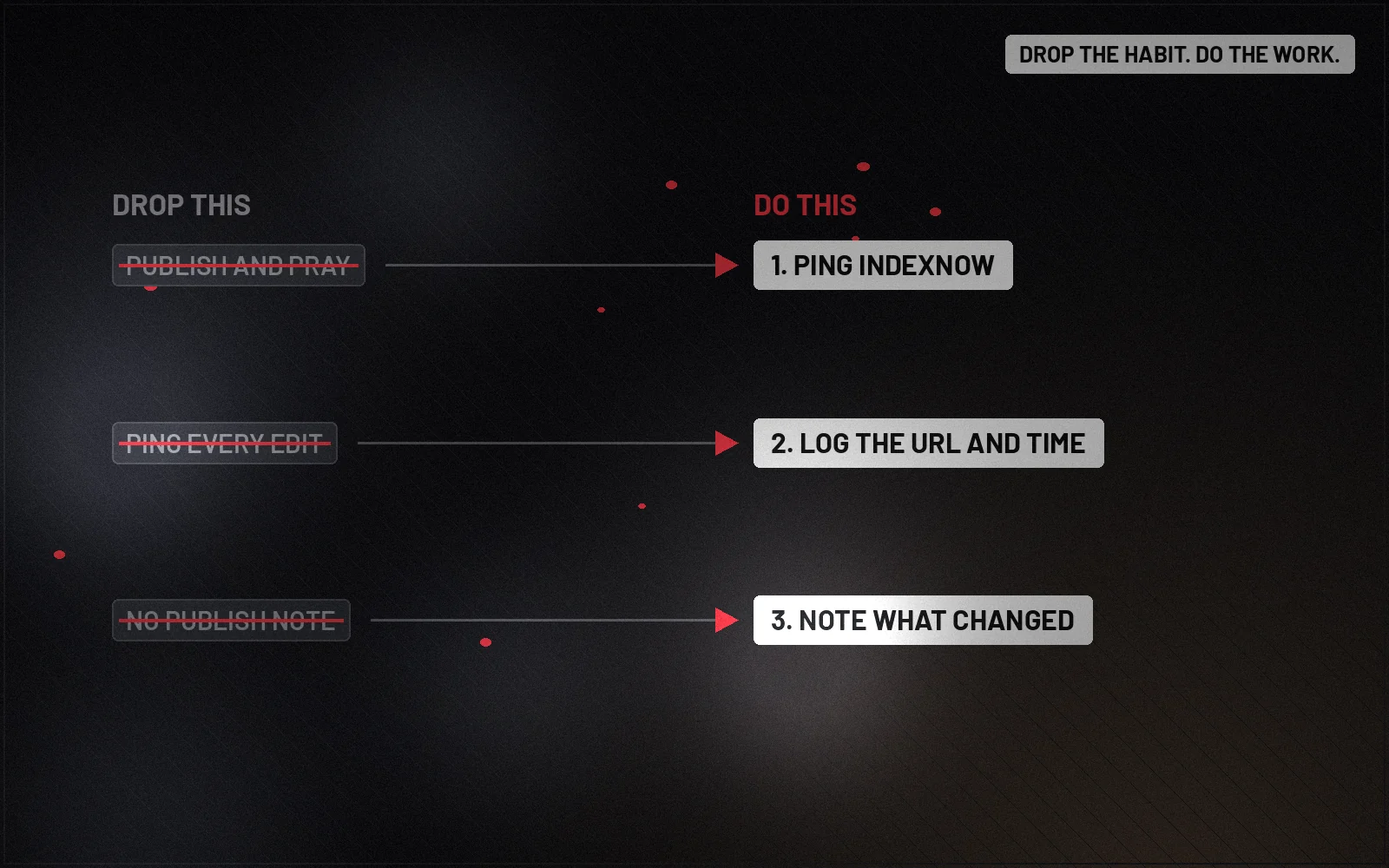
Published: IndexNow Night-Desk English
URL: https://neuwarkcommunications.com/insights/indexnow-night-desk-english-after-you-hit-publish/
Canonical: self
IndexNow: sent 02:14 PHT
Sitemap: listed / not yet
Owner: Insights night desk
Correction path: edit the source block, do not stealth-rewrite the title after ads launch
Timezone matters. “Sent at 2am” is not a time. “Sent 02:14 PHT” is a time. Diaspora desks and Singapore buyers read the same note.
What should you never write in the note?
Do not invent a Search Console verification code. Do not invent an impressions number from memory. Do not claim “we are number one for the budget fight” an hour after publish.
Kill: “Google has been notified and ranking is expected this morning.” Say: “IndexNow sent at 02:14 PHT to participating engines. Google does not use IndexNow. Ranking is not a promise. Recheck the live URL at 09:00 PHT.”
The honesty is the brand. Overclaiming a ping is how a client learns to ignore your scorecards.
How does the publish note help GEO?
Answer engines fetch what they can fetch. A 404 with a beautiful title is still a 404. A duplicate with two slugs becomes two half-answers.
The publish note is how you prevent the duplicate. If the slug must change, the note says the old URL redirects. If it does not redirect, you did not change a slug. You created a ghost.
Kill: leaving `/insights/geo-faq-english` and `/insights/geo-faq-english/` live as separate objects with different titles. Say: one trailing-slash rule, one canonical, one ping.
What does the operator say in Slack or Viber?
One paragraph. No scoreboard.
Live: IndexNow Night-Desk English
Link: the full URL from the live tab
Ping: IndexNow sent, 02:14 PHT
Do not change the slug after 09:00. If a fact is wrong, reply in this thread and we edit the source block.
That is enough. A twenty-line “distribution plan” written at 2am is how the URL gets lost.
What if IndexNow is blocked or the key is missing?
Write the blocker. Do not pretend the ping happened.
Kill: “We use IndexNow” in the post while the key file is missing. Say in the note: “IndexNow blocked. Sitemap only. Flag to web. Do not claim fast indexing.”
Then the Monday scorecard can tell the truth. Vanity words to kill on that scorecard: “dominating search,” “AI-first distribution,” “guaranteed Overview.” Our weekly comms scorecard English has the labels to use instead.
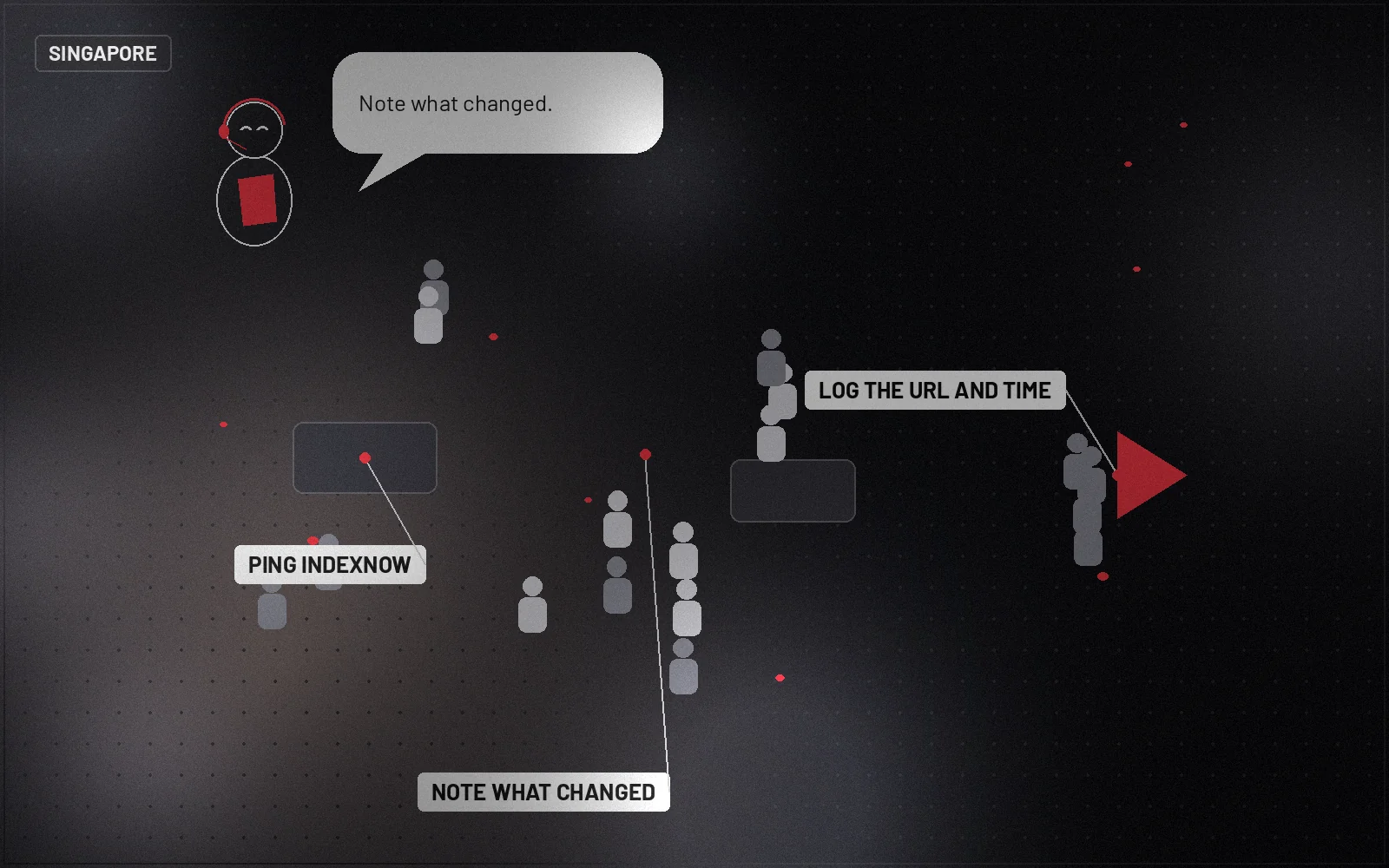
Monday field kit
- Final URL copied from the live tab, not from the editor preview.
- Canonical checked.
- IndexNow result written as sent, not sent, or blocked.
- Sitemap check.
- One owner.
- One rule: no slug edits after the paid desk is briefed.
Paste-ready kill list for the note itself:
- Kill “should be indexed.” Say “ping sent” or “ping not sent.”
- Kill “new URL coming.” Say the URL that exists.
- Kill “SEO pending.” Say the name of the person who owns the next check.
FAQs
What is an IndexNow publish note?
It is the six-line note written after publish: URL, canonical, ping, sitemap, owner and correction path. It turns a checkbox into a record someone else can check on Monday.
Does IndexNow replace Search Console?
No. IndexNow pings participating engines such as Bing, and Google does not use it. Google’s record lives in your sitemap and Search Console, and you never invent verification codes in public posts.
Should every Insights post mention IndexNow?
Only posts about publishing operations. Situation reports do not need a protocol lecture.
What if WordPress changes the slug on publish?
Treat that as an incident. Redirect the announced URL, update the note, and tell the paid desk before they paste.
Can we ping from staging?
No. Ping only the public URL, on the host that holds your key file. Staging URLs should never be submitted.
What to do this week
Add the six-line note to the publish checklist. Use it on the next five Insights posts. If a post from last week has two live slugs, pick one canonical and redirect the other before you write anything new.
Neuwark Communications runs publish operations and GEO production under Digital & Social and Crisis & Rapid Response. If publish is still a hope and not a note, talk to us at Contact. More operator English is in Insights.
Related: Discover-grade publishing with NewsArticle schema and IndexNow · Weekly comms scorecard English · Crisis dark-site English · Title tag English APAC