
Most Singapore corporate communications teams treat POFMA as a legal event: counsel opens the Act, someone screenshots a Direction, and Marketing is told to “wait.” That is how you wake up to a staffer quoting the disputed claim on LinkedIn, or a founder thread that argues the merits online while the Direction’s clock is already running.
This article is a POFMA compliance communications Singapore readiness pack for the night before a Direction is likely—or the first hours after one arrives. It is written for corporate and public-affairs operators, not as a reading of any named case. Primary framing comes from the POFMA Office Regulations page (last updated 4 June 2026) and About us (last updated 8 May 2026). Statutory definitions of Direction types are cross-checked against the Protection from Online Falsehoods and Manipulation Act 2019 on Singapore Statutes Online.
Educational note (YMYL): This is operator guidance for communications teams. It is not legal advice, not a substitute for Singapore counsel, and not an official position of the POFMA Office, IMDA, or MDDI. Directions, notices, and Codes of Practice change—confirm the live instrument and your counsel’s instructions before you publish, post, or reply.
Neuwark Communications runs Singapore public-affairs and crisis drills from our account office at Level 39, Marina Bay Financial Centre Tower 2, 10 Marina Boulevard, Singapore 018983 (contact +63 923 859 6587). Soft path: Crisis rapid response · Public affairs · Contact. Related reading: IMDA code consultation comms checklist, brand safety agency Singapore AI likeness ads.
Why the night before belongs to communications
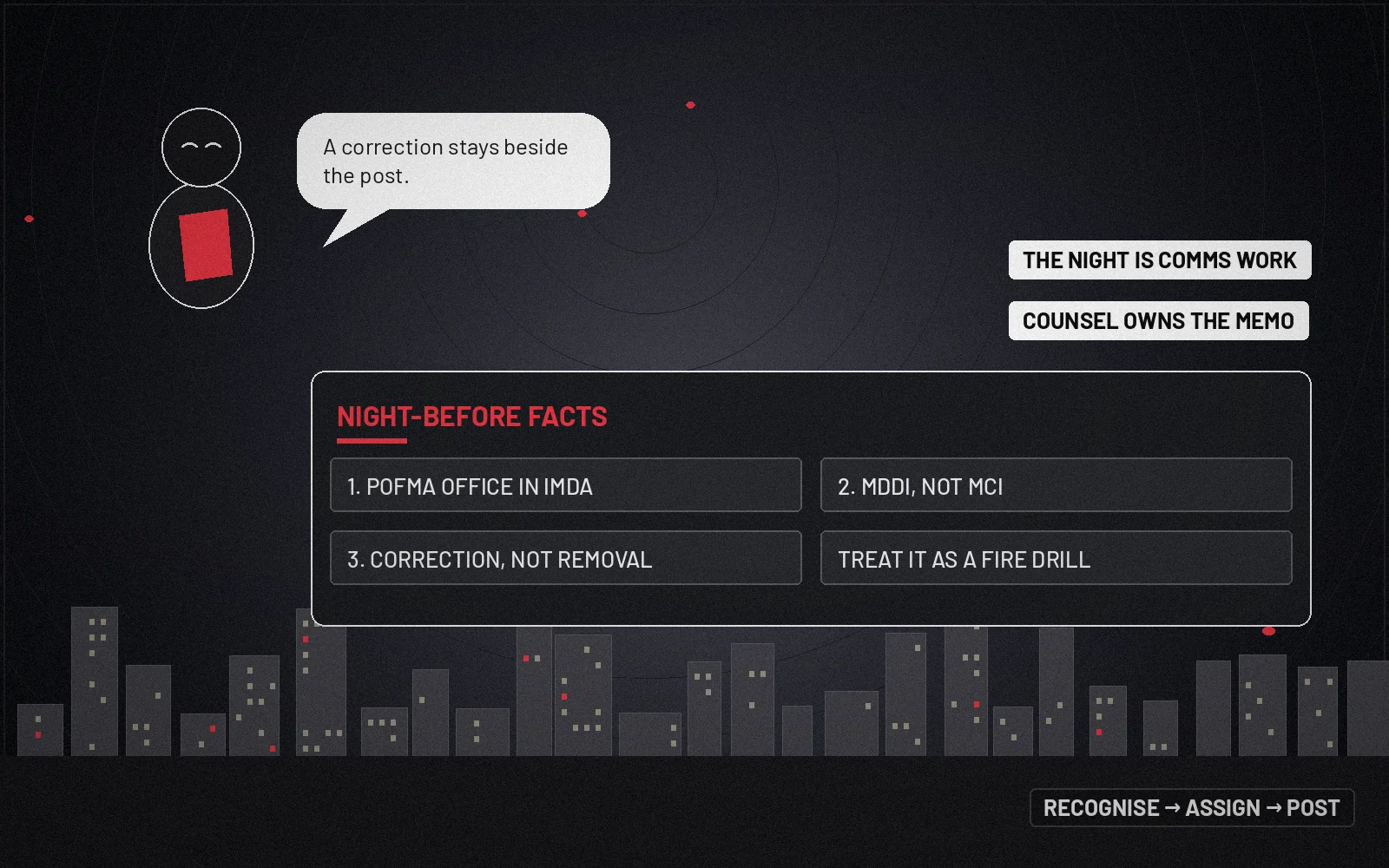
The POFMA Office sits within the Infocomm Media Development Authority (IMDA) and administers POFMA as part of a Whole-of-Government effort against online falsehoods that affect the public interest. It issues Directions and Notices upon the instruction of Ministers, monitors compliance, and administers Codes of Practice under the Act. Communicators operate inside a statutory Direction clock: counsel owns substance; you own public surface control. See POFMA Office — About us.
Singapore’s digital portfolio ministry is the Ministry of Digital Development and Information (MDDI)—formerly MCI, renamed effective 8 July 2024. Keep that rename in holding lines and FAQ language so you do not look dated under pressure.
POFMA’s own summary is blunt: primary tools are correction directions, and those directions do not require the online falsehood to be removed. In more serious cases, a stop communication or disabling direction may be used. Directions can only be issued if (1) a false statement of fact has been or is being communicated in Singapore through the Internet, and (2) it is in the public interest to issue the direction. Source: POFMA Office — Regulations.
If your brand speaks into Singapore (en-SG audiences, local staff, SG-regulated product, or regional HQ narrative), treat a probable Direction night as a comms control window, not only a counsel inbox.
Who this is for / who should skip
| Use this pack | Skip or hand off |
|---|---|
| Corporate comms / public affairs leads at firms that publish into Singapore or employ SG staff | Purely overseas entities with no SG operations, staff, or product—still verify with counsel if you publish into SG |
| Agencies coordinating holding lines across HQ, regional, and local desks | Anyone seeking case outcomes, named company examples, or guaranteed regulator reactions—those are not published here |
| Product marketing / social owners whose calendars can restate a disputed claim overnight | Teams that only need a one-line “we comply with all laws” boilerplate (too thin for Direction nights) |
Original element: night-before POFMA direction readiness pack
Below is the artefact pack we run with clients when a Direction is plausible or has just landed. Steal the structure; fill every cell with your counsel’s reading of the live instrument. No invented outcomes—only process.
1) Direction-type recognition table (official descriptions only)
Use this table to brief non-lawyers in the war room. Descriptions track POFMA Office framing plus statutory labels on Singapore Statutes Online—not case commentary.
| Direction type (label) | What it typically requires (high level) | Who it is usually aimed at | Comms implication (ops, not legal conclusion) |
|---|---|---|---|
| Correction Direction | Communicate a correction notice in the specified form, manner, audience, and time; POFMA Office notes primary tools are correction directions and do not require removal of the online falsehood | Person who communicated the subject statement in Singapore | Build correction-notice placement ops; do not invent a “take it down” narrative unless counsel says the instrument requires it |
| Stop Communication Direction | Stop communicating the subject statement in Singapore by the specified time; may also require a correction notice | Person who communicated the subject statement | Channel kill list becomes mandatory; removal / unavailability steps are counsel-led; Comms owns silence discipline around the claim |
| Disabling Direction | Internet intermediary disables access by end-users in Singapore to subject material (by specified time); may include related notice duties | Internet intermediary that provided the service | Platform / intermediary liaison track; brand pages that ride the same service need a parallel employee FAQ |
| Related Part 4 labels (Targeted / General Correction, etc.) | Correction-notice duties aimed at intermediaries or broader communication of notices under Part 4 of the Act | Intermediaries / specified recipients per instrument | Treat as multi-channel placement work; do not argue the falsehood in side posts |
Always open the live Direction text and the Regulations overview. Links from that page also point to the Act, Regulations, Rules of Court, and prescribed intermediaries on Singapore Statutes Online—bookmark those the night before, not at H+3.
2) Role matrix — first 6 hours (Comms / Legal / Policy / Leadership)
| Role | Owns in first 6 hours | Signs off | Must not dump onto others |
|---|---|---|---|
| Comms / Public affairs | Holding lines, employee FAQ, social kill list, media fence, stakeholder ladder timing | External narrative tone; what staff may say | “Legal will handle all talking” while LinkedIn stays ungoverned |
| Legal | Instrument reading; privilege; whether / how to seek variation or appeal pathways under the Act | Any statement about what the Direction requires | Expecting Comms to invent a legal theory for a founder thread |
| Policy / Government relations | Authority map (Minister instruction → POFMA Office / IMDA administration); association hygiene | Whether any GR outreach is appropriate after compliance steps are clear | Briefing desks in ways that restate the disputed claim |
| Leadership / CEO office | Single external voice decision; resource lock for counsel + ops | Final “who speaks” list | Live-tweeting personal views that reopen the factual dispute |
If one row is empty at midnight, your counsel memo may be clean while your public surface is not—and that is a communications failure.
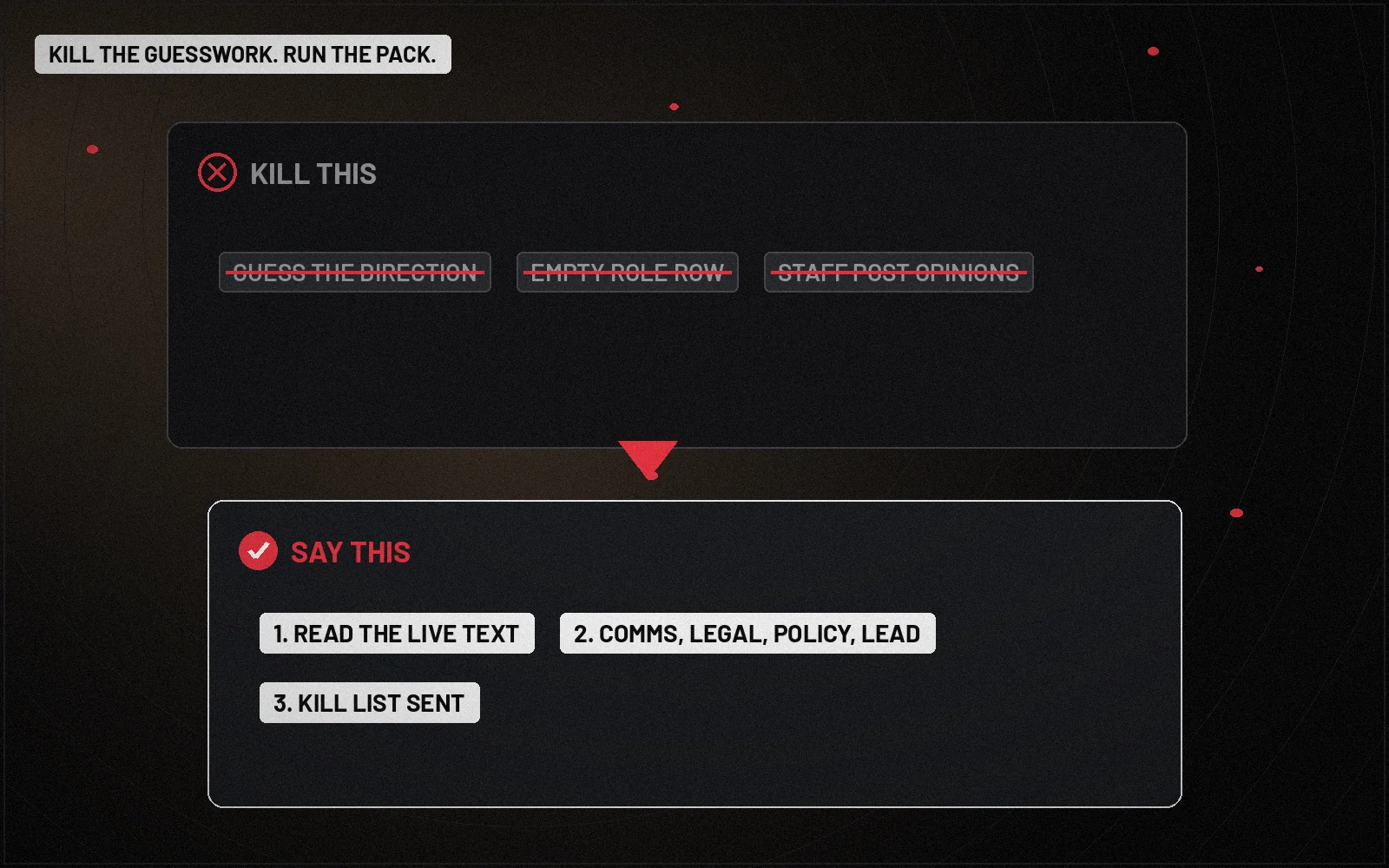
3) Channel inventory + kill list (what staff must not post)
Inventory (map before sleep): newsroom; LinkedIn company + executives; other social; employee advocacy; support macros; IR portal; broadcast lists; internal chat; partner co-marketing drafts.
Kill list (post where social calendars live):
- 1. Do not restate the disputed factual claim “for context” in any public or semi-public channel.
- 2. Do not publish founder or executive “clarifications” that argue the merits online while the Direction’s notice duties are unresolved.
- 3. Do not green-light influencer or partner posts that amplify the original claim.
- 4. Do not let customer-support macros paste the disputed sentence into ticket replies.
- 5. Do not schedule thought-leadership that uses the same claim as a hook.
- 6. Do not meme, subtweet, or “ratio” commentary about the Direction itself.
- 7. Do not promise outcomes, fine amounts, or case comparisons in public posts.
Dual-control publish rights on company social from H0 until Legal clears the next window.
4) Holding-line discipline
Holding lines exist to acknowledge process without arguing the falsehood online. Draft three tiers the night before:
- 1. Employee one-liner: We are coordinating with counsel on a regulatory Direction. Do not post about the underlying claim. Direct questions to [internal owner].
- 2. Customer / partner line: We take regulatory compliance seriously in Singapore. Our team is implementing the required steps. We will share accurate updates through official channels only.
- 3. Media fence: We have received / are preparing for a Direction administered via the POFMA Office framework. We will not debate the underlying factual dispute in this interview. Counsel-approved statement only.
Rules of use: no improvisation; no “off-record” restatement of the claim; no comparing your situation to unnamed “other companies.” If a journalist asks for case law colour, route to counsel—Comms does not invent OSC/POFMA case stories.
5) Stakeholder ladder (employees → customers → investors → media)
| Order | Audience | Why this order | Artefact |
|---|---|---|---|
| 1 | Employees / contractors with public profiles | They post fastest and feel least governed | FAQ + kill list + named internal owner |
| 2 | Customers / users who saw the original claim | Support macros leak claims | Macro freeze + approved FAQ |
| 3 | Investors / board | Rumour risk in chat groups | Counsel-cleared note; no speculative valuation language |
| 4 | Media / analysts | They quote whatever is already messy | Single spokesperson; written lines only |
Skip a rung only if counsel instructs a different sequence for privilege or instrument reasons—and document why.
6) Worked process example (hypothetical template times only)
No named company, no invented outcomes. Use as a rehearsal clock:
| Mark | Clock | Comms actions | Legal / Policy actions |
|---|---|---|---|
| T-12h | Night before (plausible Direction) | Freeze speculative posts on the disputed topic; open war-room channel; inventory live campaigns; draft 3-tier holding lines | Confirm watchers for Direction service; pre-brief leadership on correction vs stop-communication vs disabling labels |
| H0 | Direction received / confirmed | Trigger kill list; dual-control social; employee FAQ live | Parse instrument; list required notice placements and deadlines |
| H+1 | First hour | Leadership voice lock; media fence on; pause partner content | Privilege calls; decide if variation/appeal discussion stays internal |
| H+3 | Placement window opening | Execute only counsel-approved correction-notice / channel steps; screenshot proof of placement | Confirm wording matches specified form/manner |
| H+6 | First checkpoint | Stakeholder ladder rung 1–2 complete; rumours log started | Compliance checklist vs instrument; escalate gaps |
Bake in time of day, not only calendar dates. Singapore end-user availability and intermediary clocks do not care that your regional HQ is still asleep.
7) FAQs (operator, not counsel)
Does a Correction Direction always mean we must delete the post? Not according to the POFMA Office’s own overview: primary tools are correction directions, and those directions do not require the online falsehood to be removed. Always read your instrument—Comms must not invent a deletion narrative. Source: Regulations.
Who issues Directions? The POFMA Office issues Directions/Notices upon the instruction of Ministers, and monitors compliance. Source: About us.
Where do Codes of Practice fit? Separately, the POFMA Office has issued Codes of Practice for prescribed Internet intermediaries and digital advertising intermediaries (prominence of credible sources, transparency of online political advertisements, preventing abuse of online accounts). Those are systems/process obligations for prescribed intermediaries—not a substitute for Direction-night holding lines. Source: Regulations — Codes of Practice.
Can Marketing “explain our side” on LinkedIn while Legal works? Default no. Explaining your side often restates the disputed claim. Holding lines acknowledge process; they do not litigate facts in the feed.
What should we bookmark tonight? pofmaoffice.gov.sg/regulations, pofmaoffice.gov.sg/about-us, and the Act / Regulations / Rules of Court / prescribed intermediaries links collected on the Regulations page via Singapore Statutes Online.
Soft path: when you need a drill, not a blog post
If your Singapore desk has never run a Direction-night tabletop—roles empty, kill list missing, holding lines unfinished—build the pack before you need it. Neuwark’s crisis rapid response, Singapore government relations, and public affairs teams run Singapore-first drills from MBFC Tower 2. Start at Contact.
For adjacent regulatory hygiene (consultations, brand-safety advertising rules), see our live Insights on the IMDA code consultation communications checklist and brand safety agency Singapore AI likeness ads.
Bottom line
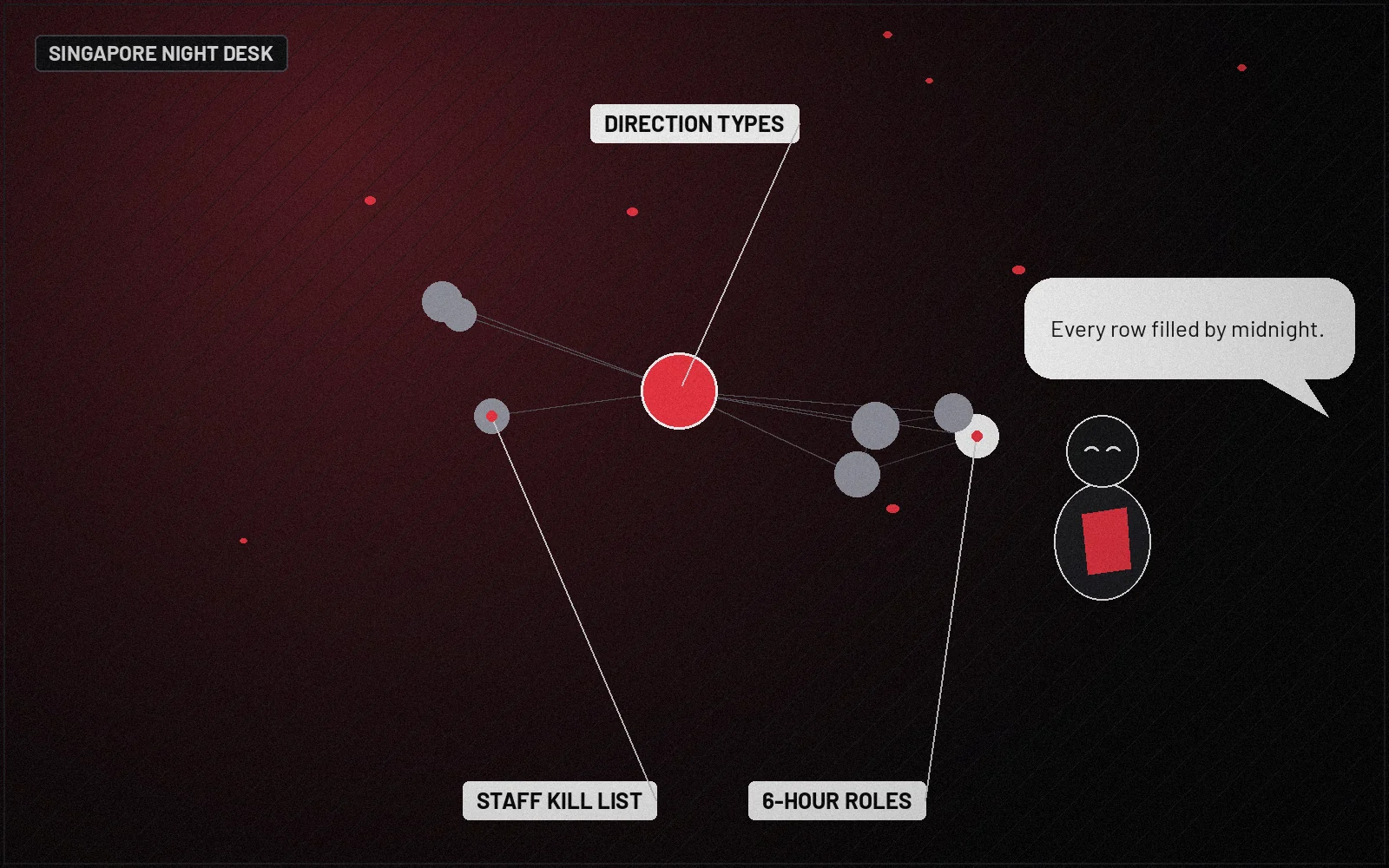
POFMA compliance communications Singapore is not a press release contest. Correction directions are the primary tool and do not, on the Office’s own description, require removal of the falsehood; stop-communication and disabling directions are reserved for more serious cases; and every Direction still needs the twin gates of a false statement of fact communicated in Singapore online and public interest. Your night-before job is narrower and harder: recognise the Direction type, lock roles for six hours, inventory channels, enforce a kill list, hold the line without arguing the claim, and climb the stakeholder ladder in order—with counsel owning substance and communications owning the public surface. For the wider communicator map, see the Singapore regulator map (IMDA, MAS, PDPC, MDDI, POFMA).