
Early–mid September 2026 stacked Korean entertainment and beauty breaches into one communications problem. An MSIT probe around 3 September found roughly 39.54 million Tving accounts compromised. Weverse confirmed about 422,584 accounts around 6 September. Gangnam Unni / Healing Paper exposed about 219,665 users—including roughly 48,000 in Japan—plus sensitive consultation details and photos around 8 September. That is not three separate apology days. It is one personal data breach communications Korea Japan stress test for any consumer platform that sells trust across Seoul and Tokyo.
When consult photos leak, the apology is expected. The proof system behind it is what the market prices. Users do not care which vendor ticket number failed. They care whether you can say what happened, what to do tonight, and why they should stay. Advertisers and partners care whether your updates contradict each other by Friday.
Neuwark Communications builds breach-notification language, dark-site modules, CEO proof lines, and trust-rebuild sequencing for KR/JP-touching brands. This retainer is distinct from the legal-heavy Korea PIPA breach communications playbook. Soft path: Services · Contact.
Why a September breach cluster is a communications system failure
A single incident can be framed as a security event with a communications wrapper. A cluster reads like a system that cannot notify, sequence, or rebuild trust under pressure. Streaming, fandom, and beauty apps sit on intimate data—watch history, social graphs, consult photos. Intimate data breaches are reputation events first. Legal timelines matter; they do not write the first hour.
Street-smart questions users ask within minutes:
- 1. Was I hit?
- 2. What should I do tonight?
- 3. Why should I trust you again?
If your first public line answers counsel’s checklist instead of those three questions, you have already lost the group chat. Cluster weeks punish teams that invent process after midnight. War rooms that start with “Who drafts the Korean FAQ?” and forget Japan-resident users create a second crisis by Thursday.
Treat the September stack as drill tape. Notification language, dark site, CEO lines, and cross-border sequencing belong in one retainer—not three panic memos stapled together after the Herald headline. Boards that still debate “tone” while support queues die are buying a second week of coverage they will not like.
Operational tells that you are already late:
- No single URL where facts live
- KR and JP statements diverge on data classes
- CEO posts emotion without a dated proof calendar
- Employees learn from Twitter before the internal brief
Fix the system, not the press release adjectives.
Notification language that holds under PIPA pressure (not a legalese dump)
PIPA pressure is real. Dumping statute language into a push notification is still bad communications. Notification has a job: clear, human, actionable, and consistent across email, in-app, SMS, and the dark site.
Write for a tired user on a train:
- What happened, in one sentence
- What data classes may be involved (without speculative scare)
- What you are doing now
- What the user should do in the next 24 hours
- Where updates will live (single URL)
Do:
- Match KR and JP versions on facts, not on marketing tone
- Timestamp every update in local time zones users actually live in
- Separate “confirmed” from “under investigation”
- Give a support path that does not require a lawyer to open
- Offer password and session reset steps before the essay about culture
Don’t:
- Hide Japan exposure in a footnote
- Blame a vendor in the first line while users still lack reset steps
- Promise “no evidence of misuse” if you cannot sustain that claim for 72 hours
- Soft-pedal sensitive photo exposure with euphemisms that read as gaslighting
Keep Crisis & Rapid Response owners in the room with counsel. Counsel sets floors; communications sets whether users feel respected. If counsel and comms only meet after the draft is public, you will ship a letter no human can use.
Dark site + FAQ when Japan-resident users are in the dump
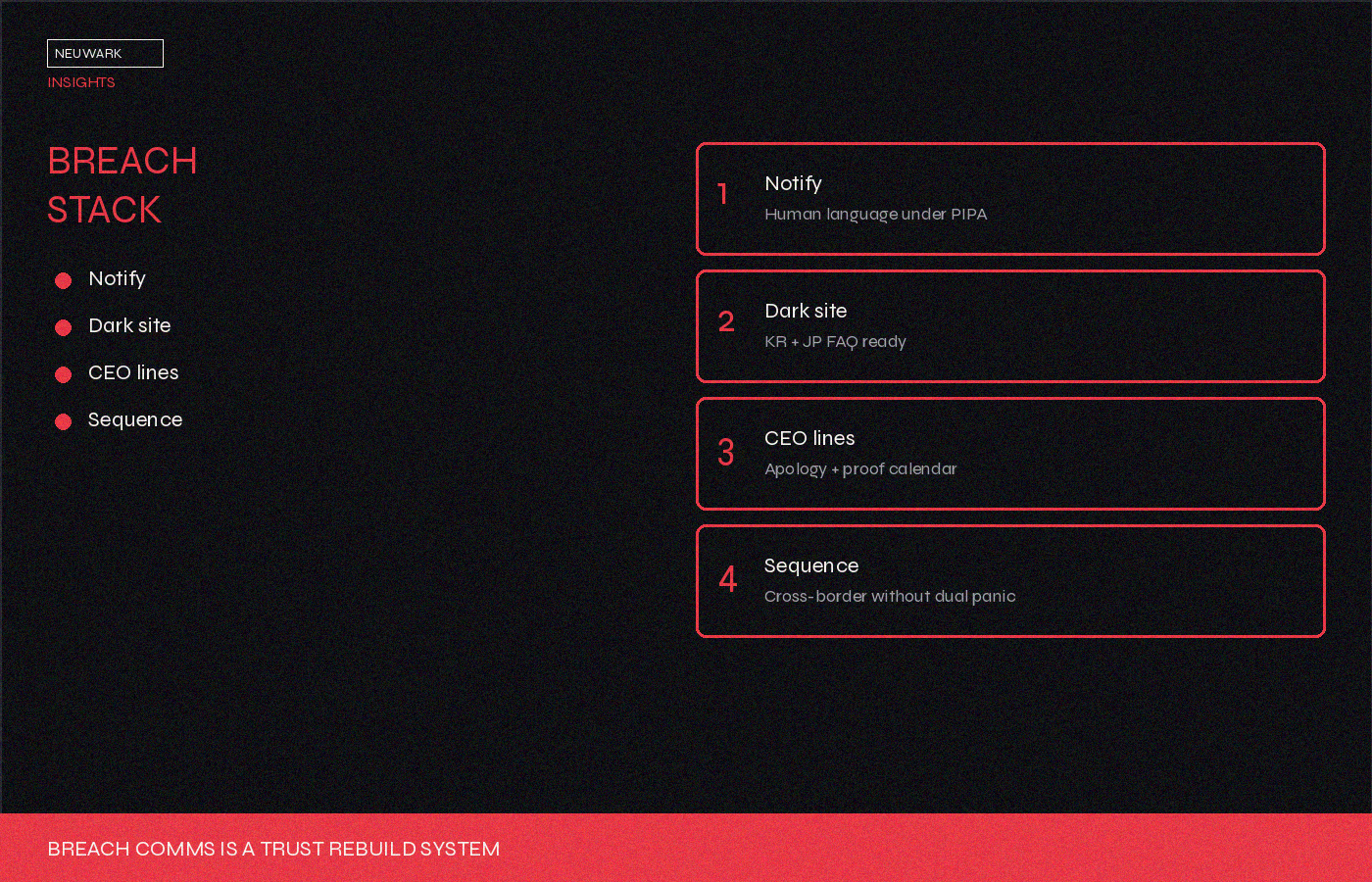
If Japan-resident users are in the dump, your Japanese FAQ is not a translation ticket for next week. It is hour-zero infrastructure. Pair this with crisis dark-site readiness and Japan-side privacy messaging habits from Japan APPI AI data communications.
Dark-site modules that earn their keep:
- Status banner with last-updated time
- “Am I affected?” decision tree without collecting more PII than needed
- Password / session reset steps in both languages
- FAQ for parents, partners, and employers who saw a screenshot
- JP-specific: timelines, contact channels, and what Japanese users should expect next
- Media kit that matches the public FAQ (no dual narrative)
- Changelog so journalists can see what changed without hunting caches
Street-smart rule: if the dark site disagrees with the CEO line, journalists will choose the contradiction. Lock one fact sheet. Publish once. Update with changelogs, not silent edits. Index the URL so Search does not send people to a three-year-old privacy policy instead of the incident page.
Beauty and consult-photo cases need extra care. Provide a path for image takedown requests that is staffed, dated, and honest about what you can and cannot control once files circulate. Empty “we care” language without a ticket queue is worse than silence.
CEO lines: apology expected, proof system priced
Korean and Japanese audiences have different apology rituals, but both punish empty theater. Markets—and B2B partners—price the proof calendar:
- What independent review is underway?
- When will interim findings ship?
- What access controls changed this week?
- How will affected users get concrete help (monitoring, consult-photo paths, account locks)?
CEO lines that work:
- Acknowledge harm without hedging into nonsense
- Own the user impact before the vendor blame
- Announce a dated proof path
- Commit to a single update URL
- Show up for employee and creator briefings the same day
CEO lines that fail:
- “We take privacy seriously” with no dates
- Soft-pedaling sensitive photo exposure
- Performing emotion while support queues are dead
- Blaming “sophisticated actors” as if that absolves notification duty
Boards should ask for the proof calendar in the same meeting as the holding statement. That is the money difference between a retainer and a weekend scramble. Investors will tolerate bad news; they punish amateur hour.
Cross-border KR/JP stakeholder sequencing without dual panic memos
Cross-border breaches create dual panic when KR and JP teams write separate memos that diverge by Friday. Sequence stakeholders once:
- 1. Users — clear notification + dark site
- 2. Employees / creators / partners — what they can and cannot say
- 3. Regulators / MSIT-facing process — coordinated with counsel
- 4. Japan-side partners and platforms — same facts, local manners
- 5. Investors / advertisers — trust-rebuild path, not spin
- 6. App stores and payment partners — if inventory or payouts are at risk
Use one bilingual fact core. Localize manners and channels. Do not localize the casualty of truth. Advertisers watching beauty and streaming inventories will screenshot contradictions faster than your social team can delete them. If your JP partner learns from a Korean blog before your brief, you have already lost narrative control in Tokyo.
Build a 72-hour clock: hour 0 holding + URL; hours 1–6 user channels live; hours 6–24 JP FAQ parity; hours 24–72 proof calendar and advertiser brief. Miss the clock and the cluster owns you.
Distinct from the PIPA legal playbook hub: what this retainer sells
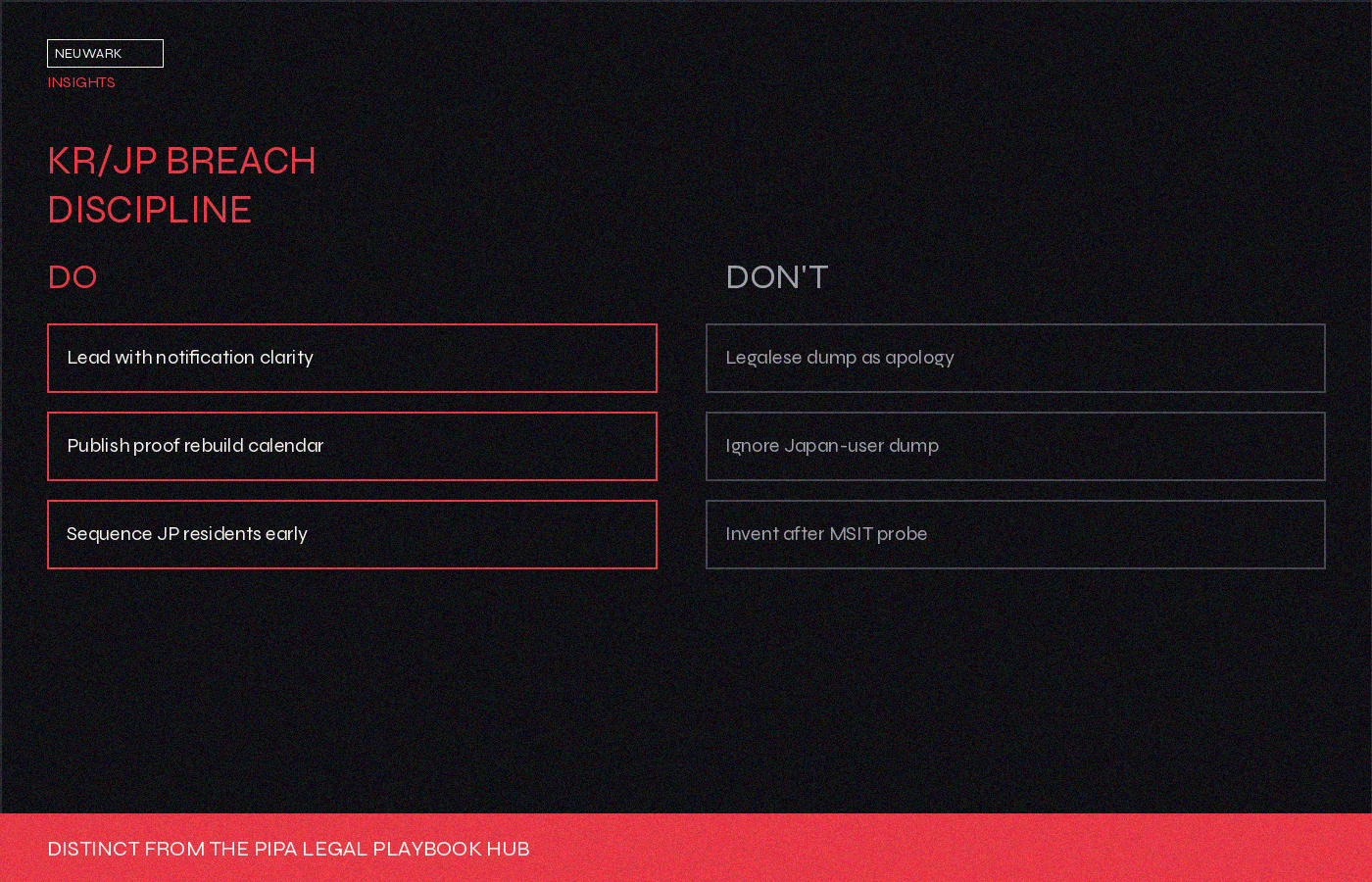
The Korea PIPA breach communications playbook is the legal-pressure and surcharge framing hub. This piece sells the operating stack for KR/JP consumer platforms after a live cluster: notification craft, dark site, CEO proof lines, and cross-border sequencing. Different SOW. Different dashboard. If you merge them, you get either a memo users cannot use or a campaign counsel will not sign.
Browse more Insights or start at About if you need the firm context. Home: [neuwarkcommunications.com](/).
What “trust rebuild” looks like in the first 30 days
Apology week is not rebuild week. Rebuild is a dated program users and advertisers can audit without a NDAed slide. In the first 30 days after a KR/JP cluster, ship visible work:
- Week 1: notification parity (KR/JP), dark-site changelog, support SLAs published
- Week 2: interim security findings summary (even if partial), access-control changes named
- Week 3: partner/advertiser brief with inventory risk honesty
- Week 4: user-facing progress note—what closed, what remains open, what you still do not know
Trust rebuild fails when you go quiet after the CEO video. Silence reads as “we hope you forgot.” A short, boring update every week beats a cinematic apology followed by radio silence. Keep the same URL. Do not open a new microsite every Monday.
Measure what matters: ticket resolution time, repeat-login success after resets, advertiser retention, and sentiment among Japan-resident users—not vanity “brand love” polls taken while people still cannot log in.
Playbook drills you should run before the next cluster
If you wait for MSIT or a Herald headline to invent roles, you will invent them badly. Quarterly drills for consumer platforms with KR/JP exposure:
- 1. Tabletop a consult-photo leak with Japan residents in the dump
- 2. Time how long it takes to publish a bilingual dark-site FAQ
- 3. Stress-test support volume at 10× normal
- 4. Rehearse CEO lines with counsel in the room—not after the post is drafted
- 5. Kill a contradictory employee tweet in under 15 minutes
Document the drill results for the board. Retainers exist so this is boring when it is real. Street-smart operators prefer boring.
Soft CTA: personal data breach communications KR/JP retainer
If your product touches Korean or Japanese consumer data—and especially if consult photos, social graphs, or payment tokens are in scope—scope the retainer before the next probe headline. Neuwark’s Crisis & Rapid Response work covers holding language, dark-site modules, CEO proof calendars, and stakeholder sequencing that survives a cluster week.
Ask for a personal data breach communications Korea Japan readiness review: Contact or Services. Bring your current notification templates and Japan FAQ (even if unfinished). We will tell you what fails a screenshot test before MSIT or users do.