

Vietnam’s Decree 330/2026/ND-CP (effective 19 August 2026; still being briefed into September—DFDL and counsel notes circulating early September) put administrative teeth on personal-data failures. That includes pressure around 72-hour breach notification and, for serious cross-border transfer breaches, fines that can reach a percentage of prior-year Vietnam revenue—widely briefed at up to 5%.
A public affairs agency Vietnam conversation is no longer optional for FDI brands and platforms. A 5% line item is a legal number until customers, employees, and partners hear about it. Then it is a trust story—and trust stories are communications work.
Neuwark Communications scopes public affairs and crisis-adjacent retainers for Vietnam-touching brands. Soft path: Services · Contact.
What Decree 330 changes for communications leaders (not only counsel)
Counsel owns the notification draft. Communications owns whether the company still has a believable voice afterward. Decree 330 changes the ops calendar:
- Clocks are shorter than your old “align next week” habit
- Revenue-linked fines make finance and the board instant stakeholders
- Cross-border transfer failures are narrative landmines for regional HQ
- Silence looks like concealment even when it is just slow email
Comms leaders should sit in the pre-mortem now—not after the first draft leaves legal. Borrow discipline from Korea PIPA breach communications playbooks without copy-pasting Korea into Hanoi.
72-hour breach clock: narrative prep before the notification draft
Do not wait for the notification letter to invent your story. Pre-build:
- Hour 0–6: Fact spine (what, whom, how contained)—no speculation
- Hour 6–24: Stakeholder sequence locked (regulators, customers, employees, partners)
- Hour 24–48: Customer trust language tested for screenshot safety
- Hour 48–72: Notification and PA lines aligned; dark-site readiness checked
If your dark site is still a theory, fix that with crisis dark-site readiness. A 72-hour clock is not a suggestion; it is a narrative fuse.
5% revenue fine as a customer-trust story, not only a legal line
Markets and customers rarely parse administrative sanction tables. They hear: “this company lost control of data” and “leadership was slow.” Your job is to separate:
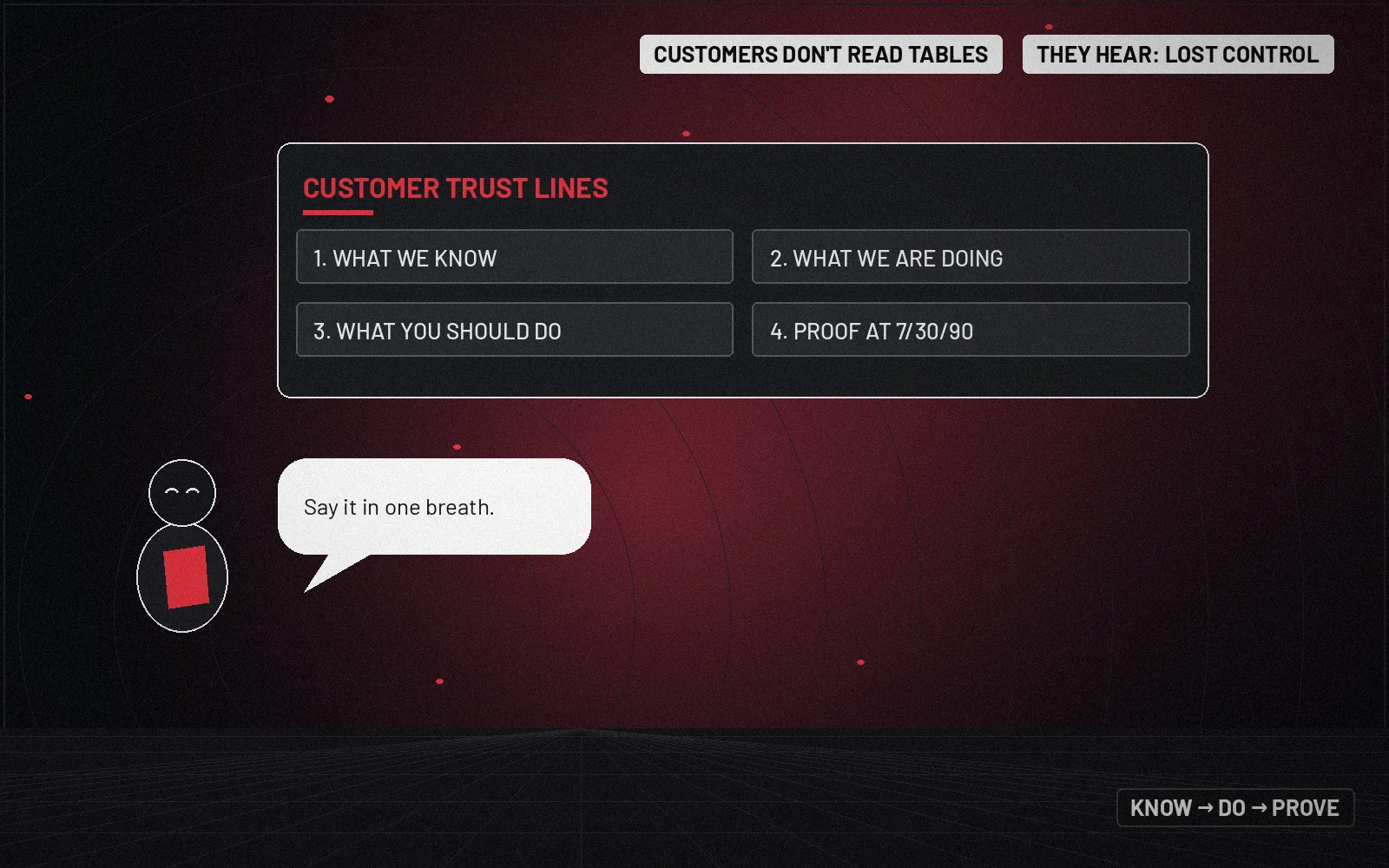
- What you know
- What you are doing
- What customers should do
- What you will prove in 7 / 30 / 90 days
Avoid swagger (“best-in-class security”) and avoid panic theater. High-school clarity wins. If you cannot say it in one human paragraph, you are not ready to speak.
Stakeholder sequence: regulators, customers, employees, partners
Sequence is strategy:
- 1. Regulators / counsel track — accuracy over speed-bragging
- 2. Employees — they will answer customer chats whether you brief them or not
- 3. Customers — plain language, no blame-the-victim tips
- 4. Partners / platforms — contract and reputation adjacency
- 5. Investors / HQ — one fact pack, not five dialects
Messy sequencing creates contradictory screenshots. Contradictory screenshots become the story.
Hanoi-ready local SEO + PA page that converts FDI searchers
FDI operators search for public affairs agency Vietnam, reputation management Hanoi, and data-incident communications when counsel forwards Decree 330 briefs. Your money page should:
- Rank for the category intent
- Explain incident PA + monitoring retainers
- Link to proof Insights without burying the CTA
- Avoid generic “ASEAN coverage” fog if you cannot staff Vietnam nuance
This Insights URL supports that page. It is not a substitute for a clean service module on Services.
Retainer scope: incident PA + reputation monitoring Vietnam
Sell the operating system, not a one-off statement:
- Pre-drafted incident narrative kits (counsel-reviewed)
- On-call PA hours during notification windows
- Stakeholder maps for VN + regional HQ
- Monitoring for local and English spillover
- Post-incident proof calendar
Price honesty beats vanity retainers. If the client only wants a press release after the fine, say what that will not buy.
What to put in the pre-mortem packet (before any breach)
Build a folder counsel and comms both trust:
- Stakeholder map with owners and backups
- Customer email / in-app notice templates marked “draft—counsel must clear”
- Employee Q&A for support and sales
- Partner note template
- Escalation tree for revenue-class sanction scenarios
- Dark-site outline with who can press publish
- Monitoring queries in Vietnamese and English
Review quarterly. A dusty packet is theater. Pair with crisis dark-site readiness so the packet has somewhere to live. Steal clock psychology—not legal text—from Korea PIPA breach communications.
FDI narrative landmines unique to Vietnam data incidents
- Promising “no impact” before forensics finish
- Blaming vendors in public before contracts and facts align
- English HQ statement that contradicts Vietnamese local channels
- Treating Decree 330 as “just another PDPA clone” without local counsel
- Waiting for perfect legal prose while screenshots fill Zalo and Facebook
Street-smart rule: shorter, dated, and revisable beats long and wrong.
Local SEO: public affairs agency Vietnam as a money page
FDI searchers type public affairs agency Vietnam, “Hanoi reputation management,” and “Vietnam data breach communications.” Your page should:
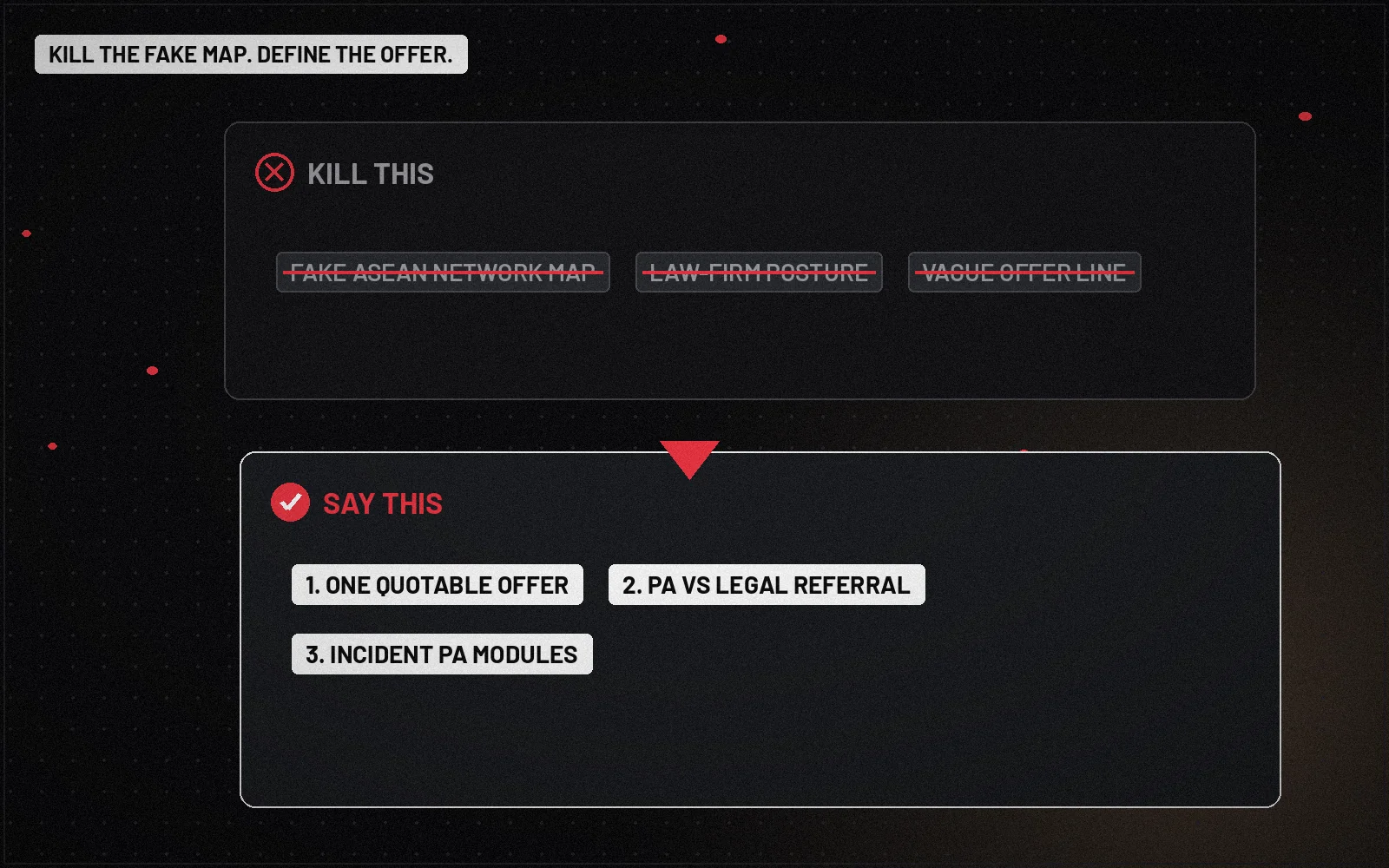
- Define the offer in one quotable sentence
- Separate PA retainer vs pure legal referral (you are not a law firm)
- Show incident PA + monitoring modules
- CTA to Services and Contact
- Avoid fake “ASEAN network” maps you cannot staff
This Insights article feeds that page with September 2026 Decree 330 context. Keep the service module evergreen; keep Insights timely.
Tabletop drill: 90 minutes that save 90 hours
Run a tabletop with counsel, IT, PA, and customer ops:
- 1. Inject a cross-border transfer failure scenario
- 2. Start the 72-hour clock
- 3. Force a customer paragraph by hour 24
- 4. Force a partner note by hour 36
- 5. Decide dark-site go/no-go by hour 48
- 6. After-action: what broke in approvals?
If approvals cannot finish a paragraph in the drill, they will not finish one in a real fine week.
Retainer pricing conversations without fluff
Talk scope in hours and artifacts: on-call windows, number of pre-cleared templates, monitoring languages, drill cadence, who can approve live copy. Avoid “always-on strategic partnership” fog. Boards buy clocks and kits. Soft next step: Contact to scope a Vietnam public affairs / data-incident engagement.
Soft CTA: Vietnam public affairs / data-incident engagement
If Decree 330 is already in your counsel’s inbox, put communications in the room before the first notification draft. Neuwark helps Vietnam-touching brands scope public affairs and crisis-adjacent retainers that treat revenue fines as trust events.
Services · Contact · Insights · About. A 5% fine is legal math until customers hear it—then it is your problem.
Draft language patterns that survive counsel review
Counsel will kill adjectives. Give them structure instead:
- What happened (known / unknown)
- Who is affected (as known)
- What we are doing in the next 24–72 hours
- How to reach support
- When the next update lands
Avoid: “world-class,” “unprecedented commitment,” “no need to worry.” Those phrases age like milk under Decree 330 scrutiny. Keep Vietnamese and English versions in lockstep—different tone, same facts. For dark-site hosting of those updates, see dark-site readiness.
Who owns which narrative lane in an FDI org
- Counsel — legal accuracy, regulator path
- PA / comms — customer, employee, partner voice
- Security / IT — technical facts that can be said
- Country GM — local legitimacy
- Regional HQ — investor and brand adjacency
If HQ writes the first public sentence without country GM and PA in the room, you will spend the next week apologizing for the first sentence. Korea’s breach-comms clock culture is a useful parallel for drills—not a legal transplant—via Korea PIPA breach communications.
Monitoring queries worth building in week one
Build bilingual sets around: decree numbers, your brand + “data,” fine/sanction verbs, executive names, product names, and partner brands. Include misspellings. Assign a human to triage—tools do not understand sarcasm in Vietnamese comment threads.
After the notification: the 30-day trust rebuild
Day 1–3: accurate notices and employee scripts. Day 7: proof of containment progress customers can understand. Day 14: partner briefing. Day 30: public “what changed” note—controls, vendors, training—not slogans.
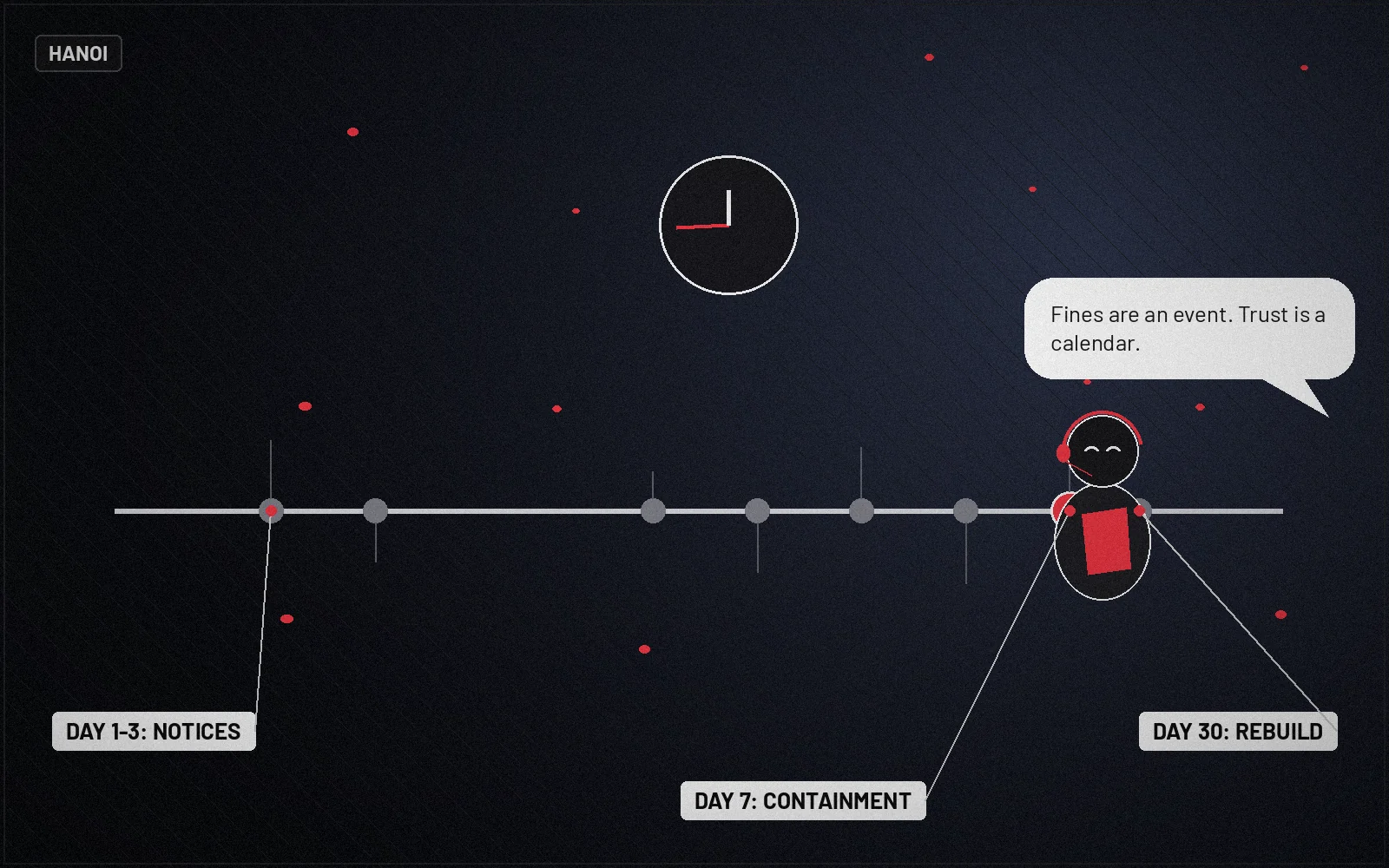
Fines are an event. Trust rebuild is a calendar.
Board one-pager: what Decree 330 means in one page
Give directors five lines max:
- 1. Clocks are shorter; notification risk is operational, not theoretical.
- 2. Revenue-linked sanctions make data incidents a brand and FDI story.
- 3. Comms must sit in the pre-mortem with counsel—now.
- 4. Customer language must be pre-cleared, bilingual, and screenshot-safe.
- 5. We are scoping a public affairs / incident retainer so we are not inventing process under a fine.
Attach the retainer scope and the tabletop date. Boards hate surprises; they tolerate calendars.
Vendor and processor clauses that belong in the PA brief
If a processor sits in the blast radius, your public affairs brief should already list: who can speak, who cannot, what joint statement rules exist, and how fast the vendor must return facts. Do not discover vendor silence during the 72-hour window. Put processor names, contacts, and escalation paths in the same packet as customer templates. That is how public affairs agency Vietnam work stays operational instead of theatrical when Decree 330 risk becomes a live incident.