
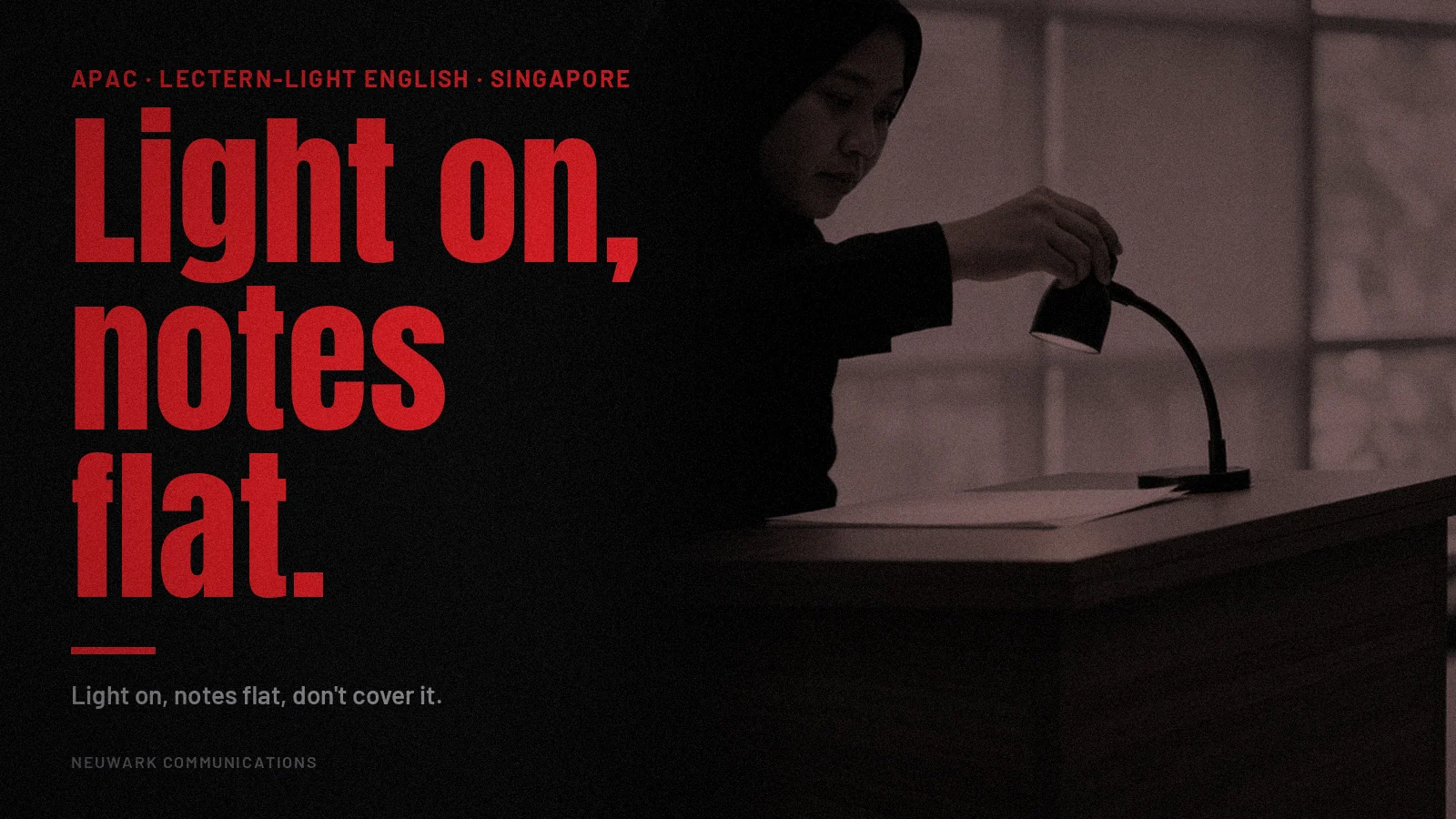
“Light on, notes flat, don’t cover it.”
Three beats before the speaker reads a word.
Street-smart APAC English: short sentences a tired operator can say out loud.
Quick answer: A lectern-light line English APAC is what the stagehand says as a speaker reaches the lectern: light on, notes flat, don’t cover it, so the page stays lit and the lamp stays clear of paper and hands.
A Singapore conference hall, house lights down.
The speaker leans in and the lectern lamp hits her eyes.
She reads the next line from memory, and loses it.
Pair it with the teleprompter line English APAC and the mic-stand line English APAC for more event language on the floor.
What is a lectern-light line English APAC?
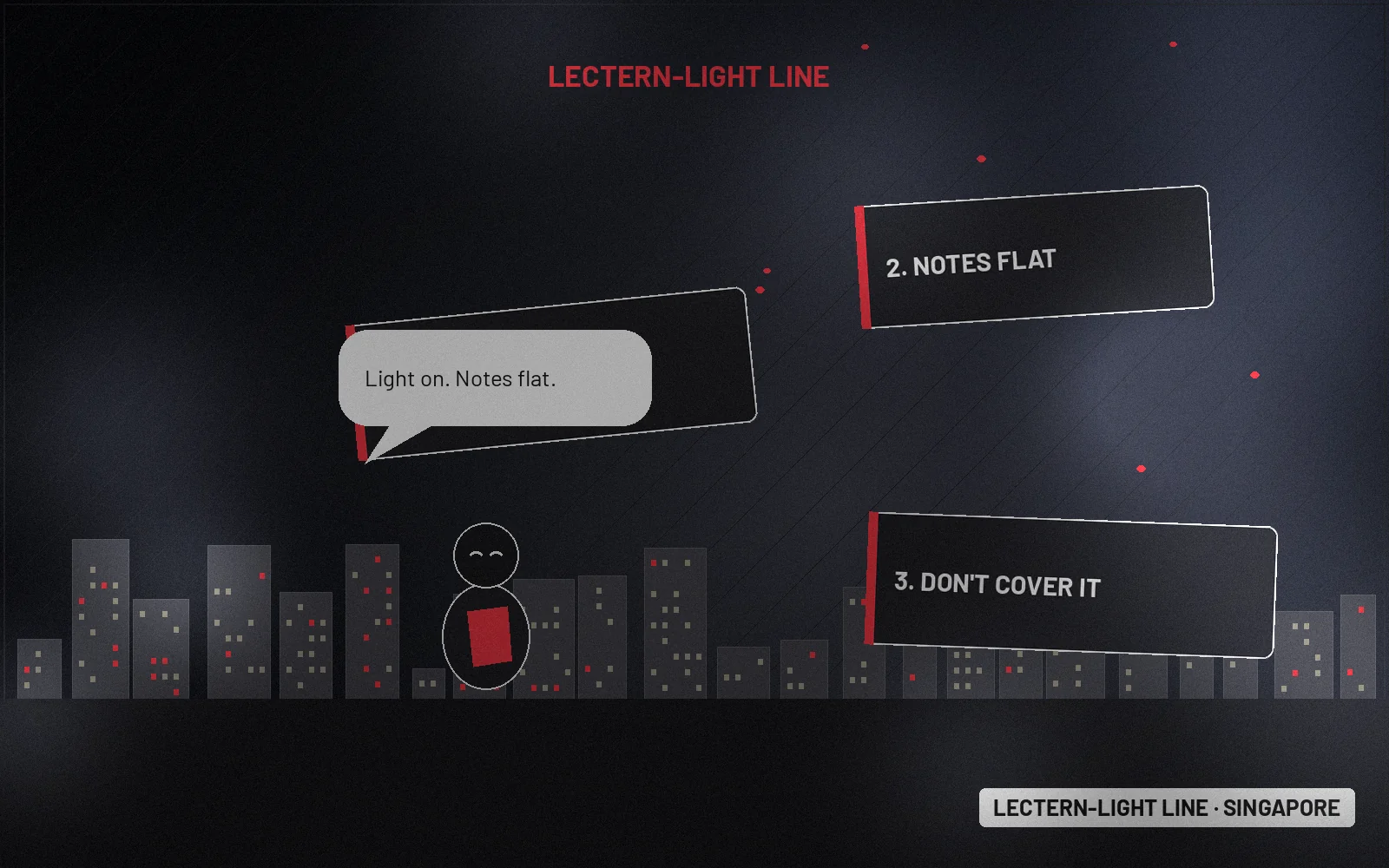
A lectern-light line English APAC has three beats: the lamp, the page and the warning. Light on tells the speaker the lamp is set for them. Notes flat keeps the page in the pool of light instead of tilted into shadow. Don’t cover it stops a folder, tablet or hand from blocking the lamp mid-talk.
Lectern-light line (illustrative):
“Light on. It’s set for your notes.”
“Keep your notes flat on the lectern.”
“Please don’t cover the lamp with your folder.”
Speakable lock (illustrative): “Light on, notes flat, and please don’t cover the lamp.”
How do you angle the lamp for a lectern-light line English APAC?
Point the lamp down at the reading surface, with the shade below the speaker’s eye line. Stand where the speaker will stand and check one printed page and one tablet. If you can see the bulb, so can the speaker. Then check the camera monitor for a bright patch on the face.
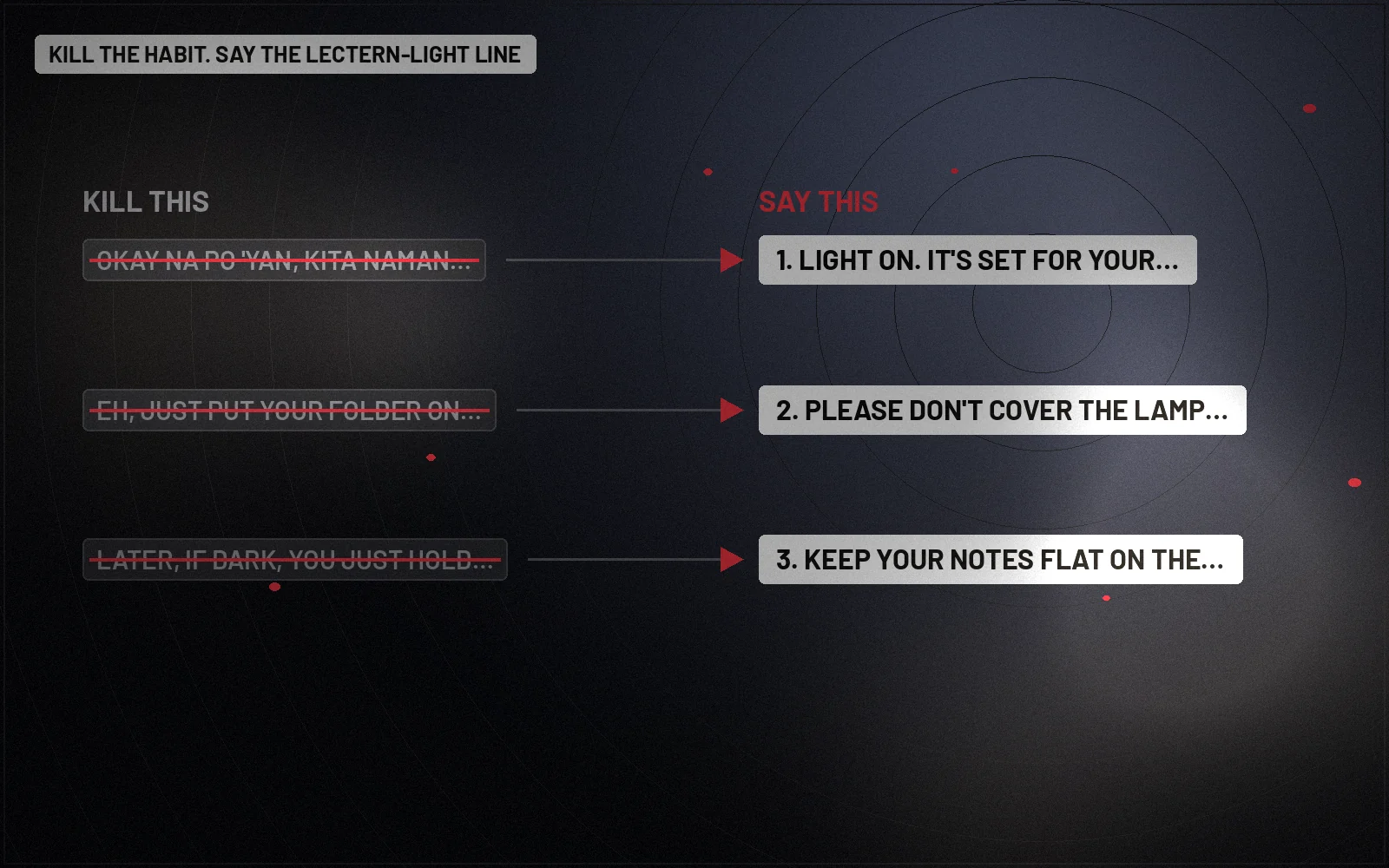
| Kill this | Say this (illustrative) | Why |
|---|---|---|
| Okay na po ‘yan, kita naman siguro. | Light on. It’s set for your notes. | Checks, does not guess |
| Eh, just put your folder on top lah, can. | Please don’t cover the lamp with your folder. | Keeps the lamp clear |
| Later, if dark, you just hold up the page. | Keep your notes flat on the lectern. | No vague later |
Lines in this table are illustrative, not quotes from real people.
What if the speaker covers the lamp after the lectern-light line English APAC?
Wait for a natural pause; never walk on mid-sentence. Then step in low, slide the folder clear of the lamp, check the page is lit and leave. If it keeps happening, move the lamp to the other side of the lectern at the next changeover. Note it on the card for the next speaker.
Why does this line work?
It answers what a speaker needs at a dark lectern: can I read, and what must I avoid? Light on says the lamp is ready, notes flat puts the page where the light falls, and don’t cover it names the one mistake that blacks out the page halfway through a talk.
How does the line play out on PH and SG desks?
Philippines desk. In PH halls, speakers often bring notes on a phone as well as paper. Check both under the lamp, and add po if it fits: light on po, notes flat. Post each speaker’s lectern set-up in the crew Viber group.
Singapore and wider APAC desk. In Singapore and Malaysia, keep it brisk at the wing: light on, notes flat, don’t cover it. In Indonesia, open with Bapak or Ibu as you show the speaker the lectern.
Monday field kit
- Lamp switched on and angled from the speaker’s mark.
- Lectern surface cleared so notes lie flat.
- One printed page and one tablet checked under the lamp.
- Lamp side noted on the changeover card.
- Spare bulb and clip lamp at the wing.
Kill rule: Never let a speaker start reading with the lamp covered or off.
FAQs
What is a lectern-light line English APAC?
A lectern-light line English APAC is the stagehand’s short script for the reading lamp: light on, notes flat, don’t cover it. It keeps the page lit, stops folders and tablets from blocking the lamp and saves the speaker from reading in the dark halfway through a talk.
When do you say the lectern-light line English APAC?
Say the lectern-light line at rehearsal and again at each changeover, as the speaker reaches the lectern. Say it once, quietly, then step back to the wing. If the lighting state changes mid-session, recheck the lamp at the next pause, not during a talk.
Who owns the lectern-light line English APAC on stage?
The stagehand owns the spoken lectern-light line and the lamp angle at every changeover. Lighting owns the house state around it, and the camera operator flags any glare on the monitor. The stage manager owns the go, so the speaker hears one voice per step.
Neuwark Communications writes event scripts through strategy and messaging and digital and social. More lines live in Insights.
Talk to us about your next event script.
Lines are illustrative communications craft, not legal advice.