
The media note ran 400 words.
The desk needed four fields.
The camera went to the opponent who sent a time and a pin.
Press availability English APAC is four fields a reporter can steal into a diary: when, where, who speaks, what the object is. Not a press release. Not a biography.
Most availabilities hide the clock under a preamble.
“In the spirit of transparency and our continuing commitment…”
The assignment editor has thirty other notes.
Yours loses because it cannot be forwarded.
Street-smart APAC English: short sentences a tired operator can say out loud.
This is a companion to our press kit English APAC piece, which covers what the desk keeps on file. This one covers the invitation to the room. It also sits next to press holding line English APAC and press embargo English APAC.
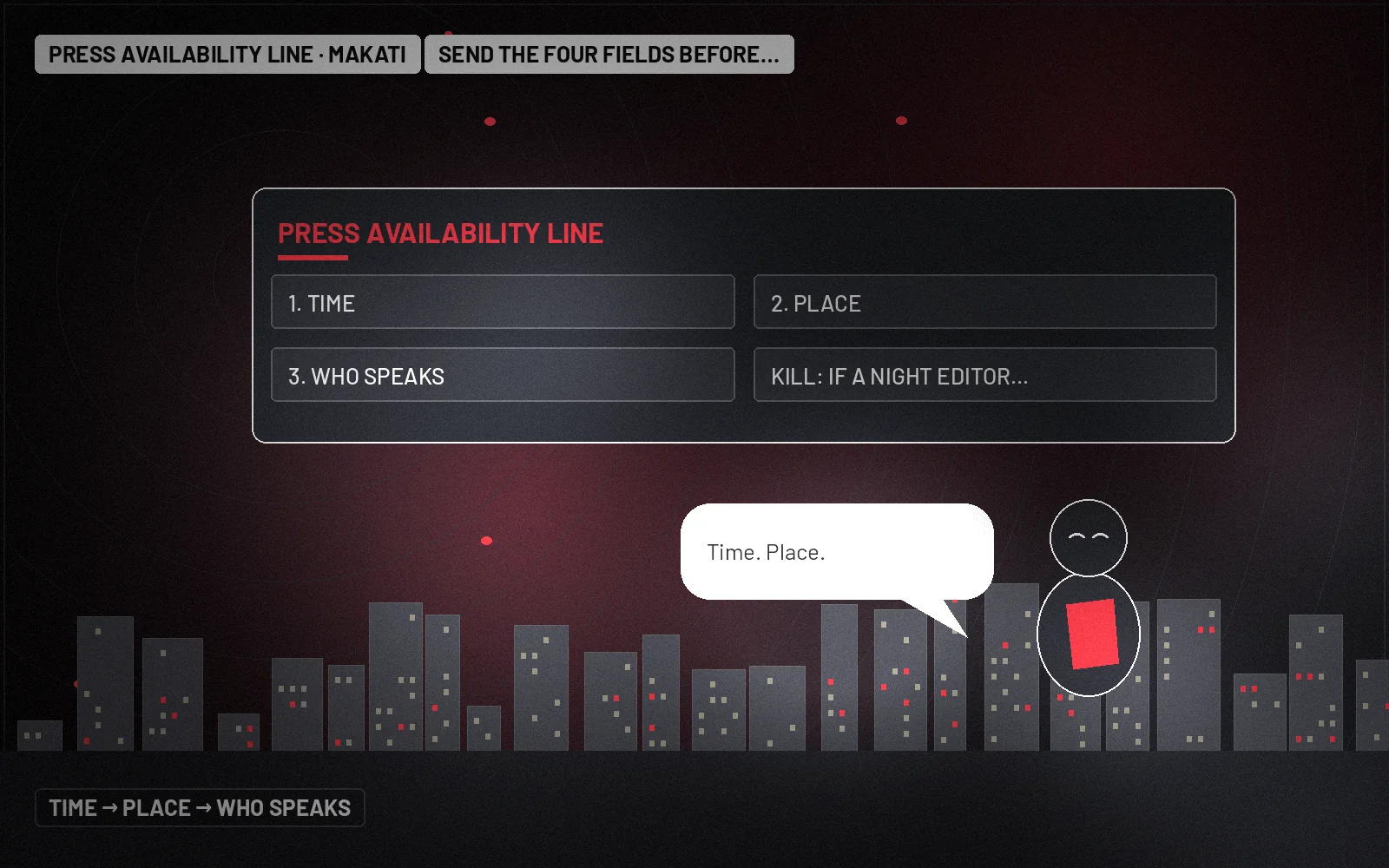
What are the four fields?
| Field | Kill this | Say this (illustrative) |
|---|---|---|
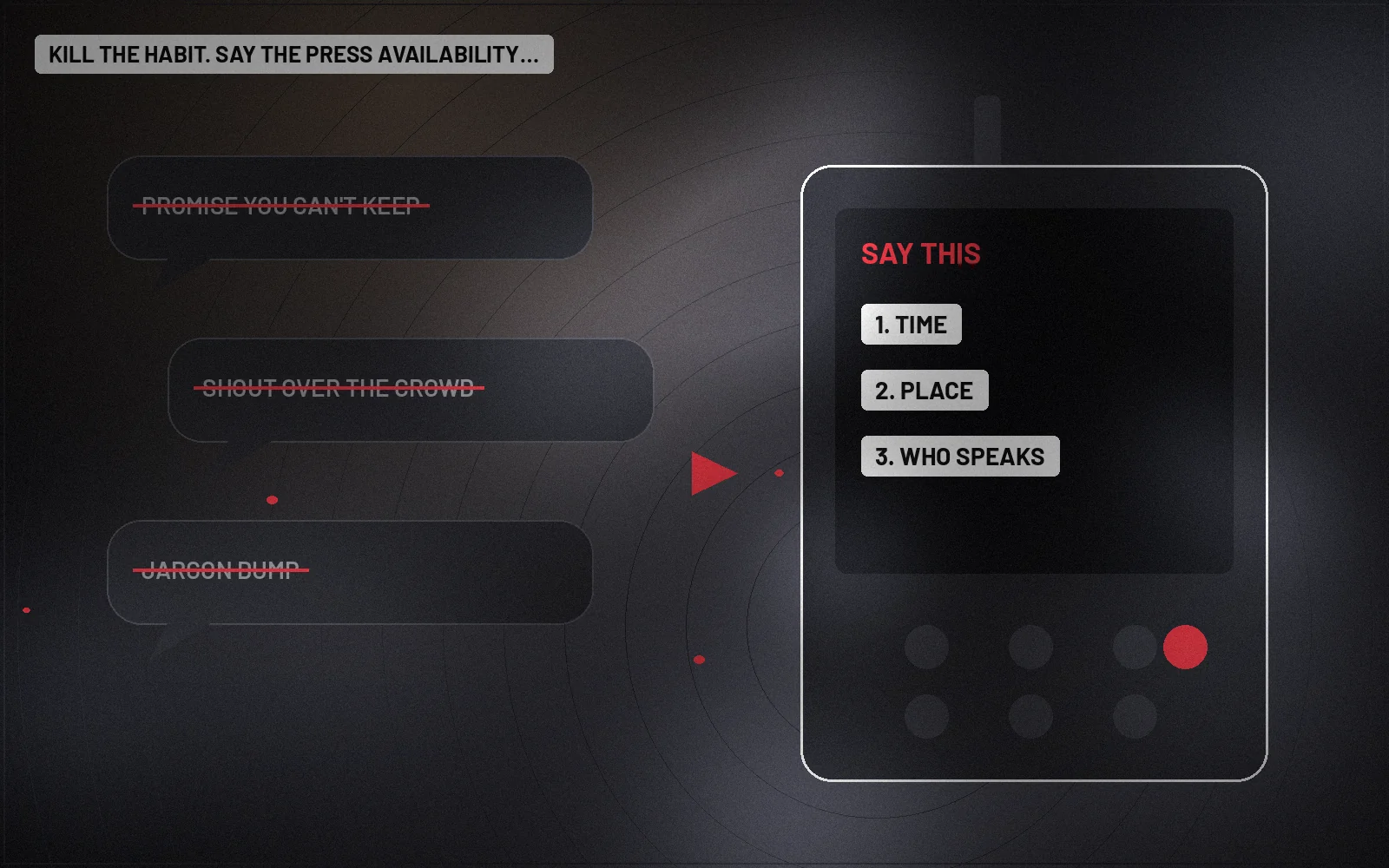
| When | Later today | Today 4:00pm, 15 minutes, doors 3:45 |
| Where | Our office | Function hall, main road, Makati. Gate 2. Pin: one link |
| Who | Our team | Research lead, on the record. Desk officer for follow-ups |
| Object | An important update | Flood-control tracker. What is public as of 2pm |
Subject line is the object plus the clock.
Body is the four fields.
Quote block is optional and short.
What the availability note must not do
- Bury the time under a mission paragraph.
- Name three speakers and no owner for follow-ups.
- Promise a number that is not cleared.
- Say “embargo” and then post the same note to a public page.
- Invite “a conversation.” Availability is a clock and a pin.
Paste-ready lock (illustrative)
Subject: Availability 4:00pm — flood-control tracker, what is public
When: Today 4:00pm, 15 minutes. Doors 3:45.
Where: Function hall, main road, Makati. Gate 2. Pin: one link.
Who: Research lead, on the record. Desk: desk officer, mobile, email.
Object: What the tracker shows as of 2pm. No new allegation.
Written statement posts at 4:20 on the newsroom page.
When should the press availability English APAC note go out?
Early enough for the desk to plan. Late enough that the time and the place will not move.
If the time moves anyway, send the change in the same thread. Subject: “Time change: now 4:30pm.” Four fields again, changed field first.
Do not send a new note with a new subject. The first one is already in the diary.
Who owns the follow-ups?
Name one person. A phone and an email that someone answers during the window.
The principal speaks. The desk officer handles follow-ups, clips, spellings and the written statement.
If the reporter has to chase the principal’s personal phone, you lost control of the record.
What happens in the room?
Start on time. Reporters plan around your clock.
The principal says the object in one breath, gives the one proof, takes questions. The desk officer keeps time and calls the last question.
The written statement posts when you said it would. If it slips, the desk officer tells the room the new time before anyone leaves.
What about reporters who cannot come?
Some desks cannot send a crew. Offer a dial-in or a live link, and give it its own line in the note, not buried in the object field.
One link. It opens the stream, not the homepage.
Say whether remote questions are allowed and how to ask one. If they are not, say so. A reporter who logs in expecting to ask and cannot will remember.
Should the availability go on social?
Only if the room is open to the public, and only after the note has gone to the desks. Same four fields, same time, same pin.
If the room is press-only, say so in the note and keep it off public pages. A public post for a press-only room invites people you cannot seat.
If reporters need an ID or a press card at the gate, put that in the where line. Nobody should find out at Gate 2.
Monday field kit
- Send the four fields before the written statement if the statement is late. The clock is the product.
- Same four fields in SMS to the beat list. Do not invent a second version.
- Hold a spare line if the principal is late: who stands in, or the note that the statement still posts at 4:20.
- Kill rule: if a night editor cannot forward the time and pin in one paste, rewrite the note.
FAQs
What is press availability English APAC?
It is four fields a reporter can steal: when, where, who speaks, what the object is.
Is this the holding line?
No. Holding line is what you say before facts are finished. Availability is the invitation to the room. Write both. Do not merge them.
Should we send a photo with the note?
Not usually. The availability note is a clock and a pin. Photos and b-roll belong with the written statement or the press kit.
What if no reporter confirms?
Hold the availability anyway if the object is real, and record it. Post the statement and the clip on time so the desk can still use them.
What to do this week
Pull the last three media notes your team sent. Can a night editor forward the time, the place and the speaker in one paste? If not, rebuild the template around the four fields.
Neuwark Communications writes media and stakeholder language under Public Affairs and Crisis & Rapid Response. If your notes still open with a preamble, talk to us at Contact. More language companions live in Insights.
Communications craft, not legal advice. Check embargo terms, venue permits and what can be said on the record with counsel before the availability.
Related: Press kit English APAC · Press holding line English APAC · Press embargo English APAC · Desk-ready pitch email English