
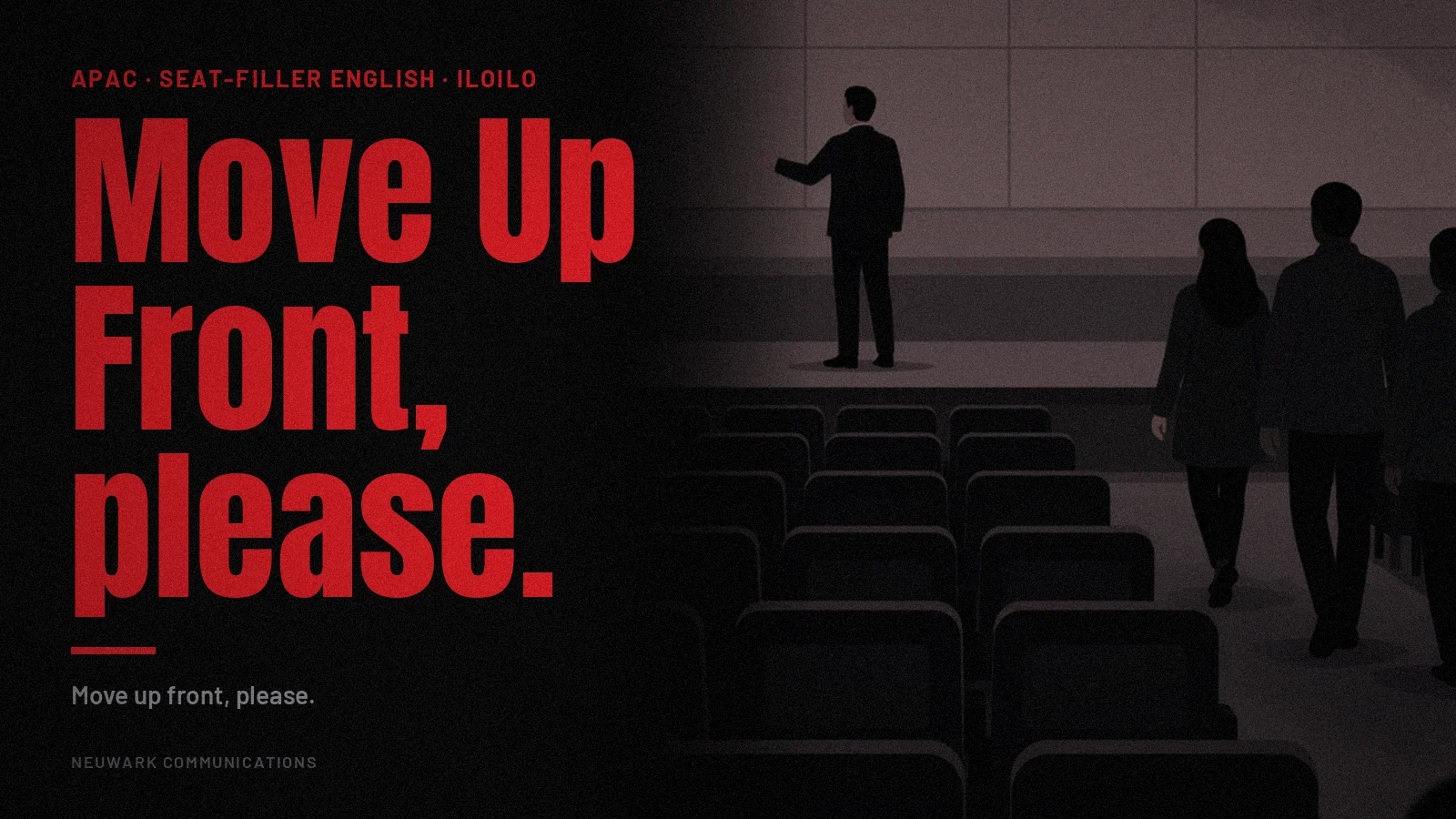
A town hall in Iloilo, five minutes before the first speaker. The back rows are full, the first four rows are empty, and the livestream camera is pointed straight at them.
Seat-filler line English APAC is the short emcee line that fills the front: the rows are open, please move up, and thank you.
Street-smart APAC English: short sentences a tired operator can say out loud.
It is the opposite job to the reserved seat line English APAC, which keeps a row held; this one opens rows up. It usually runs on the mic while the holding-slide line English APAC is on screen.
Quick answer: A seat-filler line English APAC is the emcee’s warm invitation to move into the empty front rows: the front rows are open, please move up, and thank you. Say it before the programme starts, name the rows, give guests a moment, and never single out a person or a group.
What goes in a seat-filler line English APAC?
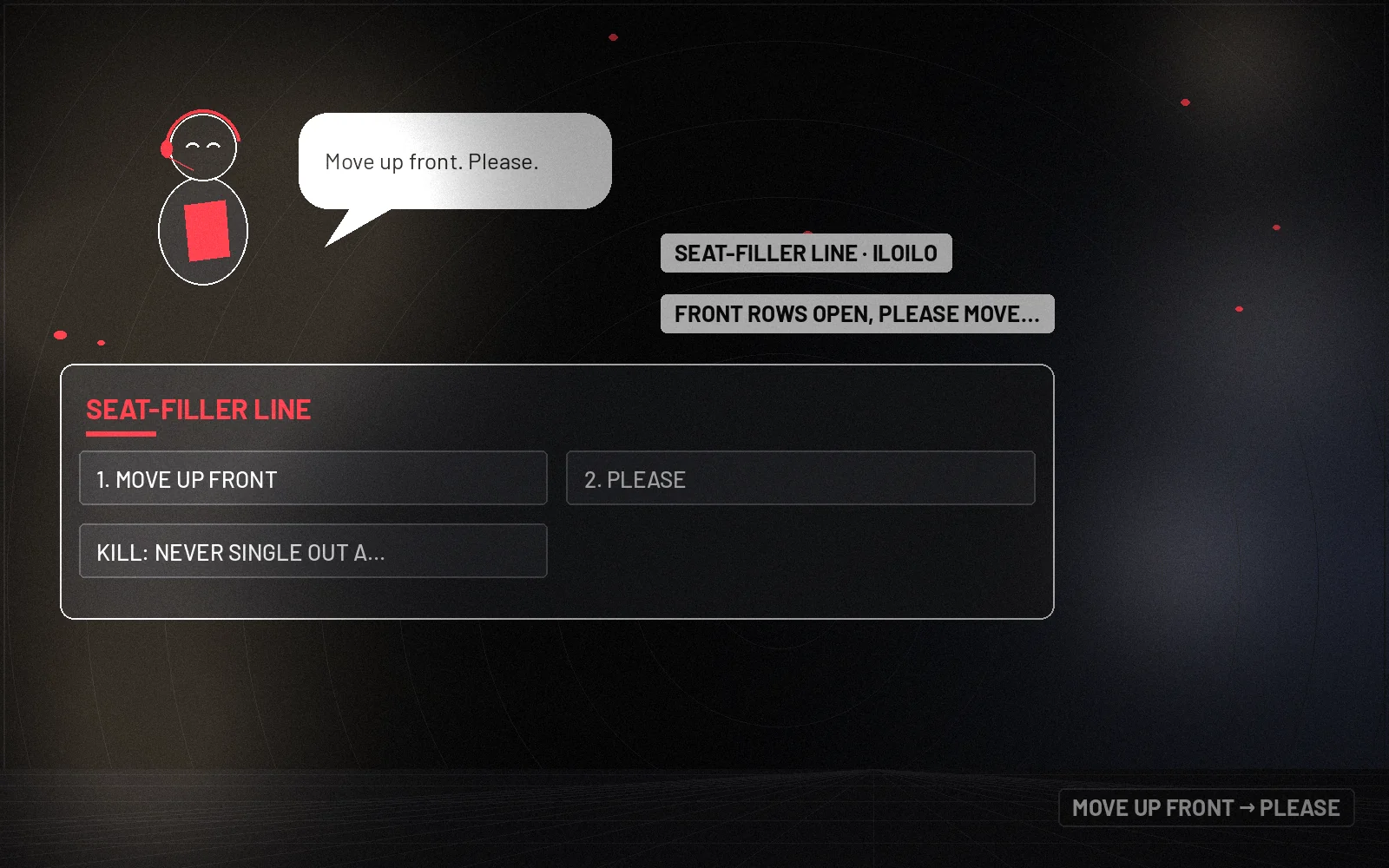
A seat-filler line English APAC has three parts: the front rows are open, please move up, and thank you. The emcee says it with a smile, names the rows clearly, and gives the room a moment to move, so guests feel invited rather than told off in front of everyone.
Seat-filler line (illustrative):
“Good morning, everyone. The first four rows are open.”
“Please feel free to move up front, there’s a better view.”
“Thank you, that helps our speakers and our camera.”
How do I ask guests to move up without sounding pushy?
Make it an invitation with a benefit: a better view, easier questions, a fuller room for the speakers. Smile, wait, and thank the first people who move. Warm event language works because nobody feels singled out, and once a few guests move, the rest of the room usually follows.
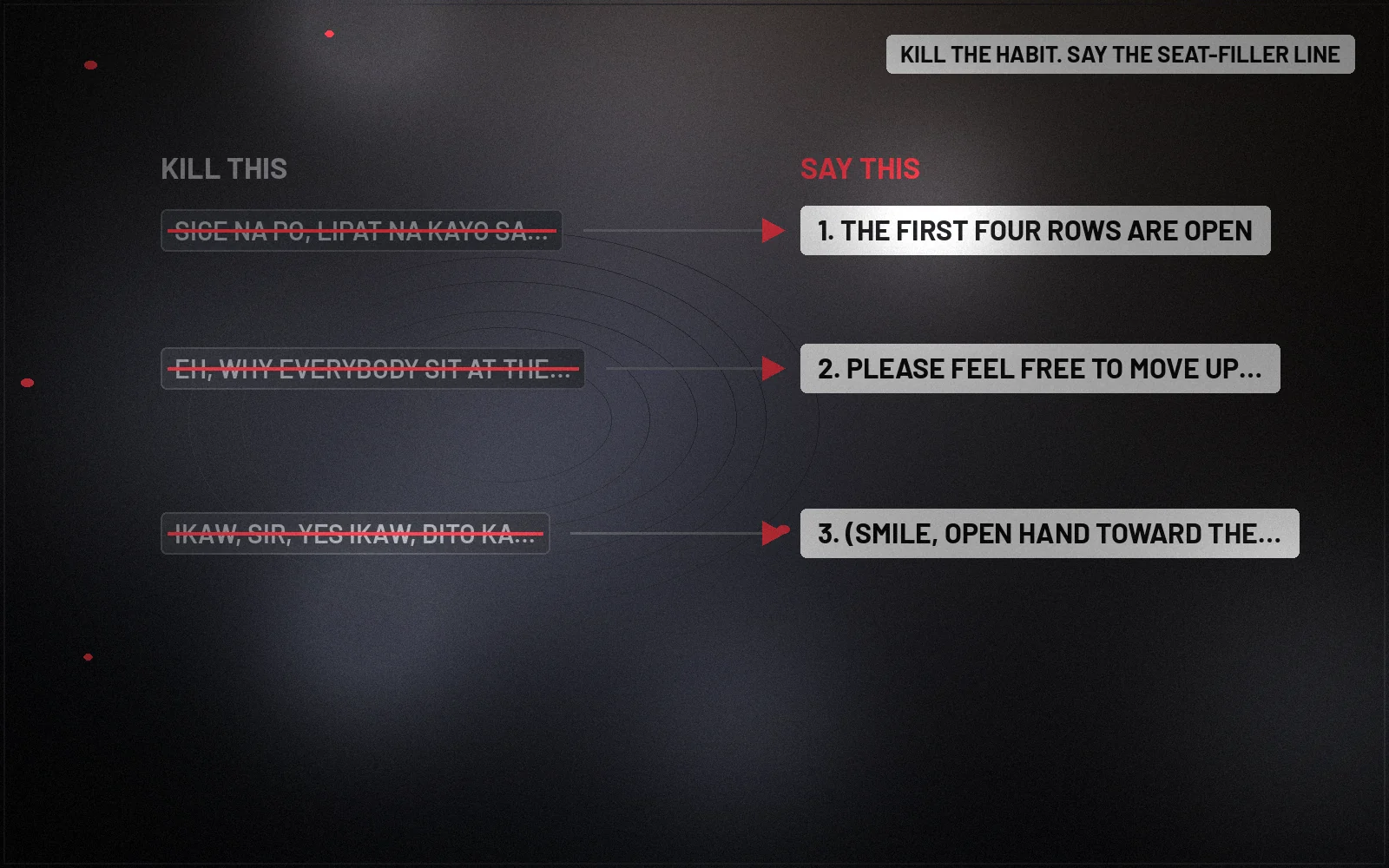
| Kill this | Say this (illustrative) | Why |
|---|---|---|
| Sige na po, lipat na kayo sa harap, wag mahiya! | The first four rows are open. | A fact, not a push |
| Eh, why everybody sit at the back one? | Please feel free to move up front, there’s a better view. | Gives a reason |
| Ikaw, sir, yes ikaw, dito ka na. | (smile, open hand toward the rows) | Never single someone out |
| Front rows not for VIP lah, just come. | Those seats are open for everyone. | Clear, no slang |
| (asking once, then giving up) | Thank you, that helps our speakers and our camera. | Thanks the movers |
When should the emcee say the seat-filler line?
Say it a few minutes before the programme starts, while guests are still settling and moving is easy. Say it once more just before the first speaker if the front is still empty. Do not say it during a speech; ushers can quietly guide late arrivals to the front instead.
What if the front rows are actually held for guests?
Then mark which rows are held and invite people into the open ones only. Say which rows are open by number, so nobody sits in a held seat and has to move again. Agree the row map with the ushers and the host organisation before doors open.
How does this play out in PH and SG?
The three parts stay the same in both markets, but shyness about the front row looks different. Use the desk notes below to adjust the tone, the humour and the ushers’ role for Philippine and Singapore audiences, and agree the row map before guests begin to arrive.
Philippines desk. In the Philippines, guests often hang back out of politeness, not reluctance. Light, warm humour helps, and ushers can invite groups up together. Say the line in English or Filipino, and thank the first movers by row, not by name.
Singapore and wider APAC desk. In Singapore, guests usually respond well to a clear, polite request with a reason. Keep the line in plain English, name the rows, use ushers rather than repeated calls, and brief them on any campaign communications seating plan.
Paste-ready lock
Speakable lock (illustrative): “Good morning everyone, the first four rows are open, so please feel free to move up front for a better view, and thank you.”
Monday field kit
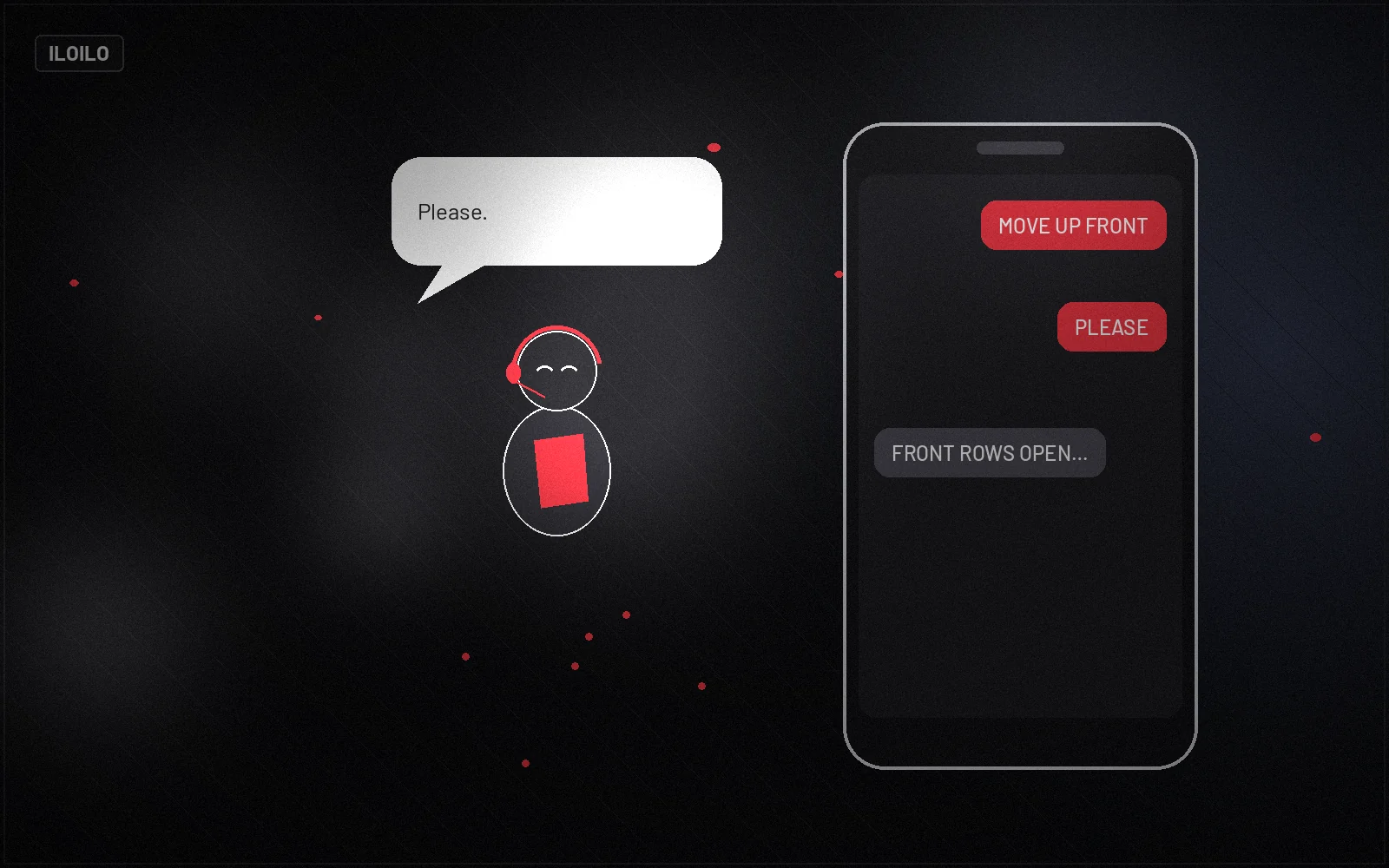
- Front rows open, please move up, thank you.
- A row map showing held and open rows.
- Ushers ready at the side aisles.
- A second call just before the first speaker.
- Kill rule: never single out a person or a group; invite the whole room.
What to do this week
- Draw the row map with the host organisation.
- Brief ushers on open and held rows.
- Write the line on the emcee’s card.
- Agree when the second call goes out.
Kill rule: if nobody moves after two calls, let the ushers guide arrivals forward quietly.
FAQs
What is a seat-filler line English APAC?
A seat-filler line English APAC is the short emcee line that invites guests to fill the front rows. It says the rows are open, asks guests to move up and thanks them.
How do you get people to sit in the front row?
To get people to sit in the front row, invite them warmly and give a reason, such as a better view. Thank the first people who move, and the rest usually follow.
When should the emcee ask guests to move up?
The emcee should ask guests to move up a few minutes before the programme starts. A second call just before the first speaker is fine.
What if the front rows are held for guests?
If front rows are held for guests, name the open rows by number and invite people only into those. Agree the row map with the ushers before doors open.
Neuwark Communications builds event scripts and campaign communications as part of our strategy and messaging work and wider services. More street-smart lines live in Insights.
Related: Reserved seat line English APAC · Holding-slide line English APAC
Talk to us about your next event script.
Illustrative lines only. Communications craft, not legal advice.