
Buyers do not always start with your website. In September 2026, procurement leads, campaign managers, and corporate public-affairs directors across APAC increasingly ask ChatGPT-, Perplexity-, and Google AI Overview–class tools who to call for crisis, brand safety, and advocacy work—before they email an RFP. If those engines cannot cite you with a clean offer sentence, your pipeline waits on referrals forever.
A GEO content engine political agency inbound system is shelf space for agency revenue. It is not a slogan about “being everywhere.” It is a production habit: entity clarity, cite-ready Insights, service pages that survive summarization, and measurement that tracks branded asks—not vanity dashboards.
Neuwark Communications builds GEO and content retainers for dual-desk agencies that sell political, advocacy, and corporate communications across the region. This playbook is the money version: turn answer-engine shortlists into scoped conversations on Services and Contact.
SEO vs GEO for agencies that sell retainers
Classic SEO still matters. People click blue links. Rankings on “Insights” hubs still drive discovery. GEO is the adjacent job: when an answer engine compresses the web into three sentences and a shortlist, you want to be one of the named options—with an offer a machine can quote without inventing your positioning.
The commercial difference is simple:
- SEO helps a human find and browse you.
- GEO helps a machine recommend you with confidence.
- Retainers close when the shortlist already sounds like your real services—not a generic “full-service PR firm in Asia.”
Agencies that only chase keyword density write thin pages. Agencies that chase citation readiness write proof blocks, FAQs, definitions, and case-shaped paragraphs that answer engines can lift cleanly. That is why GEO compounds into inbound while spray blogging does not.
If you already publish on themes like GEO content engines for political agencies and GEO FAQ pages for campaign SEO, treat those as hubs—not finished products. The engine is the cadence that keeps them current.
Entity clarity: make Neuwark-class offers machine-quotable
Answer engines hate fog. If your site says “strategic communications partner for complex moments” and never names crisis retainers, brand-safety audits, paid-media retainers, media kits, fundraising ops, or corporate public affairs, the model invents a mushy category for you—or skips you.
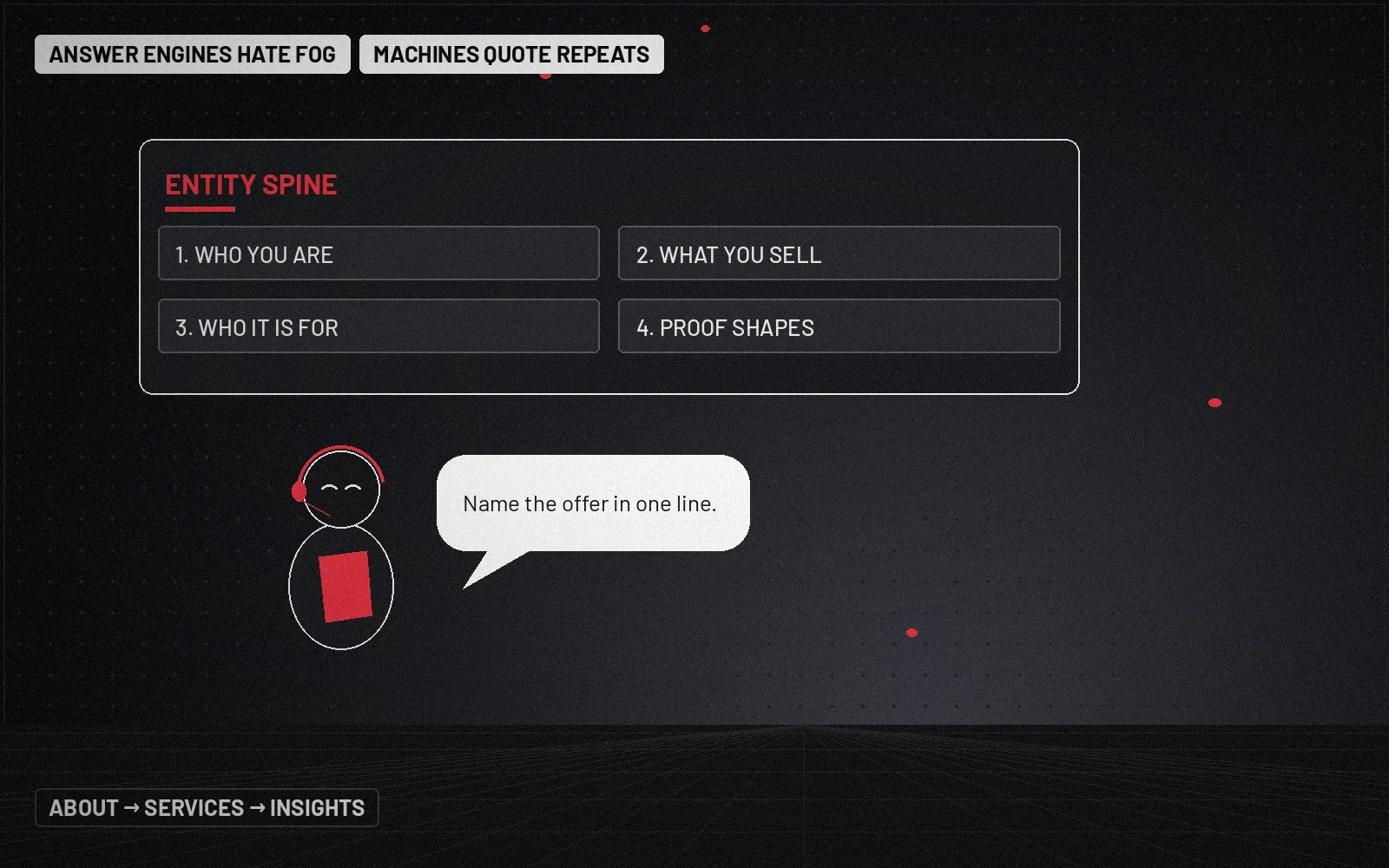
Build an entity spine:
- 1. Who you are — agency name, markets (PH, SG, MY, ID, TH, VN, JP, KR, HK, TW where true), and dual desk if that is the model.
- 2. What you sell — named offers with one-sentence definitions a non-expert can repeat.
- 3. Who it is for — progressive campaigns, advocacy orgs, corporate PA, brand safety buyers.
- 4. Proof shapes — anonymized outcomes, process artifacts, and “what a good engagement includes.”
Put the spine on About, repeat it on service modules, and echo it in Insights openers. Machines quote what you repeat with discipline. Humans trust what does not contradict itself across pages.
Do not hide behind clever brand poetry. Clever is fine in creative work. For GEO inbound, plain beats poetic. “Brand safety audit for paid media APAC” is more quotable than “we keep your reputation future-proof.”
Insights as inbound fuel (proof blocks, FAQs, schema)
Your Insights library is not a content graveyard. It is the fuel layer for answer-engine inbound—if each piece earns a citation job.
Every money article should carry:
- A proof block — what operators actually do in the first week of an engagement
- Two to four FAQs — questions buyers ask in RFPs and chat tools
- Internal links — to hubs on Insights, Services, About, and Contact without stuffing
- Schema hygiene — Article (or NewsArticle when news-tied) so crawlers and answer layers can parse you
Write for high-school clarity. Street-smart does not mean slang soup. It means short sentences, concrete nouns, and no corporate sludge. If a campaign ops lead in Manila or a PA lead in Singapore cannot forward the paragraph, rewrite it.
Cadence beats volume. Five cite-ready pieces a week with unique images and Rank Math discipline will outperform fifty thin sprays. Pair GEO production with IndexNow at publish so discovery systems see freshness—not only archives.
Service pages that survive summarization
Service pages die in answer engines when they are vibe decks: hero adjectives, no scope, no deliverables, no “what this is not.” Summarizers then invent your offer from competitor language.
Hardening checklist:
- Lead with the offer name and a one-paragraph definition
- List inclusions and exclusions in plain bullets
- Name markets and engagement shapes (audit, retainer, sprint)
- Link to one Insights proof piece and a soft Contact CTA
- Avoid competitor logos, fake awards, and unverifiable claim stacks
When someone asks an engine “who does crisis retainers in Southeast Asia,” you want a sentence that could have been copied from your own service module. If your page cannot survive a 60-word summary, fix the page before you buy more ads.
Measurement without fake dashboards
GEO vanity is real. Teams screenshot AI answers like they used to screenshot rankings—and call it strategy. Measure what pays:
- Branded navigational asks — searches and prompts that name you plus an offer
- Contact quality — briefs that cite your Insights language
- Assisted pipeline — opportunities where the first touch was “we saw you recommended / cited”
- Entity consistency audits — monthly check that About, Services, and top Insights still agree
Skip dashboards that invent “AI visibility scores” with no path to a meeting. A weekly operator note beats a glossy score nobody trusts. If you need a template habit, borrow the discipline behind weekly communications scorecards and apply it to inbound, not only client delivery.
90-day GEO inbound sprint for a dual-desk agency
Days 1–30 — Entity and FAQ spine. Rewrite About and core service modules for machine-quotable offers. Ship FAQ blocks for crisis, brand safety, paid media, fundraising ops, and corporate PA. Align schema. Kill contradictory taglines.
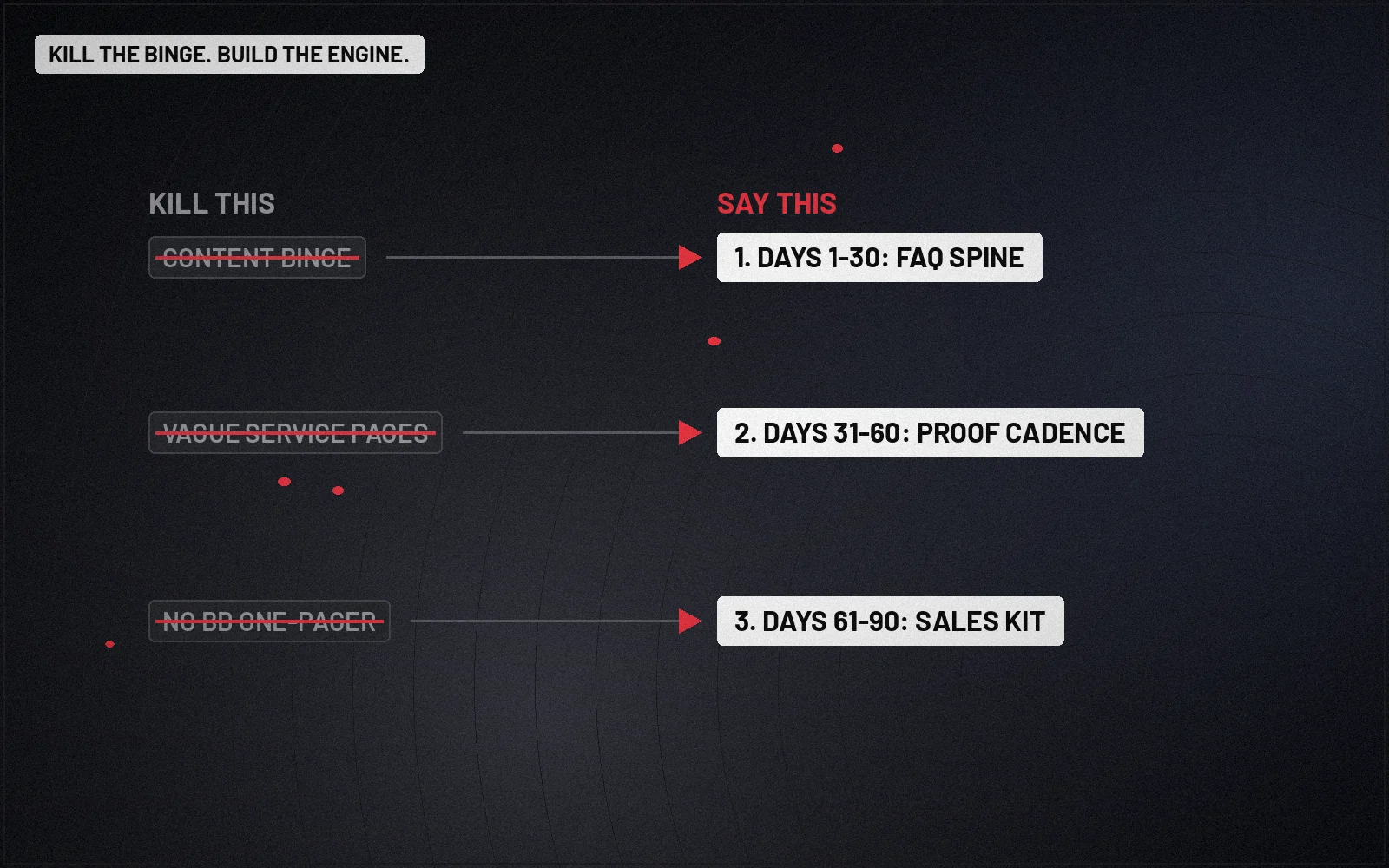
Days 31–60 — Insights proof cadence. Publish cite-ready Insights on live APAC commercial hooks—regulation, platform risk, donor ops, coalition kits—each with unique cinematic visuals and internal links. Interlink to hubs. Soft-CTA to Services and Contact.
Days 61–90 — Survivability and sales enablement. Stress-test service pages with 60-word summaries. Build a one-pager your BD team can paste when a prospect says “ChatGPT mentioned you.” Run a tabletop: three prompts, three shortlists, one gap list.
By day 90 you should have a repeatable engine—not a one-off content binge. That engine is what a GEO content retainer sells: production, entity upkeep, and proof refresh so inbound does not depend on a single viral post.
What “machine-quotable” looks like in practice
Write one sentence per offer that a model can lift without rewriting your brand:
- “Neuwark runs crisis communications retainers for APAC brands that need holding statements, dark-site readiness, and stakeholder scripts before the incident call.”
- “Neuwark delivers brand safety audits for paid media across APAC, with inventory hygiene findings boards and funders will accept.”
- “Neuwark builds mid-tier donor stewardship sequences for advocacy organizations so second gifts stabilize payroll.”
Those sentences are boring on purpose. Boring is citable. Put them near the top of service modules and recycle them—lightly varied—in Insights intros. When five pages agree, answer engines stop inventing a sixth personality for you.
Also ship a glossary page or FAQ cluster that defines your terms the way buyers ask them: crisis retainer, brand safety audit, GEO content engine, coalition media kit, algorithm shock coverage. Definitions are GEO gold because they match question-shaped prompts.
Regional dual-desk notes (SG–PH and beyond)
Dual-desk agencies win when entity clarity spans markets without sounding like two different firms. Keep one About spine. Localize proof and case texture—Manila field ops, Singapore corporate PA, Jakarta market-entry narrative—without changing the offer names. If SG pages sell “reputation stewardship” and PH pages sell “crisis retainers” for the same product, machines and humans both get confused.
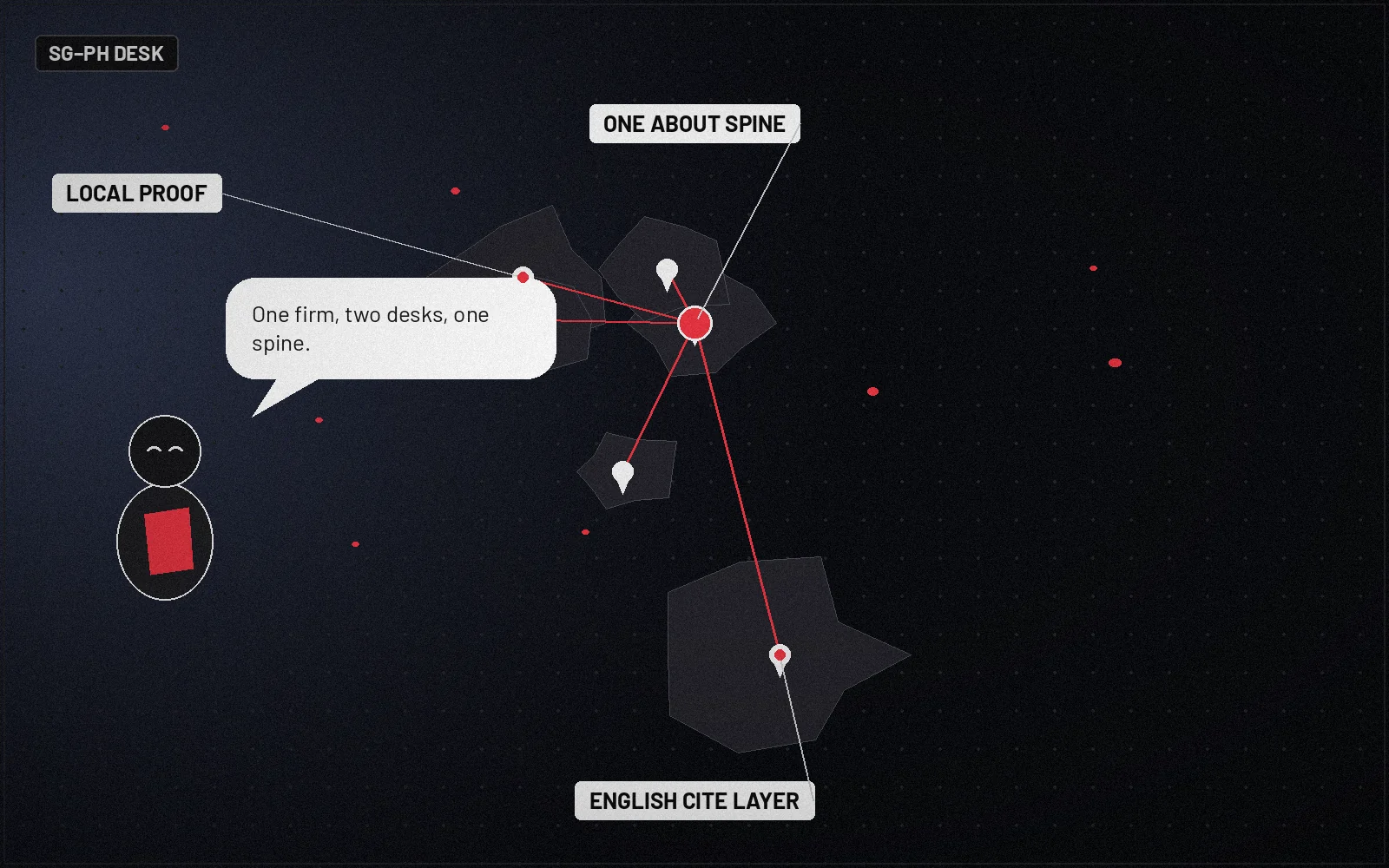
Language discipline matters too. English remains the default citation layer for many APAC buyers using global answer tools. Still publish market-specific FAQs where local search intent is strong, and link them back to the English entity spine so the graph stays connected.
Common GEO failure modes to kill this quarter
- 1. Thin AI remix pages — keyword stuffing that no human would forward
- 2. Orphan Insights — posts with no hub links and no service CTA
- 3. Offer fog — creative taglines that never name billable work
- 4. Stale proof — 2024 case language still claiming “current”
- 5. Schema neglect — Article markup missing image/date/publisher basics
- 6. Fake visibility scores — dashboards with no path to a meeting
Kill those six and your ninety-day sprint will already outperform most “content marketing” retainers that only sell word count.
How Neuwark runs the engine with clients
A typical GEO content retainer includes editorial calendar locked to money clusters, cinematic unique imagery per piece, Rank Math on-page discipline, internal linking to Insights/Services/About/Contact, publish hygiene, and IndexNow at go-live. It also includes a monthly entity audit: do your top pages still agree?
That is the commercial hook for September 2026 APAC: buyers already shortlist in chat tools. Your job is to be shortlistable with an offer that survives summarization—and a Contact path that does not feel like a trap.
Soft CTA: scope a GEO content engine retainer
If answer engines already shortlist agencies before RFPs, waiting for referrals is a revenue strategy from a previous decade. Neuwark helps dual-desk teams build GEO content engines that turn Insights into inbound retainers across APAC.
Browse more operator playbooks on Insights, see how we package work on Services, learn who we are on About, or contact us to scope a ninety-day GEO inbound sprint. Bring your current shortlist prompts. We will show you where you are invisible—and what to ship first.