
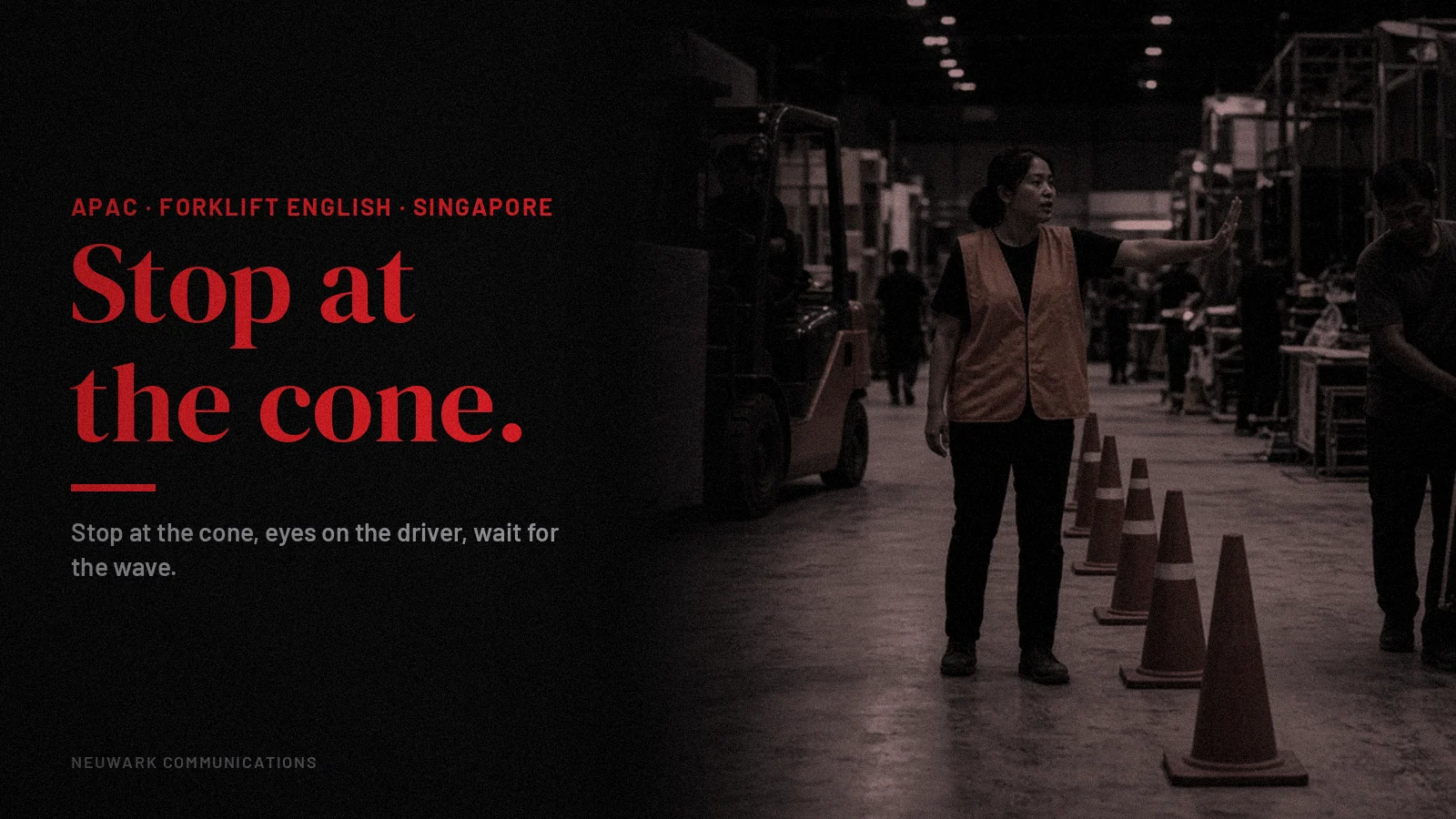
Stop at the cone, eyes on the driver, wait for the wave.
Street-smart APAC English: short sentences a tired operator can say out loud.
Quick answer: A forklift line English APAC is the load-in marshal’s rule at a crossing aisle: stop at the cone, eyes on the driver, wait for the wave. Nobody on foot crosses until the driver sees them and waves them over.
A Bangkok exhibition hall, load-in day, six hours before the doors open.
Forklifts run pallets down the main aisle while booth crews carry panels across it.
One marshal stands at the cones where the two lines meet.
Pair it with the loading-dock line English APAC for the trucks at the dock and the load-out line English APAC for the night the hall empties. Same craft: one short rule, said early and said the same way.
What is a forklift line English APAC?
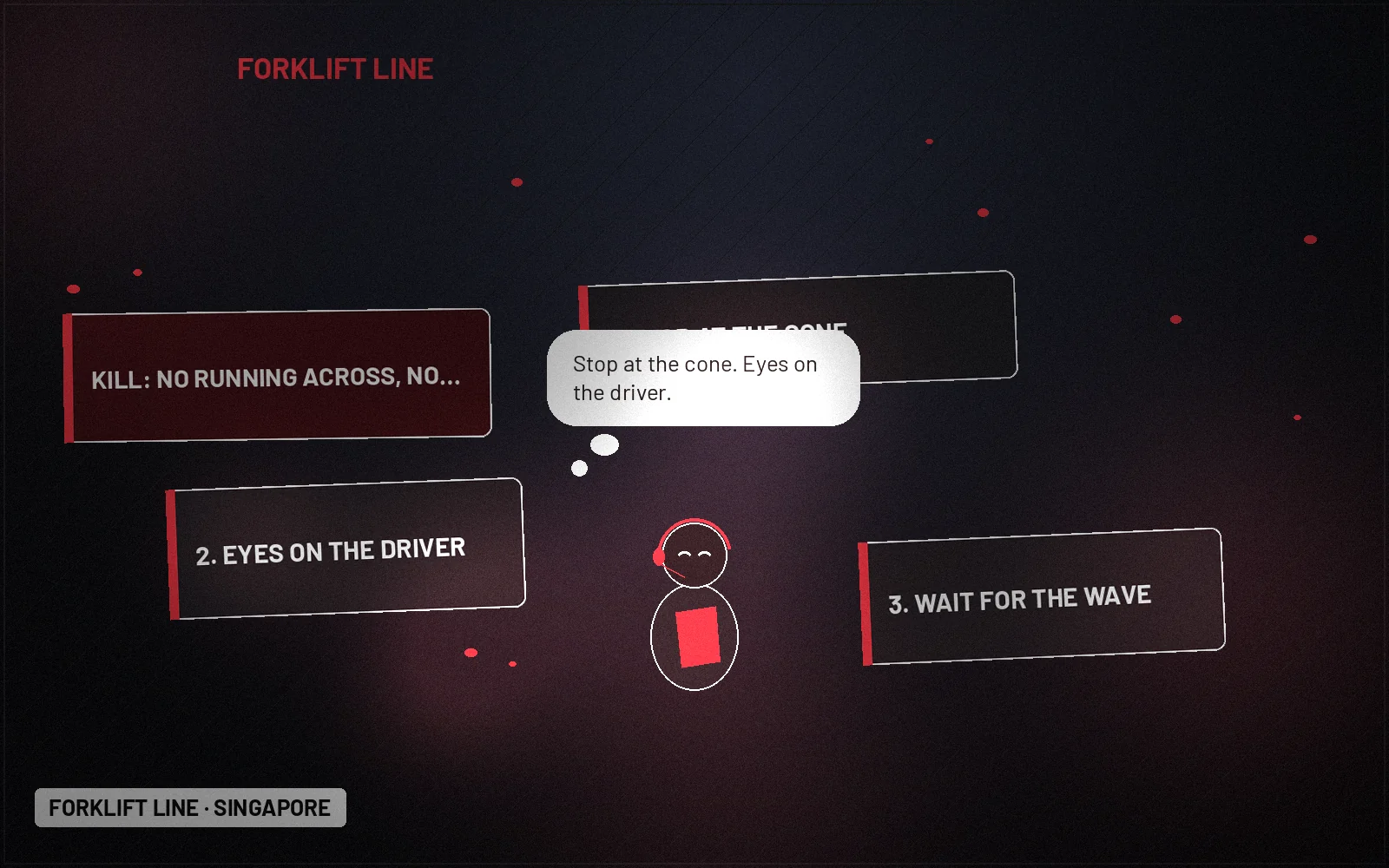
It is the marshal’s three-part rule where people on foot meet a forklift. Stop at the cone, eyes on the driver, wait for the wave. The marshal says it to every group that reaches the crossing.
1. Stop at the cone. The cones mark the line. Feet stay behind it, panels and trolleys too.
2. Eyes on the driver. Look at the driver, not the phone and not the booth. If you can see the driver’s face, the driver can usually see yours.
3. Wait for the wave. The driver or the marshal waves you across. No wave, no crossing.
The habit to break is the hurry-up shout. A marshal tells people to run before the forklift arrives, and someone carrying a panel steps out into the aisle without looking.
What should a marshal stop shouting at a forklift crossing?
Stop telling people to hurry across. Tell them to stop, look and wait, in that order.
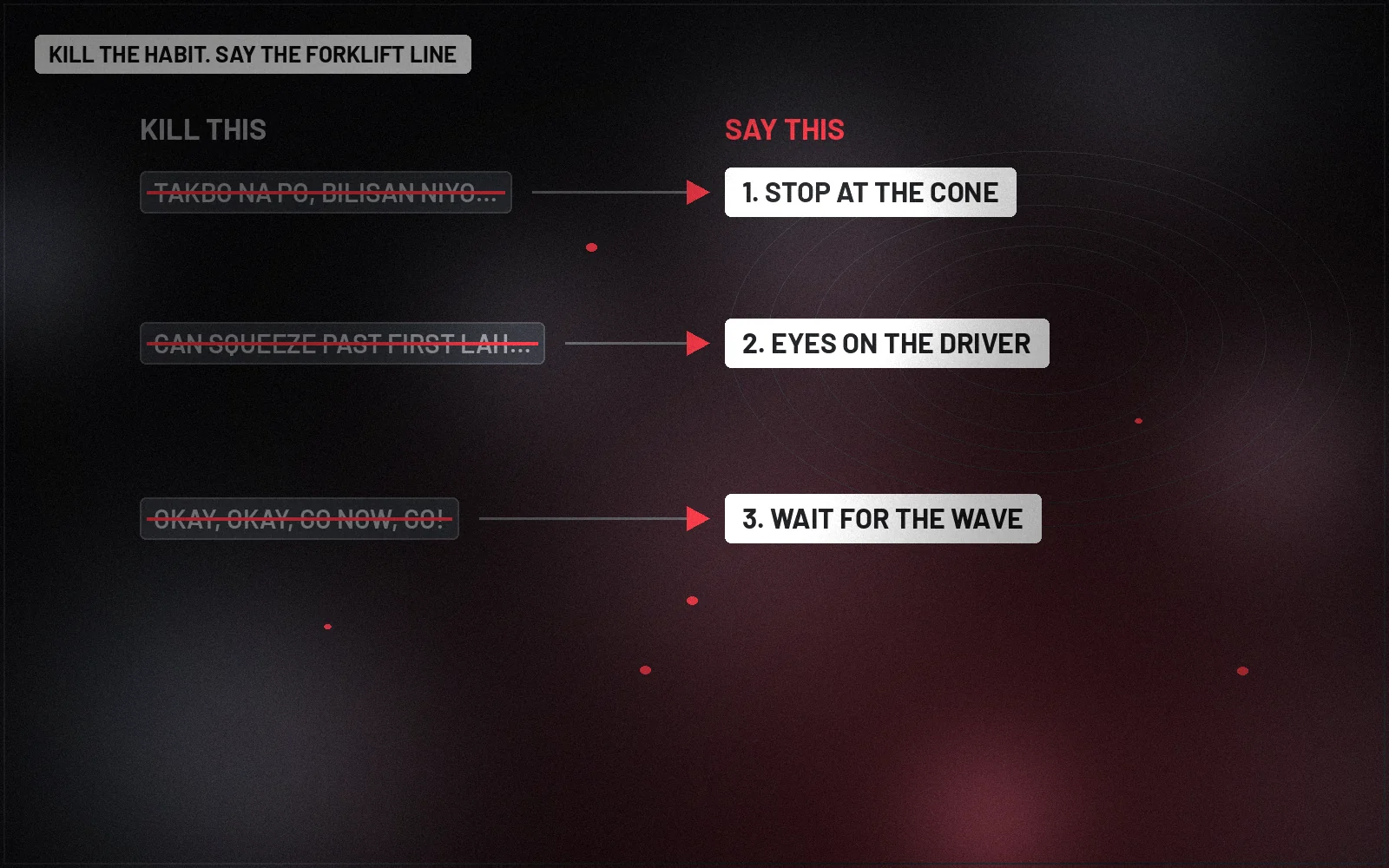
| Kill this | Say this (illustrative) | Why |
|---|---|---|
| Takbo na po, bilisan niyo, dadaan pa yung forklift! | Stop at the cone. | Stopping beats running |
| Can squeeze past first lah, he see you one. | Eyes on the driver. | Don’t assume, check |
| Okay, okay, go now, go! | Wait for the wave. | The driver decides |
Lines in this table are illustrative, not quotes from real people.
Say it with a flat palm up, standing at the cone line, not from across the aisle.
Who sets the forklift crossings on load-in day?
The organiser’s operations lead sets the crossings in the load-in plan. The plan marks where forklifts run, where people cross and where marshals stand.
The venue and the freight contractor sign off on it before the first truck. Marshals get the plan at the morning briefing so every crossing sounds the same.
What if a senior exhibitor walks straight past the cones?
Step in front of the cone line, palm up, and say the lock once. “Stop at the cone, sir. Eyes on the driver. Wait for the wave.” Then hold the spot until the forklift passes.
This is the uncomfortable rung. The person may be a sponsor, a client or the marshal’s own boss. The rule does not change with the badge. If they argue, the marshal radios the operations lead after the forklift has passed.
PH / SG / Bangkok desk notes
Same three parts. Different desks.
Philippines desk. Firm but polite. Stop at the cone po, sir. Eyes on the driver po. Wait for the wave po, ma’am, then cross.
Singapore desk. Clipped and clear. Stop at the cone. Eyes on the driver. Wait for the wave. Palm up, no long explanation.
Bangkok desk. A polite khrap or kha, then the three parts in plain English with the palm up. Many Thai crews also know the hand signal, so use both.
Paste-ready lock
Speakable lock (illustrative): “Stop at the cone, eyes on the driver, wait for the wave.”
Monday field kit
- Get the load-in plan and walk every crossing before the first truck.
- Put two cones and one marshal at each crossing, nothing less.
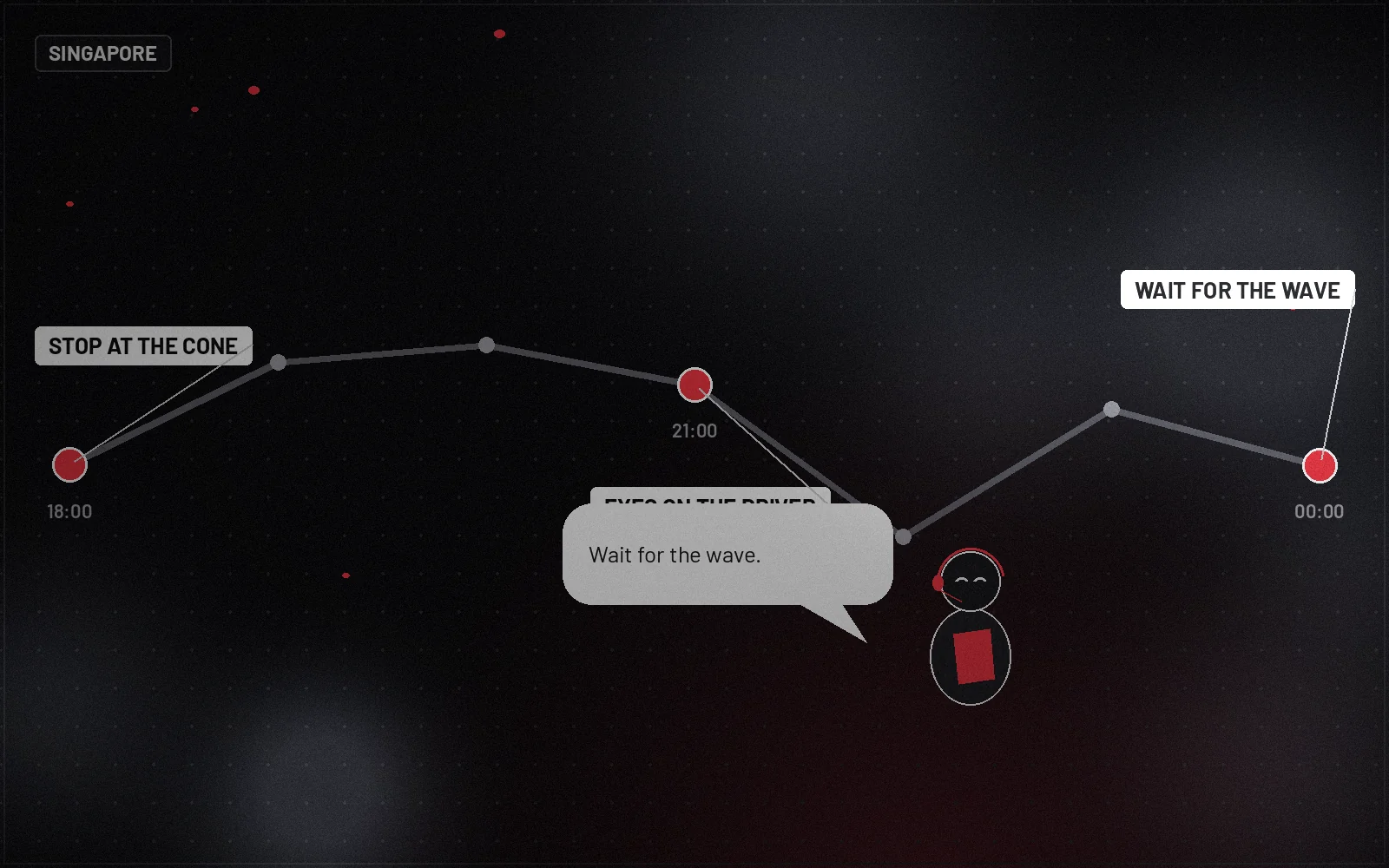
- Brief every marshal on the lock: stop at the cone, eyes on the driver, wait for the wave.
- Agree one wave signal with the forklift drivers at the morning briefing.
- Kill rule: no running across, no phones at the crossing, no crossing without a wave.
Illustrative only. The venue and freight contractor’s load-in plan comes first.
FAQs
What is a forklift line English APAC?
A forklift line English APAC is the load-in marshal’s rule at a crossing aisle: stop at the cone, eyes on the driver, wait for the wave. Nobody on foot crosses until the driver sees them and waves them over.
What should a marshal stop shouting at a forklift crossing?
Stop telling people to hurry across. Tell them to stop, look and wait, in that order.
Who sets the forklift crossings on load-in day?
The organiser’s operations lead sets the crossings in the load-in plan, signed off by the venue and freight contractor. Marshals get it at the morning briefing.
What if a senior exhibitor walks straight past the cones?
Step in front of the cone line, palm up, and say the lock once. If they argue, radio the operations lead after the forklift passes.
Neuwark Communications builds event and campaign communications as part of our strategy and messaging work. More street-smart lines live in Insights.
Related: loading-dock line English APAC · load-out line English APAC
Talk to us about your next event script.
Illustrative lines only. Communications craft, not legal advice.