
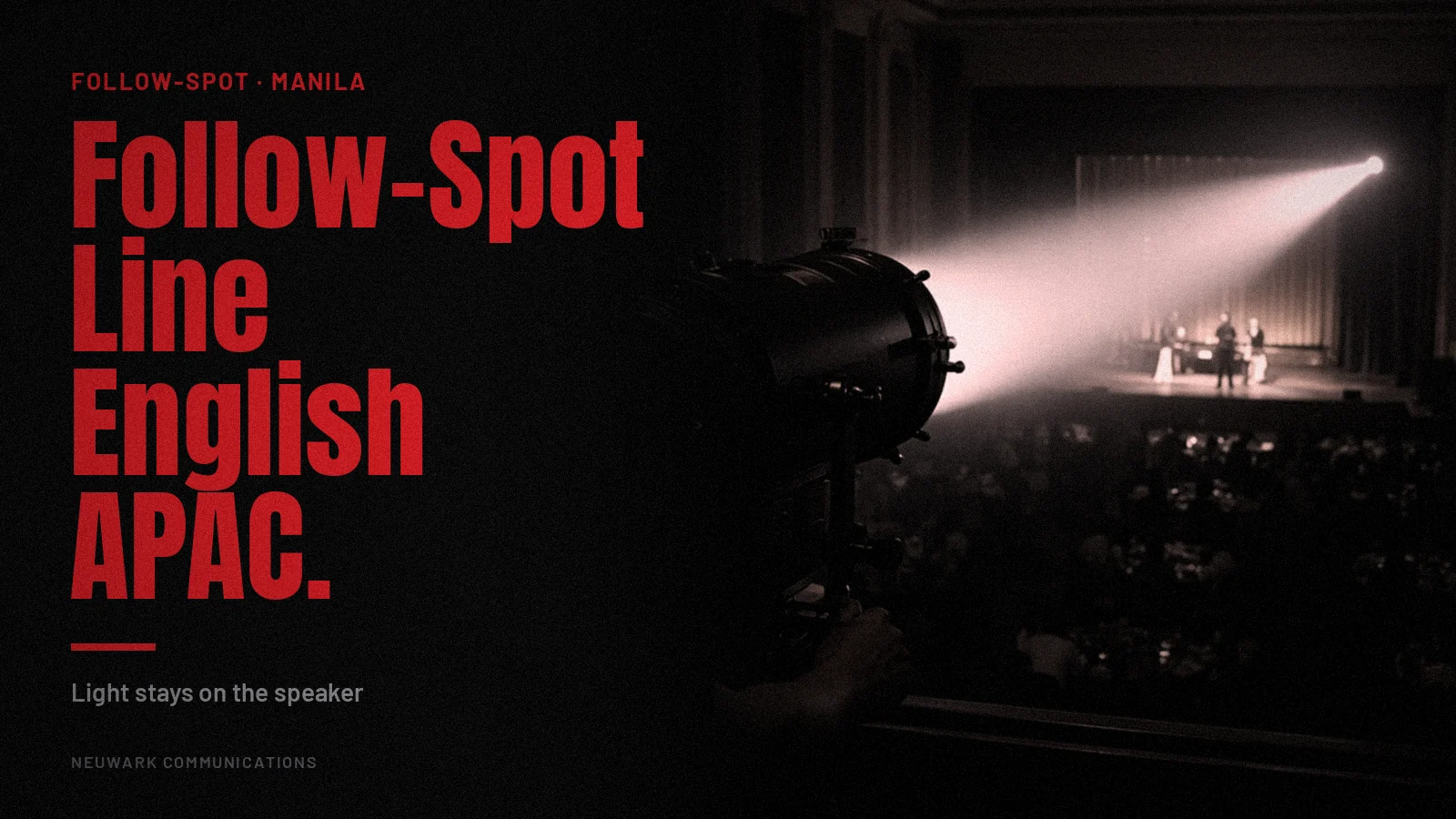
“Light stays on the speaker.”
Street-smart APAC English: short sentences a tired operator can say out loud.
A Manila ballroom, awards night, house lights at half.
The guest of honour climbs the stage steps in the dark.
The follow spot finds her three steps late, already at the lectern.
Quick answer: The follow-spot line English APAC is the show caller’s cue to the spot operator: light stays on the speaker, from the first step to centre, so the beam never drifts to an empty stage. The caller gives it on the crew channel as the name is read.
Pair it with the stage-mark line English APAC and the stage-steps line English APAC for more event language on the floor. The stage-mark line tells the speaker where to stand; this one tells the spot operator where to find them.
What goes in the follow-spot line English APAC?
The follow-spot line English APAC has three parts: the light, the stay and the speaker. Light names the one beam that moves, so nobody else adjusts. Stays means no drifting ahead, no wandering to the screen and no early fade. On the speaker fixes the target: the person walking, picked up at the steps and held to centre.
Follow-spot line (illustrative):
“Spot one, standby. Pick up at the steps.”
“Light stays on the speaker, hold the walk.”
“Settle at centre. Fade on the walk-off.”
Speakable lock (illustrative): “Light stays on the speaker.”
Print it on the caller’s cue sheet and say it the same way for every walk-on. One beam, one target, held from the steps to the walk-off.
When should the caller give the follow-spot line?
Give the standby while the emcee is still reading the introduction, so the operator has time to aim at the steps. Give the pickup as the speaker’s foot reaches the first step, not when the applause starts. Say it once on the crew channel. Then stay quiet until the walk-off cue.
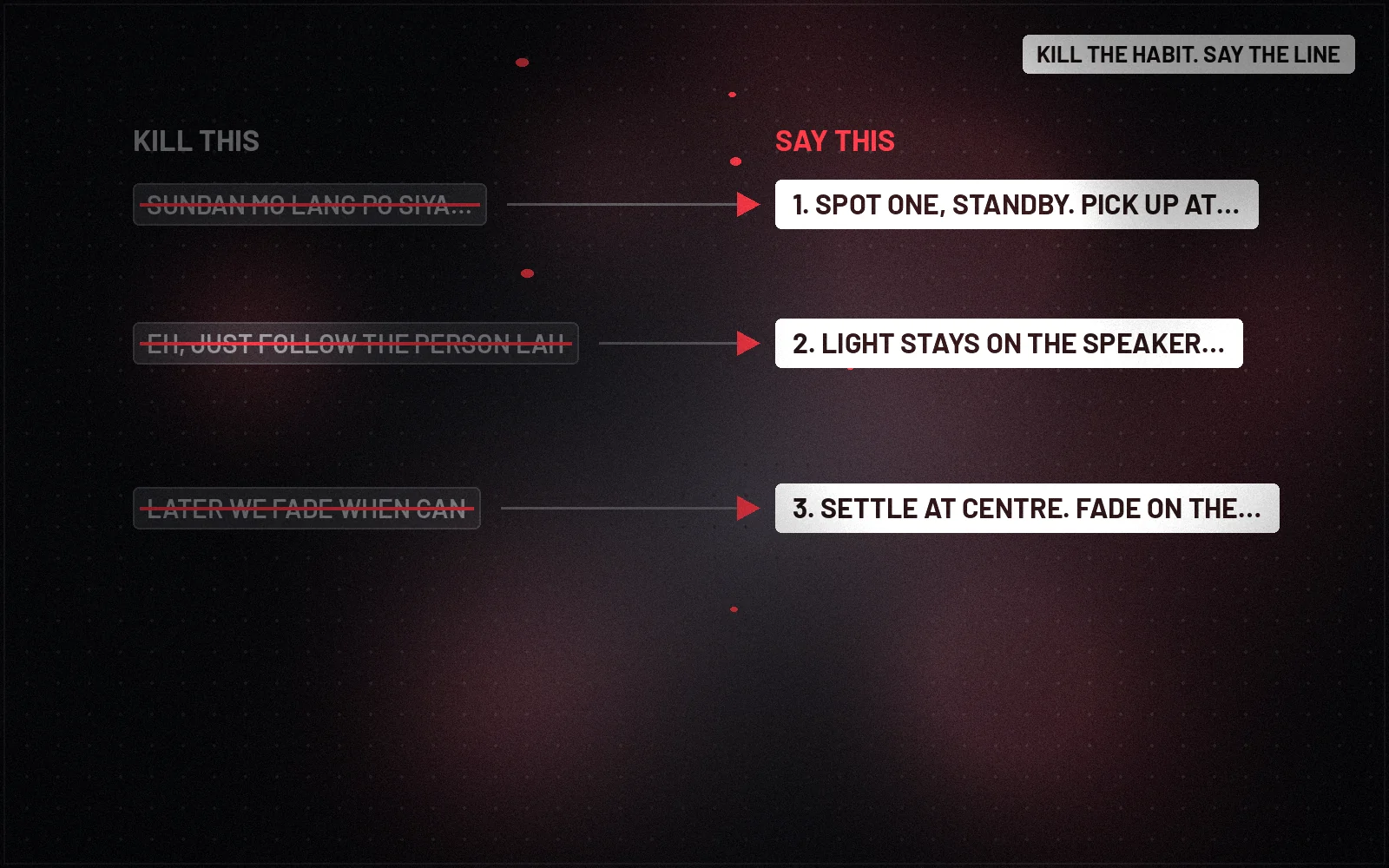
| Kill this | Say this (illustrative) | Why |
|---|---|---|
| Sundan mo lang po siya, bahala ka na. | Spot one, standby. Pick up at the steps. | One exact pickup |
| Eh, just follow the person lah. | Light stays on the speaker, hold the walk. | Names the target |
| Later we fade when can. | Settle at centre. Fade on the walk-off. | No vague later |
Lines in this table are illustrative, not quotes from real people.
What if the speaker takes the other steps?
Call it plainly: speaker on stage left steps, pick up there. Do not let the operator hunt across the stage. If the beam misses the pickup, catch the speaker at centre and hold; a late pickup at centre looks better than a beam chasing across the floor.
How do you brief the spot operator on the follow-spot line?
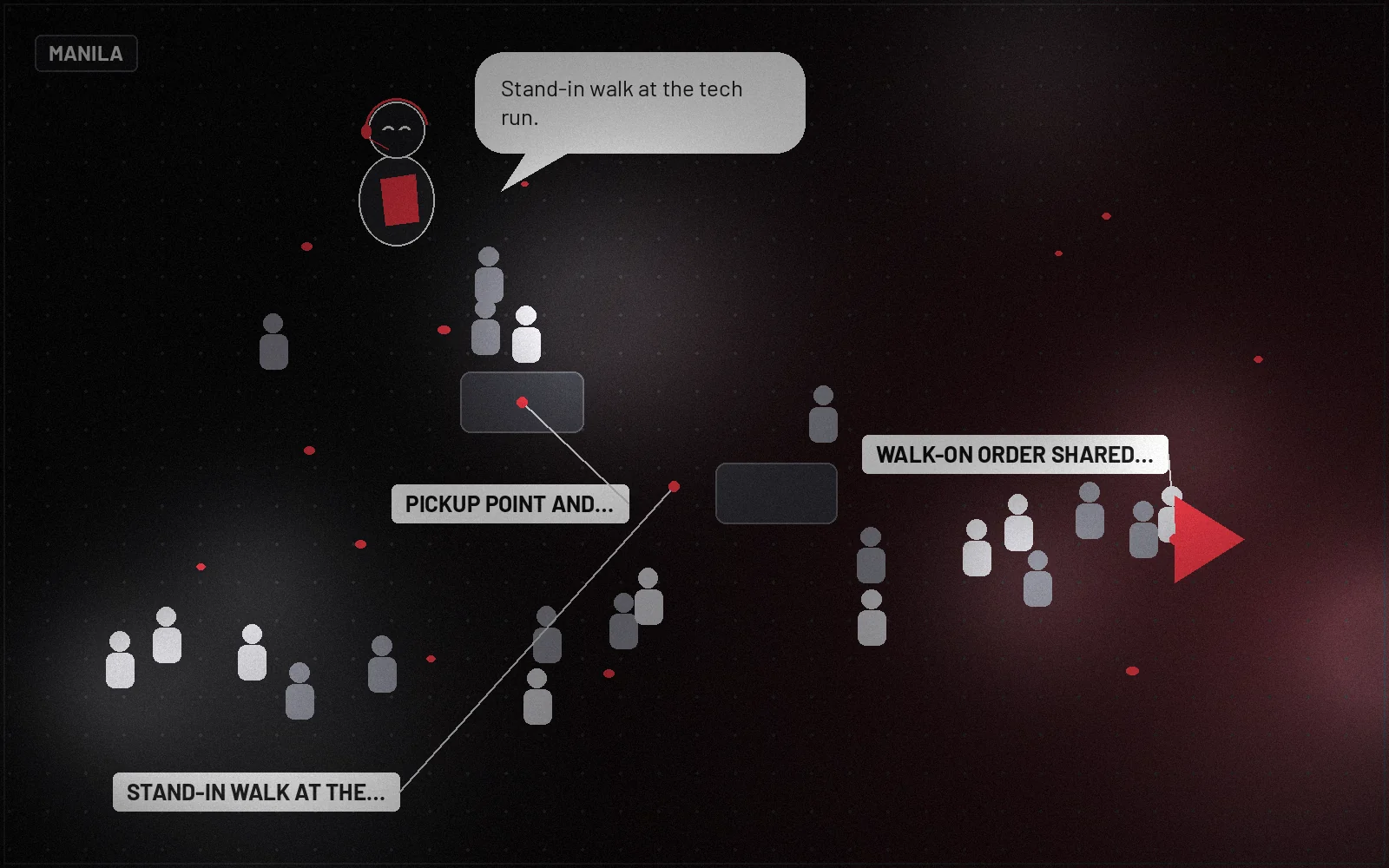
Brief the operator at the tech run, with a stand-in walking the route. Point to the steps, walk to centre and mark both on the cue sheet. Agree the words for standby, pickup, hold and fade, and use nothing else on the night.
Why does the line work?
A follow spot is the one light the whole room watches move. The line gives the operator a start point, a path and an end point, so the beam is there before the speaker needs it. The room sees a speaker walking into light, not a light searching for a speaker.
How does the line play out on PH and SG/MY desks?
Philippines desk. In Manila venues, guests of honour often arrive late and skip the walk-through. Add po and sir or ma’am when you brief the stand-in: light stays on the speaker po, from the steps to centre. Post the walk-on order in the crew Viber group so the caller and the operator work from the same list.
Singapore and Malaysia desk. In Singapore and Malaysia, keep it brisk on the channel: spot one, light stays on the speaker. Use stage left and stage right consistently, and keep the same words for every walk-on.
Monday field kit
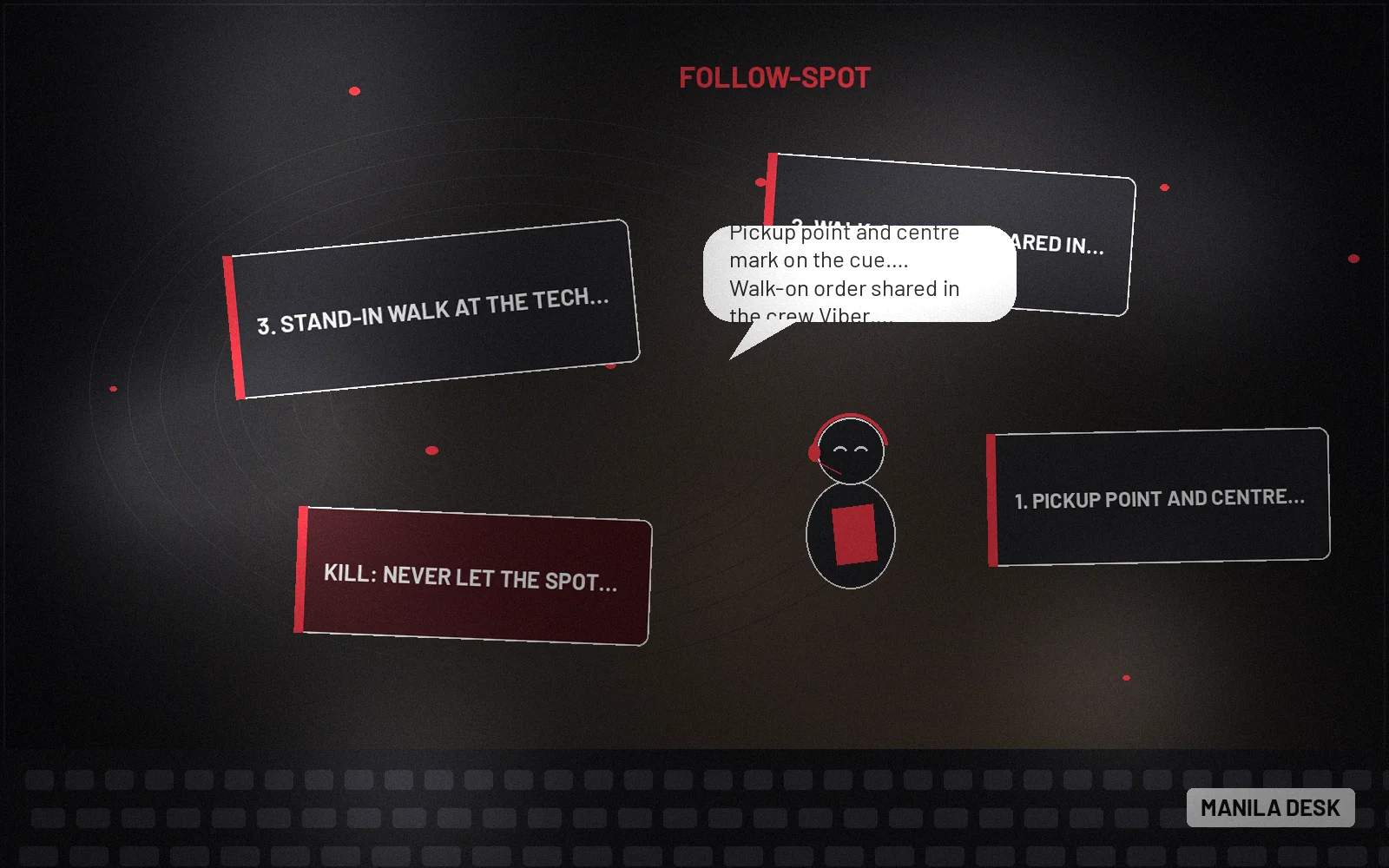
- Pickup point and centre mark on the cue sheet.
- Walk-on order shared in the crew Viber group.
- Stand-in walk at the tech run.
- Agreed words for standby, pickup, hold and fade.
- Kill rule: never let the spot operator hunt for a speaker on air.
FAQs
What is the follow-spot line?
The follow-spot line is the show caller’s cue to the spot operator: light stays on the speaker. The beam meets the speaker on the first step and holds to centre.
When do you say the follow-spot line?
Say it on the crew channel as the speaker’s name is read. The pickup itself comes at the first step.
Who owns the follow-spot line?
The show caller owns the follow-spot line. The caller gives it to the spot operator on the crew channel.
Neuwark Communications writes event scripts like this through strategy and messaging.
Talk to us about your next event script.
Illustrative lines only. Communications craft, not legal advice.