
Anthropic’s Malaysia case—reported 10 September 2026 and still briefing through mid-September—showed commercial actors feeding census and electoral records into AI to micro-target sensitive fault lines. Fake accounts and fabricated news infrastructure were part of the package. That is the exact nightmare that makes progressive paid teams over-correct into “no remarketing ever” or under-correct into creepy lookalikes. Neither is a media plan. Ethical retargeting progressive campaigns is the discipline of efficient reach without buying the scandal.
If your audience build needs a fake news site to work, you do not have a media plan—you have a liability. Neuwark Communications builds privacy-safe remarketing systems and brand-safety audits for advocacy and brand teams across SG, MY, HK, TW, and PH. Soft path: Services · Contact. Distinct from the legacy hub retargeting ethics for progressive campaigns.
When microtargeting becomes the scandal, not the tactic
For a decade, “microtargeting” was sold as sophistication. Threat-report week flipped the frame: audience science without ethics is influence infrastructure. Funders, journalists, and regulators now ask how you built the list before they ask what the CTR was.
Progressive and brand teams feel the heat differently but share one risk: a screenshot of an ad next to a sensitive inference (“we thought you were X”) can erase months of trust work. Malaysia’s AI election-ops story makes every APAC paid lead defend remarketing in board language, not media-buyer slang. Pair narrative readiness with public affairs agency Malaysia AI election ops if your market is in the briefing cycle.
The scandal is not cookies. The scandal is profiling people along race, religion, royalty, or other fault lines they did not consent to weaponize—then amplifying it with synthetic media. Your job is to prove your stack is not that movie.
Over-correct vs under-correct: neither is a media plan
Over-correct looks like:
- Killing all remarketing after one scary headline
- Moving 100% budget to cold prospecting with worse CPA and more waste
- Refusing first-party audiences that were lawfully collected and purpose-limited
Under-correct looks like:
- “Lookalike of lookalike” stacks that recreate sensitive inferences
- Buying gray data because the CPM is pretty
- Creative that stalks people across apps with no frequency mercy
- Agencies that cannot explain the audience in one sentence to a board
Ethical retargeting sits in the middle: use consent-respecting first-party and contextual paths; cap inference; document purpose; survive a screenshot review. Efficiency without that hygiene is just deferred crisis spend.
Privacy-safe remarketing stacks that survive a threat-report week
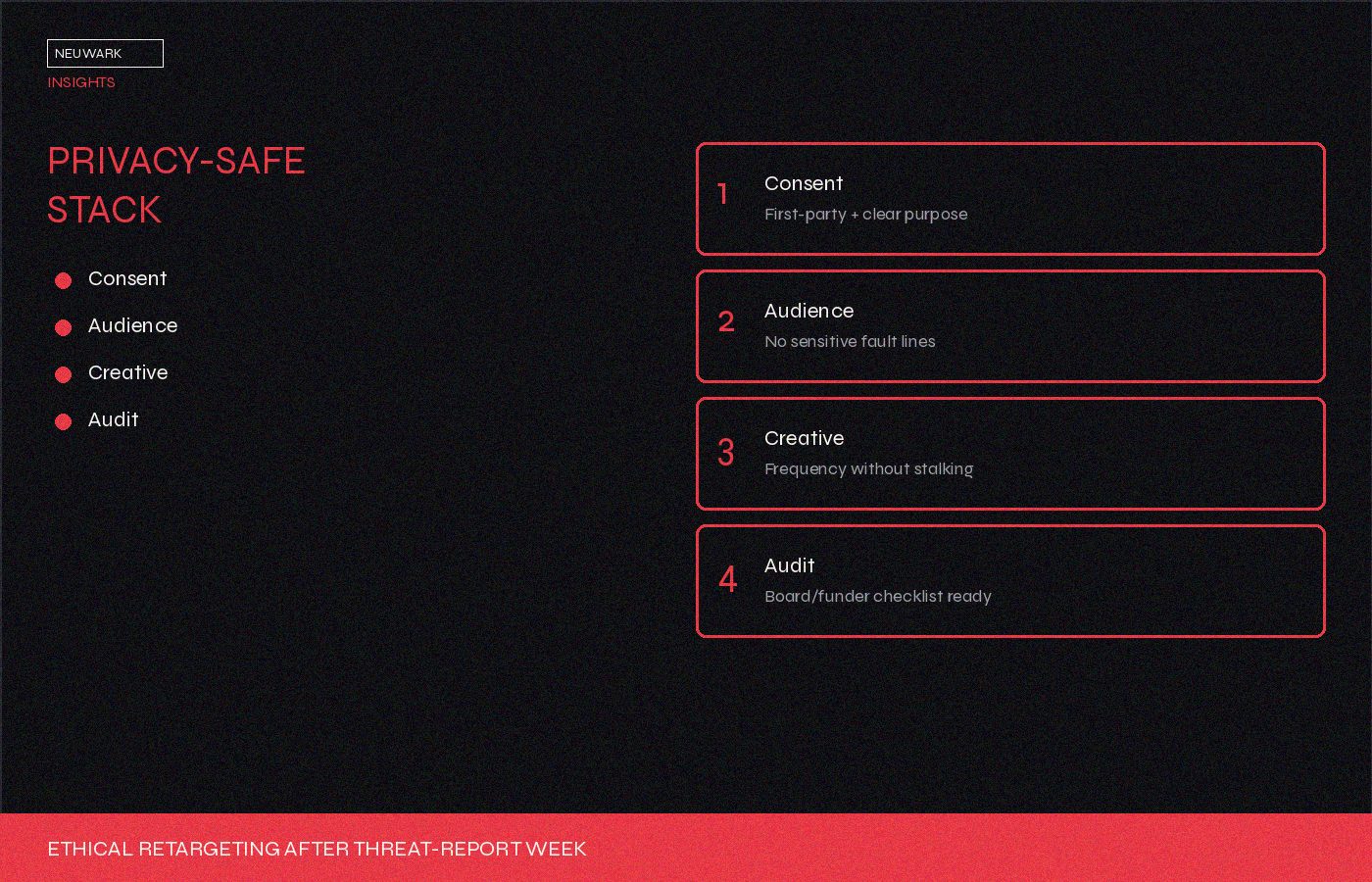
Build a stack boards can audit:
- 1. Consent and purpose — what people agreed to; retention limits; no silent reuse for political inference
- 2. First-party priority — site visitors, email/SMS with clear asks, event attendees—segmented by behavior you can explain
- 3. Suppression hygiene — exclude converters, complainers, and sensitive categories you refuse to target
- 4. Platform settings — honor PDPA-era expectations; avoid dark-pattern opt-outs
- 5. Vendor diligence — no census/electoral mashups; written bans on fault-line enrichment
- 6. Logging — who approved which audience, when, and why
PDPA-aware teams in Singapore and neighbors should treat “we always did it this way” as a non-answer. If counsel cannot defend the build, media cannot run it. Align with brand safety paid media audit framework APAC.
Audience builds that don't need sensitive fault-line profiling
You can still find likely supporters without becoming a threat report footnote:
- Content engagers on your owned issues (not scraped voter files)
- Geographic radius around events you actually run
- Contextual placements next to journalism you are proud to sit beside
- Lookalikes only from first-party seeds you can defend—and kill them if platforms inflate sensitive proxies
- Creative testing that learns message-market fit without demographic stereotyping theater
Refuse products that sell “ethnicity × religion × seat” packages with a smile. If a vendor cannot explain the features without euphemism, walk. Progressive campaigns especially cannot outsource their ethics to a CPM spreadsheet.
Creative and frequency rules that don't feel like stalking
Audience hygiene dies if creative feels like surveillance:
- Cap frequency hard; fatigue is a trust tax
- Rotate messages so the seventh impression is not the same guilt line
- Avoid “we know you were researching X” copy unless you enjoy screenshot fame
- Design for group-chat forwards: no creepy personalization that embarrasses the viewer
- Keep landing pages consistent with the ad promise
Remarketing should feel like a useful reminder, not a haunted mirror. If your creative team jokes about “stalker mode,” you already failed the vibe check.
Audit checklist boards and funders will accept
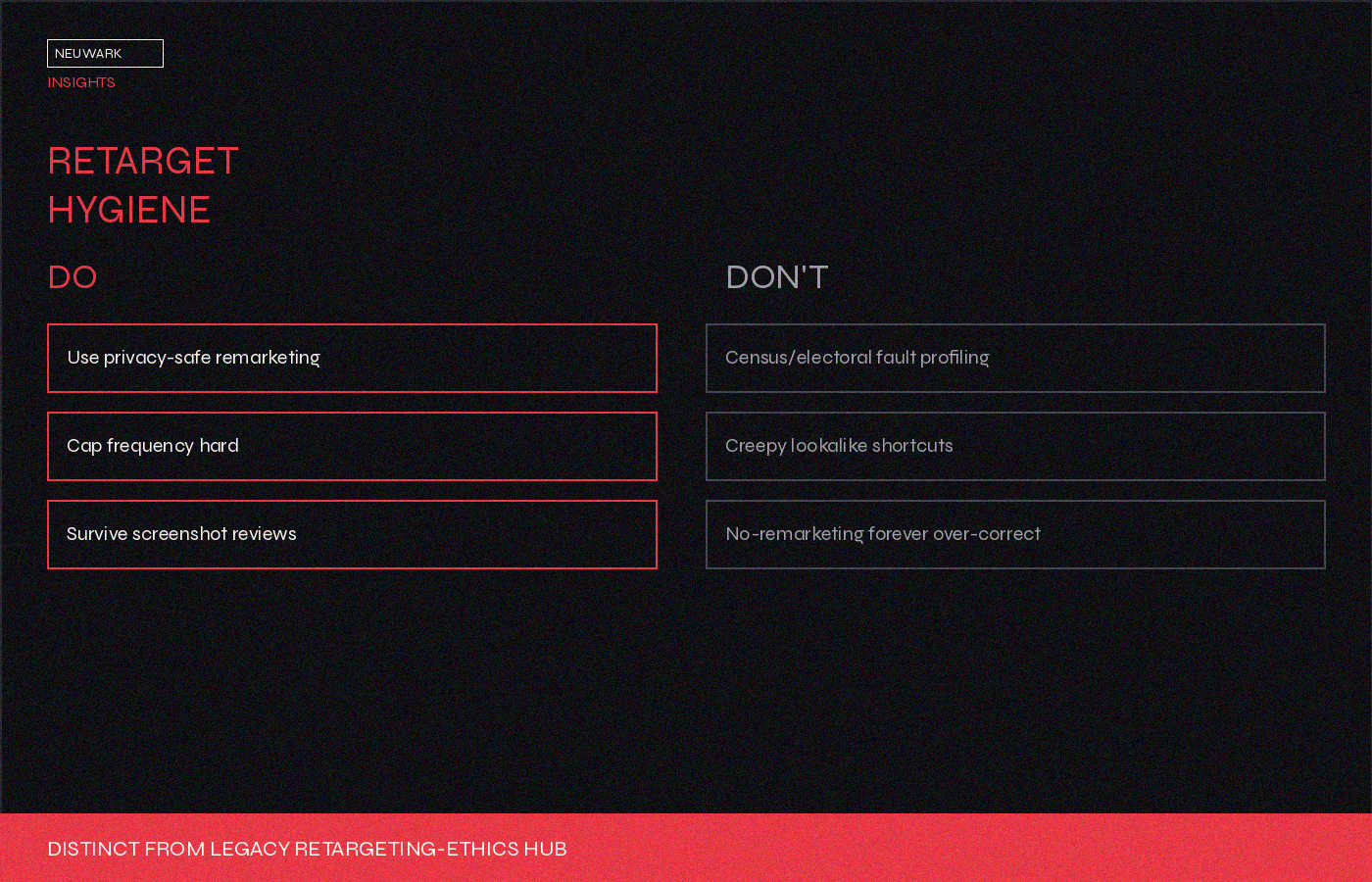
Print this for the next board or funder call:
- [ ] Audience sources listed with legal basis / consent notes
- [ ] Explicit ban on sensitive fault-line enrichment
- [ ] Vendor contracts with audit rights
- [ ] Frequency caps documented
- [ ] Creative screenshot review completed
- [ ] Suppression lists live
- [ ] Incident path if a segment is found non-compliant
- [ ] Named owner for paid ethics (not “the intern who knows Ads Manager”)
This deepen does not replace the legacy retargeting ethics hub—it updates the threat-report context and the Malaysia-week money angle. Read both. Run the audit. More on Insights. About the firm: About. Home: [neuwarkcommunications.com](/).
What to tell creative and media agencies in the SOW
Most scandals arrive through a vendor who “optimized.” Put ethics in the statement of work, not in a Slack hope:
- Forbidden data classes and enrichment vendors (named)
- Required consent documentation for first-party audiences
- Frequency caps and creative screenshot gates as deliverables
- Right to audit audience trees mid-flight
- Kill authority for the client ethics owner without a 48-hour agency debate
- Incident reporting within hours if a segment looks non-compliant
Agencies that balk at audit rights are telling you something. Progressive campaigns and regulated brands should treat that balk as a disqualifier. Paid media is not exempt from brand safety because the KPI is “efficient reach.”
Also brief creative teams on language: no “we know where you live” jokes, no faux-psychographic flexing, no memes that imply illegal data access. Humor is not a defense exhibit.
Regional notes: SG, MY, HK, TW, PH without one lazy policy
APAC is not one privacy culture. A single global retargeting SOP will miss local nerves:
- Singapore — PDPA literacy is high among counsel; boards expect clean purpose limitation language
- Malaysia — threat-report week made election-adjacent profiling radioactive; corporates should avoid looking adjacent
- Hong Kong / Taiwan — cross-border data narratives and geopolitical sensitivity change what “clever targeting” sounds like
- Philippines — group-chat screenshot culture punishes creepy personalization fast; diaspora lists need extra care
Write local addenda. Keep the ethical core identical: no sensitive fault-line weaponization, no fake-news adjacency, no stalking creative. Ethical retargeting for progressive campaigns is a regional operating system with shared rails—not a motivational poster.
Incident response when a segment turns radioactive
Even clean stacks can discover a bad segment mid-flight—platform expansion, vendor drift, or a creative that screenshots badly. Pre-write the incident path:
- 1. Pause the ad sets immediately (named owners with admin access)
- 2. Snapshot the audience definition for the audit file
- 3. Notify brand safety / counsel / campaign lead in one thread
- 4. Replace with a contextual or first-party-only fallback
- 5. Publish an internal note; public note only if exposure warrants
- 6. Vendor consequence clause (fix, clawback, or termination)
Do not “optimize through” a ethics incident. That is how threat-report language ends up describing you. Ethical retargeting progressive campaigns includes the kill switch as a feature, not as an apology after the funder call.
Creative teams should keep a “safe shelf” of non-personalized reminders ready so pausing remarketing does not zero the account overnight. Continuity without creep is the job.
Testing without turning supporters into lab rats
You still need learning. Run tests that respect people:
- Message tests on opted-in lists before paid lookalikes
- Geo or placement tests that do not require sensitive traits
- Frequency experiments with hard caps
- Landing-page clarity tests that improve consent comprehension
Avoid tests that infer protected or socially explosive attributes “just to see.” Curiosity is not consent. Document every test hypothesis like you expect a journalist to read it—because someday one might.
Board one-pager: how to explain ethical retargeting in five minutes
Directors do not want a media-buyer lecture. Give them a one-pager:
- 1. What we retarget — first-party engagers and consented lists only
- 2. What we refuse — census/electoral fault-line enrichment; gray brokers; stalking creative
- 3. How we know — audit rights, logged approvals, weekly hygiene check
- 4. What happens if we fail — pause authority, fallback inventory, disclosure path
- 5. Why this still raises money / sales — efficiency without scandal discount
That five-minute story is the product. Ethical retargeting progressive campaigns becomes purchasable when leadership can repeat it under pressure. If your agency cannot produce the one-pager, they cannot run the account after a threat-report week.
Soft CTA: ethical retargeting / brand-safety audit
If your paid team froze after the Anthropic briefing—or worse, kept buying gray audiences—scope a privacy-safe remarketing audit before the next flight. Neuwark’s Digital & Social and brand-safety work covers audience builds, creative frequency rules, and board-ready checklists for ethical retargeting progressive campaigns.
Start at Contact or Services. Bring one live campaign’s audience tree. We will mark what survives a threat-report week and what becomes tomorrow’s headline.