
The event page lived in three places. Search picked the empty one.
Campaigns clone pages for partners, for ads, for a microsite. Answer engines and search need one path.
Canonical line English APAC is the one URL the desk names when two pages say the same thing: the path a citation, a share and a night note can all use.
Street-smart APAC English: short sentences a tired operator can say out loud.
This cousins the URL slug English APAC piece. The slug names the path after the query. The canonical line says which copy is the real one.
What does the desk write down?
Four fields. Not a sitemap lecture.
| Field | Kill this | Say this (illustrative) |
|---|---|---|
| Real URL | “The microsite, or the main site, either is fine” | “https://example.org/flood-contracts is the only page we cite.” |
| Clones | Leaving partner copies unmarked | Partner copies point canonical at the real URL |
| Object match | A clone whose H1 is a different fight | Same object, or it is not a clone — it is a new page |
| Share line | Pasting whichever tab is open | The real URL in the chat, the card and the press note |
What fails in APAC campaign stacks
| Kill this | Why the wrong page ranks | Say this instead |
|---|---|---|
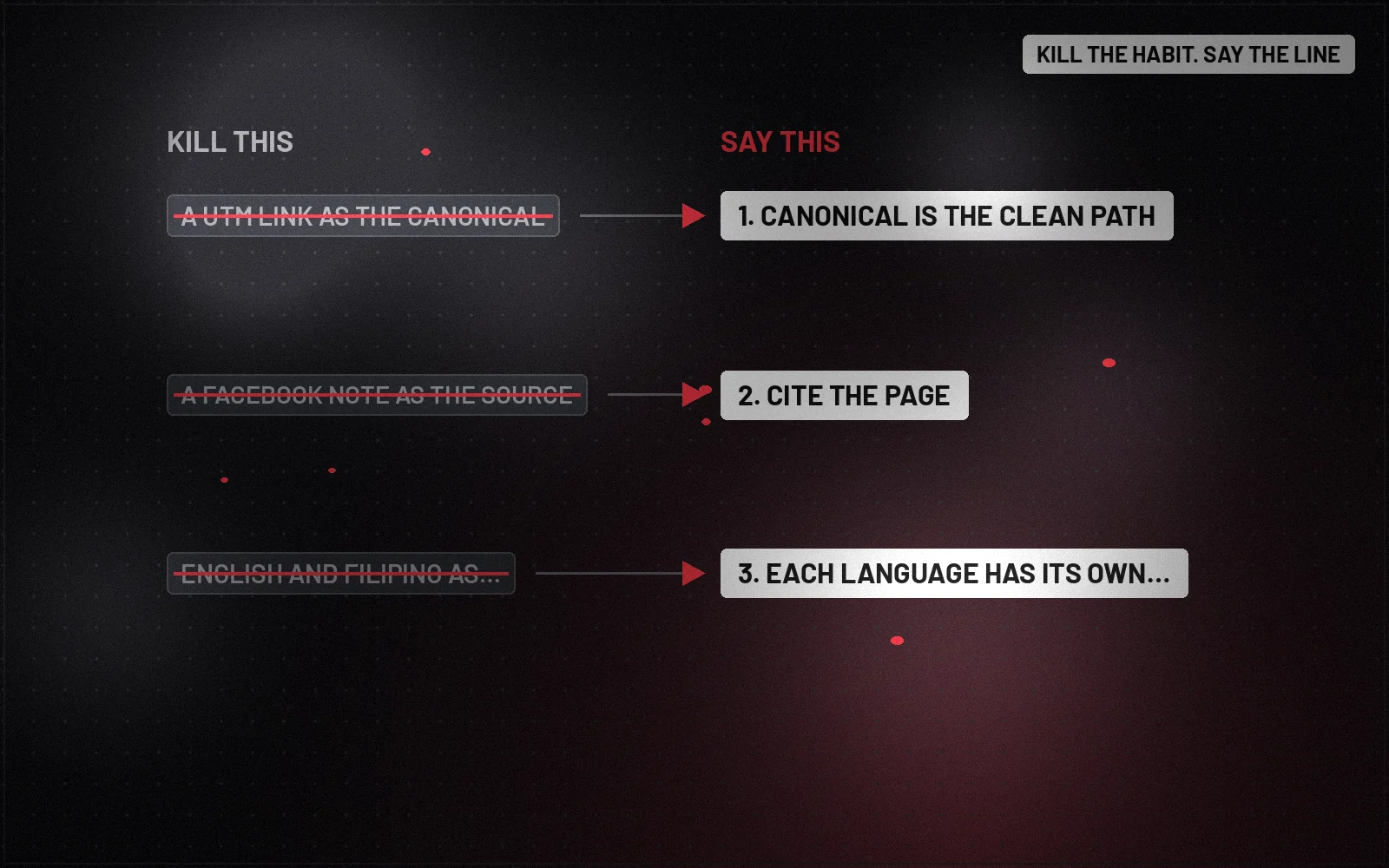
| A utm link as the canonical | Tracking parameters become the identity | Canonical is the clean path |
| A Facebook note as the source | The engine cannot cite the note | Cite the page |
| English and Filipino as accidental clones | They are translations, not duplicates | Each language has its own URL. Do not canonical one into the other. |
| “We’ll fix it after launch” | The empty clone gets the links | Name the real URL before the first share |
Kill rule: if the chat cannot agree on one URL, do not send the share.
How this helps GEO
Answer engines quote the page they can open. If three URLs disagree, they quote none, or they quote the stale one.
Put the cite-ready sentence on the real URL only. Clones either redirect or point canonical and do not invent a second fact.
Where does the canonical line English APAC live?
In three places. The page head, as the canonical tag. The share card, as og:url. The desk card, as the one URL everyone pastes.
All three say the same path. If the tag says one URL and the card says another, the engine and the chat get two answers.
Most SEO plugins write a canonical tag for you. On a cloned page, that default usually points at the clone itself. That is the bug. Check it on every copy.
Who owns the real URL?
One person on the desk. Their name goes on the card next to the URL.
Partners, ad teams and microsite vendors ask that person before they launch a copy. Not after the copy has the links.
When the page moves, the owner sets the redirect the same day and sends the new path to the partner chat.
If the owner is away, the card names a backup. One backup, not the whole team.
When should a clone redirect instead?
If nobody needs the clone to stay live, redirect it to the real URL. A redirect is cleaner than a canonical tag on a page nobody reads.
Keep a clone live only when it does a separate job: a partner audience, a paid landing test. Then it points canonical at the real URL. Translations are not clones. They keep their own.
Old event pages count. When the event is over, redirect the clone to the real page or the next event, not to the homepage.
What does the desk card look like?
Canonical card (illustrative):
Real URL: https://example.org/flood-contracts
Clones: partner copy and ad landing point canonical here
Translations: the Filipino page keeps its own URL
Owner: the digital desk lead
How do you check it before launch?
Open each clone and view the page source. Find the canonical tag. It should name the real URL, or the page itself if it is the real one.
Paste the real URL into the chat app your partners use. Check that the card shows the real page, not a clone. Do it on a phone too. Some partners will only ever see the mobile card.
Search the exact H1 in quotes. If a clone shows up beside the real page, it is pointing the wrong way or saying a different thing.
Fix the tag first, then the copy. Then send the share.
Monday field kit
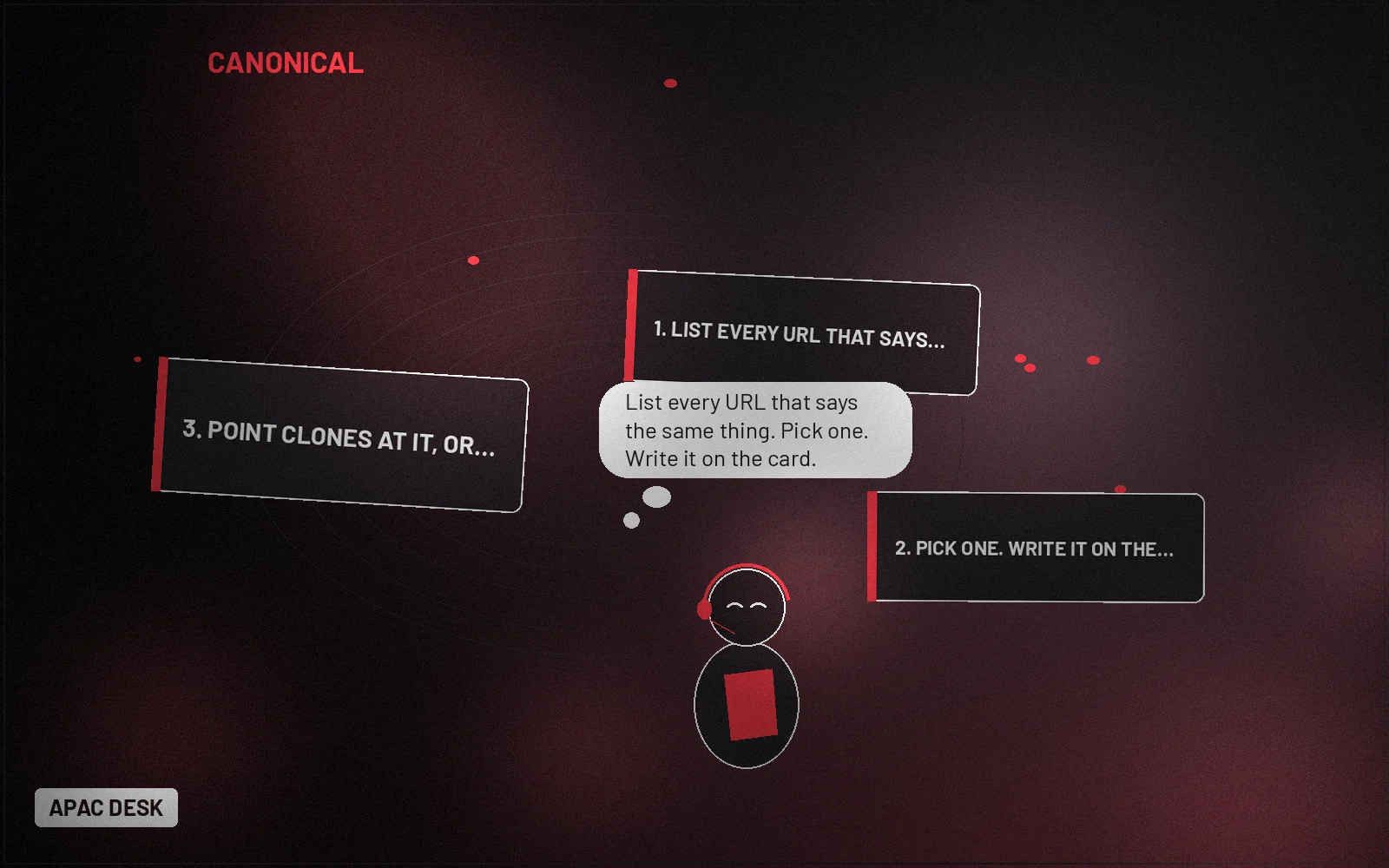
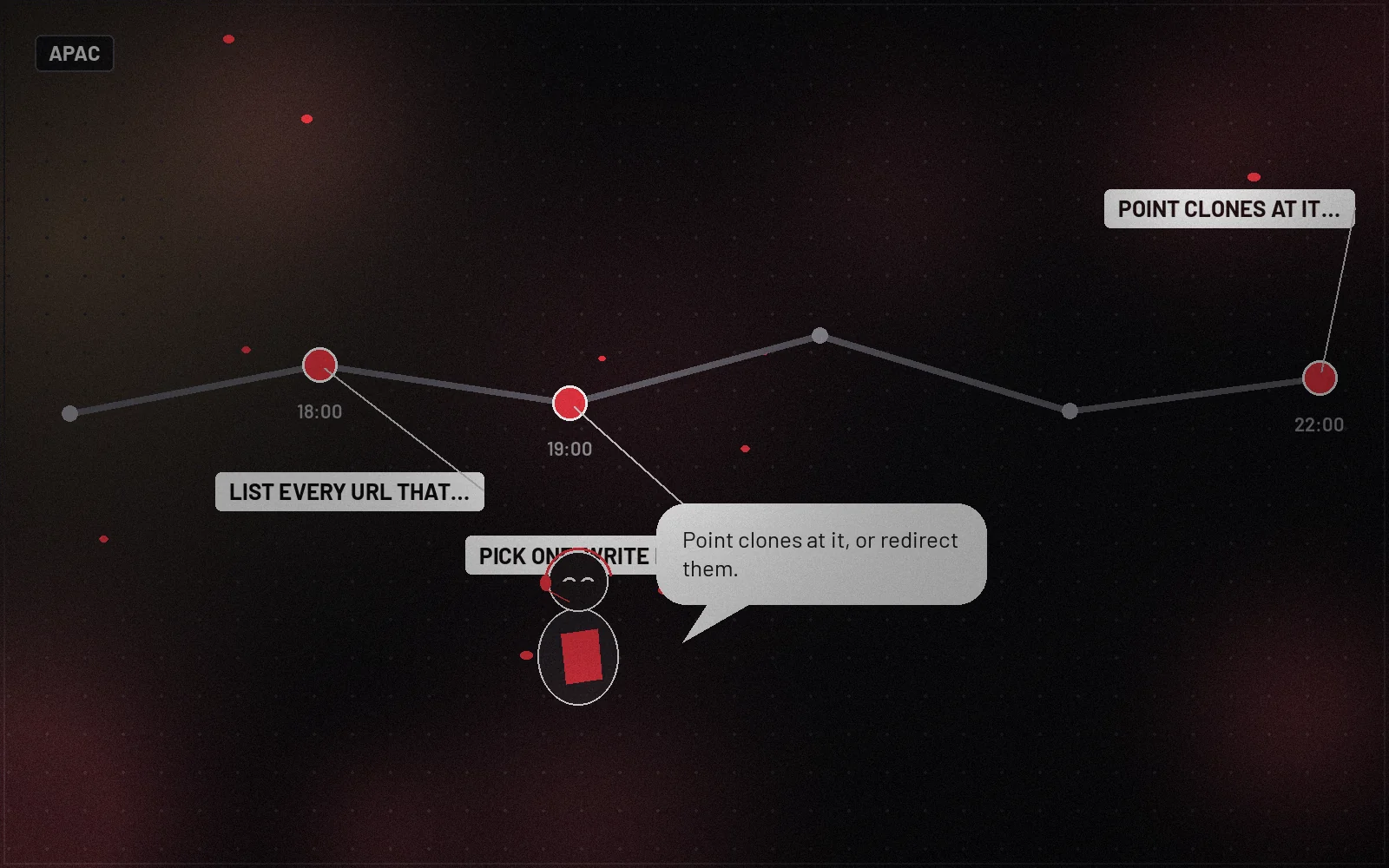
- List every URL that says the same thing.
- Pick one. Write it on the card.
- Point clones at it, or redirect them.
- Do not canonical a translation into another language.
- Paste only that URL in the next press note and partner chat.
FAQs
What is canonical line English APAC?
It is the one URL the desk names when pages are cloned, so search, shares and citations land on the same path.
Should a Filipino page canonical to the English page?
No. Translations are not duplicates. Each language keeps its own URL.
Can the ad landing page be the canonical?
Only if it is the page you want cited. A utm landing page is usually a clone, not the source.
Does a canonical tag stop the clone from showing in search?
Not always. A canonical tag is a strong hint, not an order. Engines can still pick another page, which is why a clone should never carry a different fact.
What to do this week
Search your own campaign name plus the object. If two of your URLs appear, pick one before the next share.
Neuwark Communications writes search and owned-channel language under Digital & Social. If the desk still pastes whichever tab is open, talk to us at Contact. More language companions live in Insights.
Communications craft, not legal advice. Partner copies, licensing and takedowns of cloned pages go to counsel before you act.
Related: English APAC URL slug · Open Graph card English APAC · GEO source citation English APAC · Title tag English APAC