

Most market-entry decks treat Singapore as a logistics problem: entity type, banking, talent, lease. The narrative problem arrives later—usually after a quiet briefing goes sideways, a trade association repeats a line you never cleared, or a regional HQ post contradicts what local partners heard. Stakeholder engagement Singapore work, done early, is how you stop improvising who matters once the story is already moving.
This article is for corporate communications, public affairs, and government-relations leads who must map who actually moves a narrative when a multinational or ASEAN HQ uses Singapore as a base. It offers a persona map, influence–interest matrix, and RACI you can run in a workshop—not a lobbying brief, not a name-drop list of officials, and not a substitute for counsel.
Educational note (YMYL): Process hygiene for en-SG communications teams. This is not legal advice, not lobbying advice, and not a claim that any agency or association will adopt your frame. Confirm live instruments and engagement rules with counsel before meetings, submissions, or public statements.
Neuwark Communications supports Singapore public affairs and government relations from our account office at Level 39, Marina Bay Financial Centre Tower 2, 10 Marina Boulevard, Singapore 018983 (contact +63 923 859 6587). Soft path: Singapore public affairs · Singapore government relations · Singapore crisis & issues · Contact. Related: GR vs PA buyer split · IMDA consultation checklist.
Direct answer: who moves a Singapore market-entry narrative?
| Stakeholder class | Why they move the narrative | What “good engagement” looks like for Comms |
|---|---|---|
| Employees & leadership (local + regional) | First informal briefers to partners, media, and networks | One vocabulary for why Singapore, what you will not claim, who speaks |
| Customers & channel partners | Test whether your Singapore story matches delivery and contracts | Sector-truthful promises; no “ASEAN HQ” theatre without substance |
| Investors / board / analysts | Read Singapore as capability—or risk concentration | Consistent rationale across IR, PA, and local PR |
| Trade associations & professional bodies | Amplify or dilute your frame in consultations and media cycles | Clear ask; members’ language, not press-release English |
| Media & specialist desks | Set public vocabulary faster than your website | Briefing fences; one fact spine; no off-record improvisation past Legal |
| Regulators as categories (not named individuals) | Sector codes, licences, and consultations reshape what you can say | Map which agencies your product actually touches; process hygiene first |
| Community / civil society / local partners | Decide whether presence reads as contribution or extractive HQ theatre | Listening artefacts; local proof points; no stock “giving back” lines |
| Sister markets (ASEAN country teams) | Country narratives leak upward into the hub story | Sequencing rules: what Singapore says vs what each market owns |
Enterprise Singapore’s public guidance for firms going global and partnering with Singapore (see Go Global and Why Singapore) frames the city-state as a platform for internationalisation—not as a substitute for a stakeholder map. EDB’s set-up guidance helps with establishment mechanics. Neither replaces deciding who must hear what, in what order.
Who this is for / who should skip
| Use this pack | Hand off |
|---|---|
| Comms / PA / GR leads building a Singapore (or Singapore-as-ASEAN-hub) entry narrative | Teams seeking named officials, introductions for hire, or “who to lobby” lists—counsel and ethics tracks |
| Regional HQ needing one map before the first media or association touch | Anyone asking an agency to invent regulatory outcomes or competitor comparisons |
| Boards that want influence vs interest before approving launch messaging | Pure brand campaigns with no stakeholder ownership beyond paid media |
Why generic APAC stakeholder lists fail in Singapore
A recycled “government, media, customers, employees” slide from another market usually fails three Singapore-specific tests:
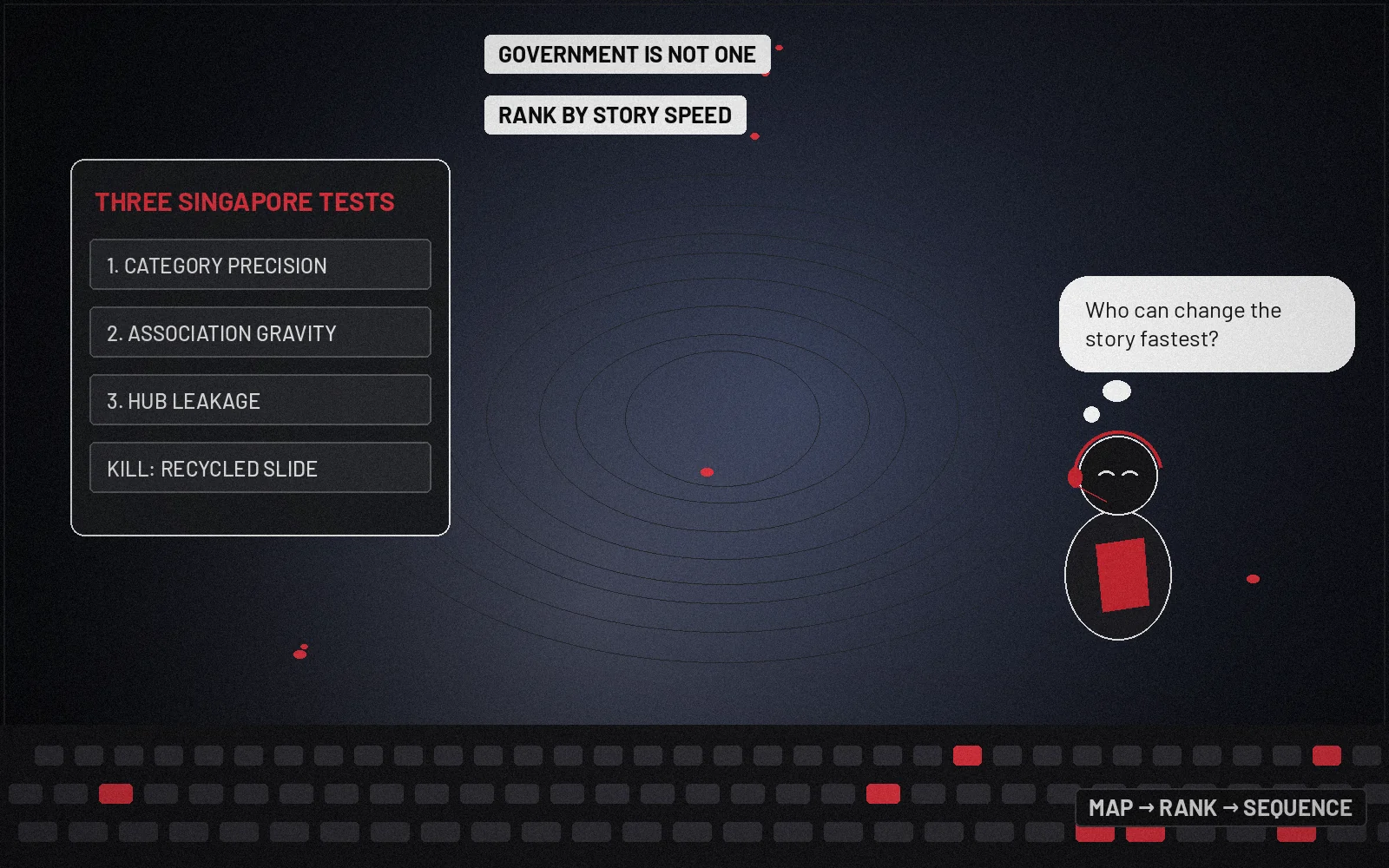
- 1. Category precision. “Government” is not one audience. Separate policy shaping (consultations, associations) from licensing and conduct (sector regulators as categories) from public narrative (media, civil society). Our government relations vs public affairs Singapore split exists because buyers who blur those lanes buy the wrong SOW.
- 2. Association gravity. Industry bodies often carry more day-to-day narrative weight than a cold email to an agency mailbox. Map them as amplifiers, not decorative logos.
- 3. Hub leakage. If Singapore is your ASEAN HQ story, every country team’s local claim can become your regional contradiction by Friday. Include internal ASEAN desks as first-class audiences.
Skip inventing “influence rankings” of ministries. Rank your audiences by how quickly they can change the story you are trying to tell.
Original element 1 — Singapore Market-Entry Stakeholder Matrix (influence × interest)
Score each audience 1–5 for Influence (can they change your narrative this quarter?) and Interest (how closely are they watching your entry?). Plot into four cells. Re-score after first consultation, first media cycle, or first partner cascade—not once a year.
| Cell | Definition | Default market-entry actions |
|---|---|---|
| Manage closely (high influence, high interest) | Can accelerate or stall the story; already paying attention | Named owner; weekly listening; pre-cleared FAQ; meeting-notes discipline |
| Keep satisfied (high influence, lower interest) | Quiet power; may not care until something breaks | Periodic brief; no surprises; escalation if interest spikes |
| Keep informed (lower influence, high interest) | Eager audience; limited ability to move the market alone | Cadenced updates; avoid over-promising |
| Monitor (lower influence, lower interest) | Background until a trigger | Light watchlist; trigger list (licence news, association letter, viral post) |
Starter scores (illustrative — re-score for *your* sector)
| Audience | Influence | Interest | Starting cell | Narrative risk if ignored |
|---|---|---|---|---|
| Local employees + people managers | 4 | 5 | Manage closely | Conflicting “why Singapore” stories to partners |
| Channel / JV partners | 5 | 4 | Manage closely | Promise leakage into customer contracts |
| Primary trade association(s) | 4 | 3–4 | Manage closely / Keep satisfied | Your frame rewritten in association English |
| Specialist media desks | 4 | 3 | Keep satisfied → Manage closely on news weeks | Vocabulary set without you |
| Sector regulator category (licence/conduct) | 5 | 2–4 | Keep satisfied / Manage closely if consultation live | Public claims that outrun licence reality |
| Policy / PA adjacency (consultations, codes) | 4 | 2–3 | Keep satisfied | Silent when a consultation closes—see IMDA checklist |
| Investors / board | 5 | 3 | Keep satisfied | HQ theatre vs operational proof mismatch |
| Community / local civil partners | 3 | 3 | Keep informed | Extractive-HQ perception |
| ASEAN country Comms leads | 4 | 4 | Manage closely | Hub story contradicted by country PR |
| Broad public / general consumers | 2–3 | 2 | Monitor → Keep informed on launch | Brand noise without stakeholder spine |
Rule: never put a named official in this matrix. Put functions and institutions as categories. Influence scores are planning tools, not status claims.
Original element 2 — eight persona cards (workshop-ready)
Fill these in one 90-minute session with Legal present for “do-not-say.”
A — Local employee / people manager. Needs plain-English purpose, role changes, and who answers hard questions. Kill: unverified market-share claims; “we are already licensed for X” without Legal. Owner: People + Comms.
B — Channel or JV partner lead. Needs a written fact spine, escalation contact, and boundaries on joint statements. Kill: partner quotes that invent government endorsement. Owner: Commercial + Comms; Legal on joint releases.
C — Trade association secretariat / committee volunteer. Needs member-useful data, a clear public-interest ask, and realistic timelines. Kill: treating the association as a press-release distribution list. Owner: PA lead.
D — Specialist journalist / desk. Needs one spokesperson, facts that survive a second question, and on/off-record rules. Kill: background colour that contradicts the on-record line. Owner: Media lead; Legal for regulated claims.
E — Sector regulator as category (compliance / licensing). Needs silence where required and accurate public descriptions of licence status—no implied endorsement. Kill: “regulators love us,” implied approvals, named officers. Owner: Compliance / GR; Comms crafts only cleared language.
F — Policy / consultation stakeholder (agency or platform as category). Needs structured submissions and process respect (see IMDA consultation checklist). Kill: press-release tone in a consultation response. Owner: PA / GR with counsel.
G — Investor / board director. Needs the same timeline and risk language as IR—proof points, not tourism copy. Kill: “regional HQ” without headcount, P&L, or decision rights. Owner: CEO / IR; Comms aligns vocabulary.
H — ASEAN country Comms lead. Needs sequencing rules, shared do-not-say, and permission to localise tone. Kill: country exclusives that contradict the Singapore narrative the same week. Owner: Regional Comms lead.
Original element 3 — Narrative RACI for the first 90 days
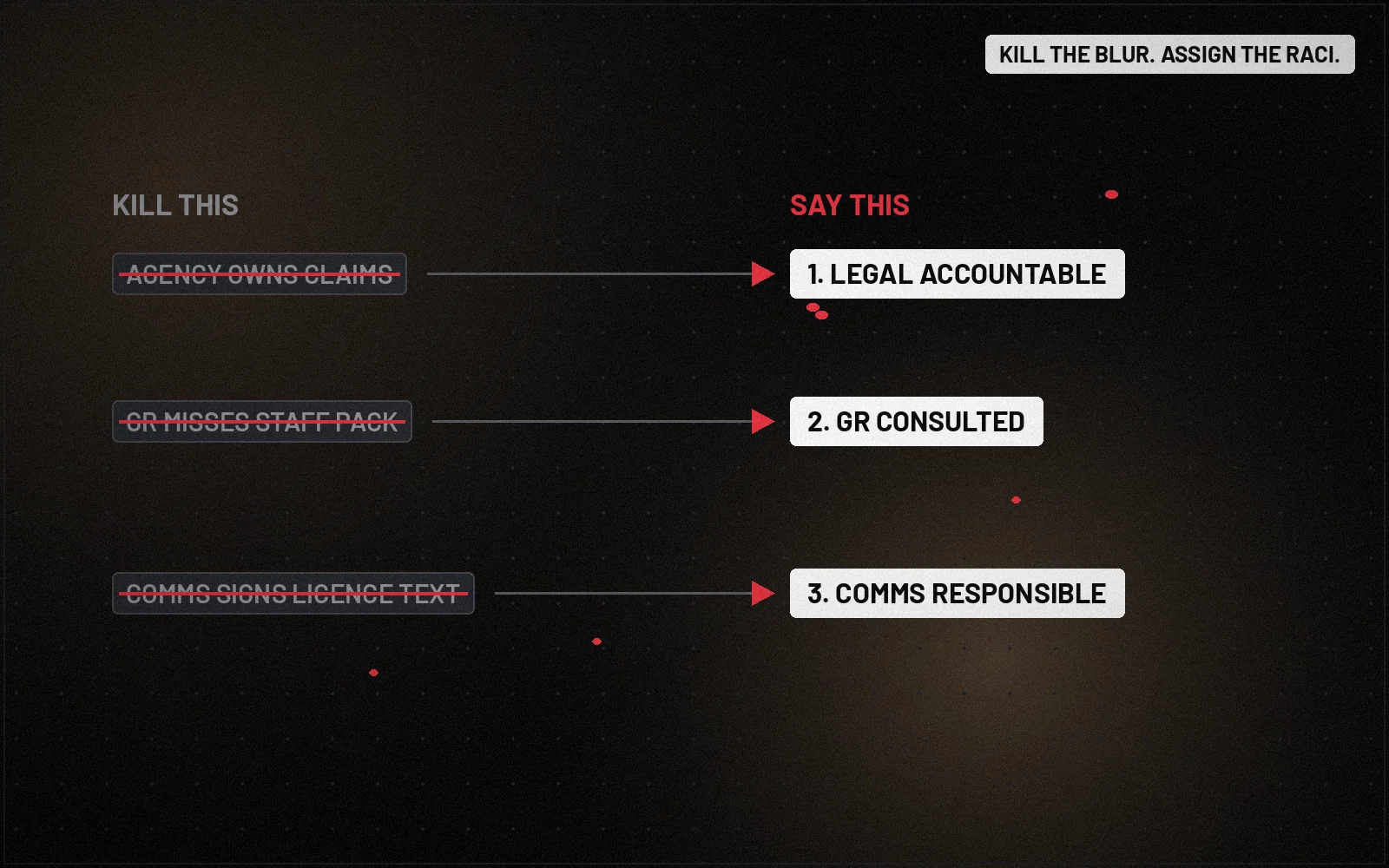
Use Responsible / Accountable / Consulted / Informed. Do not outsource Accountability for regulated claims to an agency.
| Workstream (first 90 days) | Corp Comms / PA | GR / Compliance | Legal | Country / commercial | CEO / regional | External PA/GR desk |
|---|---|---|---|---|---|---|
| Stakeholder matrix v1 + persona cards | A/R | C | C | C | A (priorities) | R (facilitate) |
| “Why Singapore” fact spine (external) | R | C | A (claims) | C | A (voice) | C |
| Association engagement plan | R | C | C | I | I | R (draft) |
| Media briefing fences | A/R | C | A (regulated lines) | I | A (who speaks) | C |
| Consultation watchlist & response ownership | C | A/R | A | I | I | R (draft support) |
| Employee narrative pack | A/R | I | C | C | A | C |
| ASEAN sequencing (hub vs country) | A/R | C | C | R (country packs) | A | C |
| Issues trigger list + escalation | R | C | C | C | A | R (crisis retainer) |
| Launch / announcement copy | R | C | A | C | A | C |
| 90-day matrix re-score | A/R | C | I | C | I | C |
How to read this: if Comms is Accountable for licence-status wording without Legal, you have inverted risk. If GR never sees the employee pack, partners will hear a softer story than regulators ever would—and that gap becomes the story.
How to run the map without theatre
- 1. Start with decisions, not logos. List the five decisions your entry narrative must survive (pricing, licence claims, headcount, partner exclusivity, ASEAN remit). Map stakeholders against those decisions.
- 2. Separate listening from pitching. First 30 days: who do we need to hear? Second 30: who needs a cleared brief? Third 30: who needs a public artefact?
- 3. Build a trigger list. Association circulars, consultation open/close, licence milestones, viral employee posts, competitor narratives in specialist press—triggers move audiences between matrix cells.
- 4. Keep a single fact spine. One page: known / unknown / do-not-say. Every persona card pulls from it.
- 5. Re-score after contact. A “Keep satisfied” association that just opened a working group is no longer low interest.
Official internationalisation and set-up pages (Enterprise Singapore market-entry support, EDB set-up) explain why firms choose Singapore. They do not tell you who moves your narrative. That is operator work.
Buyer note: PA vs GR on the same map
Public affairs often owns associations, media fences, and consultation craft. Government relations often owns process around regulated engagement and meeting hygiene. Many Singapore buyers need both—but not as one vague “govvie PR” retainer. Use the map to show which cells are PA-led, which are GR/compliance-led, and which are pure corporate communications. That is the commercial hygiene behind our GR vs PA plain-English split. Soft path when capacity is thin: Singapore public affairs and Singapore government relations, scoped under counsel.
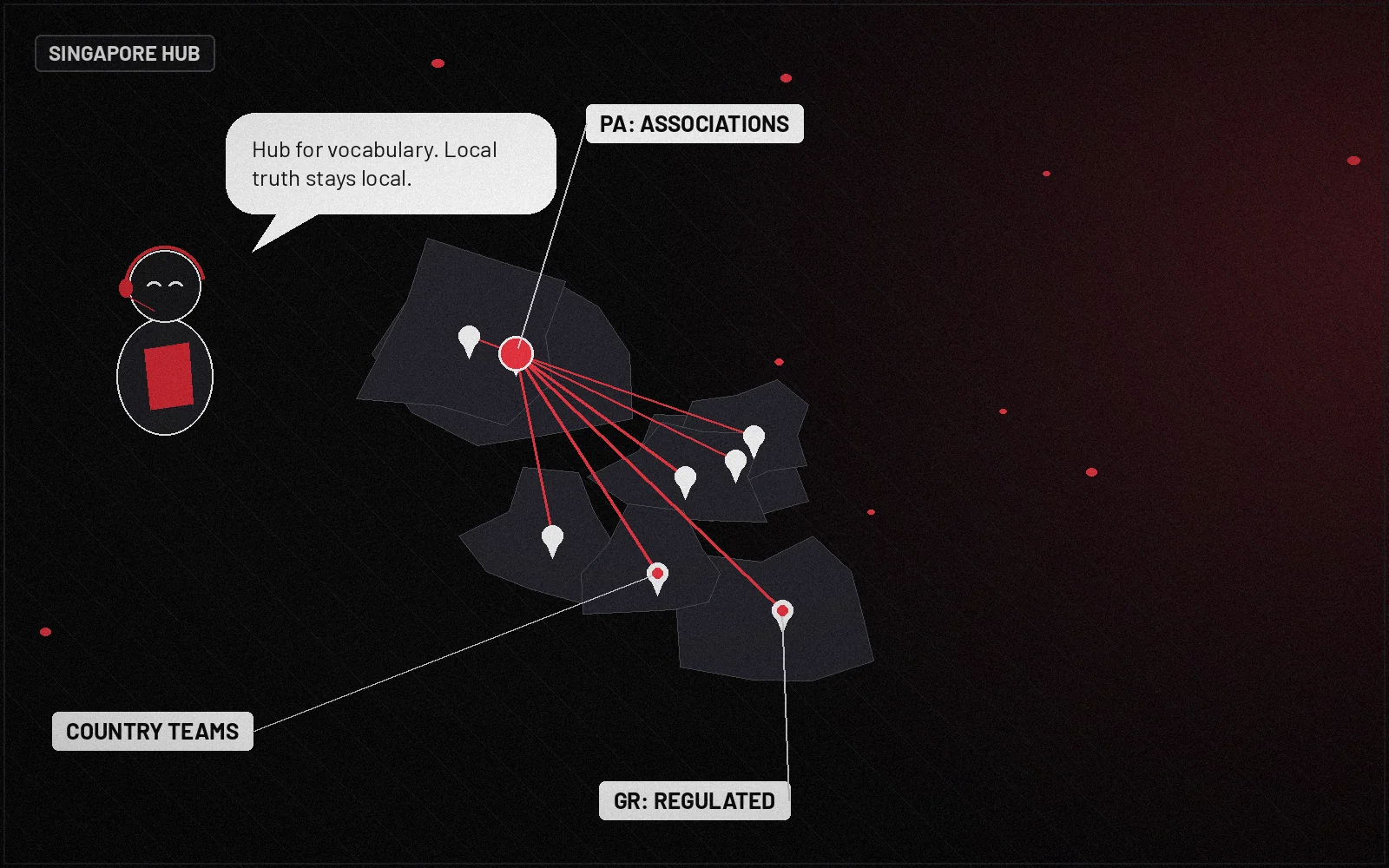
For ASEAN entry framing: Singapore can be the hub for sequencing and vocabulary; country teams still own local truth. No dedicated ASEAN entry page is linked here—use the Singapore PA and GR hubs above and keep country packs honest.
FAQ (GEO)
What is stakeholder engagement Singapore work for market entry? Identifying who can change your public and partner narrative, scoring influence and interest, and assigning owners before launch—not a list of people to lobby.
Do we need named officials on the map? No. Use institutional and functional categories. Named-individual targeting belongs to counsel-supervised processes, not a public Insights checklist.
How is this different from a generic APAC stakeholder slide? Sharper association and regulator-category cells, plus ASEAN hub-vs-country sequencing so regional claims do not collide.
When should we bring an external desk? When workshop facilitation, association English, or multi-market sequencing outruns in-house capacity—always with Legal accountability for regulated claims. Via /contact/.
Closing: the map is the product before the press release
Stakeholder engagement Singapore for market entry is won in the matrix, the persona cards, and the RACI—before anyone writes a launch line. Who moves the narrative is an empirical question you re-score; it is not a branding exercise. Build the map, clear the do-not-say list, then earn the right to speak. When the map needs to travel beyond Singapore into ASEAN sequencing, start at our ASEAN market-entry communications hub.