
A query map is not a keyword spreadsheet that dies in Drive.
It is a one-page assignment: this question gets this URL, this H2, this source block, and this owner. If two questions share a URL, say so. If a question has no URL, that is a gap, not a brainstorm.
Search query map English is the language on that page: short enough for a Monday stand-up, specific enough that two writers do not publish twins.
This is the language companion to our GEO FAQ pages playbook, which says to build a question map before you write a line, and to our budget-week paid search landing page playbook, which clusters real queries around money pages. Those pieces explain why. This one gives you the words on the map.
Street-smart APAC English: short sentences a tired operator can say out loud.
Why do APAC comms teams build the wrong list?
They start with services. Strategy. Creative. Media. Crisis. Those are how you sell. They are not how a barangay captain searches.
Voters and buyers type objects and events: unprogrammed appropriations, quiet hours, POFMA holding lines, halal mandate date, haze, ferry, airport alert. The map should start there.
A service page can exist. It should not steal the query from the playbook that actually answers it.
Kill: one Services page targeting “crisis communications Philippines Singapore Indonesia Japan Korea.” Say: one playbook URL per live situation, plus one category page that does not pretend to be all of them.
What are the four columns in search query map English?
| Column | Kill this | Say this |
|---|---|---|
| Query | a twelve-word SEO fantasy | the words a person types or asks out loud |
| URL | “TBD blog” | live, or “gap” |
| Answer owner | “content” | a desk |
| English job | “thought leadership” | title lock, source block, field card, holding page |
Paste-ready row:
Query: what to say on a crisis dark site APAC
URL: /insights/crisis-dark-site-english-apac-street-smart/
Owner: night desk
English job: four questions, four sentences, kill list
That row points to our live crisis dark-site English companion. If the URL is “gap,” the next Insights post is assigned. That is how you get five posts that are not twins of last week.
How do you keep five-a-day from cloning itself?
Check the map before the draft.
If the query already has a language companion, you do not write another companion with a new metaphor. You update the live page or you pick the next gap.
This is the difference between a series and a content mill. The series has objects. The mill has synonyms.
Kill: “Ultimate guide to GEO for campaigns 2026.” Say: the next missing object. This week that meant a title tag lock, an AI Overview source block, an IndexNow publish note, anchor English, and this query map.
How does the map serve paid search?
Paid search landing English only works when the query and the URL already match. If the map says the query belongs to a money page, do not point the ad at Insights and hope.
Kill: ads to the homepage during budget week. Say: ads to the money page whose H1 repeats the query’s object.
The query map is the brief you hand a buyer. It prevents a creative test from inventing a sixth URL overnight. Our paid search landing English companion has the H1, proof and CTA lines for the page the row points to.
What language belongs on the map itself?
Short. Operator. No strategy poetry.
Kill column headers like “narrative north star.” Say “query,” “URL,” “owner,” “job.”
Kill descriptions like “own the conversation on accountability.” Say “page answers what unprogrammed appropriations means in one classroom sentence.”
If a volunteer cannot read the map on a covered-court table, it is not a map. It is a deck.
The English job column does the most work. It tells the writer what object to produce before anyone opens a draft. “Title lock” means the title, H1, meta and slug. “Source block” means question, answer, proof, limit, next step. “Field card” means lines a volunteer can hold. If the job cell says “awareness,” send it back.
Monday field kit
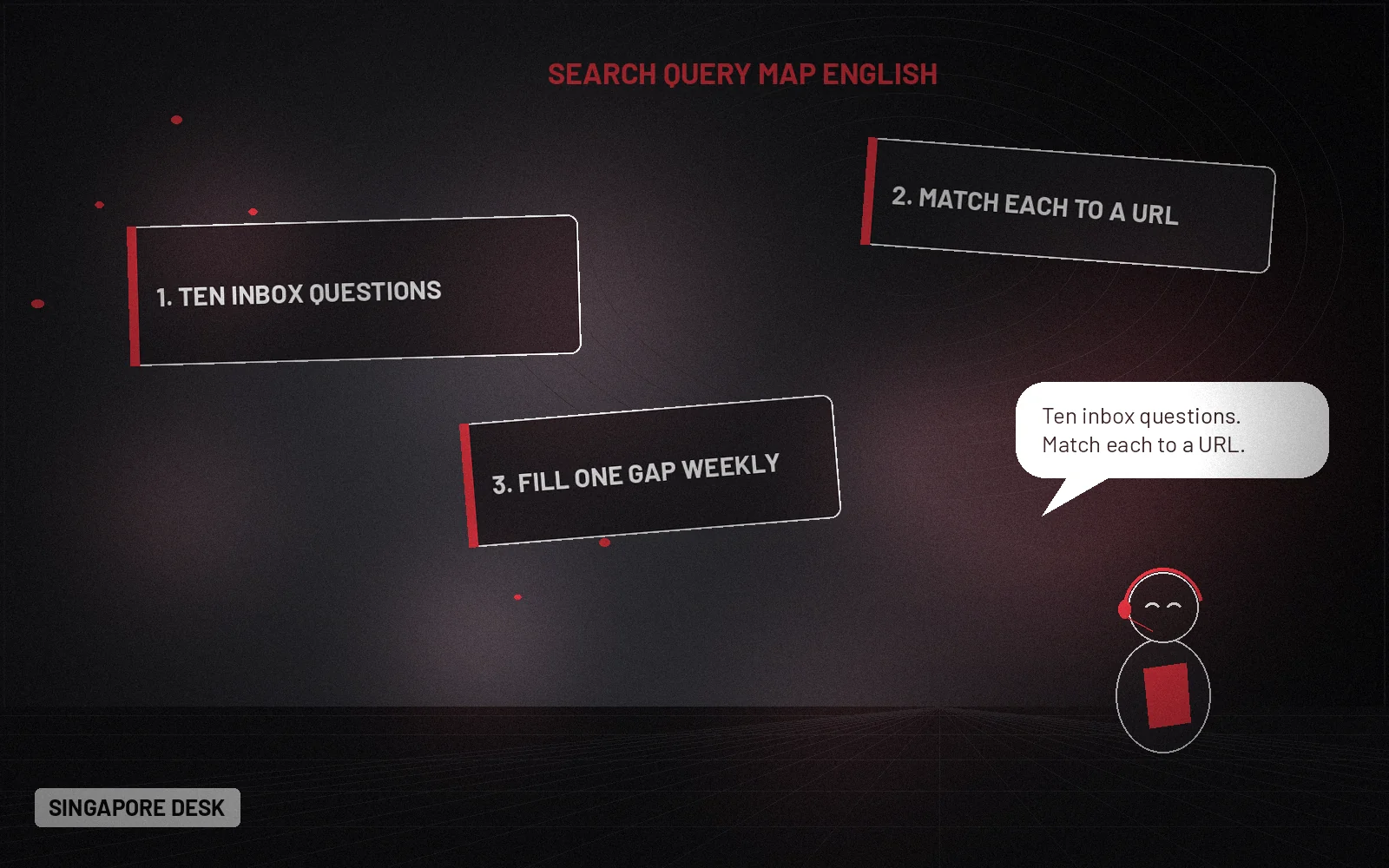
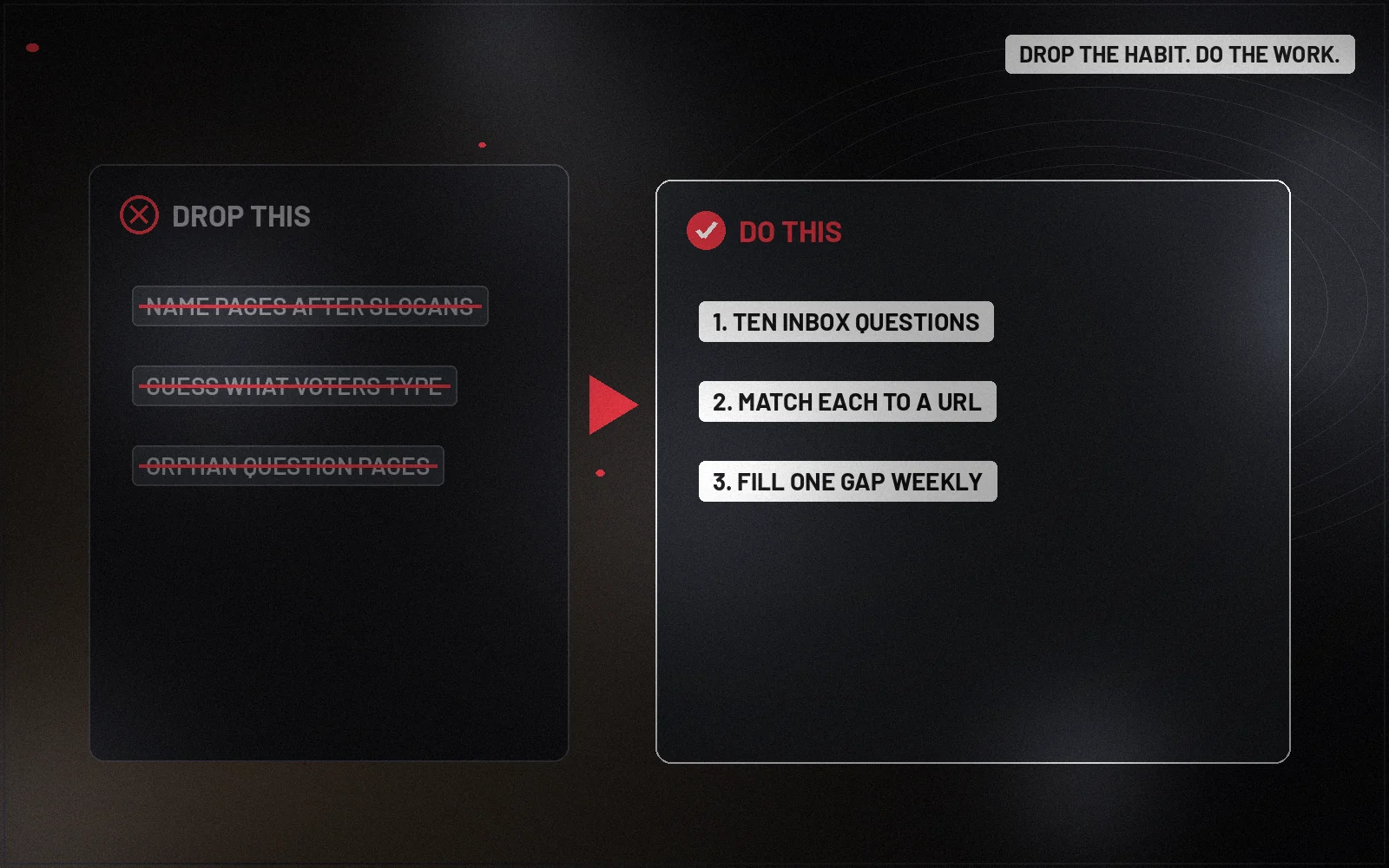
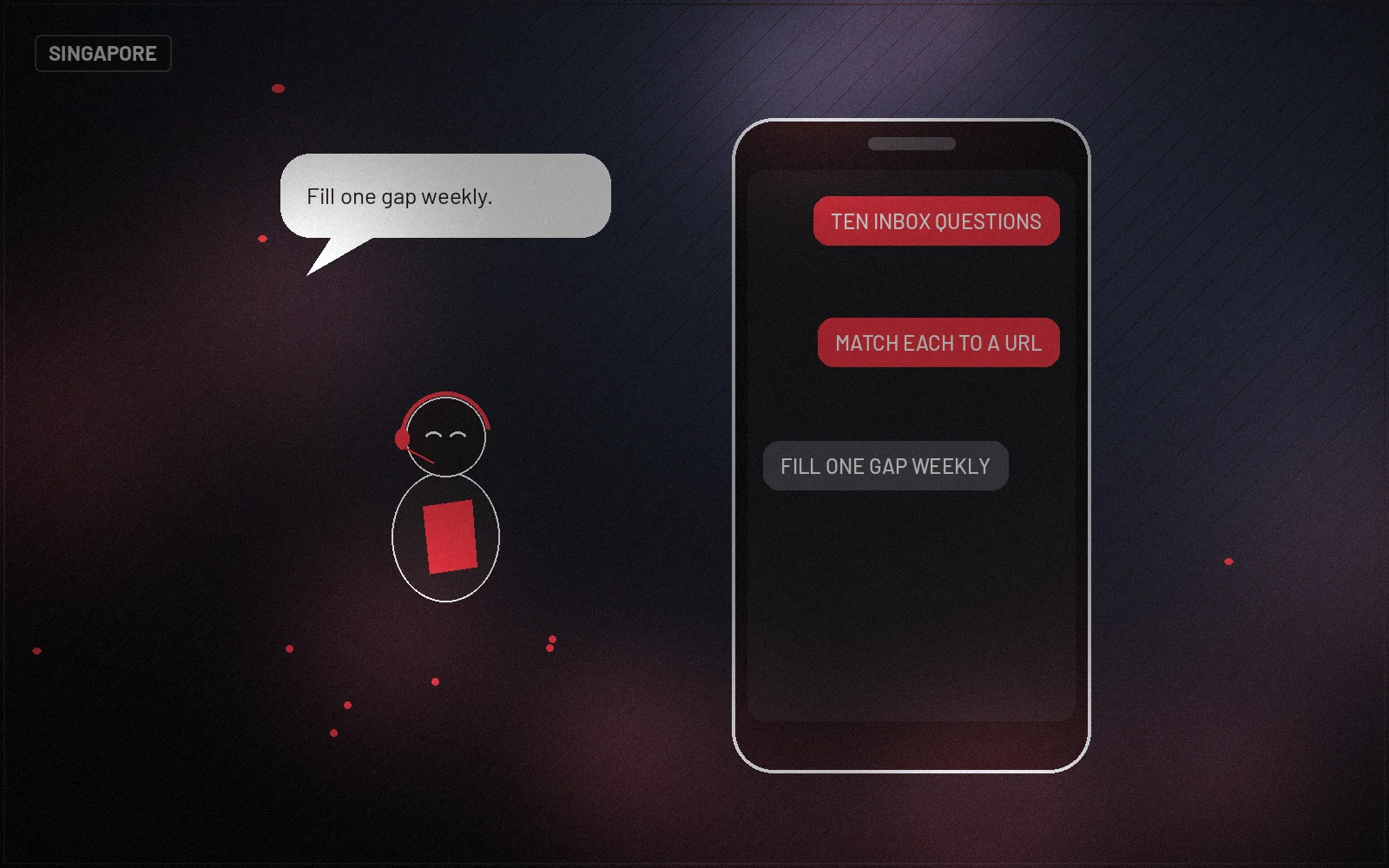
- List the ten questions the inbox actually received.
- Match each to a live URL or mark it as a gap.
- Assign one gap to this week’s Insights slate; five only if five gaps exist.
- Write the English job in one line.
- Hand the buyer only the rows that already have URLs.
- Recheck slashes and canonicals so the map does not list ghosts.
Paste-ready stand-up line:
Ten queries. Seven live. Three gaps. Today we ship the gap on internal-link anchors, not a rewrite of the GEO FAQ post.
FAQs
What is search query map English?
It is the four-column assignment that ties a real question to one URL, one owner and one English job. It is written in words an operator can read aloud at a stand-up.
Is this the same as a keyword list?
No. A keyword list is wishes. A query map is ownership.
Do we publish the map?
Usually no. Publish the pages the map assigns; the map is an operator document, and if you ever publish it, strip client names.
How does this relate to People Also Ask?
People Also Ask is a source of questions. It is not automatic ownership, so only add a question if your desk will maintain the answer.
Can GEO tools replace the map?
Tools can list questions. They cannot decide which question is yours, because that is an editorial call.
What to do this week
Build the four-column map for your current Insights library. Mark twins. Mark gaps. The next five posts come from gaps, each with a feature image that carries no fake newspaper type and in-article frames a desk can recognize.
If the calendar says “five SEO posts” and the map says “zero gaps,” update live pages instead of minting synonyms. That is still SEO. It is better GEO.
Neuwark Communications builds query maps and GEO content engines under Digital & Social and Media & Paid. If you need the map written as operator English your Monday desk will actually open, talk to us at Contact. The language companions sit in Insights.
Related: GEO FAQ pages for campaign SEO · Paid search landing English · GEO FAQ answer English · Crisis dark-site English