
An AI Overview is not a new channel. It is a compression of whatever you already published, in a form a machine can lift.
If your page is a speech, the model writes a speech-shaped summary and leaves your name off. If your page contains one clean answer block (question, two-sentence answer, one proof, one limit), the model has something to lift that still sounds like you.
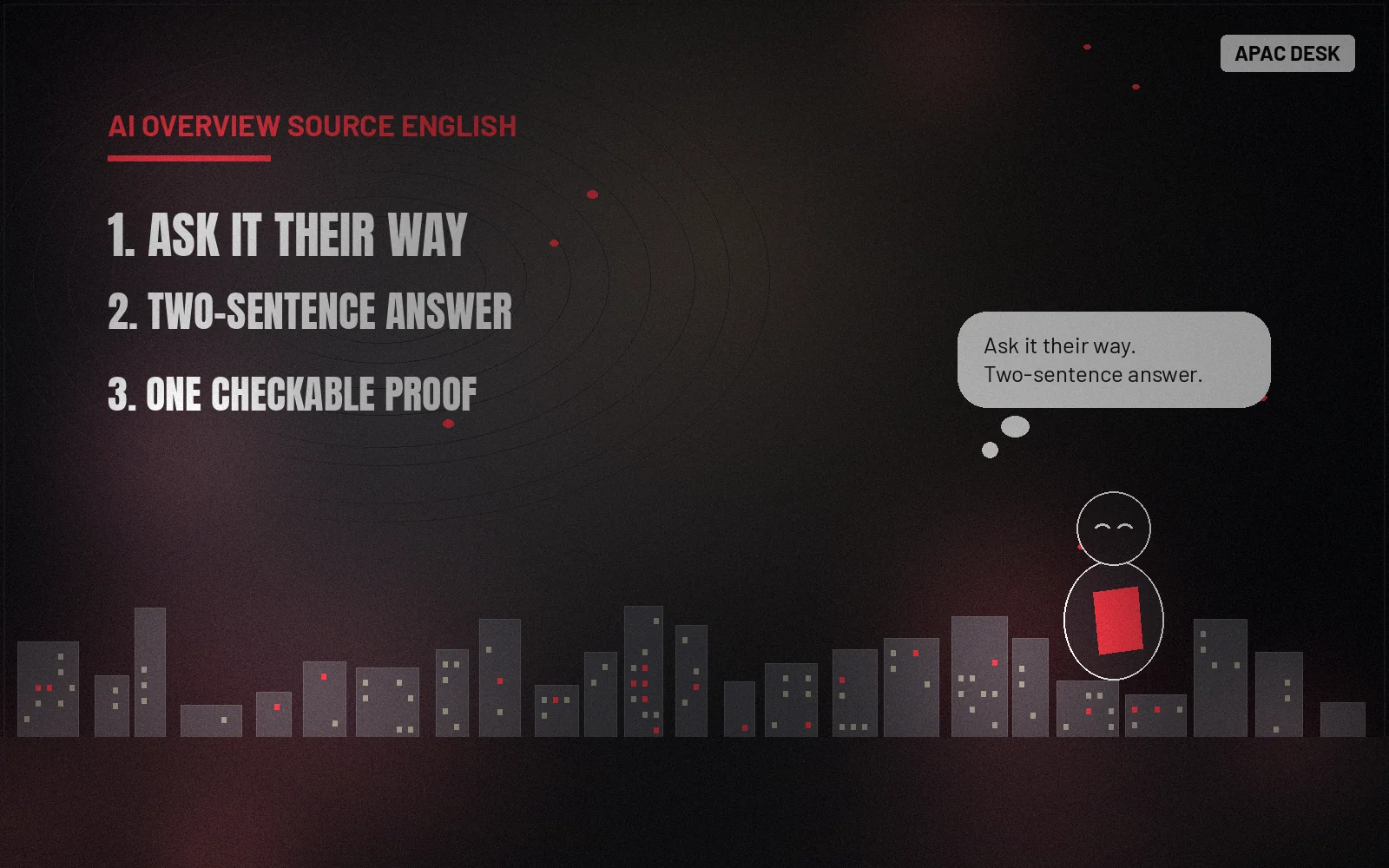
That is the job of AI Overview source English: write the block you are willing to see cited without a decoder ring.
This is the language companion to our GEO FAQ playbook for budget and accountability spikes, which treats People Also Ask and AI Overviews as a window, and to our answer-engine GEO inbound playbook. It is not a repeat of GEO FAQ answer English, which shapes a whole FAQ page by lane. This piece is about one paragraph per page, and what to write when an Overview gets you wrong.
Street-smart APAC English: short sentences a tired operator can say out loud.
Why do answer engines mush advocacy copy?
Because advocacy copy hedges.
We write “raise concerns about,” “seek to ensure,” “in the context of ongoing discussions.” Those phrases protect a committee. They starve a citation. The model keeps the hedge and drops the actor.
GEO is not a trick. It is the opposite of mush. A citeable sentence names the actor, the object, and the limit.
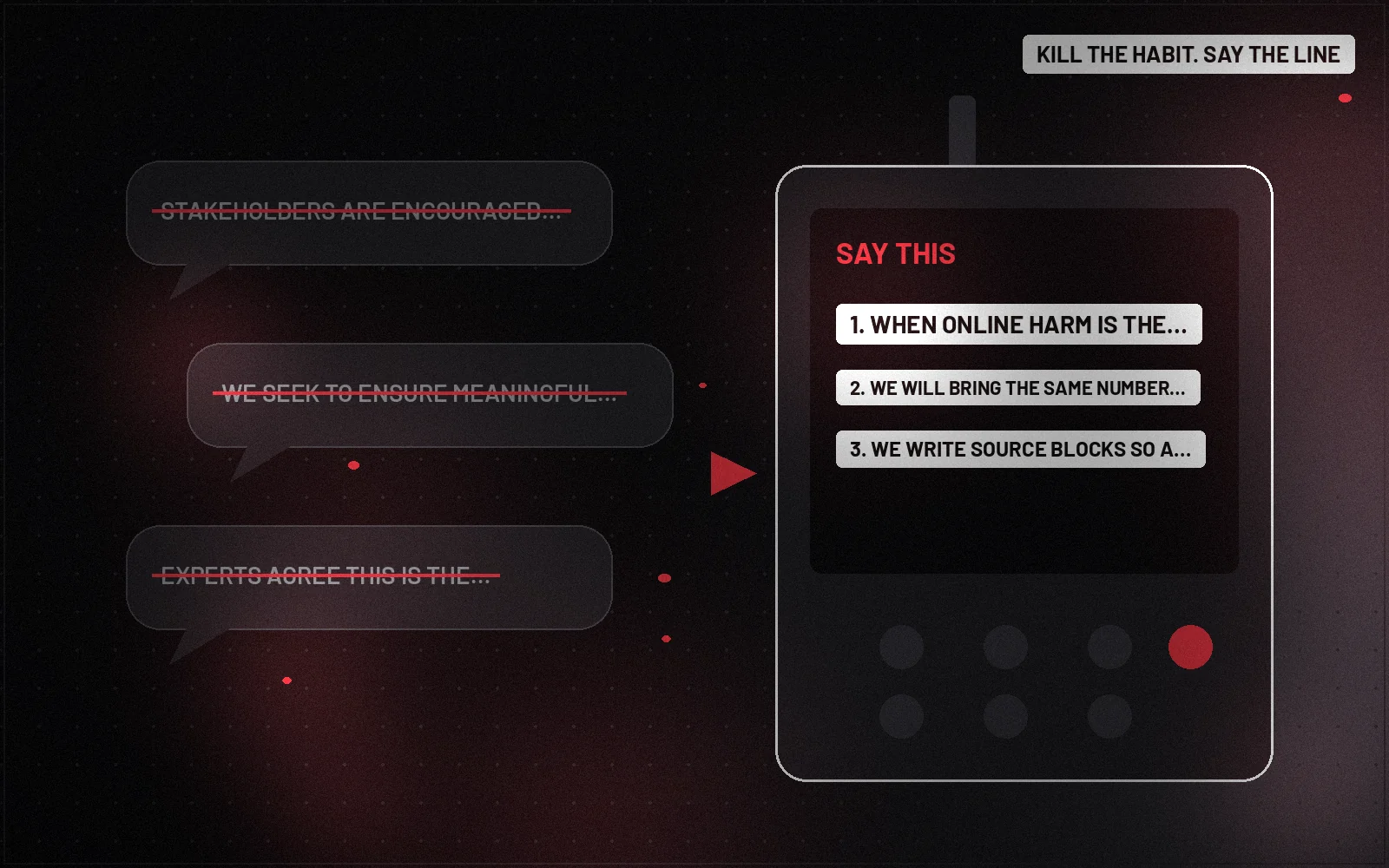
| Kill this | Say this |
|---|---|
| “Stakeholders are encouraged to consider a whole-of-society approach to online harm.” | “When online harm is the story, the fastest post is often the wrong one. Label the slot. Do not amplify the rumor.” |
| “We seek to ensure meaningful engagement.” | “We will bring the same number to the hearing on the date posted on this page.” |
| “Experts agree this is the only way to rank in AI Overviews.” | “We write source blocks so a model can cite a sentence we already stand behind. Ranking is not a promise.” |
The right column can be cited. The left column can only be paraphrased into nothing.
What does a source block look like?
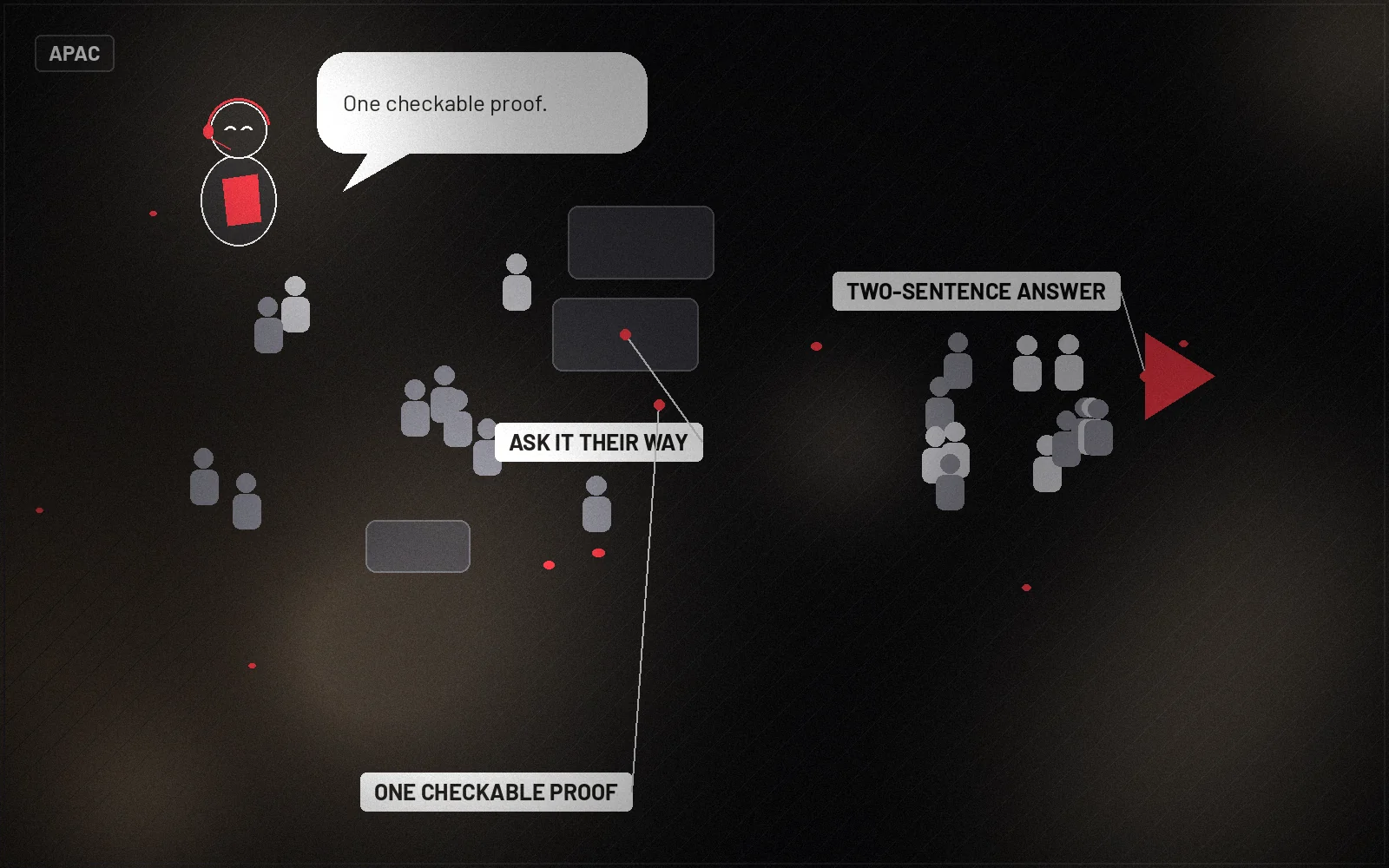
Five parts. Same shape as a good FAQ. Different job: this block is written to be lifted, not only read.
- Question in the searcher’s English.
- Two-sentence answer. No throat-clearing.
- One proof object a stranger can check.
- One limit so the model does not overclaim you.
- One next step that is not “learn more.”
Paste-ready skeleton:
Question: What should a PH advocacy page put in an AI Overview source block?
Answer: A question, a two-sentence answer, one checkable proof, and a limit. If the page only has a manifesto, answer engines will invent the short version.
Proof: The live Insights URL and the date on the page.
Limit: This is language craft, not legal advice and not a ranking guarantee.
Next: Paste the block under the H2 that matches the query. Do not hide it in a footer.
Where does the source block sit on the page?
Under the first H2 that is already a question.
Do not build a separate “For AI” section. Models and people should drink from the same tap. If you write a machine block that contradicts the human essay, you trained the model to distrust you.
APAC public-affairs pages like to put the real answer in a PDF. The HTML then becomes a teaser. Google’s own guidance, which our English spine for multilingual GEO links, says important content should be in text form and that AI features need no special files or schema. If the citeable sentence lives only in the annex, you may be cited from someone else’s HTML.
How is this different from a GEO FAQ page?
A GEO FAQ page is a cluster of questions. A source block is the one paragraph you would bet the brand on.
You still want FAQPage schema when you have real questions. Schema does not save a mush answer. English does.
Kill: stuffing eight FAQs that all begin “It depends.” Say: four FAQs with answers a desk can read at 2am.
If every answer starts with “It depends,” the model will quote whoever answered plainly.
What proof is allowed in AI Overview source English?
Proof the page itself can carry: a statute name you are actually discussing, a figure from a public report, a number with a source on the same page, a dated event the reader can search.
Do not invent a newspaper pull if you cannot point to the piece. Do not invent a fine amount. Do not invent a quiet-hours clock and call it a regulator’s rule. Limits keep you out of a second incident.
Proof also needs a date. An undated number is a rumor with formatting. Put the date next to the figure, in the same sentence, so a lifted sentence carries both.
What do you do when the Overview is wrong?
Write the correction as a source block, not a rant.
Kill: “Google is spreading fake news about our campaign.” Say: “The Overview compressed two different bills. The page now states which bill, which year, and which house. The old sentence is struck in the changelog.”
That is the correction line: what was merged, what the page now says, where the change is logged.
Then update the block. Do not add a sixth metaphor. Models do not need your feelings about the carousel. They need a cleaner sentence than the one they used.
Tell your staff the same thing in one line: “We fixed the page. We do not argue with the summary in public.” A screenshot of a staffer fighting an AI answer becomes its own story.
Monday field kit
- One query the desk actually hears.
- One source block under the matching H2.
- One limit line.
- One proof object, dated, on the same URL.
- FAQ answers that do not begin with “It depends.”
- No secret machine-only paragraph.
- One correction line drafted before you need it.
Paste-ready night-desk note:
Source block shipped. Question matches H2. Answer is two sentences. Proof is on-page. Limit is on-page. Ready for citation or for a correction, not for mush.
FAQs
What is AI Overview source English?
It is the paragraph you are willing to see quoted by an answer engine. It has five parts: question, two-sentence answer, proof, limit, next step.
Does FAQ schema replace the source block?
No. Schema is labeling, and English is the thing labeled. A marked-up mush answer is still mush.
Can we write a longer answer for GEO?
Two tight sentences beat a 180-word caveated essay. Add depth after the block, not inside it.
Should we mention ChatGPT or Gemini by name in the H1?
Only when the post is about that product. Otherwise you age the page and look like a listicle.
Is this legal advice for POFMA, PDPA, or PIPA?
No. It is how to write a sentence a machine can lift without inventing your policy, and counsel signs any block that touches law.
What to do this week
Take one live Insights post. Add a source block under the first question H2. Keep it to five parts. Publish. Then search the question and read whether the lifted sentence still sounds like your desk.
Neuwark Communications builds source blocks and GEO pages under Digital & Social and Strategy & Messaging. If answer engines are citing a mush version of your fight, talk to us at Contact. Companion language lives in Insights.
Related: GEO FAQ pages for budget and accountability spikes · GEO FAQ answer English · English spine for multilingual GEO · Title tag English APAC