

A title tag is not decoration. It is the sentence a search result shows when a voter, a buyer, or a staffer types the fight into a box.
Most APAC advocacy pages fail that sentence. The H1 is a speech. The title tag is a slogan. The meta is a paragraph nobody asked for. Three rooms, three arguments. Search treats that as a page that does not know what it is.
Title tag English APAC desks can paste is one lock: one claim, one place, one proof word, and a length a phone can finish.
This is the language companion to our GEO content engine playbook for answer-engine inbound, which argues that pages must be machine-quotable, and to the Discover-grade publishing checklist, which sets the human H1, short SEO title and tight meta as publish rules. This piece gives you the words.
Street-smart APAC English: short sentences a tired operator can say out loud.
Why do title tags die on advocacy sites?
Because the page was written as a press release and then squeezed into Rank Math.
A press release starts with the institution. A search result starts with the question. If your title begins with the coalition name, you have already spent the first twenty characters on a brand the searcher does not type.
Philippine budget week, Singapore issue weeks, and Indonesian mandate clocks all produce the same failure: the homepage title stays generic while the attention sits on one specific query. “Accountability.” “Transparency.” “Public interest.” Those words feel serious in a boardroom. They are mush on a results page.
The night desk then “optimizes” by stuffing the year and the country into every field. Year and country help when they match the query. They hurt when they replace the claim.
What is the title lock before anyone hits publish?
Four fields. If one is empty, the page waits.
| Field | Kill this | Say this |
|---|---|---|
| Title tag | “Neuwark · Insights · Strategy” | Claim or question first, then place. Short enough for a phone. |
| H1 | A poetic line that does not match the title | The same claim as the title, in human order |
| Meta | 300 characters of mission language | One proof and one next step, about 140 to 160 characters |
| Slug | `/blog/untitled-draft-3` | The claim in short English words the searcher already uses |
Paste-ready lock, shown on our own paid-search landing companion (illustrative):
Title: Paid search landing English for advocacy money pages
H1: Paid Search Landing English: H1, Proof and CTA Lines for Advocacy Money Pages
Meta: Street-smart APAC English for advocacy money pages. H1, proof and CTA a buyer can paste when budget-week intent hits.
Slug: paid-search-landing-english-advocacy-apac
The title can be shorter than the H1. The H1 cannot contradict the title. If the title says “money pages” and the H1 says “our theory of change,” you shipped two pages on one URL.
Why must the title start with the claim?
Because the cut-off title is the only title many mobile users see.
APAC search is phone-first. Long titles get trimmed on small screens, which is why desks work to roughly sixty characters. That is not a style rule. It is the edge of the screen. If the claim sits after the pipe, the pipe is what they read.
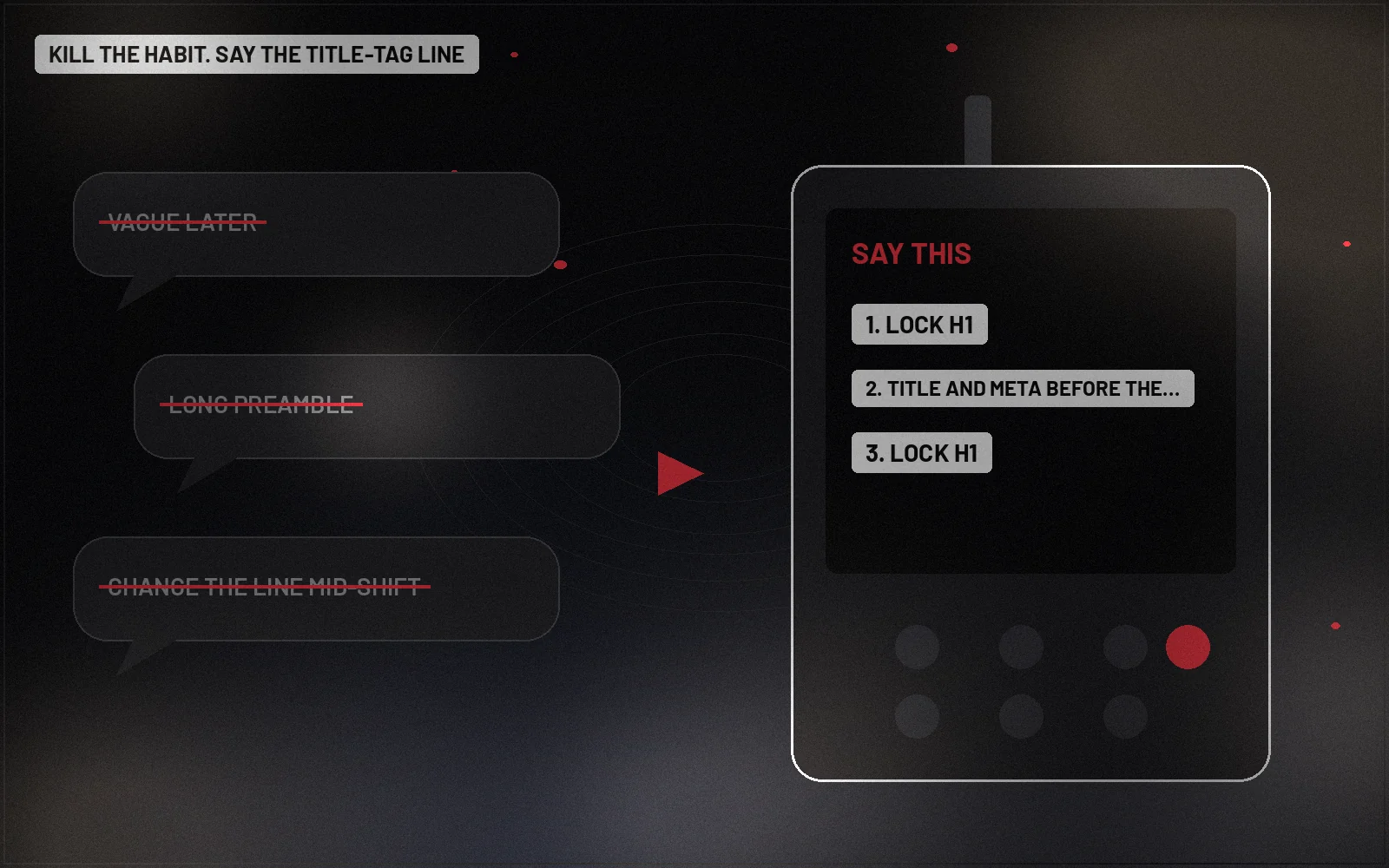
Kill: “Neuwark Communications: Title-Tag English APAC for Night Desks.” Say: “Title-Tag English APAC: Lock H1, Title and Meta.”
Brand can live after the pipe if there is room. Brand should not eat the query.
What does a good meta actually do?
It answers the click test: would a tired organizer open this instead of the government PDF?
A meta that restates the title is wasted. A meta that sells the agency is ignored. A meta that names the object (the SMS, the FAQ block, the holding page) gets the click from the person who has to write that object tonight. The rule we pin above the desk: the meta names the object.
Kill: “We help campaigns communicate with impact across the Philippines and Singapore.” Say: “Paste-ready title, H1 and meta lines. One claim. One proof word. A length a phone can finish.”
Proof words that travel in this series: paste, lock, kill list, screenshot, night desk, field card. If your meta has none of those, you wrote a brochure.
How do SEO and GEO share the same title tag English APAC teams write?
SEO is the blue link. GEO is the sentence an answer engine lifts.
They want the same spine. If the title is vague, the model has nothing clean to cite. If the title is a slogan, the model rewrites you into mush.
GEO does not need a different title. It needs a title that is already a citeable sentence. Our English spine for multilingual GEO makes the same point about the answer sentence under every translation.
Kill: “Everything you need to know about campaign SEO in 2026.” Say: “Title-tag English APAC desks lock before publish: claim, place, proof word.”
The year is optional. The place is required when the law or the audience is local. “APAC” is a market. “PH” or “Singapore” is a query. Pick the one the searcher types.
What do you check on a Monday scrape?
Open the live Insights index. For each new URL, read the title tag in the browser tab, not the H1 on the page.
If the tab title and the H1 argue, fix the tab first. Search results show the tab. Humans meet the H1. They should be cousins, not strangers.
Then search the exact title in quotes. If a partner reprinted you with a different title and no canonical, you now have two arguments for one piece. That is a GEO leak. An answer engine can blend the two versions into one vague summary.
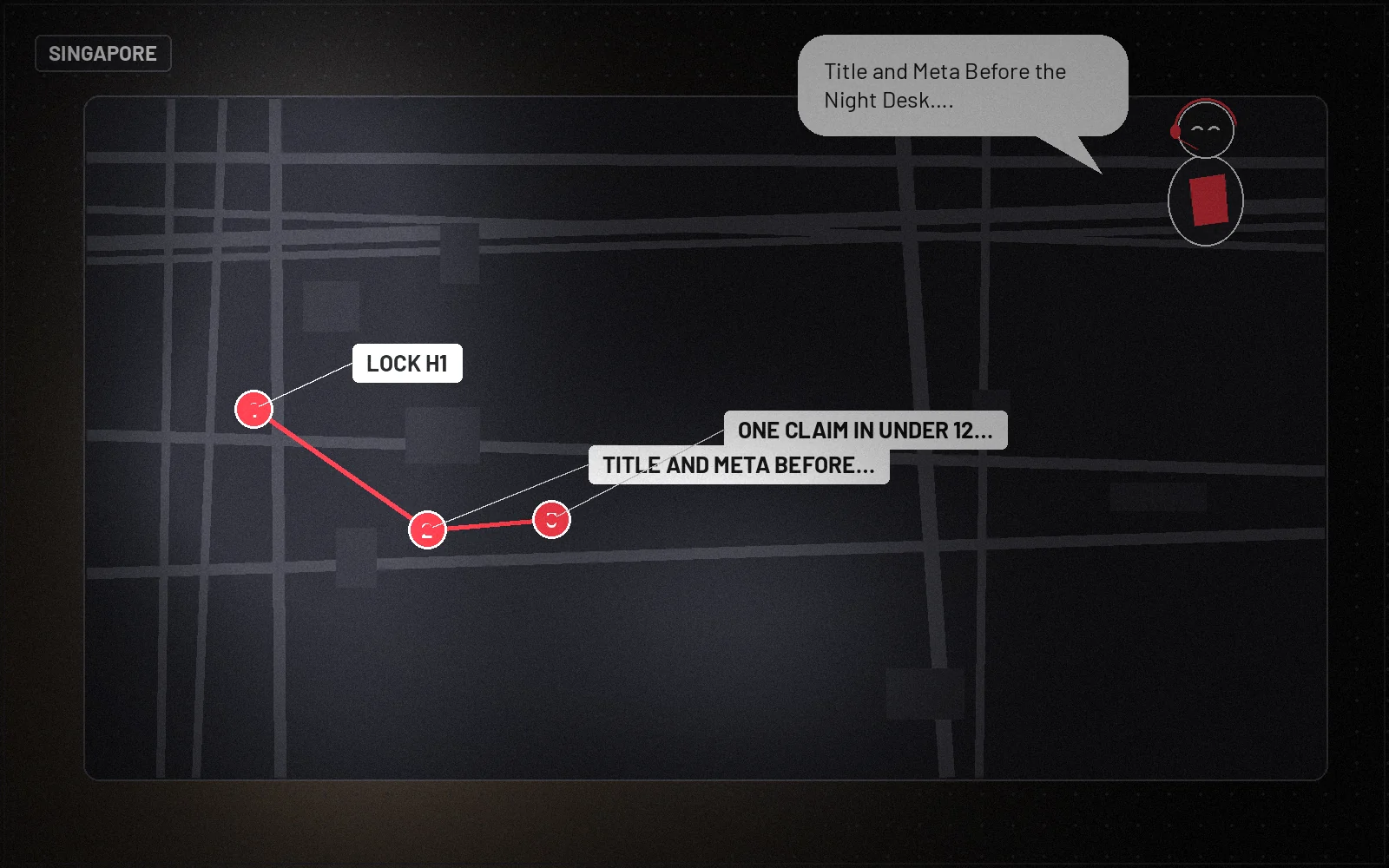
Monday field kit
- One claim in under 12 words.
- Place only if the query needs it.
- Title short enough for a phone, about sixty characters.
- Meta 140 to 160 characters with one proof word and one object.
- Slug in the searcher’s English, not the speechwriter’s English.
- H1 matches the claim. It may add a subtitle. It may not change the fight.
- No brand-first titles except on the homepage and the contact page.
Paste-ready comment for the CMS:
Lock check: title starts with claim. H1 cousins the title. Meta names the object. Slug is the query. Ship or wait.
FAQs
What is title tag English APAC teams should lock?
One claim, an optional place, one proof word, and a phone-length title. The H1, title and meta share the claim; they do not take turns inventing a new one.
Can the H1 be more interesting than the title?
It can be more human. It cannot be a different promise. If the title is about title tags and the H1 is about “winning the narrative,” you wrote a homepage.
Do we put 2026 in every title?
Only when the query includes the year or the statute year matters. Recurring playbooks age faster when the year is the hook.
Should every Insights post include “English” in the title?
Yes when the post is a language companion with paste-ready lines, kill lists and field cards. No when the post is a situation report. Do not force the series word onto a news wrap.
What if Rank Math says the SEO score is red?
Read the fields, not the score. A green score on a slogan is still a slogan.
What to do this week
Pick five live Insights URLs. Write the current title, H1 and meta in a three-column sheet. Mark every row where the claim changes between columns. Fix those five before you draft a sixth post.
Neuwark Communications writes title locks and page English under Digital & Social and Strategy & Messaging. If your night desk ships pages with unlocked titles, talk to us at Contact. More language locks live in Insights.
Related: GEO content engines for answer-engine inbound · Paid search landing English · GEO FAQ answer English · English spine for multilingual GEO