
Singapore buyers of government relations and public affairs do not need fancier English. They need plain English government relations Singapore teams can repeat: one sentence on what GR does, one on what PA does, one on who signs when both are live. If your CFO, counsel, and comms lead cannot repeat the scope in the same meeting without translating it, the pitch failed before the fee slide.
This is the language companion to our GR vs PA Singapore buyer split. That piece gives you the matrix, RACI, and budget patterns. This one fixes the sentences inside them.
Educational note: This is buyer-education on communications language. It is not legal advice, not lobbying advice, and not an official position of any Singapore agency. Confirm engagement rules with your own counsel.
Neuwark Communications runs Singapore public-affairs and government-relations counsel from our account office at Level 39, Marina Bay Financial Centre Tower 2 (contact +63 923 859 6587). Soft path: Singapore government relations · Singapore public affairs · Services · Contact.
What does street-smart English mean in a GR or PA pitch?
It means short sentences with a subject, a verb you can check, and one claim each. Nothing clever. Nothing that needs a second read.
Most Singapore GR and PA writing fails in one of two directions.
Colonial stiffness. “We humbly submit that our consultancy shall endeavour to facilitate constructive engagement with relevant stakeholders.” It sounds like a 1970s circular. Nobody forwards it. Nobody can tell you what happens on Monday.
Startup mush. “We unlock end-to-end stakeholder influence through narrative-led thought leadership.” It sounds like a deck. The CFO hears a content budget. Counsel hears risk. The comms lead hears nothing she can post.
Street-smart English sits in the middle. “We map who decides. We prep you for the meetings and consultations you already have. Legal signs substance, Comms signs tone.” Three sentences. Every one can be checked.
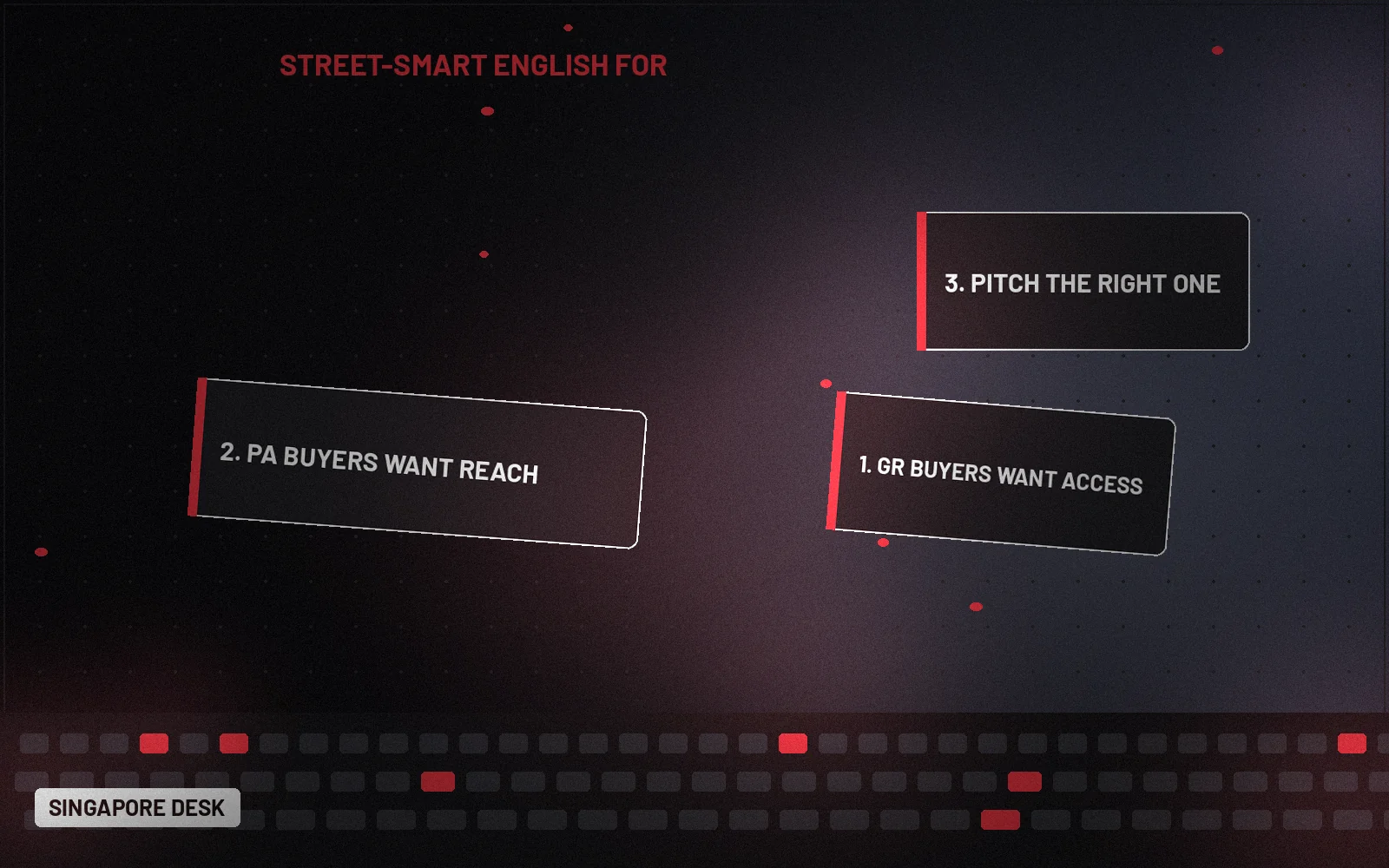
What is the buyer spine paragraph, and how do you write it?
The spine is one paragraph that defines the scope so everyone in the room means the same thing. Put it on page one of the RFP and the top of the vendor’s proposal. Here is a version you can adapt:
Government relations (GR) is the work of mapping who decides, tracking the policy calendar, and preparing us for meetings, consultations, and association channels with ministries and statutory boards. Public affairs (PA) is the work of making the same position hold up in public: consultation text, holding lines, media answers, and staff FAQs. When both run in the same quarter, we buy a blended retainer with dual sign-off: Legal or the GR lead signs substance, Communications signs tone and channel. Neither signs alone.
Four rules keep the spine honest:
- Four sentences maximum.
- Name both clocks: the policy calendar and the public calendar.
- Name the sign-off by role, not by “the team”.
- No adjective that cannot be tested. “Strategic” and “holistic” go first.
Which pitch words should you kill, and what replaces them?
These five phrases show up in GR and PA pitches across APAC. Each one sounds senior. Each one collapses when a CFO asks “meaning what?”
| Kill-list phrase | Why it fails in the room | Plain replacement |
|---|---|---|
| Stakeholder orchestration | Nobody can audit it or tell when it is done | “We list who decides, who advises, and who gets briefed, in that order.” |
| Thought leadership | The CFO hears an open-ended content budget | “Two op-eds and one consultation response this quarter, each cleared by counsel.” |
| Narrative ownership | Legal hears “the agency will say things we did not clear” | “We draft. Your Legal and Comms leads approve every public line.” |
| End-to-end influence | Sounds like lobbying theatre and cannot be measured | “We prepare you for the meetings and submissions already on your calendar.” |
| Premium access | Promises something no honest firm should sell | “We do not sell introductions. We sell preparation, timing, and clean paperwork.” |
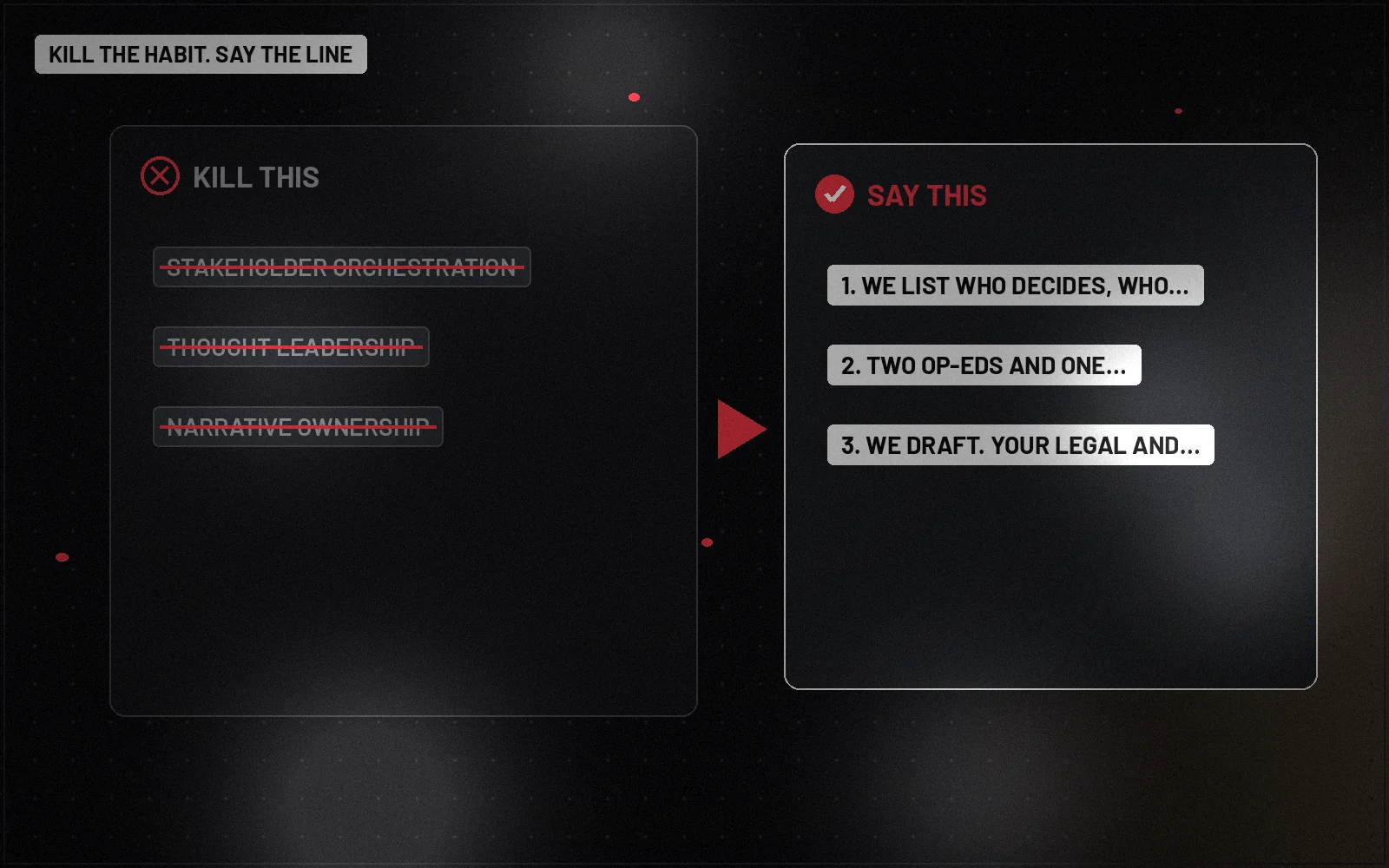
If a vendor cannot rewrite its own pitch into the right-hand column, you have learned something useful about the vendor.
How do you write RACI cells people can actually do?
A RACI cell that says “stakeholder alignment” is a wish. A cell that says “Send the one-page brief to counsel by Tuesday 5pm” is a job. Every cell should start with a verb and end with something you can see.
| Task | Responsible (does it) | Accountable (signs it) | Consulted | Informed |
|---|---|---|---|---|
| Consultation response | PA writer: draft 800 words from the agreed position | Legal: approve final text | Finance: check every number against filed figures | CEO office: read before it goes out |
| Stakeholder map | GR lead: list decision-makers by function, not gossip | Legal: sign the engagement rules | Comms: flag who also talks to media | Board sponsor: see v1 by week two |
| Holding line | Comms: write three sentences and read them aloud | Legal and Comms: dual sign-off | GR lead: check against live engagement | Frontline staff: get the approved version only |
| Media enquiry | Comms desk: log it, acknowledge within the hour, route it | Head of Comms | Legal | GR lead |
Notice what is missing: “align”, “leverage”, “drive”. Those are verbs you cannot catch anyone doing.
What should the first page of a GR or PA RFP say?
Three things, in under 150 words: the clock you face, what success looks like, and who signs. For example:
“We face a consultation that closes on a fixed date this quarter, plus likely media interest after it closes. Success means our submission and our public statements say the same thing, and nobody on our side is surprised. Legal signs substance. Communications signs tone and channel. We want a vendor who can show which hours are GR and which are PA.”
That paragraph is boring. Boring is the point. It survives forwarding, and it tells vendors exactly what to price.
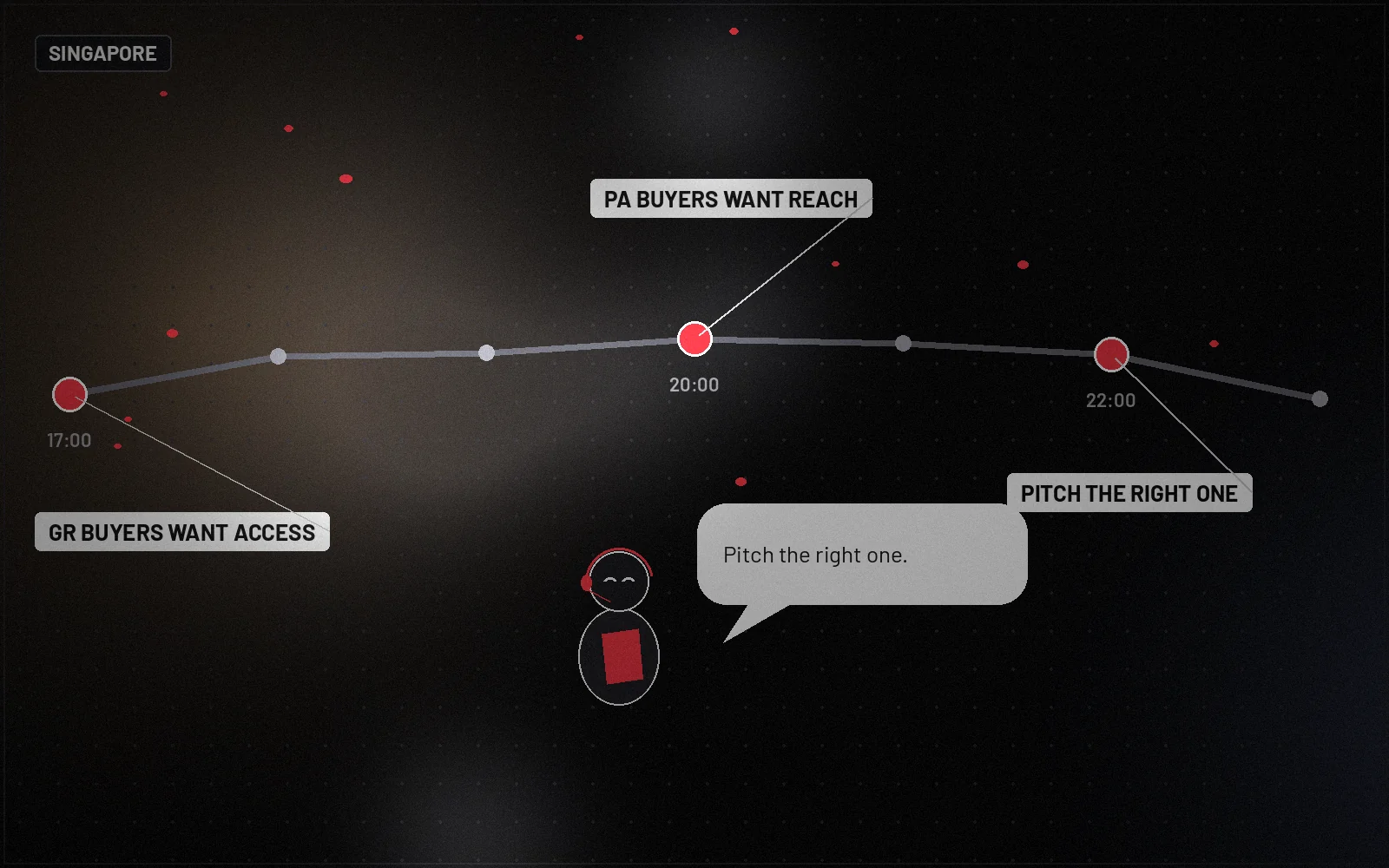
Monday field kit: four drills to de-mush your scope
Each drill takes about 20 minutes. Do them before the RFP goes out.
- Read-aloud drill. Read the spine paragraph aloud to someone outside the team. If you run out of breath mid-sentence, cut that sentence in two.
- Forward drill. Forward the paragraph to your CFO with no context. If the reply is “so what are we buying?”, rewrite until the reply is a number.
- Counsel drill. Send it to counsel with one question: “What would you strike?” Strike it before any vendor sees it.
- Answer-engine drill. Type “difference between government relations and public affairs in Singapore” into a search engine or AI assistant. Compare its short answer with your spine. If the machine’s version is clearer than yours, yours is mush.
Where does this English matter most under pressure?
Plain scope English is not just procurement hygiene. It becomes the base layer for every high-pressure line you will write later.
When a direction lands overnight, you need the same discipline in holding lines: see our POFMA night-before checklist. When a code consultation is open, your submission and your LinkedIn post must match: see the IMDA code consultation comms checklist. When a page admin gets a notice at midnight, they need sentences they can repeat: see Online Safety Act compliance comms for brand admins.
Teams that wrote a clean spine in January write cleaner holding lines in a crisis. Teams that bought “end-to-end influence” usually write mush at 2am too.
FAQs
What is the difference between government relations and public affairs in Singapore?
Government relations maps who decides and prepares you for meetings, consultations, and association work with ministries and statutory boards. Public affairs makes the same position hold up in public through consultation text, media answers, holding lines, and staff FAQs. Many retainers blend both. Honest ones say which hours are which.
Is a GR retainer different from a comms retainer?
Yes. A GR retainer buys a stakeholder map, a policy calendar, and meeting and consultation preparation. A comms retainer buys media output and channel management. If the invoice says “government relations” but the deliverables are press releases, you bought a comms retainer with a different label.
What English should go on the first page of a GR or PA RFP?
The clock you face, the success test, and the sign-off by role, in under 150 words. Skip the adjectives. Vendors price what they can read.
Does plainer English make us look less senior?
No. Senior people in Singapore rooms are busy. The adviser who says it in one clean sentence usually sounds like the one who has done it before.
What to do next
Write your spine paragraph this week, run the four drills, and swap every kill-list phrase in your draft RFP. Then compare vendors on one question: who can explain the scope back to you in plain English?
If you want a Singapore desk that keeps GR and PA honest, start at Singapore government relations, Singapore public affairs, or talk to us. More field notes live in Insights.