
Procurement briefs in Singapore often ask for a government relations consultancy Singapore retainer and a public affairs agency Singapore programme in the same sentence. Those labels overlap in agency decks. Inside a buyer organisation they must not. If Legal budgets for regulator engagement while Corporate Communications budgets for narrative and consultation writing, a fuzzy RFP produces two invoices for one confused scope—or one thin retainer that fails both clocks.
This article gives buyers a plain-English split: what government relations usually owns, what public affairs usually owns, where they must share a war room, and a RACI-style matrix you can paste into an RFP. It is written for commercial investigation, not for title inflation.
Educational note (YMYL): This is buyer-education for communications and corporate affairs. It is not legal advice, not lobbying advice, and not an official position of any Singapore ministry, statutory board, or competent authority. Engagement rules, disclosure duties, and consultation windows change—confirm live instruments and your counsel’s reading before you brief leadership or sign a scope.
Neuwark Communications runs Singapore public-affairs and government-relations counsel from our account office at Level 39, Marina Bay Financial Centre Tower 2, 10 Marina Boulevard, Singapore 018983 (contact +63 923 859 6587). Soft path: Singapore government relations · Singapore public affairs · Public affairs · Crisis rapid response · Contact. Related reading: IMDA code consultation comms checklist, POFMA directions night-before checklist, Online Safety Act compliance communications for brand admins.
Direct answer: how buyers should split the two labels
| Label buyers hear | Practical Singapore meaning | Typical owner inside the company | Typical artefacts |
|---|---|---|---|
| Government relations (GR) / government affairs | Narrower track: policy monitoring, regulator and ministry engagement design, association channels, issue calendars tied to governmental decisions | Corporate affairs / GR lead (often beside Legal / Compliance) | Stakeholder map of decision-makers; meeting briefs; association positioning; issue trackers; escalation ladders to counsel |
| Public affairs (PA) | Broader track: policy literacy plus narrative, consultation responses, media/stakeholder communications, employee FAQ when policy becomes public | Corporate communications / PA lead | Holding lines, Q&A, consultation drafts, media fences, narrative packs that survive scrutiny |
| Blended retainer | One senior counsel desk covering both when the calendar is continuous | Dual-signoff (Comms + Legal/GR) | Weekly triage + shared RACI; still name which hours are GR vs PA |
In short: government relations Singapore work is about who decides and how you engage them without theatre. Public affairs Singapore work is about how the same policy story holds with the public, partners, media, and staff. Many government relations consultancy Singapore retainers quietly include PA hours; honest scopes say so up front. Neuwark’s own Singapore hub frames the same split: PA covers the broader narrative field; GR focuses more tightly on government and statutory stakeholders (Singapore public affairs).
Who this is for / who should skip
| Use this split | Skip or hand off |
|---|---|
| Procurement, corporate affairs, or Comms leads writing an en-SG RFP for GR, PA, or both | Teams shopping for “access theatre,” named introductions as the product, or competitor-bashing |
| Regional HQ teams entering Singapore who need one shared vocabulary with Legal | Anyone seeking case outcomes, lobbying guarantees, or political-donation strategy—those are counsel / compliance tracks |
| Boards that must approve two budgets and want to know what each buys | Pure brand PR pitches with no policy calendar (use a media retainer, not a GR label) |
Why the labels blur in Singapore (and why buyers still need the split)
Singapore does not run a US-style public lobbyist registration system for ordinary commercial advocacy. That absence of a single “lobbyist licence” label is exactly why agency language drifts: almost everything can be called public affairs, government affairs, or government relations without a statutory title forcing a bright line.
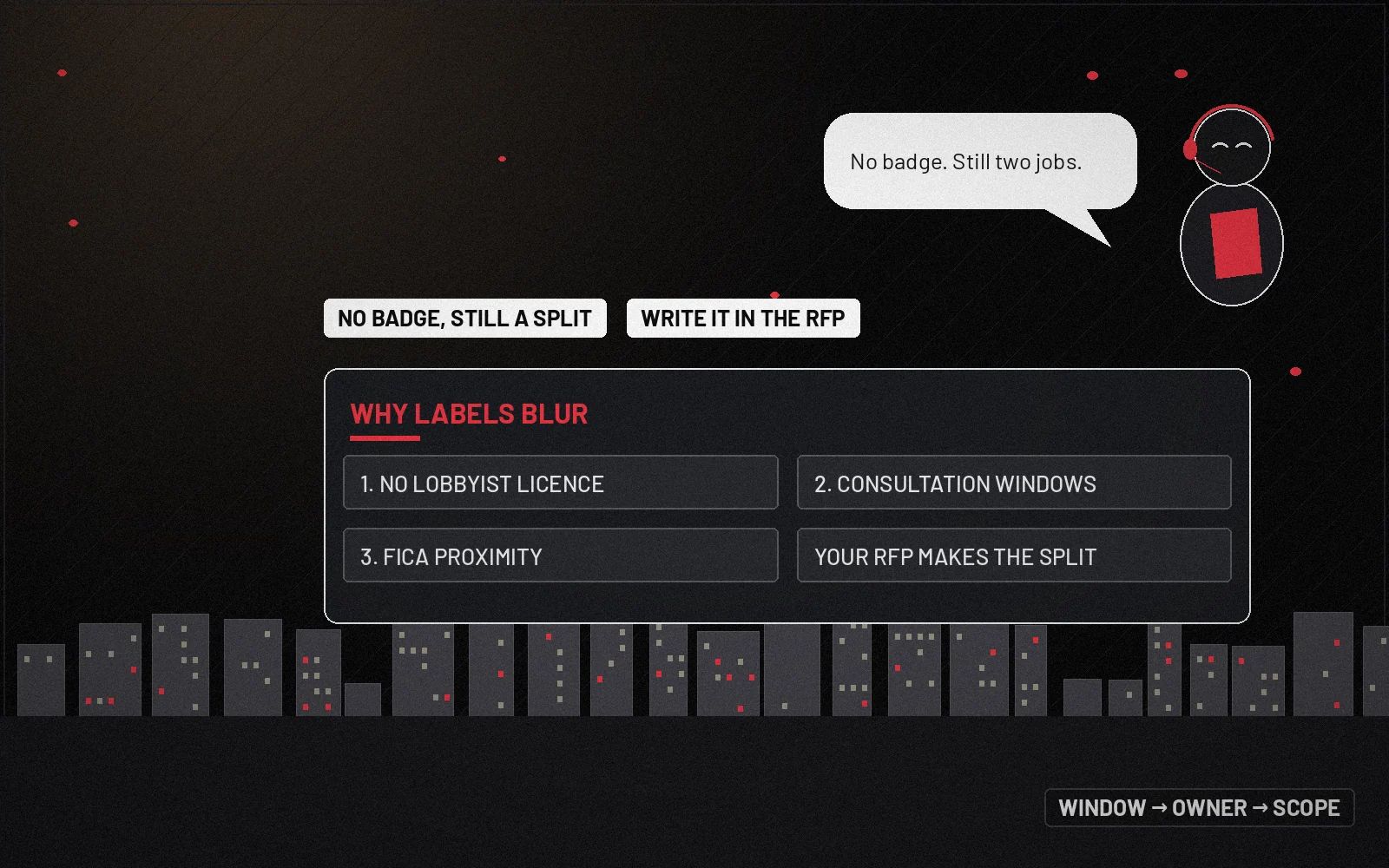
What does exist is a dense engagement environment buyers must respect:
- 1. Formal public consultations on bills, codes, and instruments—typically posted by ministries and statutory boards, often mirrored on the Government’s REACH feedback channels. Example shape: MOF’s public consultation on the proposed Finance (Income Taxes) Bill 2026 (feedback window stated in the release: 8 June to 1 July 2026), with documents on MOF and REACH portals.
- 2. Sector consultations with short softcopy windows—e.g. MDDI and IMDA’s public consultation on the draft Digital Infrastructure Bill (submissions due no later than 22 July 2026, 10am, softcopy only, per the release).
- 3. Foreign-interference countermeasures under the Foreign Interference (Countermeasures) Act 2021 (FICA), which defines activity directed towards political ends and influencing Singapore governmental decisions. FICA is not a corporate GR licensing scheme; it is a foreign-interference statute. Buyers still need counsel when foreign principals, politically significant persons, or political ends sit near a brief. Political-donation / PSP transparency sits with competent authorities such as the Registry of Foreign and Political Disclosures / ELD political donations materials—not with a communications retainer.
OECD summaries of Singapore’s good regulatory practices also describe REACH as a standing channel for consultation papers and feedback summaries after exercises (see OECD — Singapore GRP chapter). Use that as process literacy, not as a promise that every agency will always publish every summary on the same clock.
Buyer implication: without a statutory lobbyist badge, your RFP must invent the split. If you do not, vendors will fill the silence with the broadest label that wins the pitch.
Original element 1 — GR vs PA comparison matrix (Singapore buyer view)
Paste this into a scoping memo. Fill the “your case” column before you issue an RFP.
| Dimension | Government relations track | Public affairs track | Blended when… |
|---|---|---|---|
| Primary audience | Ministries, statutory boards, regulators, industry associations that sit next to decision-makers | Same policy stakeholders plus media, partners, employees, customer communities, NGOs | Issue will go public while engagement is still live |
| Success metric | Decision-process clarity: wrong doors avoided; counsel-aligned engagement; consultation/meeting readiness | Narrative durability: holding lines survive second questions; consultation text matches public story | Board needs one scorecard covering both |
| Core artefacts | Stakeholder map (functions, not gossip); issue calendar; meeting/association briefs; escalation to Legal | Holding lines, FAQ, consultation response draft, media fence, kill list for risky claims | Shared intake funnel + dual review |
| Clock type | Policy / licensing / association calendars; quiet windows before public noise | Consultation close dates; media cycles; employee rumour cycles | Both clocks open in the same fortnight |
| What it is not | Guaranteed access, unofficial “relationships,” or legal opinions | Slogan fog, unverified stats, or replacing counsel on statutory meaning | A single junior account manager owning Legal and media without senior dual-signoff |
| Typical budget home | Corporate affairs / GR / sometimes Legal ops | Corporate communications / PA / brand-comms ops | Split line items even under one vendor |
| Failure mode | Meeting without a counsel-cleared ask; association letter that contradicts Legal | Public line that over-promises what an engagement can deliver | Two vendors contradicting each other in the same week |
Worked example (anonymised pattern — not a case study)
A regional platform faces a code consultation and, two weeks later, a journalist asking what the company “told the regulator.”
- GR track alone: maps IMDA/MDDI decision points, drafts association input with Legal, books internal prep for any formal engagement. Stops short of media lines.
- PA track alone: drafts public FAQ and consultation narrative; may under-weight who actually decides and what counsel will allow in writing.
- Split done right: GR owns the decision map and engagement hygiene; PA owns the external narrative and consultation prose; Legal signs both; one kill list bans inventing “we have been assured…” language.
That is the commercial investigation answer to “do we need a government relations consultancy Singapore desk or a public affairs agency Singapore desk?”—often both, named separately.
Original element 2 — RACI-style role split for the first 90 days
Use Responsible / Accountable / Consulted / Informed. Adjust titles to your org chart; do not outsource Accountability to a vendor.
| Workstream (first 90 days) | In-house GR / Corporate affairs | In-house Comms / PA | Legal / Compliance | External GR/PA counsel | CEO / leadership office |
|---|---|---|---|---|---|
| Policy & consultation calendar | R | C | C | C | I |
| Stakeholder map (gov / statutory / association) | A/R | C | C | R (draft) | I |
| Formal engagement briefs / meeting prep | R | C | A (substance) | R (comms craft) | I |
| Consultation response drafting | C | R | A (legal substance) | R (structure/writing) | I |
| Public holding lines & media fence | C | A/R | C | R (draft) | A (who speaks) |
| Employee / partner FAQ on policy issues | C | A/R | C | C | I |
| Crisis / direction / notice intake (POFMA, OSC, code breach claims) | C | R (comms ops) | A | C | A (voice) |
| Vendor scope & invoice coding (GR vs PA hours) | A | A | C | I | I |
How to read this: if Legal is never Accountable on consultation substance, you are buying ghost-writing that can contradict filings. If Comms is never Accountable on holding lines, GR meetings will leak through founder posts. External counsel is rarely Accountable for statutory meaning—that stays in-house or with retained lawyers.
Original element 3 — buyer decision checklist (GR, PA, or blend)
Score each item Yes / Partial / No. Count Yes = 2, Partial = 1, No = 0.
Cluster A — lean GR-heavy
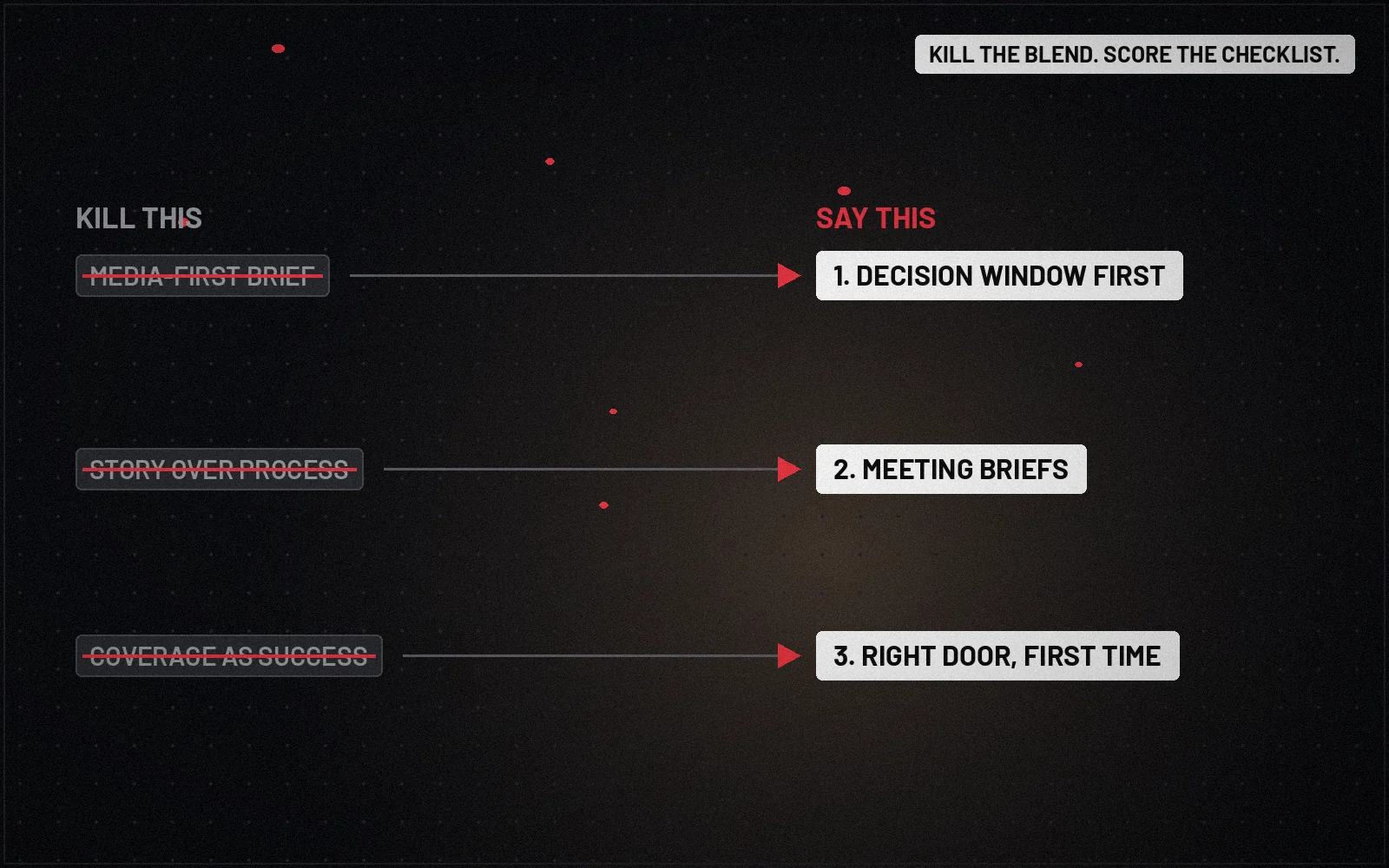
- 1. Your next 90 days are dominated by licensing, code, or ministry decision windows with little public noise yet.
- 2. You need a stakeholder map of functions (who decides / who influences) before any media programme.
- 3. Association or chamber channels are your primary engagement surface.
- 4. Legal wants meeting briefs and escalation ladders more than brand storytelling.
- 5. Success is “we did not walk into the wrong door,” not “we earned coverage.”
Cluster B — lean PA-heavy
- 1. A consultation or bill is already public (or about to be), and you must publish a coherent company narrative.
- 2. Journalists, partners, or employees will ask what you submitted or believe.
- 3. You need holding lines, FAQ, and a kill list for unverified claims.
- 4. Brand and policy language must stay identical across LinkedIn, IR, and consultation text.
- 5. Success is “our story survives a second question,” not “we booked five meetings.”
Cluster C — force a blend
- 1. Both a quiet engagement track and a public narrative track are live in the same quarter.
- 2. You already saw contradiction risk between Legal letters and Comms posts.
- 3. A direction, notice, or online-safety / falsehoods instrument could hit brand surfaces while GR talks continue (see related packs on POFMA and Online Safety Act brand admins).
- 4. Procurement must show two line items even if one vendor delivers both.
- 5. Board reporting needs one RACI, not two vendor decks.
Scoring rule of thumb
| Pattern | What to buy |
|---|---|
| Cluster A ≥ 8 and Cluster B ≤ 4 | GR-primary retainer; light PA on call |
| Cluster B ≥ 8 and Cluster A ≤ 4 | PA-primary programme; GR as map + counsel hours |
| Cluster C ≥ 6 or (A and B both ≥ 6) | Named blend with separate hour pools and dual-signoff |
| All clusters ≤ 4 | Do not buy a GR/PA label yet—fix the policy calendar and Legal owner first |
How Singapore engagement surfaces map to GR vs PA hours
Buyers waste money when every surface is billed as “government relations.” Map the surface to the track:
| Surface | Usually GR-coded | Usually PA-coded | Dual-review required? |
|---|---|---|---|
| Ministry / statutory board consultation portal submission | Structure with GR map | Prose + public consistency | Yes — Legal A on substance |
| REACH / public feedback channels | Awareness in calendar | Public narrative alignment | Yes when org-branded |
| Industry association working group | Primary GR | Messaging pack if public | Often |
| Bilateral regulator engagement (counsel present) | Primary GR | Holding lines if outcome becomes public | Always with Legal |
| Media interview on the same issue | Rarely | Primary PA | Always |
| Employee town hall on regulatory change | Context from GR | Primary PA | Legal C |
| Crisis / correction / direction response | Stakeholder ladder | Comms ops + fence | Always — see crisis desk |
For consultation craft patterns specific to IMDA-style code windows, use the IMDA code consultation communications checklist. For overnight direction readiness, use the POFMA and Online Safety packs linked above—not a generic GR pitch deck.
Mistakes Singapore buyers make when they confuse the scopes
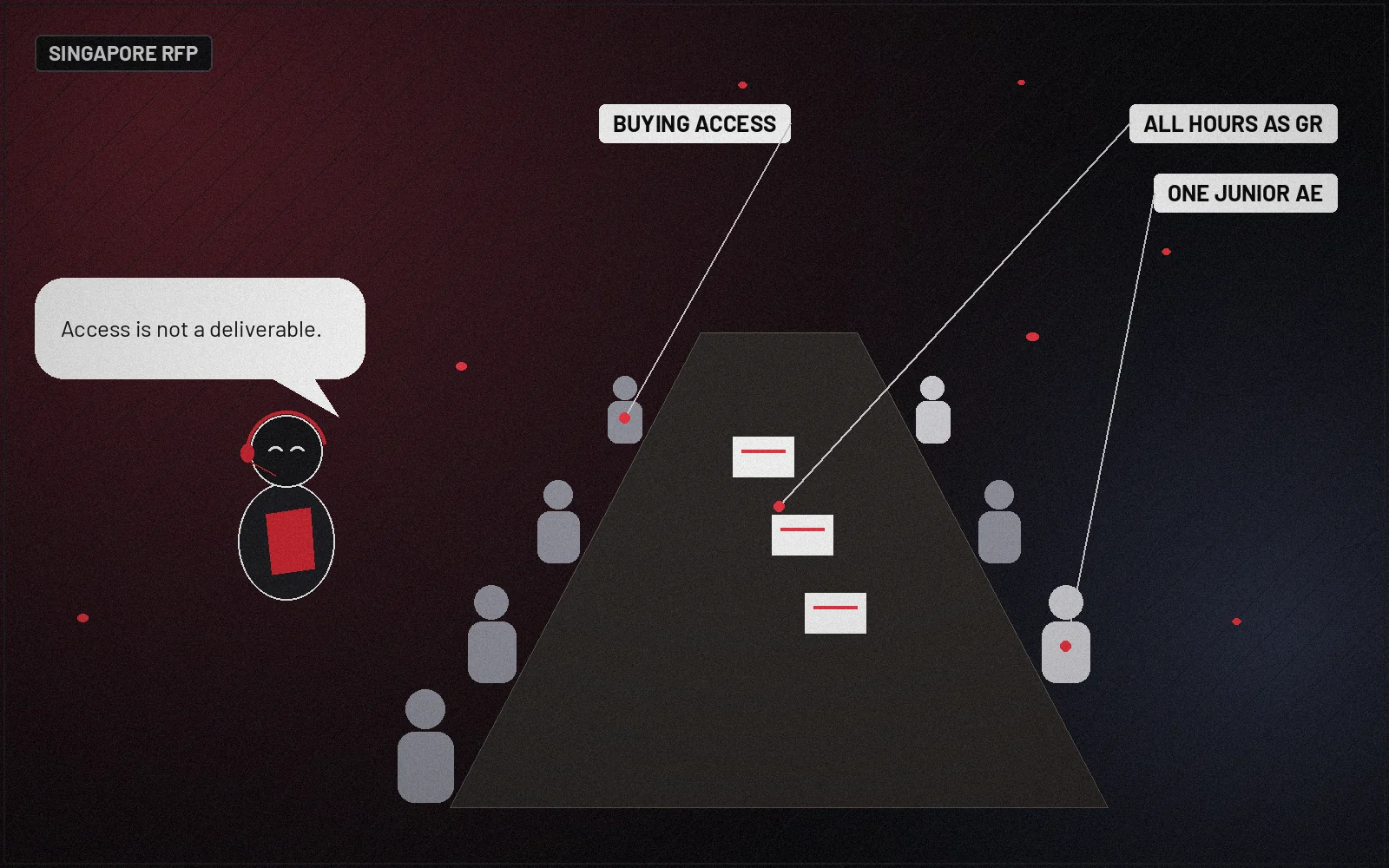
- 1. Buying “access” as a deliverable. Singapore buyers who cannot name a decision window and a Legal owner are not ready for a GR retainer. Access theatre is not a scope line.
- 2. Letting one junior AE own Legal substance and media tone. That is how consultation language and LinkedIn posts diverge.
- 3. Coding all hours as government relations to impress the board. Boards that later ask for media outcomes will find the invoice dishonest. Split the codes.
- 4. Ignoring FICA proximity when foreign principals sit in the brief. FICA is about foreign interference countermeasures (SSO — FICA); it is not a GR product. Escalate to counsel early; do not ask a PA writer to “handle FICA.”
- 5. Skipping dual review on anything that paraphrases an Act, code, or Direction. Neuwark’s Singapore PA practice treats dual review as hygiene, not optional polish (Singapore public affairs).
- 6. Starting media before the stakeholder map exists. You then educate the wrong audience first.
- 7. Treating consultation close dates as “approx.” Softcopy-only windows with hard timestamps (see MDDI/IMDA Digital Infrastructure Bill consultation timing above) punish approximate project plans.
- 8. Asking GR counsel for guaranteed policy outcomes. Educational retainers sell clarity, sequencing, and durable narrative—not votes, licences, or unpublished assurances.
Budget split patterns (no invented fee tables)
We do not publish invented Singapore day-rates here. Use hour pools and artefact gates instead:
| Pattern | GR hour pool focus | PA hour pool focus | Gate before month-2 fees |
|---|---|---|---|
| Market entry, quiet | Stakeholder map v1; association landscape; issue calendar | Thin—holding lines only if asked | Map + Legal sign-off on engagement rules |
| Active consultation | Decision map; association alignment | Consultation draft + FAQ + media fence | Dual-reviewed submission pack |
| Post-instrument / scrutiny | Escalation ladder; regulator Q prep | Narrative repair; employee FAQ; kill list | Single external voice list from leadership |
| Continuous regulated sector | Weekly GR triage | Weekly PA triage | Shared RACI reviewed quarterly |
If a vendor cannot show which artefacts sit in which pool, you are buying a slogan, not a government relations consultancy Singapore or public affairs Singapore programme.
FAQs buyers actually ask
Is government relations the same as lobbying in Singapore?
Not as a single licensed title. In buyer language, GR is the engagement-and-policy track with government and statutory stakeholders. “Lobbying” in overseas statutes often means a defined, discloseable activity. In Singapore, focus on the activity, counsel’s reading of applicable law (including any FICA proximity), and consultation/meeting hygiene—not on importing a US lobbyist badge into your RFP.
Can one agency deliver both GR and PA?
Yes, if the scope names both hour pools, dual-signoff, and artefacts. Many Singapore retainers are dual-purpose. The failure mode is one blended invoice with no RACI.
Where does crisis communications sit?
Crisis ops (directions, notices, sudden scrutiny) usually sit in the PA/comms war room with Legal accountable for instrument reading—see crisis rapid response. GR still owns the stakeholder ladder so you do not freelance engagement during a live instrument.
Do we need a Singapore phone number on the vendor?
Ask for a real operating model and accountable seniors. Neuwark’s Singapore account office is at MBFC Tower 2 Level 39; contact remains +63 923 859 6587. Do not invent local numbers in your own vendor scorecards.
What should the first 30 days produce?
A dated policy calendar, a function-level stakeholder map, a GR vs PA RACI, a kill list for unverified claims, and a named Legal dual-reviewer. If week four only produced a mood-board, renegotiate.
What to do next
Write three sentences before you send any RFP: (1) the decision window and close date you actually face, (2) whether success is engagement hygiene, narrative durability, or both, and (3) who inside your company is Accountable for Legal substance versus external voice. Then issue scope language that matches the matrices above—and link vendors to your live consultation artefacts, not to a generic “ASEAN government relations” slogan.
If you want a Singapore-first desk that keeps GR and PA labels honest, start from Singapore government relations, Singapore public affairs, or Contact.