
Singapore’s Online Safety (Relief and Accountability) Act 2025 (OSRAA) and the Online Safety Commission (OSC) began operating on 29 June 2026. Most corporate communications playbooks still treat this as a “platform problem.” That is how a regional brand wakes up to an OSC direction aimed at its Facebook page admins, or to an Online Harm Notice landing in a community manager’s inbox with no counsel, no kill list, and no holding line.
This is an Online Safety Act compliance communications Singapore operator pack for brand and public-affairs teams that administer pages, groups, forums, or community spaces used by people in Singapore. Primary framing comes from the joint MDDI–MinLaw release of 14 May 2026, the OSC launch release of 28 June 2026, MinLaw’s OSRAA overview (last updated 28 June 2026), and MinLaw’s duties of online platforms page (last updated 28 June 2026). Victim reporting routes are cross-checked against osc.gov.sg.
Educational note (YMYL): This is communications-ops guidance. It is not legal advice, not a substitute for Singapore counsel, and not an official position of the OSC, MDDI, MinLaw, or IMDA. Directions, notices, prescribed lists, and response windows change—confirm the live instrument and your counsel’s reading before you disable content, reply publicly, or brief leadership.
Neuwark Communications runs Singapore public-affairs and crisis drills from our account office at Level 39, Marina Bay Financial Centre Tower 2, 10 Marina Boulevard, Singapore 018983 (contact +63 923 859 6587). Soft path: Singapore public affairs · Crisis rapid response · Public affairs · Contact. Related reading: POFMA directions night-before checklist, IMDA code consultation comms checklist.
Why brand page admins sit inside OSRAA — not outside it
OSRAA creates three named actor classes. Directions from the Commissioner of Online Safety may go to any of them:
| Actor (OSRAA label) | Who this usually is for a brand | Why Comms owns surface control |
|---|---|---|
| Communicator | The person who posted the harmful material | Staff, agencies, or partners can become Communicators if they publish the harm |
| Administrator | People who create, set up, or administer an online location (page, group, forum, community space) | Brand page / group admins are squarely in scope when harmful content sits on spaces they run |
| Platform | Providers of services people use to post, share, view, or interact online | Your host platform may receive parallel notices; your admin team still owns brand-side response |
Sources: MDDI–MinLaw 14 May 2026; MinLaw OSRAA overview.
Statutory torts under OSRAA clarify duties for the same three classes. In the first operational phase, those torts apply to five harms (see below). Administrators must not set up or run spaces in a way that facilitates online harm, and must take reasonable measures when properly notified. Platforms must take reasonable steps after an Online Harm Notice. Communicators must not communicate or engage in the specified harms in Singapore. See the same MDDI–MinLaw releases and MinLaw’s platform-duties page.
If your brand speaks into Singapore (en-SG audiences, local staff, SG customer communities, or regional HQ narrative), treat page/group administration as a regulated surface, not a marketing side task.
Who this is for / who should skip
| Use this pack | Skip or hand off |
|---|---|
| Corporate comms / public affairs / community leads who admin brand pages, groups, forums, or employee communities used by people in Singapore | Purely overseas entities with no SG audiences, staff, or admin surfaces—still verify with counsel if Singapore users can join your spaces |
| Agencies coordinating holding lines across HQ, regional, and local social desks | Anyone seeking case outcomes, named company examples, guaranteed OSC decisions, or litigation strategy—those are not published here |
| Legal + Comms war rooms that need a shared vocabulary for OSC directions vs Online Harm Notices vs POHA | Teams that only need a one-line “we comply with all laws” boilerplate (too thin for admin-side clocks) |
First-phase harms (confirm before you brief)
From 29 June 2026, OSC operations and specified statutory tort provisions focus on five harms. The remaining categories are listed for progressive implementation. Descriptions below track official annex language; open the live OSC and MinLaw pages before you brief non-lawyers.
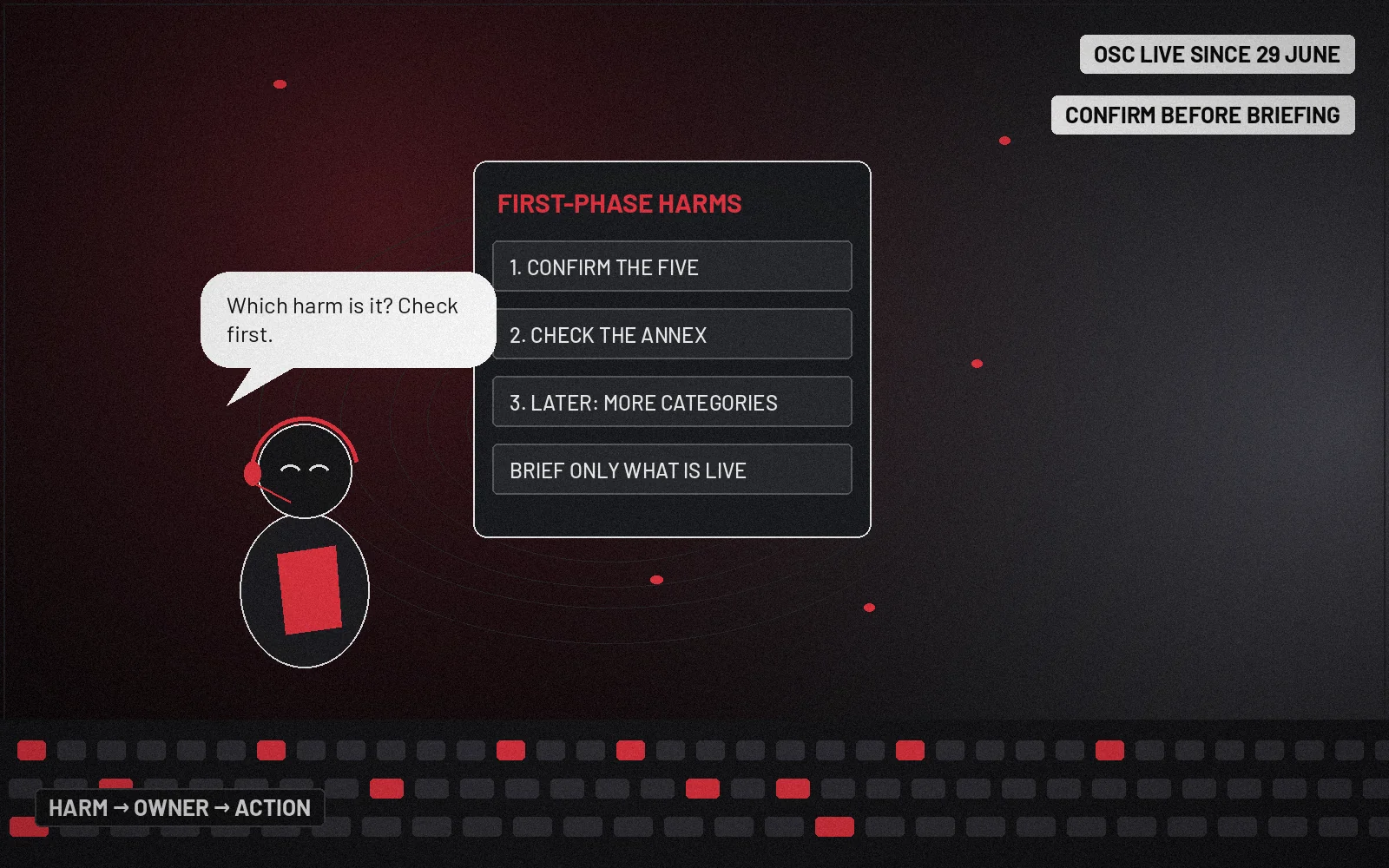
| Harm (first phase) | Official plain description (annex / OSC framing) | Comms note |
|---|---|---|
| Online harassment (including online sexual harassment) | Sharing threatening, abusive, insulting, sexual, or indecent material about a person, or sending such material to them online | Often arrives via brand comment threads and group chats |
| Doxxing | Sharing identity information online with the intention to cause harm | Employee doxxing can spill onto brand surfaces fast |
| Online stalking | Repeated unwanted contact attempts | Escalation paths must not restate victim details |
| Intimate image abuse | Sharing intimate images/videos of a person online without consent (including ads/offers); images may be real or generated | Highest sensitivity; no public “context” posts |
| Image-based child abuse | Sharing sexual, violent, or abusive images/videos of a child under 16 online (including ads/offers); may be real or generated | Immediate counsel + platform + OSC pathways; never amplify |
Sources: MDDI–MinLaw annex (14 May 2026); MinLaw annex PDF / OSC launch materials; osc.gov.sg.
Progressive-implementation categories named in the official annex include online impersonation, inauthentic material abuse, online instigation of disproportionate harm, incitement of violence, incitement of enmity, publication of false material, publication of statement harmful to reputation, and non-consensual disclosure of private information. Do not invent start dates for those rows—watch MDDI / MinLaw / OSC updates.
How victims reach OSC — and why your admin clock can start before you do
Official reporting guidance (MinLaw OSC launch, 28 June 2026):
- 1. Online harassment and online stalking: victims should first report to the platform. If the platform fails to respond promptly or provides an inadequate response within 24 hours, they may then file with the OSC.
- 2. Intimate image abuse, image-based child abuse, and doxxing: victims may report directly to the OSC via osc.gov.sg.
- 3. Reports via the OSC site require details of the harm (for example URLs, screenshots, images, videos). Parents/guardians may file for victims under 18. Another person may file with the victim’s written authorisation. No fee to report to the OSC.
- 4. OSC assesses reports. If there is reason to suspect online harm, the Commissioner may issue directions to Communicators, Administrators, or Platforms—for example to disable access to harmful content or restrict a perpetrator’s account. Non-compliance with a direction is a criminal offence (per the same launch release).
Separately, statutory torts can be triggered when a victim sends an Online Harm Notice in the prescribed form and manner to an Administrator or Platform. MinLaw hosts the form on its Online Safety site; some platforms may host a webform (MinLaw links those where applicable). See MinLaw OSC launch §§16–19 and platform duties.
Comms implication: your team may learn about a case from (a) an OSC direction, (b) an Online Harm Notice, (c) a platform ticket, or (d) a journalist/staff tip—often out of order. Build one intake funnel so Legal and Comms see the same artefact within minutes.
Original element: brand-admin Online Harm / OSC response pack
Below is the artefact pack we run when a Singapore-facing brand page or group may receive an OSC direction or Online Harm Notice. Steal the structure; fill every cell with counsel’s reading of the live instrument. No invented outcomes—only process.
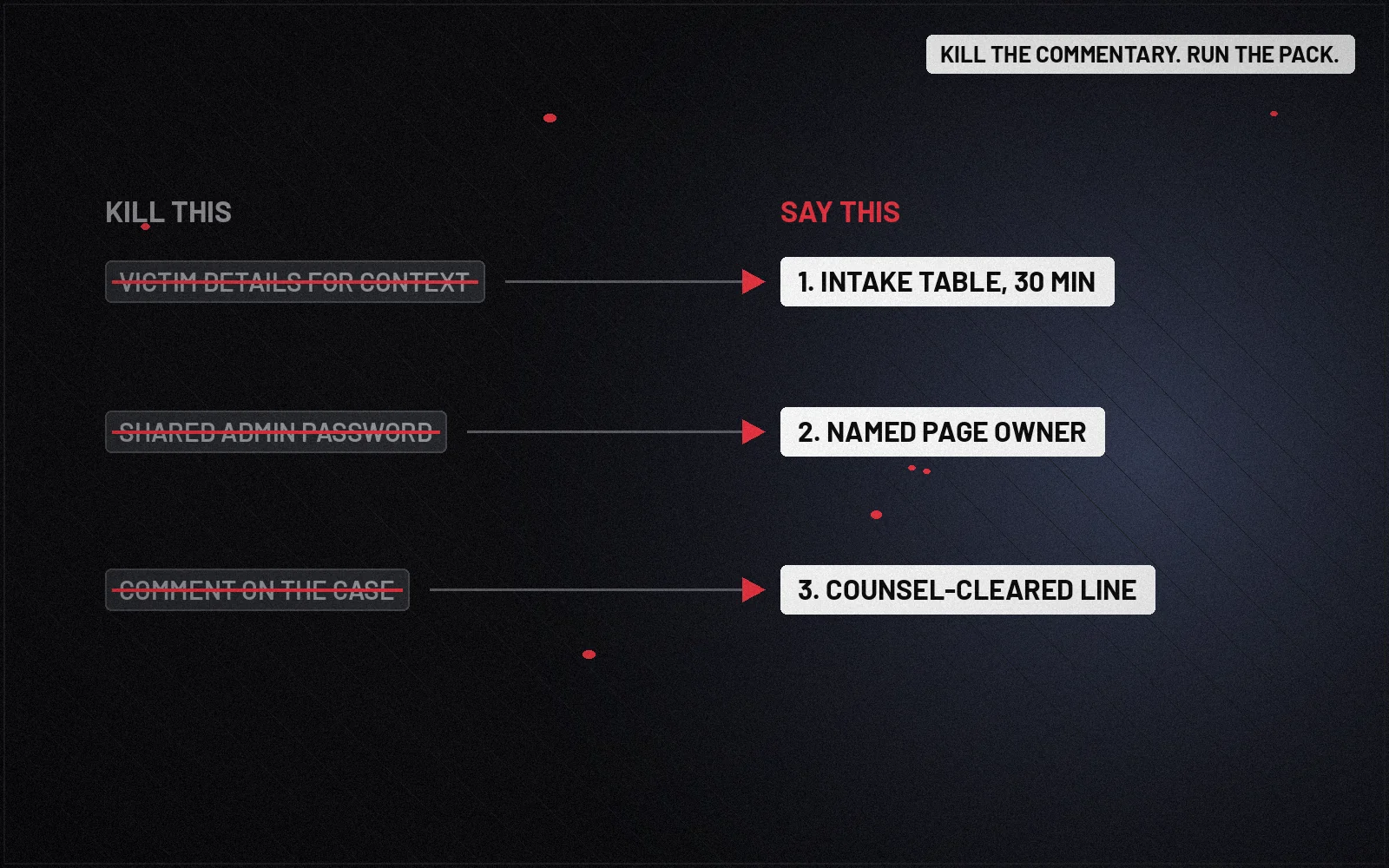
1) Intake classification table (first 30 minutes)
| Signal that arrives | Likely track | First 30-minute owner | Do not do |
|---|---|---|---|
| OSC direction naming your page/group admins | OSC compliance track | Legal + Comms war room lead | Argue the merits on social; rename admins to “hide” |
| Online Harm Notice (prescribed form) to admin inbox / page mail | Statutory-tort notice track | Legal triage + community lead | Delete the notice; reply casually from a personal account |
| Platform ticket / Trust & Safety flag only | Platform track (may precede OSC) | Community ops + Legal | Assume “platform handling” means brand silence forever |
| Journalist / activist tip with screenshots | Reputation track (may become OSC/tort) | Comms lead + Legal | Confirm victim identity details in public replies |
| Staff report that a comment thread “went nasty” | Pre-notice hygiene | Community lead | Leave thread unattended overnight |
2) Role matrix — first 6 hours
| Role | Owns in first 6 hours | Signs off | Must not dump onto others |
|---|---|---|---|
| Comms / Public affairs | Holding lines, employee FAQ, social kill list, media fence, stakeholder ladder timing | External narrative tone; what staff may say | “Legal will handle all talking” while brand replies stay live |
| Legal | Instrument / notice reading; privilege; compliance steps; reconsideration/appeal clocks if relevant | Any statement about what a direction or notice requires | Expecting Comms to invent a legal theory for a founder thread |
| Community / social ops | Admin roster lock; thread freeze; evidence capture (URLs, timestamps, screenshot set); disable access only as counsel directs | Channel kill execution | Soft-deleting evidence needed for counsel |
| Leadership / CEO office | Single external voice decision; resource lock | Final “who speaks” list | Live personal posts that restate alleged harm details |
| HR / People (if staff involved) | Internal welfare + workplace process handoff | Internal-only language | Public HR commentary on named individuals |
3) Channel inventory + kill list
Inventory (map before you need it): brand pages and groups on Meta properties; LinkedIn Company Page + employee advocacy; X / YouTube / TikTok / Telegram / WhatsApp communities; forums; support macros; partner co-admin accounts; agency contractor logins; scheduled posts; auto-replies.
Kill list (post where social calendars live):
- 1. Do not restate alleged victim identity details “for context” in any public or semi-public channel.
- 2. Do not publish founder clarifications that argue the merits of a live OSC or notice track.
- 3. Do not green-light influencer or partner posts that amplify the disputed material.
- 4. Do not let support macros paste alleged doxxing content into ticket replies.
- 5. Do not schedule thought-leadership that uses the live case as a hook.
- 6. Do not meme, subtweet, or “ratio” commentary about the OSC decision itself.
- 7. Do not promise outcomes, damages figures as predictions, or case comparisons in public posts.
- 8. Do not announce admin roster changes as a public “fix” narrative without counsel.
4) Decision framework — notice vs direction vs platform flag
Work this as a sequence, not a debate:
- 1. Capture the artefact (PDF/email/webform receipt) and lock privilege with counsel.
- 2. Classify actor class named (Communicator / Administrator / Platform) and harm category claimed.
- 3. Clock any stated compliance time on a direction; for Online Harm Notices to platforms, note MinLaw’s guidance that prescribed platforms face specified response windows of 6 hours (intimate image abuse or image-based child abuse involving exposed private parts), 24 hours (other intimate image / image-based child abuse forms), and 48 hours (all other covered online harms)—unless they show it was not reasonable to meet that window. Source: MinLaw — duties of online platforms. Brand admins are not those platforms, but your parallel brand-side actions should not lag while counsel reads.
- 4. Contain public surface (comments, shares, employee posts) without destroying evidence.
- 5. Comply with counsel-directed takedown / disable / account steps.
- 6. Communicate only after Legal clears: internal FAQ first, then external holding line if needed.
- 7. Calendar review rights if your counsel advises pursuing them: reconsideration applications to the Commissioner must be made no later than 14 days after the initial OSC decision; further appeal to the Online Safety Appeal Panel no later than 14 days after the reconsidered decision, with a $200 appeal application fee (per MinLaw OSC launch §§12).
5) Holding-line scaffold (fill with counsel — never invent facts)
Use as structure only:
- Acknowledge process, not guilt narrative: we take online safety duties seriously and are reviewing the matter with counsel.
- Confirm cooperation where accurate: we are engaging with the relevant processes and platforms as advised.
- Protect victims: we will not restate personal details or republish alleged harmful material.
- Point staff internally: employees should use the internal FAQ channel; do not comment on live cases.
- Close: further updates only if operationally necessary and counsel-cleared.
Never invent OSC findings, damages, or “we were cleared” language.
Prescribed platforms — what brand teams should know without overclaiming
MinLaw states that some platforms are prescribed for specified Online Harm Notice response times (list includes, among others, YouTube, Google Maps Reviews, Facebook, Instagram, Threads, WhatsApp, X, HardwareZone Forums, TikTok, Reddit, Telegram, and WeChat—confirm the live MinLaw list before briefing). Separately, six online service providers are prescribed for additional OSC obligations reflecting significant reach in Singapore (Facebook, Instagram, YouTube, X, TikTok, and HardwareZone Forums per MinLaw annex materials). Sources: platform duties page; OSC launch annex PDF.
Comms takeaway: if your brand community lives on a prescribed service, assume Trust & Safety and OSC pathways can move on statutory clocks even when your internal Slack cannot. Pre-map who among your admins receives platform mail.
Mistakes that turn a notice into a second crisis
- 1. Treating OSC like a PR complaint. Directions and criminal non-compliance risk are not “customer care tickets.”
- 2. Public case commentary. Restating alleged harassment or doxxing content recreates harm and undermines counsel.
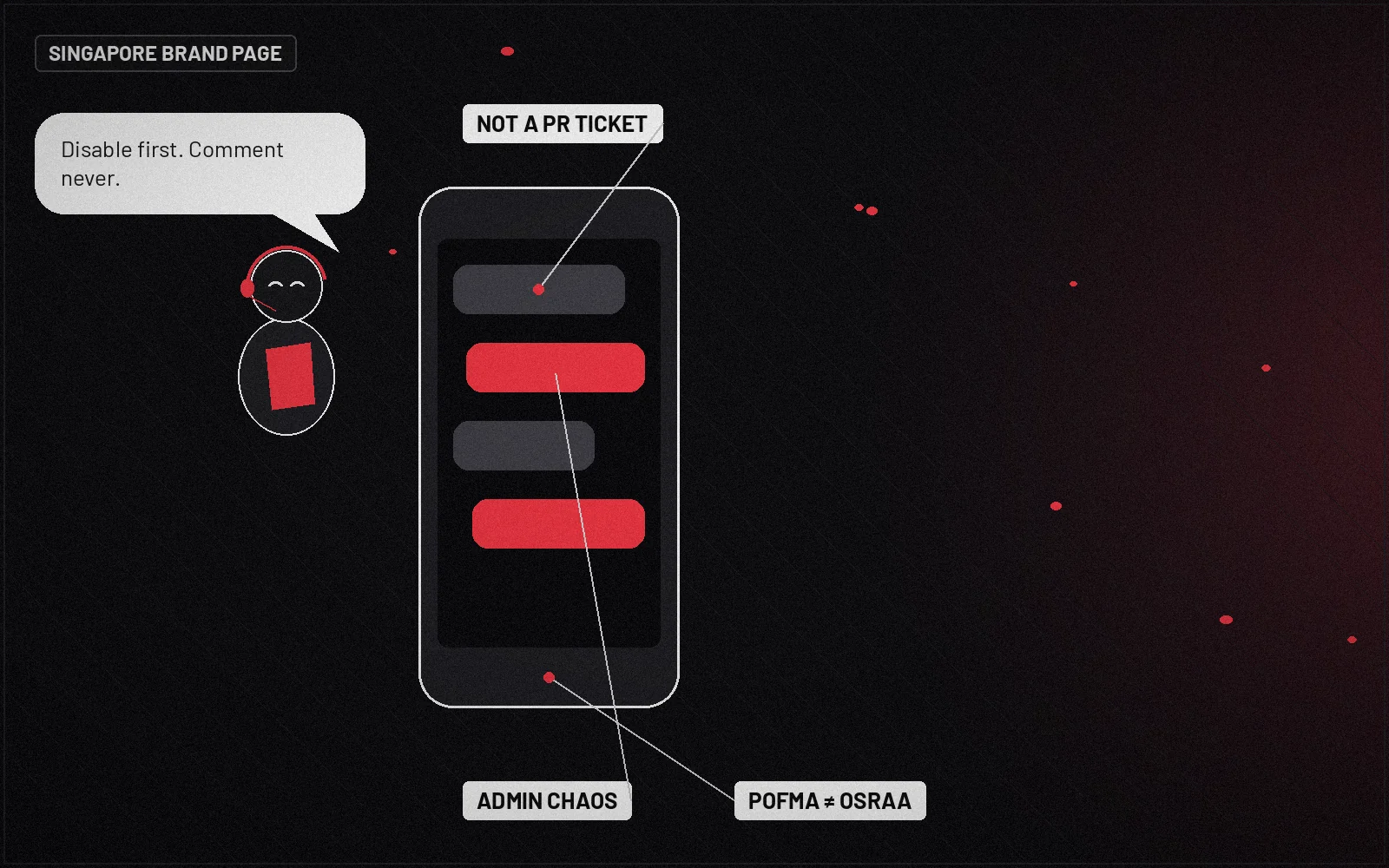
- 3. Admin chaos. Shared passwords and unnamed contractors mean nobody owns the disable step when minutes matter.
- 4. Ignoring POHA coexistence. MinLaw notes OSRAA court remedies complement existing Protection from Harassment Act pathways. Do not tell victims—or journalists—that “only OSRAA applies.” Source: MinLaw OSC launch §21.
- 5. Minimum-damages mythmaking. For intimate image abuse and image-based child abuse, MinLaw states the Court will award at least $5,000 for each image or recording if the claim is made out. That is a statutory floor for those image harms when claims succeed—not a threat line for brand posts. Source: same launch release §20.
- 6. Confusing POFMA with OSRAA. POFMA targets online falsehoods in the public interest via Minister-instructed directions administered with IMDA’s POFMA Office. OSRAA/OSC targets specified online harms to victims with relief and accountability tools. Keep the regimes separate in holding lines. Related Neuwark pack: POFMA night-before checklist.
Worked example (composite — not a real case)
A Singapore consumer brand runs a public Facebook group moderated by two agency contractors and one in-house marketer. Overnight, a thread includes repeated abusive posts naming a customer. The customer reports to the platform. Twenty-six hours later the brand’s community inbox also receives an Online Harm Notice addressed to administrators, and a journalist asks for comment.
What good ops looks like: Legal opens the notice; Comms freezes scheduled posts and employee advocacy; community ops captures URLs/timestamps without resharing the abuse; leadership names one spokesperson; holding line stays process-only; counsel decides disable steps and any platform correspondence; nobody debates the customer on-thread.
What failure looks like: a contractor “clears the thread” without preserving evidence; a founder posts a personal apology that restates the abusive claims; Marketing issues a long narrative before counsel reads the notice.
FAQs
Does OSRAA replace POFMA or IMDA online-safety codes?
No. OSRAA/OSC is a victim-relief and accountability framework for specified online harms. POFMA and IMDA codes remain separate regimes. Keep playbooks labelled so war rooms do not mix instruments.
Are brand page admins always “Administrators” under OSRAA?
OSRAA’s Administrator concept covers persons who create, set up, or administer online locations such as groups, pages, forums, or communities. Whether a specific roster qualifies in a live matter is a counsel question—treat admin status as high-risk until Legal says otherwise. Sources: MDDI–MinLaw 14 May 2026; MinLaw OSRAA overview.
Where do victims report?
osc.gov.sg. For harassment and stalking, MinLaw’s launch guidance says report to the platform first; escalate to OSC if the platform response is missing or inadequate within 24 hours. For intimate image abuse, image-based child abuse, and doxxing, victims may go to OSC directly.
What if we disagree with an OSC decision?
MinLaw describes a two-stage review: reconsideration to the Commissioner within 14 days of the initial decision (no fee), then appeal to the Online Safety Appeal Panel within 14 days of the reconsidered decision ($200 fee). Ask counsel whether and how your organisation is an eligible person before calendaring anything public.
What to do next
Tonight: map every Singapore-facing page/group admin roster, name the Legal + Comms intake owners, and paste the kill list into your social calendar tool. This week: run a 60-minute tabletop using the classification table above with a composite harassment-thread scenario. If you need a Singapore public-affairs or crisis drill partner, start at Singapore public affairs or Crisis rapid response. Place OSC duties on the wider Singapore regulator map (IMDA, MAS, PDPC, MDDI, POFMA) so brand admins know which body owns which clock.