
Multi-org coalitions burn money when every partner re-shoots the same proof, rewrites the same caption, and ships five incompatible end cards. A coalition shared creative library fixes that: one governed system for masters, cutdowns, captions, and versioning so advocacy networks across the Philippines, Singapore, Indonesia, Thailand, and the wider APAC region spend production pesos once and ship many times.
Neuwark Communications builds creative systems for progressive and public-interest coalitions. Soft path: Services · Contact. Related: coalition media kit production checklist, coalition partner media kit advocacy, and coalition branding not Frankenstein logo farm.
The real cost of “everyone make their own”
Production burn is not only invoices. It is delayed launches, mismatched claims, orphan cutdowns with no rights paperwork, and partners who refuse to share because last time their logo was cropped off. In APAC advocacy, that waste multiplies across languages and platforms.
A shared library is not a Dropbox of random MP4s. It is a governed asset system: approved masters, named variants, caption packs, credit rules, and expiry dates. Without governance, “sharing” becomes a virus of outdated claims.
What belongs in the library (and what does not)
Include
- Film and photo masters with clear usage rights
- Platform cutdowns (9:16, 1:1, 16:9) with version IDs
- Caption packs in agreed languages and reading levels
- End cards and lower-thirds that follow the coalition brand bible
- Claim sheets: what each asset is allowed to say, with source links
- Accessibility text: captions, alt text, and transcript stubs
- Kill dates for time-bound campaigns
Exclude or quarantine
- Drafts still in legal review
- Partner-exclusive assets without a share license
- Unverified user-generated content
- Anything with identifiable minors without proper releases
- Surfaced “hot takes” that were never approved as coalition voice
Governance that prevents Frankenstein branding
Name a creative steward—person or small cell—not a rotating chat admin. The steward owns intake, naming conventions, and retirement. Partners nominate local editors who can request variants but cannot silently overwrite masters.
Governance checklist
- Written contribution agreement: who owns what after deposit
- Naming convention: `campaign_theme_lang_ratio_v##`
- Dual approval for claims that touch law, health, or elections
- Logo lockups that preserve partner marks without soup
- Credit line standards for photographers, editors, and community sources
- Quarterly audit: kill expired assets; archive with reason codes
- Incident path when a bad asset ships
Shared libraries fail when the loudest partner ships first and everyone else cleans up. Process beats personality.
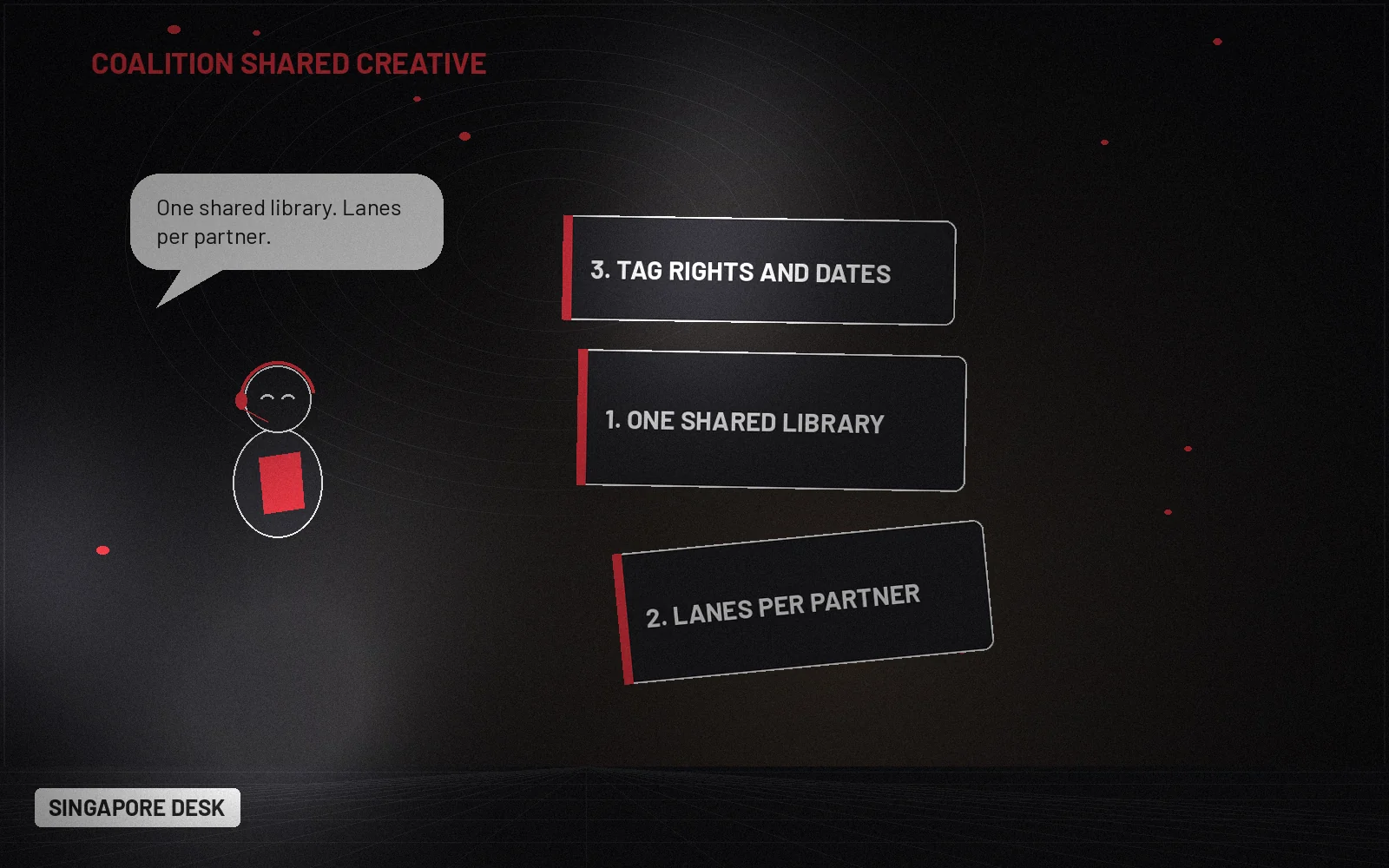
Rights, licenses, and the paperwork that saves you later
Every master needs a rights record: territory, duration, media types, talent releases, music cues, and sublicense rules for partners. If you cannot answer “Can Jakarta post this cutdown next month?”, you do not have a library—you have a liability pile.
Prefer plain-language license summaries on the asset page, with the full contract attached for counsel. Train organizers that “I found it in the folder” is not clearance.
Minimum rights fields per asset
- Owner / licensor
- Territories (PH only, ASEAN, global)
- End date or perpetual flag
- Allowed edits (crop yes/no; text overlay yes/no)
- Required credits
- Political / election use restrictions
- Contact for dispute
Versioning and captions that scale across languages
APAC coalitions rarely ship one language. Build caption packs as first-class objects, not afterthoughts. Keep a source-of-truth English or local primary, then controlled translations. Machine translation can draft; humans approve anything that carries policy claims.
Version IDs must travel with the file name and the metadata. When a claim is corrected, retire the old version visibly. Partners who keep posting v1 after v3 exists create public contradiction that opponents will screenshot.
Practical version workflow
- 1. Master approved and locked
- 2. Cutdowns generated from master, not from other cutdowns
- 3. Caption pack attached with language codes
- 4. Partner localizations request a new version ID
- 5. Steward merges useful localizations upstream when they improve the set
- 6. Expired versions move to archive with “do not use” watermark in the catalog UI
Cutting production burn without cutting conviction
Shared libraries are not an excuse for bland creative. They are how you protect budget for the shoots that matter: new proof, new faces, new places. Reuse the infrastructure pieces—lower thirds, motion templates, safe end cards—so every new shoot stretches further.
Measure burn reduction simply: fewer duplicate day rates for the same scene type; faster partner launches; fewer emergency redesigns after logo fights. Also measure quality: engagement and field feedback on shared assets versus one-off experiments.
Tooling: enough system, not enterprise theater
Small coalitions can start with a well-permissioned drive plus a metadata sheet. Mid-size networks should move to a lightweight DAM or digital asset tool with roles, expiry, and search. Large networks need SSO, audit logs, and regional mirrors for download speed.
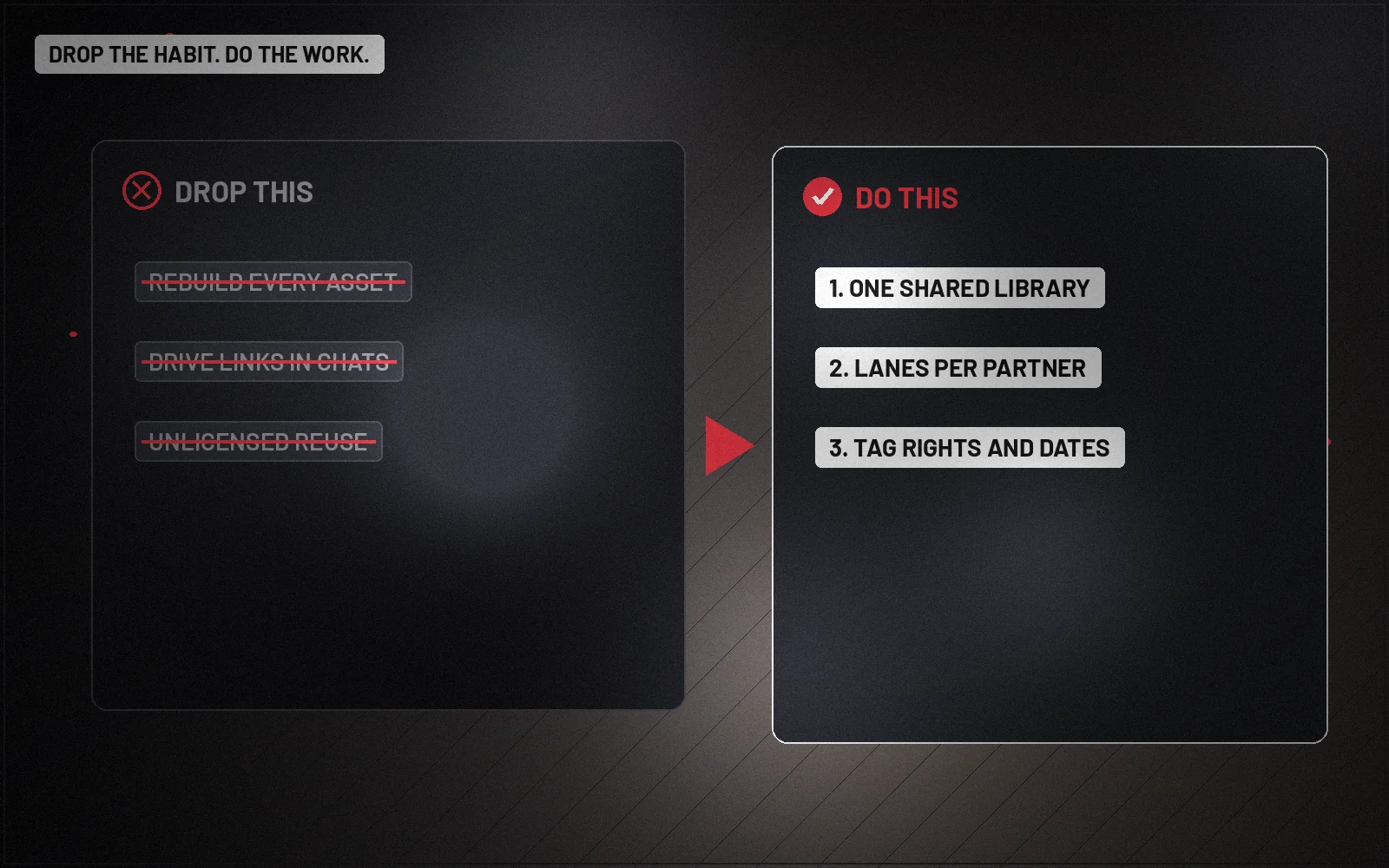
Whatever the stack, prioritize search and permissions over pretty dashboards. If organizers cannot find the right 9:16 in two minutes, they will shoot something worse tonight.
How this connects to media kits and brand systems
A shared creative library sits beside the coalition media kit and brand bible. The kit tells partners how to speak; the library gives them the files that already speak correctly. Without both, you get either empty rules or ungoverned files. Pair this with film still systems for social and paid when stills are your volume engine.
PH and APAC operating realities that shape the library
A Manila-based coalition partner may upload overnight. A Singapore partner may need PDPA-conscious talent releases. An Indonesia partner may need Bahasa packs before any English master ships locally. Thailand partners may face disclosure rules on influencer cutdowns. Design the library for those frictions instead of pretending one HQ culture fits all.
Bandwidth matters too. Host regional mirrors or compressed proxies so field teams in weaker connectivity areas can preview before downloading masters. A library nobody can open on a provincial connection is a Metro toy.
Election-adjacent periods add another layer. Some assets that are fine for civic education become restricted once formal campaign periods start. Tag assets with election-use flags and review them on a fixed calendar—not when a panicked organizer asks at 11 p.m.
Training organizers to use the library like professionals
Tools do not fix habits. Run a ninety-minute onboarding for partner editors:
- How to search by campaign, language, and ratio
- How to read rights fields before download
- How to request a new version instead of silently editing masters
- How to report a bad or outdated asset
- How to credit correctly in captions
Give them a cheat sheet. Test them once. Partners who skip training lose upload privileges until they complete it. That sounds strict. It is cheaper than a public contradiction.
Budget model: what shared libraries free up
Track three lines for one quarter:
- 1. Duplicate shoot costs avoided (same scene type shot by multiple partners)
- 2. Emergency redesign hours avoided after logo or claim fights
- 3. Faster time-to-post for partners who previously waited on HQ
Reinvest a visible share of savings into new original shoots—especially community-led footage that only local partners can capture ethically. Announce that reinvestment so partners feel the library gives them more creative power, not less.
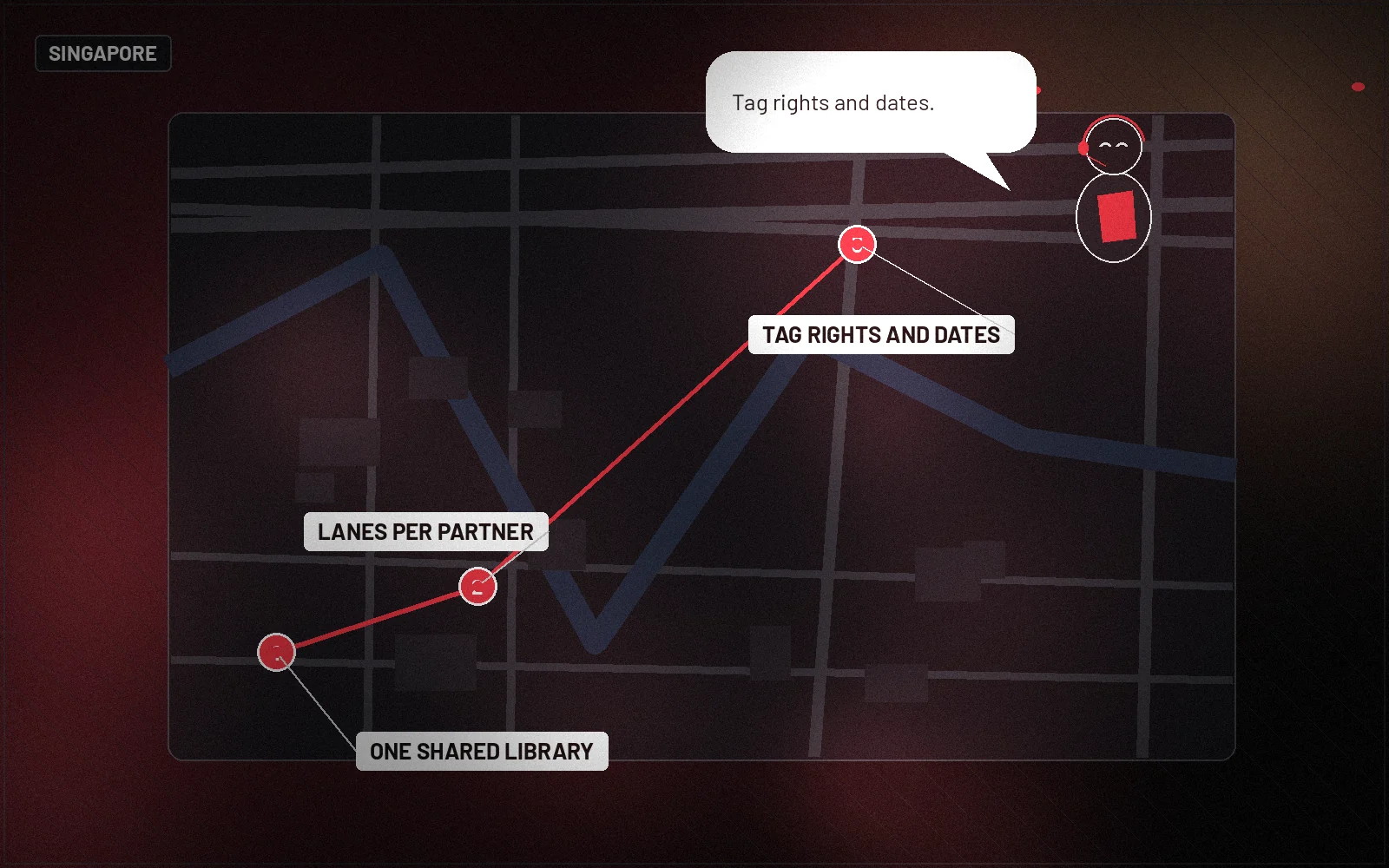
Failure modes to watch
- Hoarding: partners stop depositing because they fear logo loss—fix with credit enforcement
- Stale claims: old versions keep circulating—fix with visible retire dates and chat alerts
- Over-centralization: HQ becomes a bottleneck—fix with trained local editors and SLAs
- Under-governance: anyone can overwrite—fix with permissions and audit logs
- Aesthetic mush: shared templates erase local texture—fix by protecting local B-roll slots inside the system
Name the failure mode in retros. Fix the process, not only the file.
A ninety-day standup plan
Days 1–30: inventory existing assets; trash obvious orphans; draft contribution agreement; pick steward.
Days 31–60: stand up catalog (drive+sheet or DAM); migrate top 50 assets with full rights fields; train editors.
Days 61–90: run one live campaign entirely from the library plus one new shared shoot; publish burn metrics; adjust governance.
Do not wait for perfect software. Start with discipline. Upgrade tools when search and permissions demand it.
When to hire help versus build in-house
Build in-house when your coalition already has a trusted steward, stable partners, and enough volume to justify catalog discipline. Hire help when rights are messy, partners fight over logo soup, or you need a ninety-day standup without burning organizer time. Agencies earn their keep by installing governance and training editors—not by forever owning every export.
If you only need a one-off shoot, skip the enterprise DAM pitch. If you run quarterly multi-country flights, underinvesting in the library will cost more than the software and facilitation combined.
Soft CTA
If your APAC advocacy network is still paying five times for the same cutdown, build the library before the next campaign spike. Neuwark helps coalitions design creative governance, rights hygiene, and production systems that cut burn without diluting conviction. Start at Contact or explore Services.
Shared creative libraries are how multi-org movements act like adults with money and message. Govern the assets. Clear the rights. Version the captions. Spend the saved production budget on work that only a fresh shoot can earn.