
ASEAN HQ communications Singapore teams fail when the regional hub treats every market as a translation job. The fix is sequencing, not more slides. Singapore owns one narrative spine. Each country market owns its own facts and its own voices. Local spokespeople say the line—not a global presser pasted into ten languages.
This guide is for corporate affairs, public affairs, communications and regulatory leads at multinationals that run an ASEAN footprint from a Singapore regional headquarters. It is a sequencing playbook, not a market-entry brochure. If you are still mapping who to brief before you open a country, start with our stakeholder maps for Singapore market entry. If you are still choosing the buyer for government relations versus public affairs in Singapore, use the GR vs PA Singapore buyer split. For the commercial ASEAN entry path itself, the service page is Singapore ASEAN market entry communications.
The one rule that stops ASEAN narrative drift
Singapore is a natural place to park a regional headquarters. Singapore’s Economic Development Board positions the city as Asia’s most popular regional headquarter destination, with connectivity across ASEAN and a deep professional services base. That advantage becomes a communications trap when HQ English becomes the only English every market hears.
Meanwhile, ASEAN itself is not headquartered in Singapore. The ASEAN Secretariat sits in Jakarta, and ASEAN’s public materials, chair statements and community language live on that institutional track—not on your Singapore corporate calendar. Mixing “ASEAN story” with “Singapore HQ story” is how regional teams invent a voice that no local regulator, partner or journalist recognises.
So the rule is simple:
- 1. Hub owns the spine. One non-negotiable narrative frame, vocabulary and proof hierarchy, owned in Singapore.
- 2. Country owns the facts. Local numbers, licences, partners, timelines and regulatory language, owned by the country desk.
- 3. Local voices say it. Country-approved spokespeople deliver the line in the market’s language and channels.
Everything else in this article is how you run that rule without turning it into a 40-page brand book nobody opens on Monday.
What the Singapore hub must own (and what it must not)
The hub’s job is coherence. It is not the country’s press office.
Hub owns
- The spine sentence: what the company is doing in ASEAN and why it matters, in one durable paragraph.
- The proof hierarchy: which global metrics, product claims and ESG statements may be used without country clearance—and which may not.
- The kill list: phrases, analogies and campaign frames that create legal or political heat in more than one market.
- The escalation clock: when a country issue becomes a regional issue, and who joins the call.
- The shared glossary: names for products, programmes and roles that stay identical across markets.
Hub does not own
- Local licence status, filing dates or regulator meeting notes.
- Country media quotes that name a minister, agency or partner without country desk sign-off.
- “ASEAN-wide” pressers that pretend one statement fits Jakarta, Manila, Bangkok, Hanoi and Kuala Lumpur on the same morning.
- Crisis holding lines that ignore local labour, data or content rules.
If your Singapore team is still sorting which Singapore regulators sit in the narrative stack, keep the Singapore regulator map (IMDA, MAS, PDPC, MDDI, POFMA) next to this playbook. Hub coherence in Singapore is useless if the Singapore desk itself is confused about local rules.
Country desks: facts, voices, and the right to refuse
A country desk that cannot refuse a bad line is not a desk. It is a translation queue.
Country owns
- Local facts: prices, headcount claims, partner names, facility status, licence stage, and anything that can be checked by a local journalist in one phone call.
- Local voices: named spokespeople, language versions, and channel norms (press, trade associations, community partners, employees).
- Local kill phrases: words that are fine in HQ English and radioactive in the market’s politics or labour climate.
- Local timing: when to speak relative to filings, elections, holidays, and peer announcements.
Country may refuse
- A global presser that invents an “ASEAN launch” when the country has no local readiness.
- A proof point that uses another country’s numbers as if they were local.
- A quote that puts a Singapore executive’s name on a local political claim.
Refusal is not rebellion. It is the point of the three-part rule. Hub owns the spine; country owns the facts; local voices say it—or they do not say it yet.
Sequencing matrix: HQ vs country (RACI-style)
Use this matrix as the operating agreement, not as a decoration in a deck. R = Responsible (does the work). A = Accountable (signs). C = Consulted. I = Informed.
| Workstream | Singapore HQ | Country desk | Local spokesperson | External counsel / compliance |
|---|---|---|---|---|
| Narrative spine (ASEAN frame) | A / R | C | I | C |
| Country proof points and numbers | C | A / R | I | C |
| Product / claim glossary | A / R | C | I | C |
| Local licence and regulator language | I | A / R | I | A |
| Media quote for country story | C | A | R | C |
| Regional press release | A / R | C (each market named) | I | C |
| Country-only press release | I | A / R | R | C |
| Crisis holding line (local trigger) | C | A / R | R | A |
| Crisis escalation to regional | A | R (escalates) | C | A |
| Employee / partner brief in-country | I | A / R | R | C |
| “ASEAN” word in public copy | A | C | I | C |
| Kill-list updates | A / R | R (propose) | I | C |
How to read the matrix in practice: if HQ wants the word “ASEAN” in a headline, HQ is accountable for whether that word is earned. If the country desk wants a minister named in a quote, the country desk is accountable—and counsel is accountable for legal risk. Nobody gets to be “accountable” for a line they did not see.
Three numbered parts you can brief in five minutes
- 1. Hub owns the spine. One ASEAN frame, one glossary, one kill list, one escalation clock—owned in Singapore.
- 2. Country owns the facts. Local numbers, licences, partners and timing—owned by the country desk that can refuse.
- 3. Local voices say it. Country-approved spokespeople deliver the cleared line in local channels; HQ English is not the default broadcast.
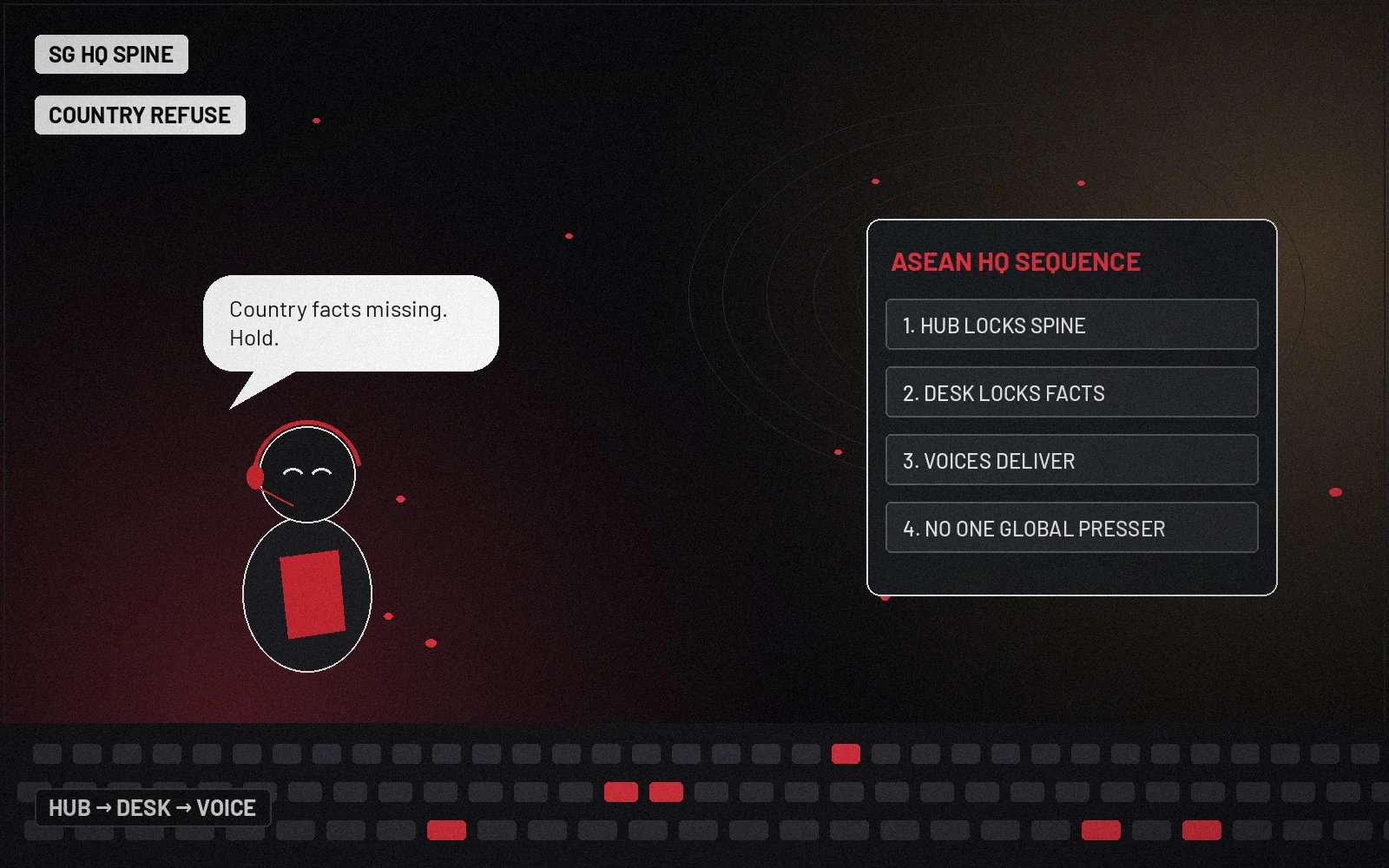
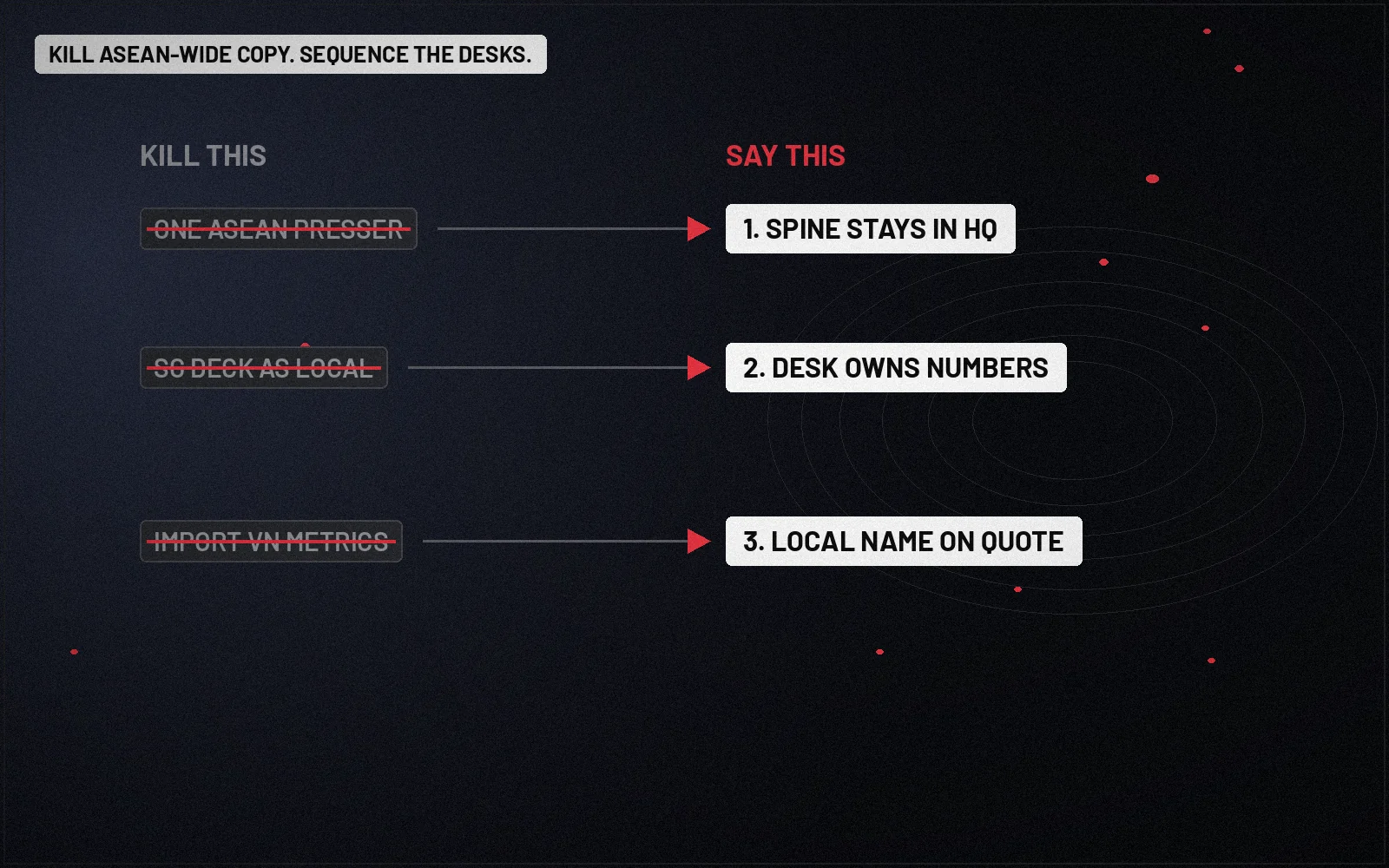
Kill this | Say this (HQ sequencing)
| Kill this | Say this | Why |
|---|---|---|
| “One global presser for all ASEAN markets.” | “Spine from HQ; facts and voices by country.” | One presser erases local readiness and local risk. |
| “Jakarta can just translate the Singapore deck.” | “Country owns facts; translation is not clearance.” | Translation without ownership invents liability. |
| “Use the Vietnam numbers—they look stronger.” | “Only the country desk’s verified local facts.” | Cross-border proof points become local false claims. |
| “Call it an ASEAN launch; we’ll sort licences later.” | “Name the markets that are actually live.” | Empty ASEAN language burns trust with regulators and partners. |
| “HQ spokesperson will take every country interview.” | “Local voices say it; HQ joins only on spine questions.” | Local journalists want local accountability. |
| “Legal can review after it ships.” | “Counsel on the matrix before it ships.” | Sequencing fails if clearance is a postscript. |
Kill the habit of treating Singapore English as universal ASEAN English. Say the three-part rule out loud before anyone drafts.
Desk notes: Singapore HQ, Manila, Jakarta, Bangkok, Hanoi
Singapore HQ. Keep the spine document to one page. If it needs a second page, you do not have a spine—you have a brochure. Pair this with your tech platform public affairs narrative stack if the product itself is the story; the stack is product logic, this playbook is geography logic.
Manila desk. Public affairs timing often collides with national political calendars and agency language. Country facts include which agency owns the file—not what HQ wishes the agency were called. For chair-year and ASEAN-facing messaging from a Philippine desk, see ASEAN chairship public affairs messaging (Philippines) as a neighbouring problem set, not a template to paste into Singapore HQ copy.
Jakarta desk. Distinguish corporate ASEAN claims from ASEAN Secretariat institutional language. The Secretariat’s home is Jakarta; that does not make your Singapore HQ “the ASEAN voice.” Country facts in Indonesia still need Indonesian clearance even when the story mentions ASEAN.
Bangkok / Hanoi / Kuala Lumpur desks. Refuse “ASEAN-wide” creative that never names the local partner, licence stage or channel. If haze, labour or content rules are in play, treat them as country facts first—see the ASEAN haze crisis communications stakeholder playbook for multi-country crisis sequencing that still respects local desks.
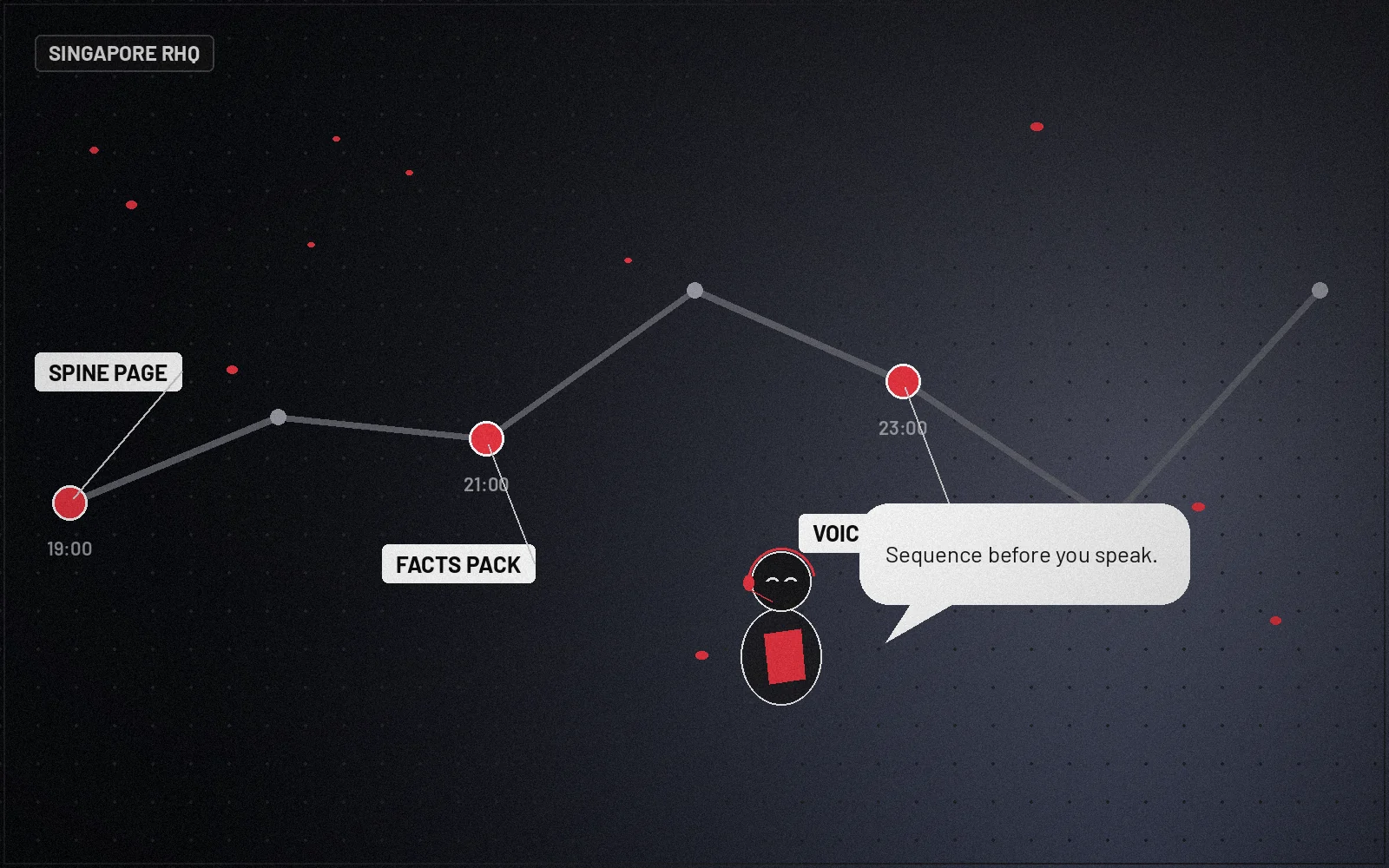
Monday field kit checklist
Run this every Monday before the week’s ASEAN communications leave the building.
Hub (Singapore) — 20 minutes
- [ ] Spine sentence unchanged? If changed, who signed and which countries were informed?
- [ ] Kill list: any new phrase from last week’s draft that must be banned region-wide?
- [ ] Escalation clock: any country issue that crossed the regional threshold overnight?
- [ ] Glossary: any product or programme rename that would break country copy?
- [ ] “ASEAN” word audit: every draft using ASEAN must list which markets are actually in scope.
Each country desk — 15 minutes
- [ ] Facts pack current: licence stage, partner names, local numbers, open regulator questions.
- [ ] Voices list: who is cleared to speak this week, in which language, on which channel.
- [ ] Refuse log: what did we refuse from HQ or agencies, and why (one line each).
- [ ] Local kill phrases: anything new from media or politics that HQ must not say.
- [ ] Timing: filings, holidays, peer announcements that block or unlock speech.
Shared close — 10 minutes
- [ ] Matrix owner names still correct (no silent hand-offs while someone is on leave).
- [ ] Regional pressers this week name markets explicitly—or they do not ship.
- [ ] Crisis holding lines pre-cleared for the two most likely local triggers.
- [ ] Archive: last week’s cleared lines filed so nobody revives a retired claim.
If the Monday kit takes more than 45 minutes, your spine is too long or your refuse log is empty for the wrong reason—nobody is refusing.
Who this is for / who should skip
For you if you run or advise an MNC ASEAN footprint from Singapore and you already have country desks (or are building them) that can own facts and refuse bad lines.
Skip if you are looking for a first company registration checklist, a visa guide, or a generic “how to enter ASEAN” brochure. That is a different job—start at Singapore ASEAN market entry communications and the stakeholder maps piece.
Common traps
- 1. Spine inflation. A 12-page “narrative architecture” is not a spine. Cut until a new hire can repeat it.
- 2. Fake ASEAN. Using ASEAN as a prestige word when only one market is live.
- 3. Proof laundering. Moving another country’s metrics into a local quote.
- 4. HQ as default spokesperson. Local interviews without local voices.
- 5. Clearance after creative. The matrix fails if counsel sees the line after the shoot.
- 6. Silent refuse. Country desks that never refuse are not aligned—they are captured.
What to do next
Print the sequencing matrix. Put names in every A and R cell. Run the Monday field kit once this week without adding new slides. If a draft still tries to ship one global presser for all markets, kill it and rewrite under the three-part rule: hub owns the spine, country owns the facts, local voices say it.
FAQs
Does ASEAN HQ communications Singapore mean every statement must mention ASEAN?
No. Most country statements should name the country. Use “ASEAN” when the hub is accountable for a true multi-market frame—and list the markets in scope.
Who writes the first draft of a regional press release?
Singapore HQ drafts the spine and shared facts. Each named country desk inserts or refuses local facts before anyone books a press time. Local spokespeople do not invent the spine on air.
What if we only have a Singapore team and freelancers in-country?
Then you do not yet have country ownership. Hire or contract a named country owner who can refuse, or keep public claims limited to markets you can actually clear.
How does this relate to Singapore regulators?
Hub coherence does not replace Singapore compliance. Keep the regulator map for Singapore-local rules, and keep country counsel for every other market’s rules.
Can we reuse last quarter’s ASEAN messaging for a new chair year or summit cycle?
Only after HQ re-clears the spine and each country desk re-clears facts and voices. Institutional ASEAN calendars change; your kill list should change with them.