
Opposition research briefing discipline Philippines campaigns actually need is not a longer dig. It is a ritual that stops unverified claims, illegal material and rumor from reaching the people who speak, write ads or post for the campaign. Intake, classify, brief, clear, archive. Five gates. Nothing crosses without a named owner.
This guide is for progressive Philippine campaign managers, communications directors, research leads and CSO partners who already gather public information and need a safer way to brief it. It is process guidance, not a how-to for dirty tricks, and not legal advice. Your counsel and compliance lead decide what your organisation may hold and say.
If you are still deciding whether research itself should sit inside the brand, start with our pieces on opposition research ethics for communications and opposition research that does not poison your own brand. This article covers the briefing ritual after the material exists.
Why briefings fail before the presser starts
Most damage from opposition research does not come from the first find. It comes from the hand-off. A volunteer forwards a screenshot. A researcher pastes a claim into a group chat. A creative lead builds a reel from a thread that was never sourced. By the time counsel asks “where did this come from?”, the line is already in a draft.
Philippine campaigns also work under real data and speech rules. The Data Privacy Act of 2012 (RA 10173) and the Cybercrime Prevention Act of 2012 (RA 10175) both matter when teams store personal data, share files or amplify claims. Treat those as counsel’s lane. The briefing ritual’s job is narrower: keep unverified and unlawful material out of spokespeople’s mouths and out of paid creative.
The five-gate briefing ritual
Run every claim through the same five gates. Skip a gate and you skip the discipline.
1. Intake
One channel only for research submissions: a shared inbox, form or ticket—not a volunteer GC, not a personal chat. Every item gets a time stamp, the submitter’s name, the claimed source URL or document, and a one-line summary. Raw files stay closed until a research lead opens them. If the item arrived as a forward with no original source, mark it unsourced at intake.
2. Classify
Before anyone writes a brief, label the item. Use four buckets only:
| Class | Meaning | Who may see it next |
|---|---|---|
| Public record | Official documents, published news, open hearings | Research + counsel track |
| Verified public claim | Attributable statement with a durable source | Research lead |
| Unverified | Rumor, anonymous tip, unauthenticated media | Research lead only |
| Stop | Illegal, intimate, or counsel-flagged material | Counsel only; never creative |
“Stop” is not a delay. It is a hard stop. Intimate images, doxxing packs and anything that looks like unlawful interception never enter a creative folder.
3. Brief
Write a short brief, not a dump. One claim, one source list, one confidence level (high / medium / do not use), one recommended use (internal awareness only / optional public line / do not use), and one owner. Attach the primary sources. Do not paste screenshots of chat threads as “proof”.
4. Clear
A named clearer—usually counsel or a designated compliance lead—must sign the brief before any spokesperson, influencer brief or paid asset uses it. Clearance is a decision, not a reaction emoji. If clearance is pending, the public answer is silence or a holding line from your crisis holding-statement templates, not improvisation.
5. Archive
File the brief, the sources, the classification and the clearance note in one place with a retention rule your counsel sets. When a claim is retired, mark it do not revive so last week’s rumor does not reappear in next week’s creative sprint. Pair this with the same hygiene you use on contacts in community organizer CRM hygiene.
- 1. Intake — one channel, time stamp, source, owner.
- 2. Classify — public record, verified, unverified, or stop.
- 3. Brief — one claim, confidence, recommended use.
- 4. Clear — named yes before any public or paid use.
- 5. Archive — keep the trail; mark retired claims.
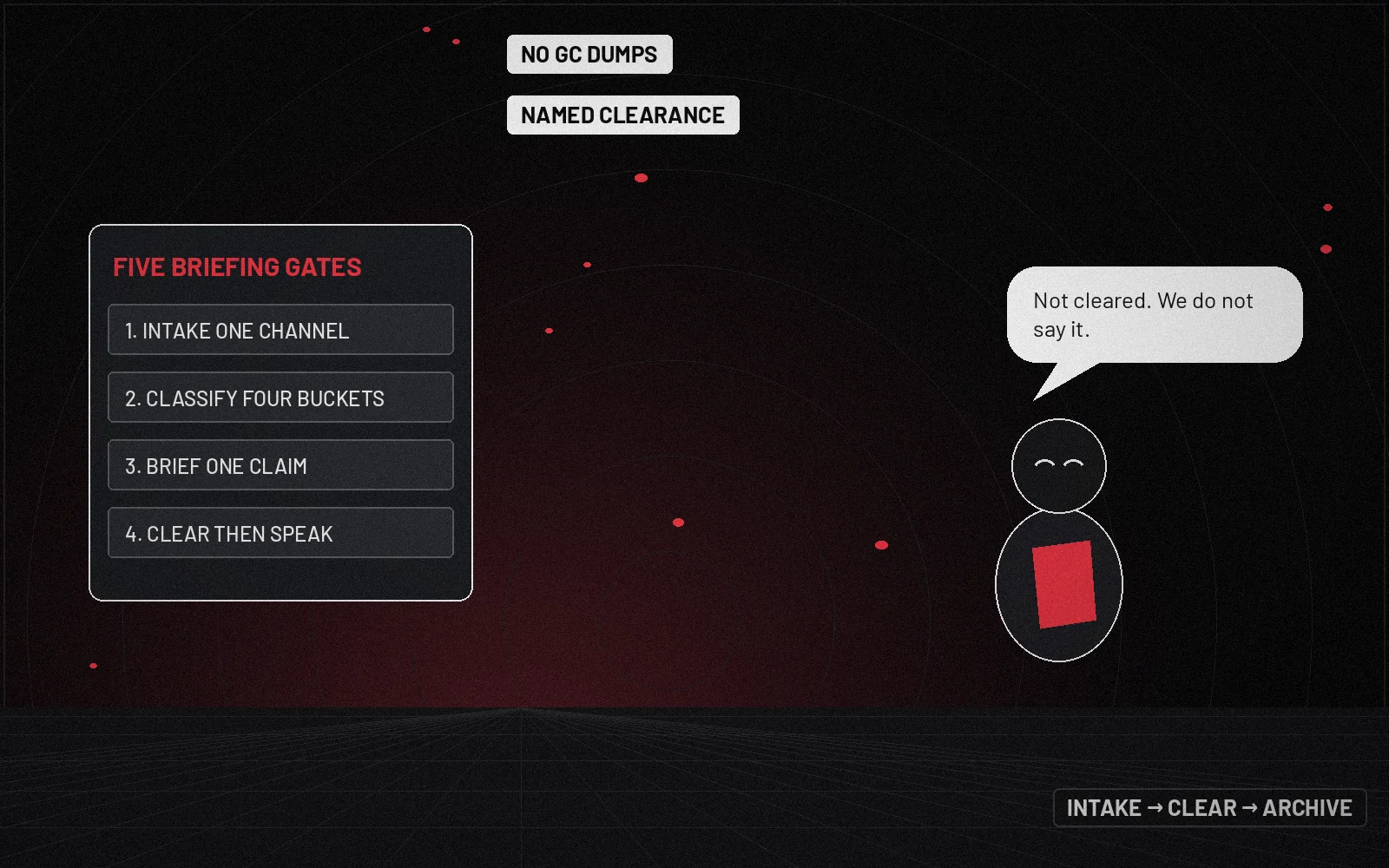
Kill this | Say this (briefing discipline)
| Kill this | Say this (illustrative) | Why |
|---|---|---|
| “Pasok na ’yan sa reel, viral eh.” | “Classify first. If it is unverified, it stays off creative.” | Virality is not a source. |
| “Forward ko lang sa GC ng volunteers.” | “Intake only through the research channel.” | Group chats erase provenance. |
| “Malapit na ’yan, tip from a friend.” | “Unsourced tip = unverified. No brief yet.” | Tips need a durable source. |
| “Sabihin na natin, mag-clarify sila later.” | “No public line until clearance.” | Corrections rarely outrun the first clip. |
| “I-save natin ’yung private photos for leverage.” | “Stop class. Counsel only. Never creative.” | Private intimate material is not research. |
| “Old file pa ’to from last cycle, reuse.” | “Check archive status. Retired means do not revive.” | Stale claims create new legal risk. |
Kill the habit of treating speed as proof. Say the gate out loud before anyone drafts.
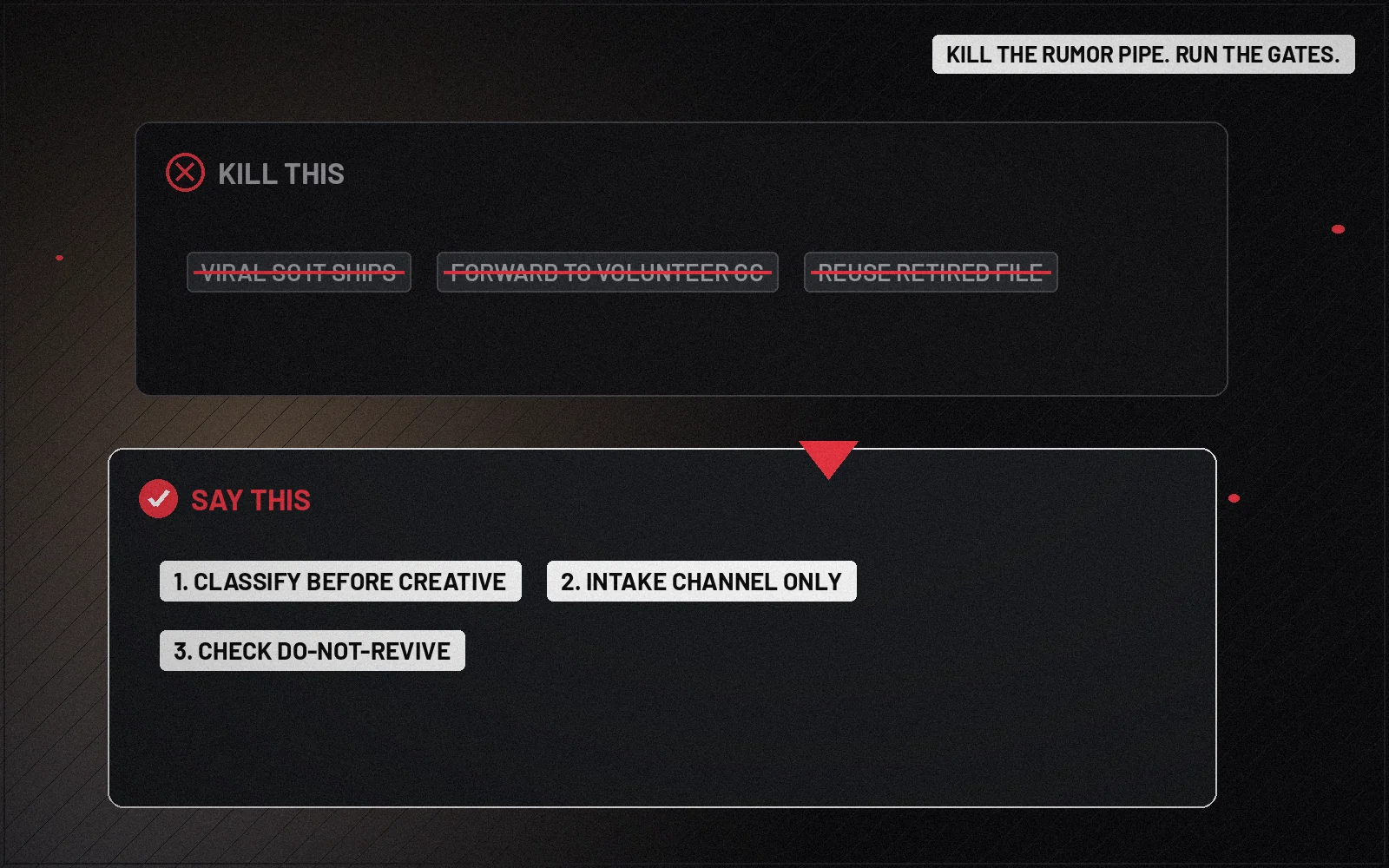
Who owns each gate
| Gate | Owner | Rule |
|---|---|---|
| Intake | Research coordinator | Reject submissions without a source pointer or submitter name |
| Classify | Research lead | Only the lead may move an item out of unverified |
| Brief | Assigned researcher | One claim per brief; confidence must be stated |
| Clear | Counsel or compliance designee | No clearance = no public or paid use |
| Archive | Research ops | Retention and “do not revive” flags follow counsel’s rule |
Campaign managers still set priorities. They do not override classification. Creative leads may request a brief; they do not invent one from a chat screenshot. Field teams who hear rumors on the ground send them to intake—the same message discipline you expect on barangay canvass scripts.
Desk notes: Manila war room, field and coalition
Manila HQ / war room. Keep the research channel on a locked device set. Print clearance boards for the day’s briefs only. When a claim spikes mid-presser, the answer is “not cleared,” not a whispered update from someone’s phone.
Field and provincial desks. Barangay volunteers should not hold opposition files. They get the approved public lines from your rapid-response calendar—see rapid-response content calendars for PH campaigns—never the raw research packet.
Coalition partners. Share only cleared briefs, with the same classification labels. If a partner cannot protect a Stop-class file, do not send it. Partnership is not a reason to widen the circle.
Monday field kit: three say-lines
- 1. Intake line: “Send it to research intake with the source link. Do not drop it in the volunteer chat.”
- 2. Clearance line: “If it is not cleared, we do not say it—on mic, on air or in ads.”
- 3. Archive line: “Retired claims stay retired. Check the flag before you reopen an old file.”
FAQ
Does opposition research briefing discipline mean we cannot use public records?
No. Public records and attributed public statements can move through the ritual faster. The ritual still applies: intake, classify as public record, brief, clear, archive. Speed comes from clean sources, not from skipping gates.
Who should clear a brief if we have no in-house counsel?
Name a compliance designee who will not also write the creative. For anything in Stop or anything involving personal data, pause public use until counsel reviews. Soften claims rather than invent clearance.
Can volunteers help with opposition research?
They can submit public links to intake. They should not store private files, run unverified tips as talking points, or brief media. Keep volunteer language on the approved canvass and rapid-response lines.
What belongs in Stop class?
Anything that appears unlawful to hold or share, intimate or non-consensual imagery, doxxing packs, and material counsel flags. When unsure, classify Stop and ask counsel—do not “hold it just in case.”
How does this relate to paid media and influencers?
Paid creative and influencer briefs only receive cleared lines. If a claim is still unverified, it does not appear in scripts, carousels or reply banks. The briefing ritual is upstream of every asset.
What to do next
Pick one live claim in your war room this week. Run it through intake → classify → brief → clear → archive with named owners and a written clearance note. If the claim fails a gate, leave it out of the next presser and the next ad set. Progressive campaigns win more trust by refusing dirty shortcuts than by racing rumor. If you want help installing the ritual across research, creative and field desks, contact Neuwark Communications.