
Partner announcements fail when every ally improvises a different frame, quote, and logo lockup under deadline. Journalists notice. Members notice. Opponents notice. What should have been a drumbeat becomes a logo farm with conflicting claims—and earned media dies in the asset handoff.
An advocacy coalition media kit template is the production system that prevents that: narrative spine, approved quotes, boilerplate, visuals with lockup rules, partner briefing packs, same-day drop workflow, and version control with a takedown path when someone goes off-message.
Neuwark Communications builds media kits and brand systems for coalitions across PH, ID, MY, and TH. Soft CTA: if your next joint statement will involve more than two letterheads, start on Services or Contact before the drop date owns you.
Why coalitions lose earned media in the asset handoff
Coverage follows clarity. When Desk A receives five PDFs with five frames, they pick none—or pick the noisiest. Common failure modes:
- Lead partners write a strong release; allies paste old talking points
- Logo lockups become a collage nobody approved
- Quotes invent facts the coalition cannot defend
- Photos lack consent notes or look like stock
- Nobody owns the same-day correction when a partner freestyles on Facebook
Money angle: earned media is cheap only when production discipline is real. Chaos burns organizer hours and burns relationships with desks you need next month. Related hubs: coalition partner media kits for advocacy and coalition branding that is not a Frankenstein logo farm.
Core kit: narrative spine, quotes, boilerplate, visuals
Build one kit spine. Everything else forks from it.
Narrative spine (one page). The argument in six to ten sentences. What changed, why it matters, what you want, what proof exists. No poetry contest.
Quotes. Primary spokesperson plus two alternates. Each quote does one job. Ban “excited to partner” fog unless you are announcing a ribbon, not a policy fight.
Boilerplate. Shared coalition boilerplate plus short partner blurbs that cannot rewrite the spine. Version-stamp both.
Visuals. Approved stills, B-roll notes, and lockup rules. Prefer cinematic, consent-clean field imagery over generic handshakes. Crimson/dark systems work when they are brand, not decoration.
Fact sheet. Numbers with sources. If a partner cannot cite it, it does not ship.
Package as a folder journalists can open on a phone: PDF release, fact sheet, logos ZIP with rules TXT, photo selects with captions, and a contact card.
Lockup rules without Frankenstein logos
Coalitions love equal billing until the horizontal logo strip becomes unreadable. Rules that save coverage:
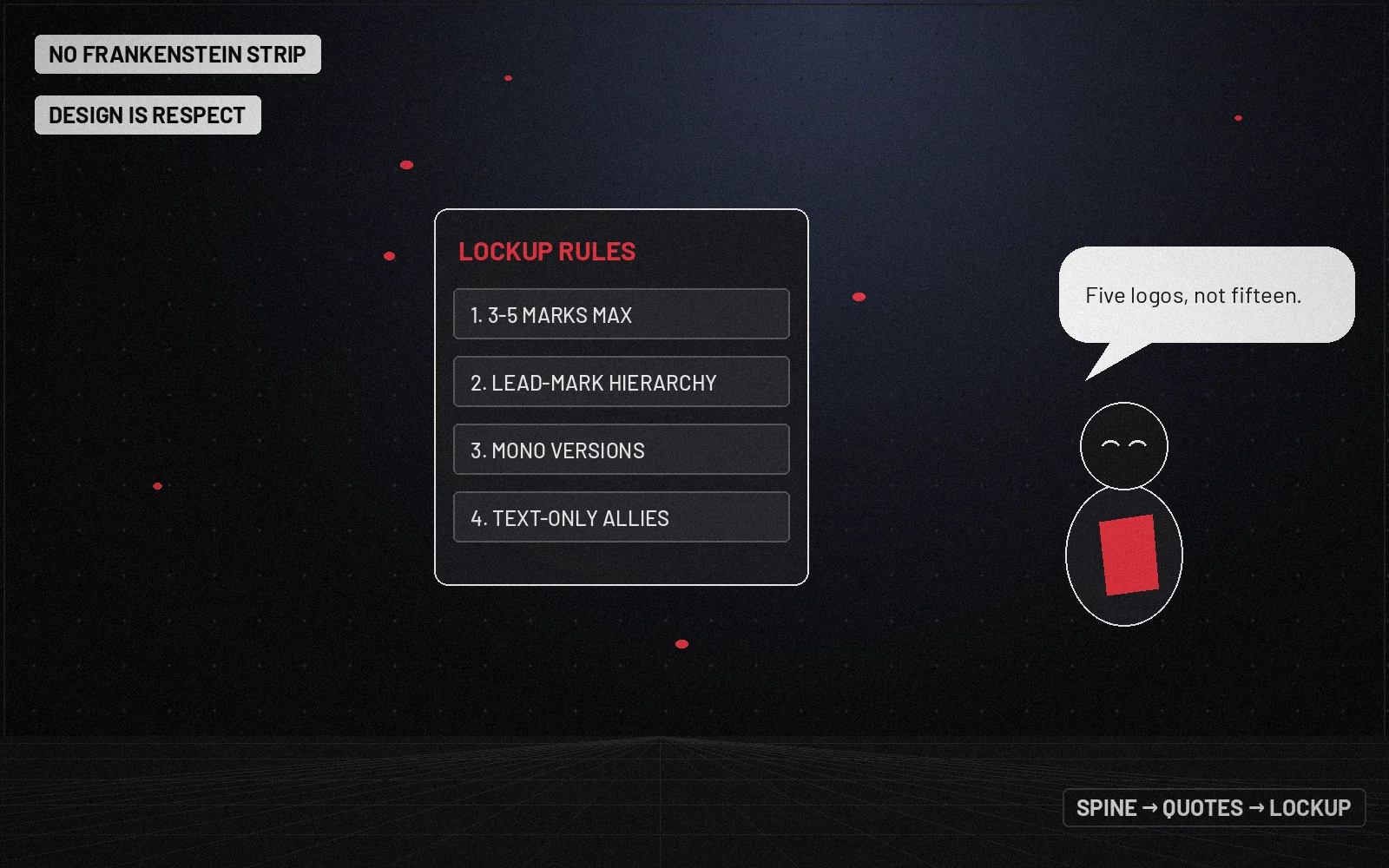
- Maximum partner marks on primary lockup (often three to five; rest listed in text)
- Clear lead-mark hierarchy for the drop owner
- Minimum clear space and monochrome alternatives for newsprint / dark mode
- Forbidden treatments (outlines, glows, rearranged order)
- A “text-only allies” list for partners who join after artwork freeze
Design discipline is respect. It tells smaller partners the coalition is serious—not that their logo will be shrunk into dust on a chaotic banner.
Partner briefing pack: what allies may / may not change
Send a one-page briefing with the kit:
- May change: local contact name, local event time, language translation with approved glossary
- May not change: frame, core claims, primary quote meaning, lockup order, embargo time
- Must do: confirm receipt, name their post owner, send draft social if they insist on custom copy
- Kill switch: who calls a takedown and how fast
If a partner cannot accept “may not change,” they are not ready for a joint drop. Better a smaller on-message coalition than a large off-message one.
Same-day drop workflow for regional desks
Regional desks in Manila, Jakarta, KL, and Bangkok do not wait for your internal Slack debate.
T–72 hours. Kit locked. Translations checked. Embargo set. Partner confirmations logged.
T–24 hours. Courtesy notes to priority desks. B-roll / stills uploaded. Spokesperson availability grid live.
T–0. Drop. Monitor. Log coverage. Correct factual errors fast; ignore noise.
T+24 hours. Wrap note to partners: what landed, what to stop saying, what is next.
Assign one drop lead. Committees write slow releases. Desks reward speed with accuracy.
Version control and takedown when a partner goes off-message
Assume someone will freestyle. Plan the response:
- Central asset library with version IDs (not five WhatsApp ZIPs)
- Public “current kit” link that always points to latest
- Takedown script: thank partner, restate spine, replace asset, notify desks if the error shipped
- Retro within 72 hours: process fix, not public shaming
Off-message is a production failure before it is a loyalty failure. Fix the system that made freestyle easier than compliance.
Production checklist you can print
Before creative
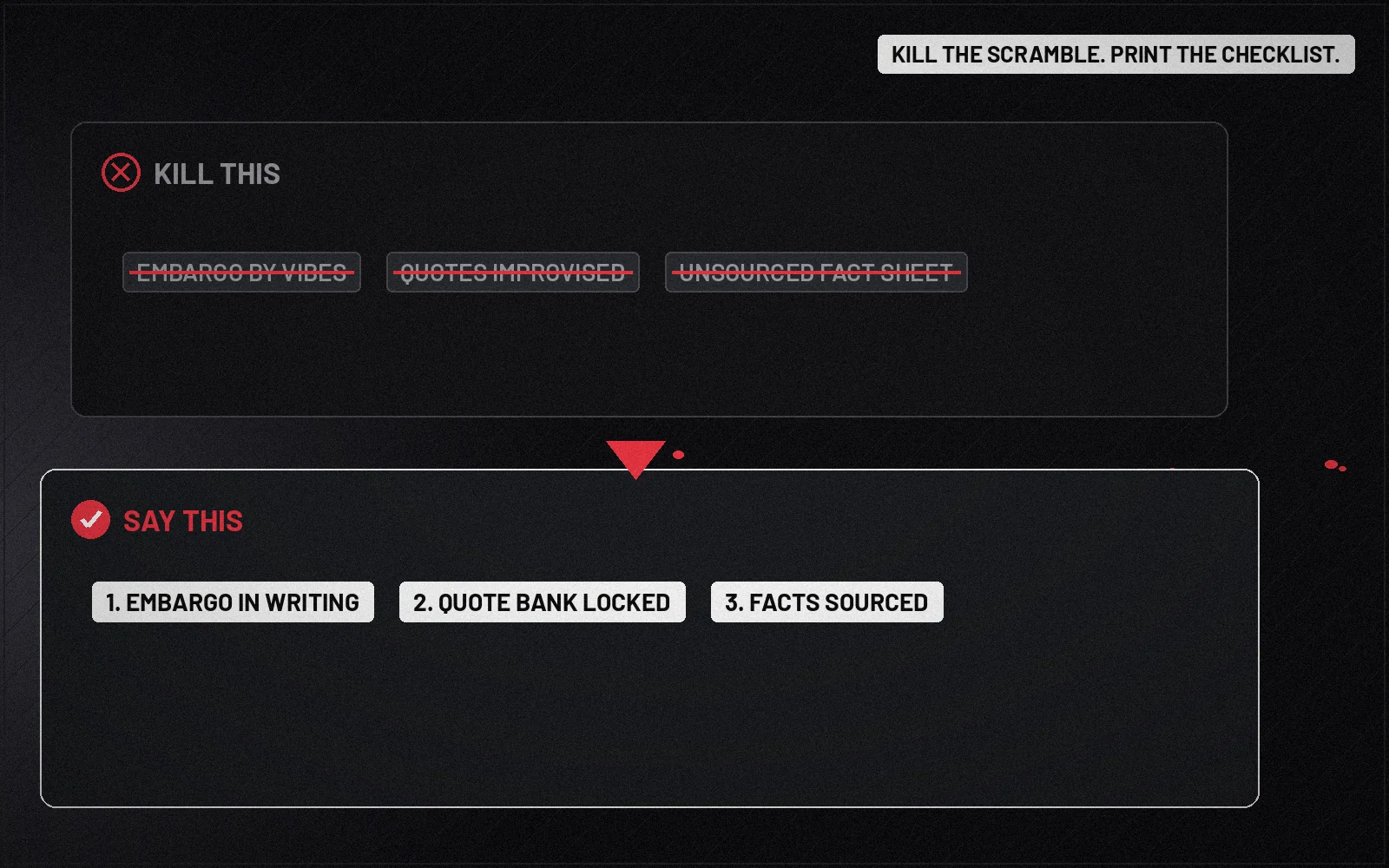
- [ ] Spine approved by drop lead + legal/risk owner
- [ ] Quote bank locked (primary + two alternates)
- [ ] Fact sheet sourced
- [ ] Embargo time agreed in writing with all posting partners
- [ ] Translation glossary approved (if multilingual)
Assets
- [ ] Release PDF (phone-readable)
- [ ] Logos ZIP + lockup rules TXT
- [ ] Photo selects with captions + consent notes
- [ ] Boilerplate shared + partner blurbs
- [ ] Social starter posts (optional) that do not rewrite the spine
- [ ] Contact card with phone that humans answer
Partner pack
- [ ] May / may not change one-pager
- [ ] Receipt confirmation logged
- [ ] Post owner named per organization
- [ ] Takedown contact shared
Drop day
- [ ] Desk courtesy list sent
- [ ] Monitoring rota live
- [ ] Correction template ready
- [ ] Partner wrap note drafted for T+24
If any box is empty within 72 hours of drop, shrink the coalition or slip the date. Shipping incomplete kits is how you train desks to ignore you.
Multilingual kits without message drift
In PH, ID, MY, and TH coalitions, language is strategy. Translate the spine with a glossary, not with five freestyle writers. Keep claims identical across languages. Allow local color only in examples and contacts. If a translation softens a hard claim—or hardens a careful one—treat it as a factual error and fix before drop.
Earned media follow-through
Kits are not the end. After coverage lands, send partners a coverage digest with approved pull quotes and a “please stop saying X” list if needed. Feed strong coverage back into fundraising proof packs and GEO Insights. The same spine should travel from press to donors to answer engines without mutating.
That is how media kit production becomes a money system—not a one-day PDF scramble.
Field photo and B-roll standards inside the kit
Journalists and partners both punish weak visuals. Inside the coalition kit, require:
- Horizontal and vertical crops ready for desks and social
- Captions with who/what/where and consent status
- No unreadable protest sign text that invents claims you did not approve
- A “do not use” folder for sensitive frames
If you lack usable imagery, commission a same-week field kit rather than recycling three-year-old rallies that contradict today’s spine. Visual mismatch is a message mismatch.
Mic-check and spokesperson discipline
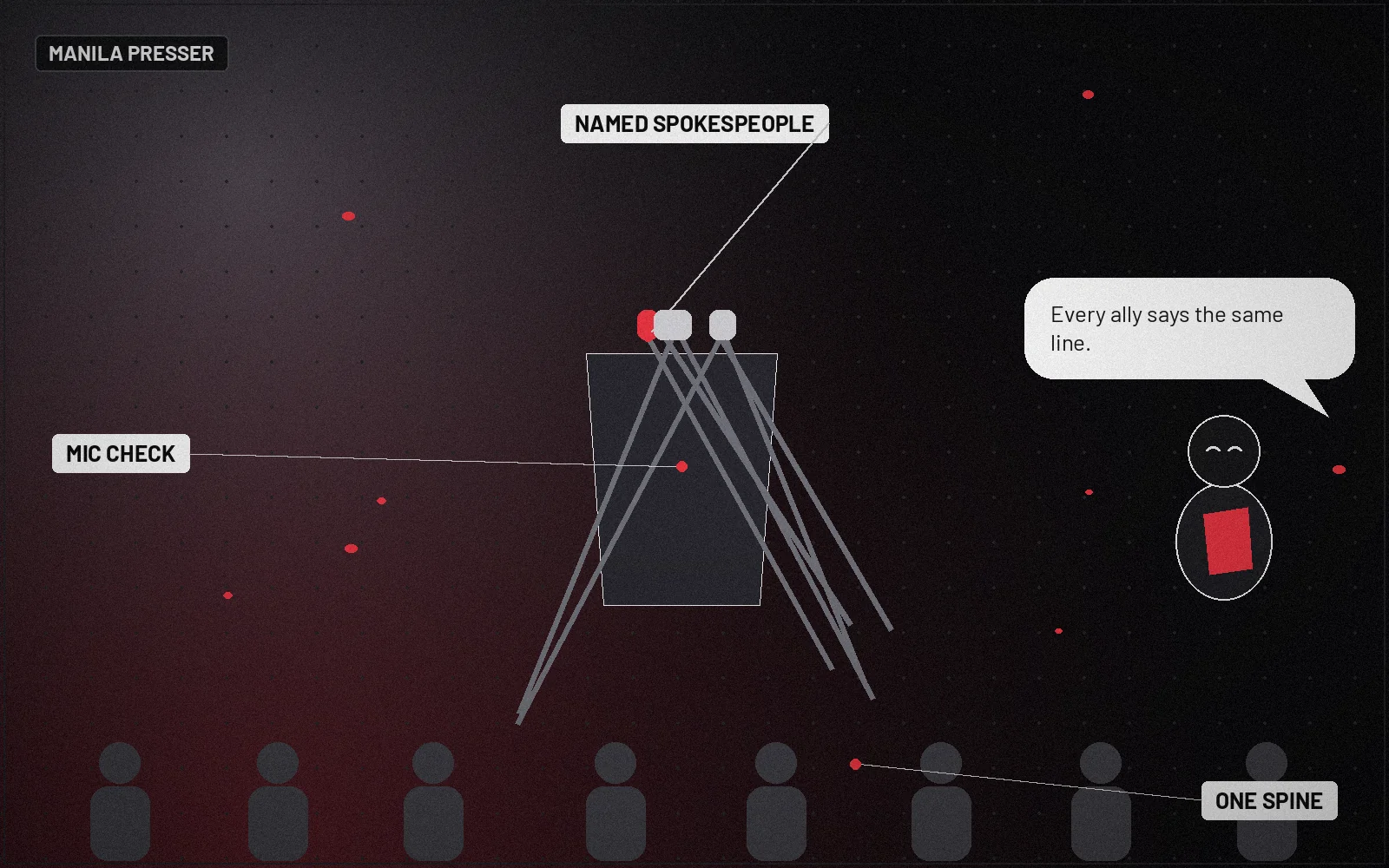
On drop day, every spokesperson should have the same three lines: what happened, why it matters, what you want. Media training lite—fifteen minutes—beats improvisation. If a partner spokesperson cannot stay on spine, they do not take the mic that day. Protecting the coalition is not disrespect; it is how you earn the next desk reply.
Budgeting kit production without starving the drop
Treat the kit as a line item: writing, design, photo/B-roll, translation, partner briefing, and drop-day monitoring. Coalitions that “just use Canva for an hour” pay later in confused coverage and repair labor. A lean professional kit for a regional drop often costs less than one week of organizer time spent fixing mismatched letterheads after the fact.
If budget is tight, shrink the partner list before you shrink quality. A sharp five-partner kit outperforms a messy twenty-partner collage every time desks are deciding what to cover.
Closing note for coalition leads
If you remember one rule, remember this: the kit is a control system, not a souvenir PDF. Version it, brief it, drop it, monitor it, and retire it when the moment ends. Allies who love the mission will still freestyle under deadline unless the on-message path is easier than improvisation. Make the on-message path the easiest path—and earned media starts to look like a drumbeat again.
Soft CTA: coalition media kit production engagement
A coalition media kit is the difference between a drumbeat and a logo farm. Neuwark produces on-message ally packs—spine, quotes, lockups, drop workflows—for advocacy coalitions across PH, ID, MY, and TH.
Browse more on Insights, see how we work on Services, read About, or contact us to scope kit production before your next joint announcement. Bring the partner list and the drop date. We will tell you what can ship on-message in time.